
Burgeoning Hatred
Denki and Iwabe remain missing, Hebiichigo’s death pulls at Buntan, and Funamushi’s son forces Boruto to confront the child left behind by revenge.
Series: Boruto: Naruto Next Generations
Episode: 249 · Burgeoning Hatred
Arc: Great Sea Battle of the Hidden Mist Village
Release: May 15, 2022
Previous: Episode 248 · Another Fierce Battle
Directory: All 293 Boruto episodes
Bottom line
Boruto Episode 249 refuses to let Funamushi’s death feel like a clean victory. Boruto and his friends survived the battle, but Denki and Iwabe remain missing, Hebiichigo is dead, and a child named Kobuna now wants Boruto dead because Funamushi was his father. The Funato war keeps handing grief to children and calling the result loyalty.
Boruto finally sees the problem from the other side. Funamushi was an attacker, a commander, and Kagura’s killer. He was also somebody’s father. Recognizing that fact does not excuse his choices. The recognition exposes why revenge is useless: every supposedly final blow creates another mourner who can be recruited into the same war.
RaeRae’s one-minute verdict
“Burgeoning Hatred” is the episode where Boruto’s certainty starts cracking, and thank goodness. He has every right to grieve Kagura. Kobuna has every right to grieve Funamushi. Neither boy has the right to turn the other into a substitute body for the adult he lost.
Find Denki and Iwabe. Give Hebiichigo a real memorial. Get Kobuna away from Funato commanders who can weaponize him. Put Boruto beside adults who can hold his anger without feeding the rage. The cycle will not end because one grieving child wins a fight against another.
Victory never arrives
The defenders defeated Funamushi, but nobody gets to celebrate. The search for Denki and Iwabe continues, and the silence surrounding them grows heavier with every passing hour. Survival feels provisional when two friends have not come home.
That emotional dissonance matters. Military language loves a clear win. Families measure success by who returns, who is injured, and whose chair stays empty. The episode lets the missing young men define the mood instead of allowing one battlefield result to erase them.
Denki and Iwabe are still missing
Days have passed since Denki and Iwabe disappeared. Hope now has to live beside the possibility that rescuers are already too late. Their friends need honest information without being forced into either false optimism or premature mourning.
Search leadership should publish what has been checked, what remains unknown, and when the next update will come. Repeating “we are doing everything possible” means little unless somebody can name the routes, witnesses, signals, and resources behind that promise.
Missing is not the same as dead
People begin struggling to believe the pair could still be alive. That fear is understandable, but assumption cannot become a substitute for evidence. A missing-person operation continues until credible facts establish another answer.
Commanders should protect the search from emotional shortcuts. Despair can end a rescue too early, while denial can prevent families from preparing for devastating news. Both risks require careful leadership and a transparent evidentiary standard.
The search needs one command structure
Multiple groups wandering independently can duplicate routes, destroy tracks, and miss information because nobody owns the whole map. One search coordinator should maintain confirmed sightings, cleared areas, hazards, witness accounts, and assignments.
That structure should not become an excuse for secrecy. Field teams and families need regular briefings. Central coordination works only when information travels back out as reliably as reports travel in.
Search teams need rest
Exhaustion does not prove devotion. Tired searchers misread terrain, overlook injured people, and endanger one another. Rotations, food, water, sleep, and medical checks are operational requirements.
Denki and Iwabe would not be honored by creating more casualties in their names. The people leading the search must say that plainly because frightened friends may otherwise treat rest as abandonment.
Families deserve verified updates
The people waiting for Denki and Iwabe should have a named contact who gives scheduled updates, including updates that say no new evidence has appeared. Silence lets rumors do the talking.
Officials should separate confirmed facts, reasonable possibilities, and unverified reports. Families should never learn major developments from a crowd, a broadcast, or a careless shinobi conversation outside a command tent.
Friends need permission to hope and fear
Boruto’s group does not need to perform confidence for one another. Hope can survive beside terror. A friend can believe Denki and Iwabe may return while also imagining the worst.
Adults should make room for that contradiction without demanding a motivational speech. Trauma rarely follows a neat emotional arc, especially while the outcome remains unknown.
Hebiichigo’s death cannot become background
Hebiichigo died during the same conflict, and the story must not let the next crisis swallow her. She was more than a casualty used to deepen Buntan’s anger. Her choices, relationships, growth, and future deserve acknowledgment.
A memorial should name what she meant to the people who knew her. Command should also investigate the circumstances of her death without turning that review into blame directed at grieving survivors.
Buntan is grieving, not merely angry
Buntan’s rage comes from losing someone who fought beside her and began imagining another life. Anger gives grief somewhere to move, but revenge offers the most dangerous destination.
She needs people who can withstand the anger without praising rage as strength. Support should include privacy, practical help, and permission to remember Hebiichigo without making another death the price of that memory.
Revenge pretends to be loyalty
The Funato frame retaliation as devotion to family and comrades. Buntan could easily mirror that logic for Hebiichigo. Both sides can call violence love while placing more grieving people beside fresh graves.
Real loyalty asks what the dead wanted, what the living need, and what action prevents another family from receiving the same news. Revenge asks only who can be made to hurt next.
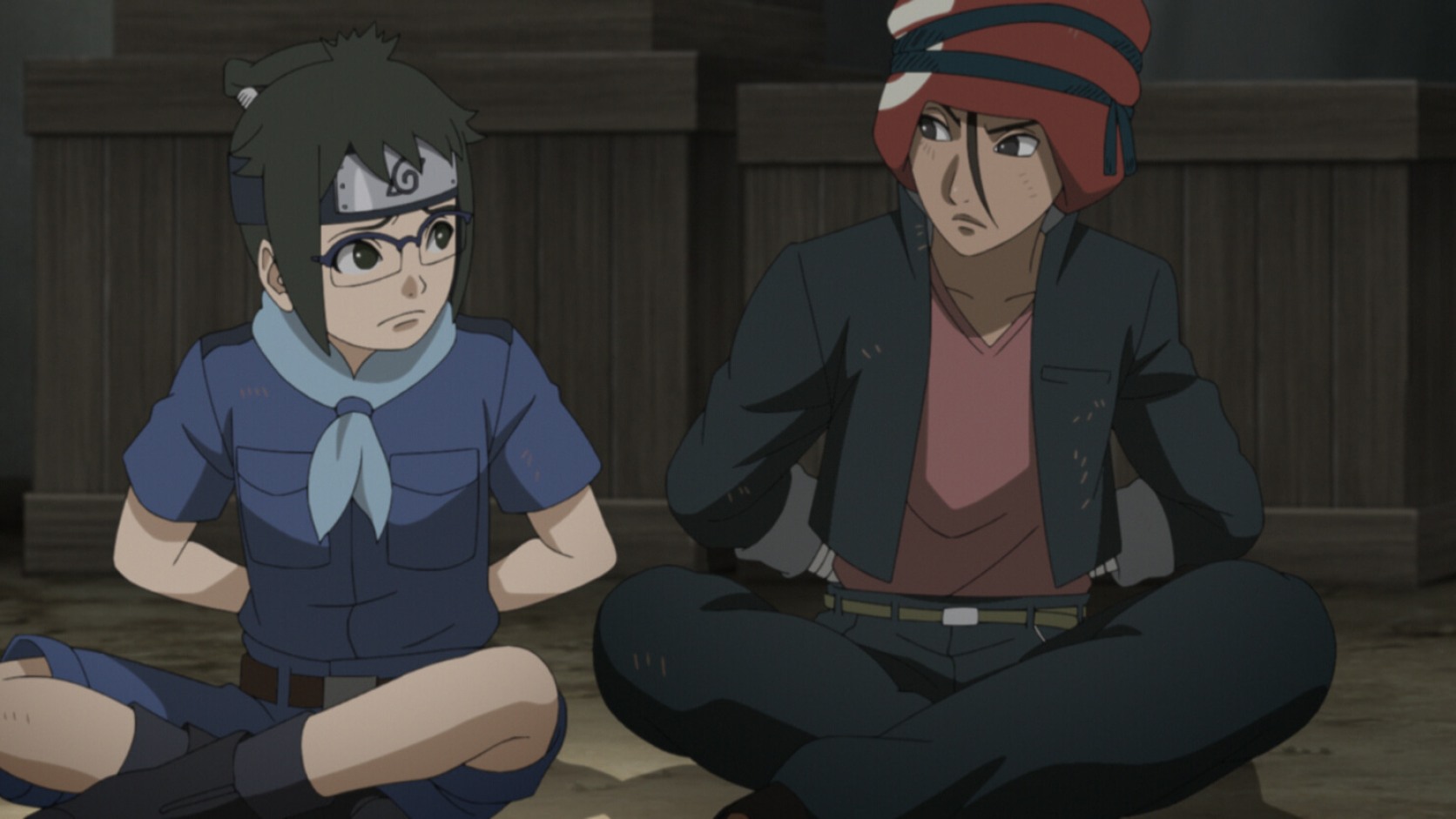
Boruto killed Kobuna’s father
Kobuna approaches Boruto with a child’s unbearable certainty: this is the person who killed his father. The accusation lands because Boruto cannot dismiss the relationship. Funamushi’s death had a life beyond the battlefield.
Boruto does not become solely responsible for the war by acknowledging that consequence. He does become responsible for what he chooses after seeing the child left behind.
Funamushi was more than one thing
Funamushi killed Kagura, endangered civilians, captured young shinobi, and repeatedly chose revenge. None of that disappears because he loved his son. Parenthood is not an acquittal.
Yet reducing him to a monster made retaliation emotionally simple. Kobuna forces Boruto to hold the complete truth: a person can commit terrible harm and still be loved by someone who experiences his death as catastrophe.
Kobuna is a child before he is an enemy
Kobuna has been handed adult grief, adult propaganda, and access to violence. Boruto should treat the attack seriously without pretending the child arrived with an adult’s freedom, training, or judgment.
The immediate goal is separation from weapons and recruiters, followed by safety, food, medical assessment, a trusted caregiver, and trauma support. Punishment cannot teach a child what exploitation has already hidden from him.
A child should not carry a commander’s war
Funamushi chose to lead fighters into battle. Kobuna did not choose the political history, military hierarchy, or retaliation doctrine surrounding his family. Adults built that system and then left a child to inherit its emotional debt.
Every commander who encourages Kobuna’s revenge shifts responsibility downward. The smallest person becomes the easiest symbol while the leaders who prolonged the war remain protected.
Boruto should not answer grief with force
Boruto can defend himself, but he should use the least force necessary to stop the immediate danger. Humiliating or injuring Kobuna would prove the Funato story that the enemy only understands domination.
Restraint is not weakness here. Restraint is Boruto refusing to make another image that adults can place in front of another grieving child.
Somebody must remove the weapon
Kobuna’s grief does not make a blade harmless. A trained adult should disarm him calmly, establish distance, and check whether other fighters are nearby. Safety comes first for Kobuna, Boruto, and everyone around them.
Once the weapon is gone, nobody should crowd, threaten, or interrogate the child. The transition from danger to care has to be visible and immediate.
Interrogation is not care
Kobuna may know where Funato fighters are located, but extracting intelligence cannot become the first response to a traumatized child. A caregiver and advocate should be present before formal questioning.
Questions must be age-appropriate, limited, and free from threats or promises nobody can keep. Information gained through fear may be unreliable and will deepen the harm already done.
Kobuna needs the truth without propaganda
He deserves to know that his father died, that his father loved him, and that his father also harmed other families. Hiding either side leaves the child vulnerable to another manipulator.
The truth should arrive gradually from people trained to support bereaved children. A courtroom speech from Boruto will not repair a life built inside the Funato cause.
Boruto cannot defend himself to a child
Boruto may want Kobuna to understand Kagura’s death, the attack on the village, and why he fought back. Those facts matter, but this moment cannot become a demand that a child approve his father’s killer.
Boruto can acknowledge the loss without asking for forgiveness. He can say that he is sorry Kobuna lost his father while refusing to pretend Funamushi’s choices were harmless.
An apology is not a confession to everything
Compassion does not require Boruto to accept sole blame for a battle created by Funato leadership. He can express sorrow for the death and recognize Kobuna’s pain without erasing self-defense, Kagura, or the civilians under attack.
That distinction protects honesty. False total guilt would help nobody, and a cold legal defense would abandon the human truth standing in front of him.
Kagura still matters
Seeing Funamushi as a father cannot turn Kagura into a footnote. Kagura was Boruto’s friend, a leader trying to protect the village, and a person whose future was stolen.
The episode’s moral demand is not equal forgetting. The demand is that grief for Kagura should not require indifference toward Kobuna.
Boruto is carrying survivor guilt
Boruto survived while Kagura and Hebiichigo did not. Denki and Iwabe remain missing. That combination can make every decision feel like evidence that he failed somebody.
Adults should identify survivor guilt before Boruto turns self-punishment into another reckless mission. Responsibility requires honest review, but guilt without boundaries becomes a weapon he uses against himself.
Karma made the danger worse
Boruto’s power can become frightening when grief and anger take control. The team needs clear safeguards around Karma use, especially near civilians and young attackers.
Those safeguards should be planned before another crisis. Depending on Boruto to regulate an overwhelming power while emotionally flooded places everyone at risk and asks too much of one teenager.
The adults keep leaving children in charge
Boruto, Sarada, Mitsuki, Denki, Iwabe, Kobuna, and other young people keep absorbing consequences created by adult institutions. They fight, search, negotiate, mourn, and make ethical decisions while commanders argue over territory and pride.
The pattern should embarrass every adult leader involved. Young shinobi having skill does not make endless exposure acceptable.
The Funato recruit through belonging
Kobuna’s loyalty likely grew through family, community, and stories about who threatened them. Recruitment does not always begin with a formal order. Sometimes a child learns that love for family requires hatred of an enemy.
Countering that message requires another place to belong. Removing the weapon without providing safe community leaves the original ideology waiting for his return.
Grief makes propaganda easier
A grieving person searches for a cause, a target, and a way to act. Propaganda supplies all three. Kobuna receives a simple story in which Boruto alone explains his father’s death.
The real history is harder: Funamushi made choices inside a movement led by adults who repeatedly sent families into danger. Complexity will not soothe Kobuna immediately, but simplicity designed for revenge will keep hurting him.
Funato leaders benefit from Kobuna’s anger
As long as Kobuna focuses on Boruto, he is less likely to ask why his father was ordered into repeated assaults or why commanders could not protect their own people. Revenge protects leadership from accountability.
That benefit should be named. The child’s pain is authentic even when powerful adults exploit its direction.
Araumi owns the larger campaign
Funamushi acted within a campaign shaped by Araumi’s command and the Funato leadership’s decisions. Accountability cannot stop with the dead field commander or move downward to his son.
Investigators should examine orders, recruitment, treatment of civilians, hostage-taking, and the use of bereaved relatives. A complete record matters for justice and for preventing later myths from replacing evidence.
The Mist also owes an accounting
The Hidden Mist cannot treat every harm as proof that only the Funato need scrutiny. Residents deserve answers about protection failures, deployment of young shinobi, evacuation planning, and decisions that exposed villages to repeated attacks.
Self-review does not create moral equivalence. Honest review creates credibility and reduces the chance that institutional pride will prepare the next disaster.
Accountability and revenge are not twins
Revenge selects a body and tries to transfer pain. Accountability establishes facts, assigns responsibility, protects rights, repairs harm where possible, and changes the systems that allowed abuse.
Kobuna deserves the second process even if the first feels emotionally immediate. Boruto does too.
Surrender must remain possible
Funato fighters who want to leave should receive clear instructions, safe routes, and review under law. If surrender means humiliation, disappearance, or execution, commanders can keep frightened people fighting.
A credible surrender policy also gives families a reason to pull relatives away from the movement. Demobilization begins when another future becomes believable.
Children need a separate exit
Minors associated with the Funato should not be processed as adult combatants. Their cases need child-protection specialists, family tracing, education, health care, and careful assessment of coercion.
Kobuna is not an exception created by his connection to Funamushi. Every recruited child deserves the same protective standard.
Families need safe reunion procedures
If Kobuna has surviving relatives who are safe and willing to care for him, reunification should be assessed rather than assumed. Family ties can protect a child, but relatives may also remain inside the armed movement.
The child’s safety, wishes, and emotional bonds all matter. Officials should avoid both automatic separation and careless return.
Memorials should not recruit the next fighter
Funamushi’s funeral could become a ceremony that glorifies retaliation and places a weapon in Kobuna’s hands. Hebiichigo’s memorial could be used the same way on the opposing side.
Memorials should tell the truth about the person without turning death into an enlistment speech. Grief needs space that does not demand another target.
Denki and Iwabe deserve more than symbols
While the search continues, people may turn them into slogans about courage or sacrifice. That language can make officials sound resolute while avoiding questions about where the young men are.
Keep the focus practical: find them, recover them, treat them, inform their families, and investigate what went wrong. Symbolism can wait.
Witnesses may hold the missing clue
Residents, children, fishermen, captured fighters, and injured combatants may have seen movement that seemed unimportant at the time. Search teams should offer safe, accessible ways to report information.
Nobody should fear punishment for remembering late or correcting an earlier statement. Memory under stress changes, and useful testimony often arrives in pieces.
Evidence must survive the battlefield
Weapons, tracks, damaged boats, communications, medical traces, and burial sites can help establish what happened to missing people and who directed attacks. Teams should document and preserve evidence rather than clearing scenes casually.
That record serves rescue first and later accountability. Families deserve conclusions built from facts rather than political convenience.
Rumors can harm the search
Unverified reports that Denki and Iwabe were seen alive or killed can redirect teams and devastate families. Officials should correct false claims quickly while explaining what remains uncertain.
Community members need a single reporting route. Public shaming will only make witnesses hide mistakes instead of updating them.
Boruto’s question is the right question
Boruto begins questioning the point of fighting the Funato. The question does not mean he should abandon people under attack. That doubt means force needs a defined protective purpose and a limit.
“Defeat the enemy” is not enough. Leaders must say whom they are protecting, what outcome ends the operation, and how the plan reduces future harm.
Fighting can stop immediate violence
When fighters attack civilians or hold captives, intervention may be necessary. Refusing revenge does not require passivity in the face of immediate danger.
The distinction is purpose. Protective force ends a threat and preserves life. Revenge continues after the threat because suffering itself has become the objective.
The mission needs an end state
If the Hidden Mist cannot describe conditions for peace, every battle becomes preparation for another battle. Capturing territory or killing commanders may weaken the Funato without resolving recruitment, displacement, fear, or grievance.
An end state needs security, lawful accountability, return or resettlement, public services, and political space that does not belong only to armed leaders.
Peace requires people who hate each other
Negotiation will involve people carrying real losses and justified distrust. Waiting for everyone to feel generous means waiting forever.
The process needs mediators, enforceable steps, monitoring, and consequences for violations. Peace is not a warm feeling. Peace is a structure that keeps anger from becoming permission to attack.
Ceasefires need verification
A ceasefire announced by leaders can fail at isolated villages where fighters receive late orders or distrust the message. Both sides need clear lines, communication channels, monitors, and procedures for alleged violations.
One incident should be investigated quickly instead of automatically becoming a reason to restart the whole war.
Prisoners need lawful treatment
Captured Funato fighters should be identified, medically assessed, protected from retaliation, and reviewed individually. Mistreatment will deepen grievances and give recruiters fresh evidence.
Lawful treatment is not a reward for good behavior. That standard separates accountability from vengeance.
Victims need repair, not speeches
Village families need homes rebuilt, livelihoods restored, injuries treated, and missing relatives found. Public praise for resilience cannot replace material support.
Funding should reach affected residents through a transparent process with appeals. People should not have to perform grief or loyalty to qualify for help.
Children need school after war
Kobuna and other children affected by the conflict need education that can continue around displacement and recovery. School offers routine, relationships, and a future identity beyond victim or fighter.
Teachers need trauma support too. A classroom cannot repair everything, but leaving children without one makes armed groups more powerful.
Trauma care must last
The first conversation after rescue or loss is not enough. Boruto, Buntan, Kobuna, the village children, and the missing men’s families may experience nightmares, guilt, anger, numbness, or fear long after the battle ends.
Support should remain available without forcing disclosure. Recovery does not follow a deadline designed for military reports.
Boruto needs an adult who will challenge him
He does not need somebody who praises every instinct because his heart is good. He needs an adult who can say when grief is driving him, remove him from a mission when necessary, and stay present through the anger that follows.
Care includes boundaries. Leaving a teenager to make every moral decision alone is not respect.
Sarada should not become his therapist
Sarada can support Boruto as a friend and teammate, but she should not carry sole responsibility for regulating his grief or Karma. She is also living through danger and loss.
Adults must provide professional and command support so friendship remains friendship rather than unpaid crisis management.
Mitsuki needs room for his own response
Mitsuki may focus on Boruto so completely that his own fear and grief disappear from view. He also lost Kagura, searched for missing friends, and faced another violent battle.
Support should ask what Mitsuki needs without making Boruto the answer to every question.
Buntan deserves choices after Hebiichigo
Buntan should be able to step away from combat, participate in memorial decisions, seek justice, or remain involved under safer conditions. Grief should not trap her in the role of avenger.
Her future can honor Hebiichigo more honestly than another body on the battlefield.
Kobuna deserves a future beyond Funamushi
He should be allowed to love his father without repeating his father’s choices. That will require adults who can tolerate complicated memory instead of demanding that Kobuna either worship or denounce him.
A child’s identity cannot be reduced to the worst act committed by a parent or to the revenge expected afterward.
Records protect children from inherited lies
Future accounts should document Kagura, Hebiichigo, Funamushi, civilian harm, command decisions, and the experiences of children on every side. Selective history creates the next grievance.
The record must distinguish verified fact from testimony and political claim. Honesty is part of prevention.
The title names a process
Hatred is “burgeoning” because adults keep feeding the emotion. Kobuna did not wake with a complete ideology. Loss, family loyalty, armed culture, and a convenient target cultivated the feeling.
That means the process can be interrupted. Adults can remove weapons, stop recruitment, tell fuller truths, provide care, and build consequences that do not require another child’s death.
This episode changes Boruto
Boruto has pushed forward through most crises by trusting effort, loyalty, and action. Kobuna forces him to see that action can save one person while creating pain elsewhere.
The answer is not paralysis. The answer is more disciplined action, grounded in protection, evidence, limits, and awareness of who will live with the result.
What responsible leadership looks like now
Continue the coordinated search for Denki and Iwabe. Protect families from rumor. Memorialize Hebiichigo without recruiting through grief. Place Kobuna with child-protection specialists. Investigate commanders on every side. Establish surrender and ceasefire routes.
Most of all, stop asking children to prove adult loyalty through violence. A leader who cannot offer them another future has not earned their sacrifice.
RaeRae’s final word
Boruto Episode 249 understands something this war keeps trying to hide: the person called an enemy still belongs to somebody. Funamushi killed Kagura and made brutal choices. Kobuna still lost his father. Both truths fit in the same room.
Boruto does not honor Kagura by killing the next grieving child. Kobuna does not honor Funamushi by becoming him. Find the missing, bury the dead with honesty, protect the living, and make every adult commander answer for the hatred they planted.
Sources and lawful viewing
Official episode reference: Naruto Official episode guide
Licensed episode route: Crunchyroll licensed series page