
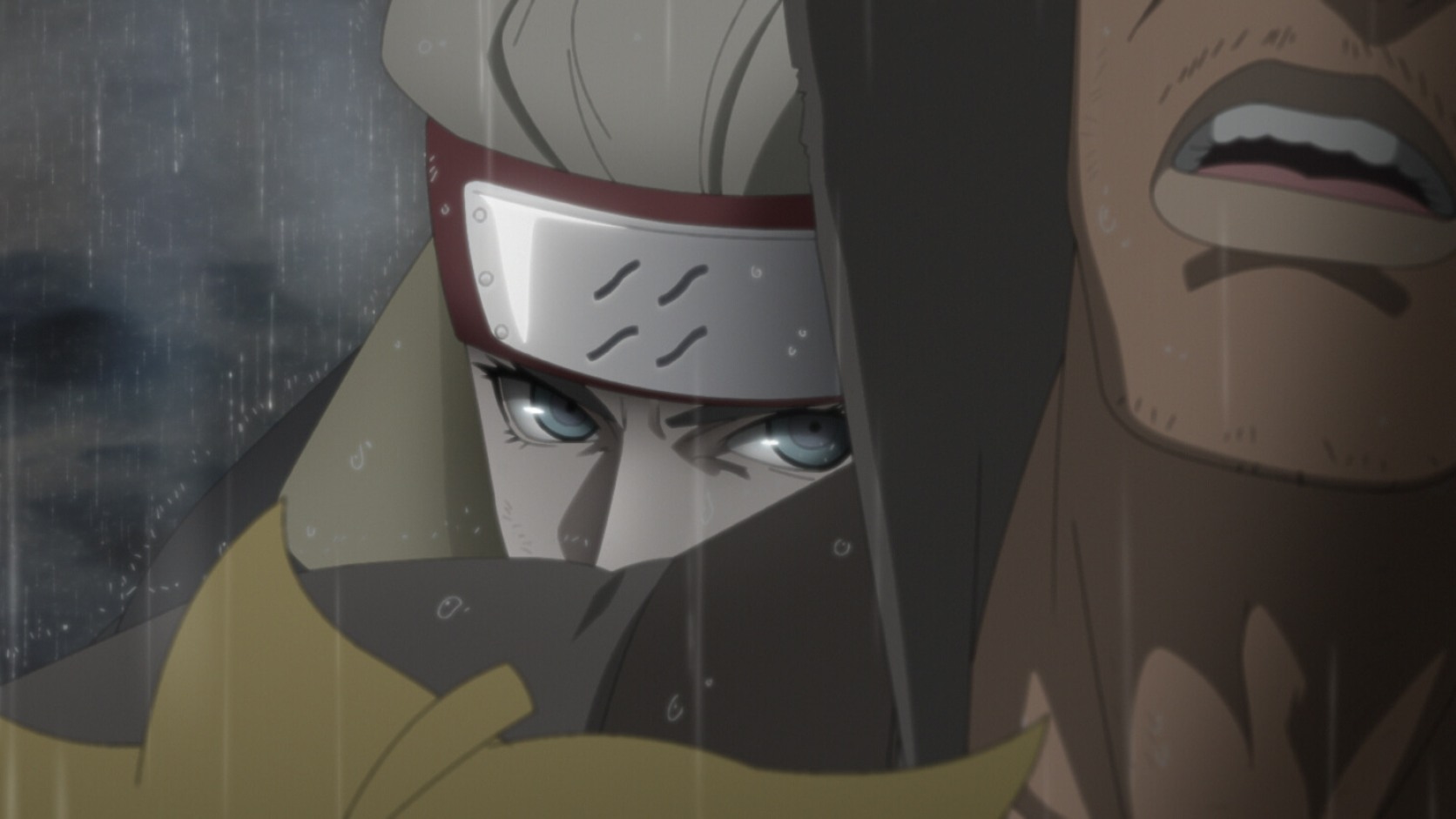
Another Fierce Battle
Denki and Iwabe are captured after protecting village children, while Funamushi returns for Seiren and forces grief, rescue, and civilian safety into the same battlefield.
Series: Boruto: Naruto Next Generations
Episode: 248 · Another Fierce Battle
Arc: Great Sea Battle of the Hidden Mist Village
Release: May 8, 2022
Previous: Episode 247 · For Kagura
Directory: All 293 Boruto episodes
Bottom line
Boruto Episode 248 brings Funamushi back to Kagura’s village with revenge still directing the mission. Denki and Iwabe, who were protecting village children, have been captured. Funamushi’s squad attacks again to avenge Seiren, forcing Boruto and the others into another battle before grief, hunger, and the previous assault have settled.
The children make every excuse collapse. Funamushi knows civilians are present, takes their protectors, and uses renewed violence around them. Boruto’s side cannot answer by treating the captives or the village as acceptable losses. Rescue must protect the people being rescued, not merely defeat the person holding them.
RaeRae’s one-minute verdict
“Another Fierce Battle” is exactly why revenge cannot be a military objective. Funamushi returns because Seiren was injured. Boruto is furious because Kagura was killed. Both losses are real. Neither loss gives anyone permission to make children the next payment.
Slow the battle down. Locate every captive. Establish proof of life. Protect the children. Open a surrender route. Keep Boruto’s Karma and grief away from the rescue plan.
Denki and Iwabe are captured
The episode begins with the defenders learning that two young shinobi are in enemy custody. Capture changes the operation from village defense alone into a hostage and rescue crisis.
Every decision must now consider what retaliation could do to people who cannot move freely.
They were protecting children
Denki and Iwabe were not pursuing glory when they became vulnerable. They were guarding children during a conflict adults allowed to reach a village.
Their capture exposes the cost of assigning young protectors without enough extraction support.
The children remain the first priority
Whether the children are captured, separated, hidden, or still moving, their location and condition must be confirmed. Fighters should not assume safety because the enemy has Denki and Iwabe.
Missing information about a child is an emergency by itself.
A rescue plan needs proof of life
The team should seek recent, verifiable evidence that Denki and Iwabe are alive and determine injuries, restraints, guards, and location. Funamushi may use false information to draw defenders into another trap.
Urgency should sharpen verification rather than erase careful checking.
The rescue clock belongs to the captives
Commanders may feel pressure to act quickly because delay looks weak. The meaningful clock is the captives’ condition: injury, exposure, movement, access to water, and immediate threat. A rushed assault that satisfies public pressure while increasing danger is not faster in any humane sense.
The team should define which new fact would trigger immediate intervention and which uncertainty justifies more observation. Time matters, but time should be measured through the people waiting to be rescued.
Parents need one reliable contact
Families of the village children, Denki, and Iwabe should receive updates through named officials who can distinguish confirmed information from rumor. Requiring parents to chase multiple command posts deepens panic and distracts personnel.
Officials should schedule updates even when nothing has changed. Silence makes families imagine the worst and leaves space for propaganda. Compassion includes saying, honestly, that the search continues and the answer is not yet known.
Rescue rehearsals should have happened earlier
A village exposed to repeated attack needed plans for missing children, captured protectors, blocked routes, and hostile negotiation before another assault. Rehearsal helps residents remember signals and meeting points when fear narrows attention.
The absence of preparation is not the children’s fault and should not be disguised as an unforeseeable emergency. After this crisis, the Mist must fund regular drills designed with residents rather than imposing a military exercise on them.
The captives may resist in ways rescuers cannot see
Denki and Iwabe might delay guards, protect information, comfort children, mark a route, or create an opening. Rescuers should not assume passivity, yet they must avoid plans that depend on captives performing heroically while injured and restrained.
Signals should be simple and optional. Failure to signal cannot be treated as betrayal. Captivity limits information and choice, so the rescue plan must carry the burden.
Reunion needs privacy and patience
After recovery, families may rush toward captives while medics need space. Officials should create a humane sequence: medical triage, confirmation of identity, contact with chosen people, private reunification, food, rest, and later debriefing.
Cameras and public ceremonies should wait. A rescued child or young shinobi does not owe the village a brave smile. The first safe moment belongs to the survivors and the people they trust.
The village should review the rescue afterward
Residents, caregivers, the rescued young people, medics, and shinobi should examine what worked and what failed. The review needs a public summary, deadlines for corrections, and funding attached to every promised improvement. Families should be able to submit testimony privately if speaking in a crowded meeting feels unsafe.
The purpose is not to turn trauma into a performance or identify one convenient scapegoat. The purpose is to make sure the next alarm reaches every household, every child has a named route, and no young protector is left carrying a public system alone.
Captives are not responsible for enemy demands
Funamushi may use Denki and Iwabe to force movement, surrender, or exchange. Whatever the demand, responsibility belongs to the captor.
Nobody becomes the cause of a concession simply because violence is threatened against them.
Denki may blame himself
He may believe his capture failed the children or exposed the team. Adults should state clearly that protecting children was worthy and that capture under overwhelming force is not moral failure.
Survivor guilt begins before rescue when people imagine everyone would be safer without them.
Iwabe may try to absorb every risk
Iwabe’s protective instincts may push him to provoke guards or sacrifice himself so Denki and the children can escape. Courage needs coordination.
He should not have to prove usefulness through injury.
Captivity requires medical assumptions
The rescue team should expect dehydration, shock, wounds, exposure, and impaired mobility. Extraction transport and medics need to be ready before contact.
Reaching captives is not the same as bringing them safely home.
Negotiation can create time
Talking with Funamushi does not reward hostage-taking automatically. Negotiation can confirm conditions, slow movement, deliver medicine, and build an opening for safe release.
Refusing dialogue for pride may spend the lives leaders claim to value.
The negotiator should not be Boruto
Boruto is mourning Kagura and furious with Funamushi. His emotions are understandable and make him poorly placed to manage a hostage conversation.
A neutral, trained adult should negotiate while Boruto receives support away from the channel.
Funamushi returns for Seiren
His squad seeks revenge for her injury. The motive repeats the pattern that killed Kagura: a loved person is harmed, so violence expands toward others.
Seiren’s life does not improve because children and young shinobi become captives.
Seiren needs treatment, not tribute
Resources spent on renewed attack could support her medical care, transport, protection, or family communication. Funamushi chooses symbolic repayment over direct care.
Revenge often performs devotion while neglecting the person supposedly being honored.
Funamushi is also avenging a command failure
He led the assault that brought his squad into resistance and loss. Framing every consequence as enemy cruelty protects his own choices from review.
Commanders should answer for the risks they created before demanding another battle.
The squad follows him back
Funato fighters return to a village where resistance, civilians, and children are known facts. Some may share the revenge motive; others may obey hierarchy or fear punishment.
Individual circumstances matter when responsibility is assessed later.
Following orders is not a complete defense
Rank-and-file fighters still have duties toward captives and civilians. They can refuse abuse, protect children, offer surrender, or preserve evidence.
Hierarchy affects choice without erasing every choice.
The village has not recovered
Residents face renewed battle after food shortage, damage, displacement, and Kagura’s death. Repeated attacks compound trauma and exhaust local resources.
A second assault lands on bodies that never returned to baseline after the first.
Evacuation plans need revision
Routes used previously may now be known or blocked. Shelters may be damaged. Families may be scattered.
Leaders must reassess current conditions rather than reissue yesterday’s instructions.
Children need relocation beyond the battle zone
Hiding children inside the village is no longer enough. Protected transport should move them to a location Funamushi cannot reach easily.
Safety requires distance when an attacker repeatedly targets the same community.
Caregivers must travel with them
Removing children without trusted adults can deepen terror and create family separation. Transport plans should preserve caregivers, medication, identification, and reunification records.
Evacuation should not resemble another abduction.
Food must move with evacuees
The village already faces shortage. Relocation without meals, water, infant supplies, and medical diets simply moves the crisis.
Logistics are part of rescue, not a problem for later.
Boruto wants Funamushi to pay
Kagura’s death makes the renewed attack personal. Boruto may see Funamushi’s return as an opportunity to finish what rage began.
The captives cannot become the stage for Boruto’s emotional resolution.
Karma cannot lead the rescue
Karma activation may increase power while reducing predictability. A hostage operation needs precision, restraint, and stable judgment.
Any plan involving Karma requires safeguards, consent from teammates, and an immediate stop condition.
Sarada should control the operation
Sarada can separate rescue, civilian evacuation, perimeter defense, intelligence, and medical response into clear roles. She should designate a person with authority to stop Boruto.
Command works best when consequences are assigned before crisis peaks.
Mitsuki should not become Boruto’s permission
Mitsuki may understand Boruto’s grief and follow him into danger. True support could mean blocking a reckless charge or choosing captives over Funamushi.
Loyalty is not agreement with every impulse.
Kawaki’s directness needs limits
Kawaki may prefer decisive force and view hesitation as risk. His survival instincts are valuable, but captives and children make blunt escalation dangerous.
Efficiency should be measured by lives protected, not speed of attack.
Buntan has tactical knowledge and grief
Buntan can help predict Funamushi’s behavior and identify openings. Kagura’s death may also make her eager for retaliation.
Her expertise should be respected while another leader holds the final safety decision.
Hebiichigo understands coercion
She knows what captivity and state control feel like. Her insight into how prisoners may react can improve the rescue.
The team should listen without making her relive trauma for their benefit.
Kyoho can support extraction
His strength may help carry injured captives or clear routes. The role needs protection and backup rather than assuming he can absorb unlimited force.
Physical capacity never makes a person expendable.
The trio’s legal status still matters
Participation in another battle should not postpone their freedom again. Every action must be documented and sentence review should continue independently of the outcome.
Kagura’s death cannot return them to invisible custody.
The curse marks must remain absent
No commander should restore lethal control because the battle is chaotic. Trust shown under pressure strengthens the case for permanent freedom.
Safety should come from planning, not a switch inside somebody’s body.
Rescue intelligence needs more than one source
Scouts, local witnesses, tracks, sound, terrain, and enemy communications should be compared. Funamushi has already seen through one defense plan.
The team should assume he expects the obvious rescue route.
A diversion must protect civilians
Creating noise elsewhere could pull guards away, but a diversion near homes or shelters could redirect attack toward residents.
Tactical creativity remains bound by civilian safety.
Snipers and ranged techniques need strict rules
Long-range force may seem safer for rescuers while increasing risk to captives standing near targets. Shooters need positive identification and clear authorization.
Uncertainty is a reason not to fire.
Captors need a surrender route
Funato fighters guarding Denki and Iwabe should know they can disarm and receive humane custody. A safe route can fracture the group’s willingness to continue.
When every exit looks fatal, people stay loyal to violence longer.
Funamushi needs to be separated from command
His grief and repeated civilian disregard make continued leadership dangerous. Funato members should relieve him or refuse unlawful orders.
Internal accountability could save their own people as well as the village.
Captured Funato fighters need humane treatment
Defenders must document identity, injuries, location, and transfers. Torture or retaliation for Kagura would destroy the distinction Boruto’s side claims to defend.
Rights matter most when revenge feels popular.
The children may witness violence during rescue
Even a successful extraction can expose them to blood, shouting, jutsu, and death. Teams should shield their view where possible and explain what is happening in simple language.
Psychological protection belongs beside physical cover.
Children should not be questioned immediately
Investigators may need information, but safety, food, sleep, and caregiver contact come first. Interviews should be brief, age-appropriate, and conducted by trained people.
Repeated questioning can become another trauma.
Denki and Iwabe need private debriefs
They should receive medical care and rest before recounting captivity. Separate interviews can preserve evidence without forcing public heroism.
Captives deserve control over how much personal detail becomes public.
The village needs a casualty and missing-person desk
Families require one reliable location for updates, reports, and reunification. Staff should distinguish confirmed facts from uncertainty.
Rumor thrives when nobody owns communication.
Names should not be announced too early
Injury or death information should reach families privately before public release. Mistakes can cause irreversible harm.
Speed is not compassion when accuracy is missing.
Media access needs boundaries
Reporters may document civilian harm and command failure, but children and newly freed captives should not be filmed without consent.
Public accountability does not require intimate suffering as content.
Funamushi’s revenge should be documented
Orders, statements, witness accounts, damage, and treatment of captives should be preserved for legal review. The story cannot depend only on the winner’s summary.
Evidence gives grief somewhere lawful to go.
Seiren should learn what was done in her name
If she survives, she deserves truthful information about Funamushi’s choices. Others should not decide that she wanted children endangered as proof of loyalty.
Nobody owns another person’s injury as authorization.
Araumi bears command responsibility now
Having taken control of the Funato forces, Araumi must restrain Funamushi, protect civilians, and establish lawful objectives. If he encourages revenge, responsibility moves upward.
Leadership includes the violence subordinates are allowed to repeat.
Isari may be the person who can intervene
Even after removal from command, Isari may understand logistics, personnel, and Araumi’s grief. He could advocate for restraint or preserve records.
Losing rank does not erase moral agency.
Chojuro owes more than reinforcements
The Mizukage must protect the village, recover captives, feed residents, preserve the trio’s rights, and investigate Kagura’s death. Sending fighters addresses only one part of responsibility.
Government care continues after the enemy retreats.
The Leaf owes care to Denki, Iwabe, and Boruto
These young shinobi are operating far from home in a conflict that escalated beyond their original mission. Leaf leadership should provide extraction support, family communication, medical care, and trauma treatment.
Allied territory does not erase an employer’s duty.
Families should hear directly from officials
Parents and guardians need timely, accurate updates from named contacts. They should not learn about capture through rumor or public reports.
Respect begins with refusing to make families chase information.
A successful rescue is not the end
Denki and Iwabe may carry fear, shame, nightmares, pain, or anger. Children may regress or avoid places associated with capture. Long-term care should be funded before attention shifts.
Survival opens recovery. Survival does not complete recovery.
The village needs compensation again
Renewed assault adds property damage, lost work, food loss, medical cost, and displacement. Each round should be documented without forcing residents to start the claim process from zero.
Repeated harm needs cumulative accounting.
Reconstruction should reduce future risk
Rebuilding can add protected shelters, multiple supply routes, accessible evacuation paths, communication systems, and water safeguards.
Restoration should return community choice rather than permanent militarization.
Memorial language matters
Kagura should be remembered for trust and protection, not as a command to destroy Funamushi. Public speeches should avoid turning his death into recruitment.
The phrase “for Kagura” should lead toward care.
Grief belongs outside the chain of command
Boruto, Araumi, Funamushi, and every affected family need places to mourn without operational authority attached. Counselors, elders, family, and community rituals can hold emotions the battlefield cannot.
No one should have to issue orders to prove grief is real.
The title admits repetition
“Another Fierce Battle” sounds almost routine, which is exactly the problem. Another battle means another evacuation, another injury list, another child hiding, and another set of promises about later repair.
Repetition should create urgency to stop, not numbness.
What the episode does well
The episode ties Funamushi’s revenge directly to captive protectors and endangered children. Boruto’s side cannot pursue a clean duel while people depend on restraint.
The battle matters because rescue and civilian care complicate every powerful move.
Where the story should push harder
Children and captives deserve aftermath beyond the action sequence. Araumi’s responsibility for Funamushi should become explicit, and Chojuro’s government should answer for repeated village exposure.
Consequences should travel upward through both chains of command.
What Denki and Iwabe deserve
They deserve careful rescue, medical care, privacy, family contact, trauma support, and freedom from blame. Their attempt to protect children should not become a reason to send them back immediately.
Young protectors need protection too.
What the children deserve
They deserve evacuation with caregivers, food, truthful explanations, privacy, counseling, and a future where adults do not call their danger unavoidable.
No child should become leverage in a feud inherited from strangers.
What Boruto deserves
Boruto deserves grief care, Karma safeguards, and teammates empowered to stop revenge from directing him. He deserves to honor Kagura without becoming another weapon made from loss.
Anger can be heard without receiving command.
RaeRae’s final ruling
“Another Fierce Battle” places Denki, Iwabe, and village children inside Funamushi’s revenge campaign. That choice removes every romantic excuse. Seiren’s injury deserves care. Kagura’s death deserves grief and accountability. Neither deserves a rescue operation made more dangerous by adults competing over whose pain authorizes the next attack.
Confirm the captives’ condition. Move the children. Use a trained negotiator. Keep Boruto away from revenge command. Preserve surrender routes and evidence. Treat every prisoner humanely. Keep the trio free. Hold Araumi responsible for the forces he now commands. Fund the village’s repeated recovery.
Do something for Kagura that Kagura would recognize: protect people, trust change, and refuse to let inherited violence choose everybody’s future.
Sources and lawful viewing
Naruto Official lists “Another Fierce Battle” as Boruto Episode 248 and states that Denki and Iwabe have been captured before Funamushi returns to attack the village in revenge for Seiren. Crunchyroll carries the episode where regional availability permits and lists a May 8, 2022 release. Streaming details can vary by country.
Official episode reference: Naruto Official episode guide
Licensed episode route: Crunchyroll licensed series page
After watching, ask whether the rescue plan protects the captives more than the fighters’ pride, why children remain inside Funamushi’s revenge campaign, and what “for Kagura” means when Kagura’s values point away from retaliation.