
For Kagura
The survivors face hunger and danger around village children while Araumi answers Tenma’s death and Seiren’s condition by turning private grief into unchecked military command.
Series: Boruto: Naruto Next Generations
Episode: 247 · For Kagura
Arc: Great Sea Battle of the Hidden Mist Village
Release: May 1, 2022
Previous: Episode 246 · A Heavy Loss
Directory: All 293 Boruto episodes
Bottom line
Boruto Episode 247 refuses to let Kagura’s death remain a private grief. The village is short on food after Funamushi’s assault, children are placed directly in danger, and the survivors have to keep people alive while mourning. Across the conflict, Araumi learns that Tenma has died and that Seiren is near death. He removes Isari from command and takes control of the Funato forces himself.
Both sides are being pulled toward the same trap. Grief becomes authority, authority becomes retaliation, and civilians become the material leaders spend. “For Kagura” should mean protecting the people Kagura tried to protect, not turning his name into another reason to continue the war.
RaeRae’s one-minute verdict
The food shortage is the moral center of this episode. War is not only the fatal strike everybody remembers. War is children without dinner, caregivers rationing meals, damaged supply routes, and residents wondering whether help will arrive before the attackers return.
Araumi’s grief is real. Taking direct command while enraged is dangerous. Feed the village, remove children from the fighting, preserve Kagura’s work, and keep grieving leaders away from unchecked military power.
Kagura’s absence changes every task
The team must continue without the person who chose the village, knew the residents, and held authority over the supervised trio. Every ordinary decision now carries the knowledge that Kagura should have been present.
Grief does not pause logistics, which makes logistics feel cruel.
The village has a food shortage
Funamushi’s assault disrupted supply, damaged stores, trapped residents, or increased the number of people needing meals. Hunger becomes an immediate threat even after the main fight moves away.
Food security belongs inside every defense plan, not inside the cleanup footnotes.
Children feel scarcity first
Young children need reliable calories, clean water, and familiar routines. Adults may skip meals to protect them, hiding the depth of the shortage until caregivers collapse.
Ration plans must account for age, health, pregnancy, disability, and medical need rather than dividing every portion equally.
Equal portions are not always fair portions
A child, an injured fighter, an older resident, and a person doing heavy rescue work have different needs. Distribution should be transparent while allowing medical exceptions.
Fairness means meeting human needs, not making every plate visually identical.
Food must not become a loyalty test
Residents should receive supplies whether they volunteered, evacuated, criticized Kagura’s plan, or have relatives connected to the Funato. Aid cannot be conditional on political performance.
Hunger used to produce obedience is another weapon.
The team needs an inventory before promises
Boruto and the others should count usable food, water, fuel, medicines, cooking equipment, storage space, and likely days without resupply. Honest numbers help residents plan.
Reassurance without inventory creates panic later.
Damaged food needs inspection
Floodwater, smoke, broken refrigeration, pests, and debris can make supplies unsafe. Desperation may push people to eat contaminated food.
Medics and knowledgeable residents should inspect stores and explain which items can be recovered.
Clean water outranks almost everything
Large water jutsu and battle damage can contaminate wells or storage. Drinking, cooking, hygiene, and medical care all depend on safe water.
Testing, boiling, filtration, and protected distribution points should begin immediately.
The Hidden Mist owes emergency supply
The village absorbed an attack connected to the broader defense of the Hidden Mist. Chojuro’s administration should send food, water, medicine, transport, and staff without waiting for residents to submit perfect requests.
Public responsibility begins before paperwork is complete.
Supply routes need protection
Deliveries can become targets, and a single convoy may reveal shelter locations. Planners should use multiple routes, stagger movement, and provide escorts focused on aid rather than pursuit.
Food reaching people matters more than winning another visible clash.
Local food knowledge belongs at the center
Residents know stored crops, fishing areas, edible plants, community kitchens, and households with special needs. Outside shinobi should support that knowledge rather than taking control automatically.
Emergency management works better when local expertise leads.
Kitchens can become care hubs
Shared kitchens can distribute meals, information, medical referrals, and family updates. They also create crowding and possible targets, so locations need protection and backup sites.
Feeding people is infrastructure, not background domestic work.
Cooking labor should be recognized
Women, older residents, and caregivers often absorb food preparation while fighters receive public praise. Their work requires fuel, water, rest, safety, and compensation.
Survival depends on labor stories routinely ignore.
Children are present during renewed violence
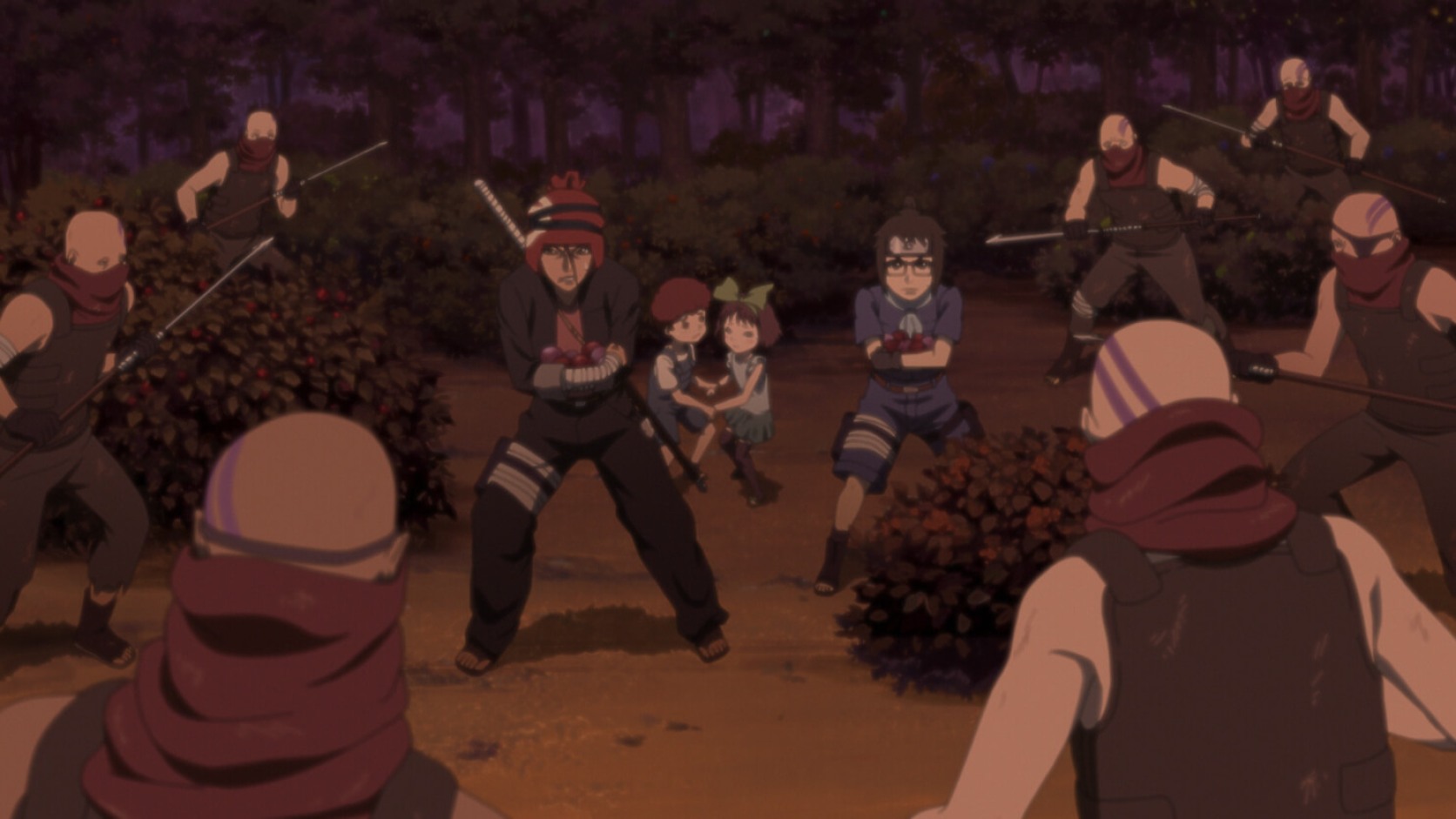
Funamushi continues fighting despite children nearby. Their presence should trigger restraint, withdrawal, or a change of location. Instead, his revenge keeps expanding the danger.
Knowing children are present makes foreseeable harm impossible to dismiss as surprise.
Children are not emotional scenery
The episode can use frightened children to show that Funamushi has crossed a line. Those children also need names, caregivers, medical checks, sleep, and follow-up after the scene ends.
Their fear should lead to policy, not only audience outrage.
Denki and Iwabe need evacuation authority
Young shinobi protecting children should know where to move them, who receives them, and when to abandon combat objectives. They should not improvise custody while surrounded.
Protecting children requires a system stronger than personal bravery.
No child should be asked to stay quiet forever
Concealment may require silence during immediate danger. After safety, children should be allowed to cry, ask questions, repeat stories, or refuse to talk.
Survival behavior should not become a permanent expectation of emotional control.
Missing children need immediate search teams
Food distribution and evacuation can expose that someone is unaccounted for. Search teams need last-known locations, clothing descriptions, medical information, and safe routes.
Families should receive regular updates rather than rumors.
Funamushi disregards civilian harm
His actions show that revenge has outranked protection of noncombatants. He cannot claim that the village forced his hand when he chooses to fight through spaces where children are visible.
Command responsibility includes deciding not to use available force.
Kagura would not want this done in his name
Kagura’s choices centered trust, protection, and the possibility that people could become more than inherited labels. Retaliation that endangers children would betray those values.
The phrase “for Kagura” must be tested against the life Kagura actually lived.
Boruto needs a purpose other than revenge
Solving the food shortage gives Boruto necessary work that directly protects people. Practical care can hold grief without pretending grief has ended.
Feeding a child may honor Kagura more honestly than landing another blow.
Work cannot become avoidance forever
Useful tasks can stabilize Boruto, but adults should not let him bury trauma under endless responsibility. He still needs rest, counseling, and space to mourn.
Service is not a substitute for feeling.
Sarada must watch the whole team
Sarada should monitor Boruto’s anger, Mitsuki’s loyalty, the trio’s legal vulnerability, food distribution, and renewed attack risk. Leadership after death includes knowing that people may look functional while falling apart.
Check-ins should happen privately and repeatedly.
Mitsuki needs his own grief acknowledged
Mitsuki often supports Boruto so quietly that his own reaction disappears. He lost Kagura too and witnessed Boruto’s dangerous Karma activation.
The calmest person in the group still deserves care.
Buntan loses an advocate and a friend
Kagura believed in a future for Buntan beyond custody. She may respond with rage, suspicion, or renewed desire for violence. Those feelings should not be used to justify restoring control.
Grief under surveillance is still grief.
Hebiichigo may want to leave
Kagura’s death removes the strongest reason she had to trust the arrangement. Leaving could be fear, self-preservation, or refusal to become the next sacrifice.
Officials should not interpret departure as proof that lethal marks were necessary.
Kyoho needs choices after Kagura
He should decide whether to help with food, defense, burial preparation, or rest. Commanders must not assign him the hardest labor because his strength is convenient.
Autonomy matters in grief as much as battle.
The curse marks must stay gone
Kagura removed the trio’s marks before asking for help. Restoring them after his death would reverse his humane decision and weaponize the loss.
Permanent removal should be documented with independent medical review.
Kagura’s final request needs witnesses
People who heard his request should record their memories separately while details remain fresh. Differences should be handled carefully rather than forcing one dramatic version.
Last words deserve accuracy without becoming state scripture.
Araumi learns Tenma is dead
The Funato leader receives news that his adopted son has been killed. He is also living with Seiren near death. The grief is immense and immediate.
Nobody in that condition should take unchecked control of a military force.
Isari tells him the truth
Isari carries the responsibility of informing Araumi. Delivering death news within a command structure can be dangerous when the leader punishes messengers or treats bad news as disloyalty.
Organizations need cultures where truth can reach authority safely.
Araumi removes Isari from command
Relieving Isari may be based on strategy, blame, mistrust, or rage. The timing makes impartial judgment doubtful. No transparent review appears before the decision.
Grief can make accountability feel urgent while making fair accountability harder.
Isari deserves clear reasons
If his command failed, Araumi should identify the orders, evidence, and expected standard. Removal may be necessary, but the process should protect the force from arbitrary leadership.
Even military hierarchy benefits from recorded reasons and review.
Araumi takes direct control
The person with the deepest personal loss now holds the broadest operational authority. That combination creates risk of escalation, collective punishment, and refusal to negotiate.
Power should narrow during acute grief, not expand.
Funato advisers should intervene
Senior members need authority to delay retaliatory orders, require civilian-risk review, and insist on clear objectives. Advisers who only affirm Araumi are not providing counsel.
Loyalty sometimes means stopping a leader from making grief permanent policy.
Tenma should not become a recruitment slogan
Funato leadership may use his death to demand greater sacrifice. Tenma’s choices and flaws should not be simplified into a symbol that cannot object.
The dead deserve memory, not conscription into every future battle.
Seiren’s condition should lead to care
Seiren needs medical treatment and protection while near death. Her injury should not become another excuse to endanger unrelated civilians.
Caring for her body is a more direct expression of love than expanding the war.
Araumi may feel he failed as a father
Taking command can offer the illusion that more control will repair a parental failure. That emotional need may push him to pursue certainty through violence.
Counselors and trusted family should help him separate grief from operational decisions.
The Funato rank and file will absorb his rage
Soldiers may receive harsher orders, shorter timelines, and greater risk because Araumi needs action. Their loyalty does not make their lives disposable.
Commanders owe followers protection even when followers volunteer.
The conflict now has mirrored grief
Boruto mourns Kagura. Araumi mourns Tenma and fears losing Seiren. Each side can point to a fresh wound and claim retaliation is justice.
Mirrored pain does not create moral equivalence for every action. The mirror shows why escalation can continue forever.
A ceasefire is more urgent after loss
The political cost of negotiation rises when families are grieving. The human need rises faster. Neutral mediators should seek pauses for medical aid, food delivery, evacuation, and body recovery.
Talking during grief can prevent another notification.
Food corridors should be protected
Both sides should agree that civilian food and medical deliveries will not be attacked or seized. Routes, times, markings, and monitors should be public enough to protect aid without revealing residents unnecessarily.
Hunger should never become military leverage.
Aid distribution needs independent oversight
The Mist may favor loyal areas, while Funato sympathizers may redirect supplies. Community representatives and neutral observers can track deliveries and complaints.
Transparency keeps food from becoming propaganda.
Residents need culturally familiar food
Emergency calories matter, but unfamiliar or unsuitable supplies may go unused. Dietary needs, allergies, religious practices, and cooking methods should guide procurement.
Respect remains part of aid during crisis.
Infant feeding needs specialist support
Caregivers need safe water, privacy, nutrition, and accurate guidance. Formula without clean water can create danger; pressure around breastfeeding can create shame and medical risk.
Support should follow each family’s needs without judgment.
Food waste must be prevented without policing hunger
Storage, rotation, refrigeration, and shared preparation can reduce loss. Guards should protect supplies from organized seizure while avoiding humiliation of desperate residents.
People taking extra food may be feeding someone invisible to the line.
The village needs a public ration schedule
Residents should know distribution times, locations, quantities, and complaint routes. Clear information reduces crowding and rumor.
Schedules must remain flexible for people who cannot travel or wait safely.
Home delivery may protect vulnerable residents
Teams can bring food and water to injured, disabled, older, or isolated people. Delivery workers need safety escorts and accurate lists without exposing private medical details.
Access should not depend on reaching the loudest queue.
Grief rituals need food too
Communities often gather, cook, and share meals after death. Scarcity may make mourning rituals impossible or create guilt around using supplies.
Emergency aid should allow culturally meaningful remembrance rather than reducing survival to calories alone.
Kagura’s memorial cannot consume relief funds
A public memorial may matter, but money for statues or ceremonies should not replace meals, housing, medical care, or compensation.
Honor becomes hollow when children are hungry beside the monument.
The village should decide how Kagura is remembered
Residents may remember him as a childhood neighbor, protector, commander, or person who brought war to their doorstep. Those views can coexist.
Official praise should not erase community complexity.
Chojuro must protect Kagura’s unfinished work
The Mizukage should preserve the trio’s records, keep the marks removed, support the village, and investigate deployment failures. Grief speeches are not enough.
Institutional follow-through is memory with consequences.
Boruto should not be sent after Araumi
The symmetry may tempt leaders to place grieving Boruto against grieving Araumi. Such a mission would weaponize both losses and increase Karma risk.
Adults should interrupt the mirror rather than stage the next collision.
Children need truthful explanations
Adults should explain that Kagura died, that the danger may continue, and that children did not cause the battle. Euphemisms can confuse them; graphic detail can overwhelm them.
Truth should match age and arrive with a trusted caregiver.
Nightmares and regression are normal responses
Children may struggle to sleep, cling to adults, lose skills temporarily, become irritable, or reenact the attack. Caregivers need support rather than blame.
Trauma care should continue after visible wounds close.
The surviving adults need care to care for children
Parents and guardians cannot provide endless calm while hungry, grieving, injured, and displaced. Respite, meals, counseling, and practical help strengthen child safety.
Supporting caregivers is direct support for children.
Food shortages can outlast the visible emergency
Even after roads reopen, farmers may have lost seed, fishers may have lost boats, shops may have no capital to restock, and families may have spent every reserve while displaced. A few emergency deliveries can prevent immediate hunger without restoring local food security. Recovery plans should follow the full path from production and transport to storage, sale, cooking, and household access.
The Hidden Mist should provide grants rather than loans that trap residents in debt for damage caused by a regional war. Local producers should receive replacement tools, safe access to water, and priority in public purchasing. Rebuilding a food system means restoring dignity and choice, not maintaining a permanent ration line.
Nobody should disappear from the ration records
Displaced people, undocumented residents, travelers, former prisoners, and families staying outside formal shelters may be missed by official counts. Community outreach teams should visit remote homes and temporary camps without turning aid registration into immigration or security enforcement.
People often avoid public distribution because of disability, fear, stigma, or prior mistreatment. Anonymous complaint routes and partnerships with trusted local groups can reveal gaps. A complete plan looks for people who are absent instead of assuming absence means no need.
Aid workers need protection and rest
Cooking, carrying water, registering families, driving supply routes, and comforting frightened children are physically and emotionally exhausting. Volunteers may continue because they believe stopping would betray Kagura or abandon neighbors. Coordinators should rotate shifts, provide meals, offer mental health support, and make rest mandatory before exhaustion causes mistakes.
The people keeping everyone alive should not become the next invisible casualties. Gratitude must appear as staffing, safety equipment, compensation, and time to recover.
What the episode does well
The story links military escalation to food scarcity and child danger instead of keeping war inside fighter choreography. Araumi’s takeover shows how grief can reshape command, while the village storyline shows the ordinary work required after a hero dies.
The contrast makes loss feel structural as well as personal.
Where the story should push harder
Residents need more authority over aid and defense. The trio’s legal future should be addressed immediately, and Araumi’s command takeover deserves internal opposition rather than automatic obedience.
The episode sees the danger clearly enough to demand consequences later.
What Kagura’s people deserve
They deserve food, clean water, safety, grief care, truthful records, and the freedom to remember him without being recruited into revenge. The trio deserve completion of the path toward freedom he defended.
Nobody should have to prove love through another battle.
What the Funato families deserve
They deserve truthful news about Tenma and Seiren, safe space to mourn, and protection from leaders using grief to demand greater sacrifice. They deserve a route toward peace that does not require denying their losses.
Care can cross a political line without erasing accountability.
RaeRae’s final ruling
“For Kagura” should be a promise to feed the village, protect the children, keep the trio free, and stop grief from receiving unchecked command. Funamushi’s violence leaves the community short of food. Araumi’s losses push him to remove Isari and seize control. Both storylines show what happens when crisis narrows every choice toward force.
Open protected aid routes. Publish the ration plan. Deliver food to vulnerable residents. Fund caregivers and trauma care. Preserve Kagura’s final request and sentence records. Keep the curse marks gone. Give Araumi time to grieve away from operational command. Create a ceasefire before Kagura and Tenma become matching slogans for the next deaths.
The best thing anyone can do for Kagura is protect the future he believed people could still choose.
Sources and lawful viewing
Naruto Official lists “For Kagura” as Boruto Episode 247 and describes Araumi taking command after learning of Tenma’s death while Boruto’s group addresses the village food shortage. Crunchyroll carries the episode where regional availability permits, lists a May 1, 2022 release, and notes Funamushi fighting despite children being present. Streaming details can vary by country.
Official episode reference: Naruto Official episode guide
Licensed episode route: Crunchyroll licensed series page
After watching, ask whether feeding the village honors Kagura more than revenge, whether Araumi can command fairly while grieving Tenma and Seiren, and who protects children when every adult leader insists the next battle cannot wait.