
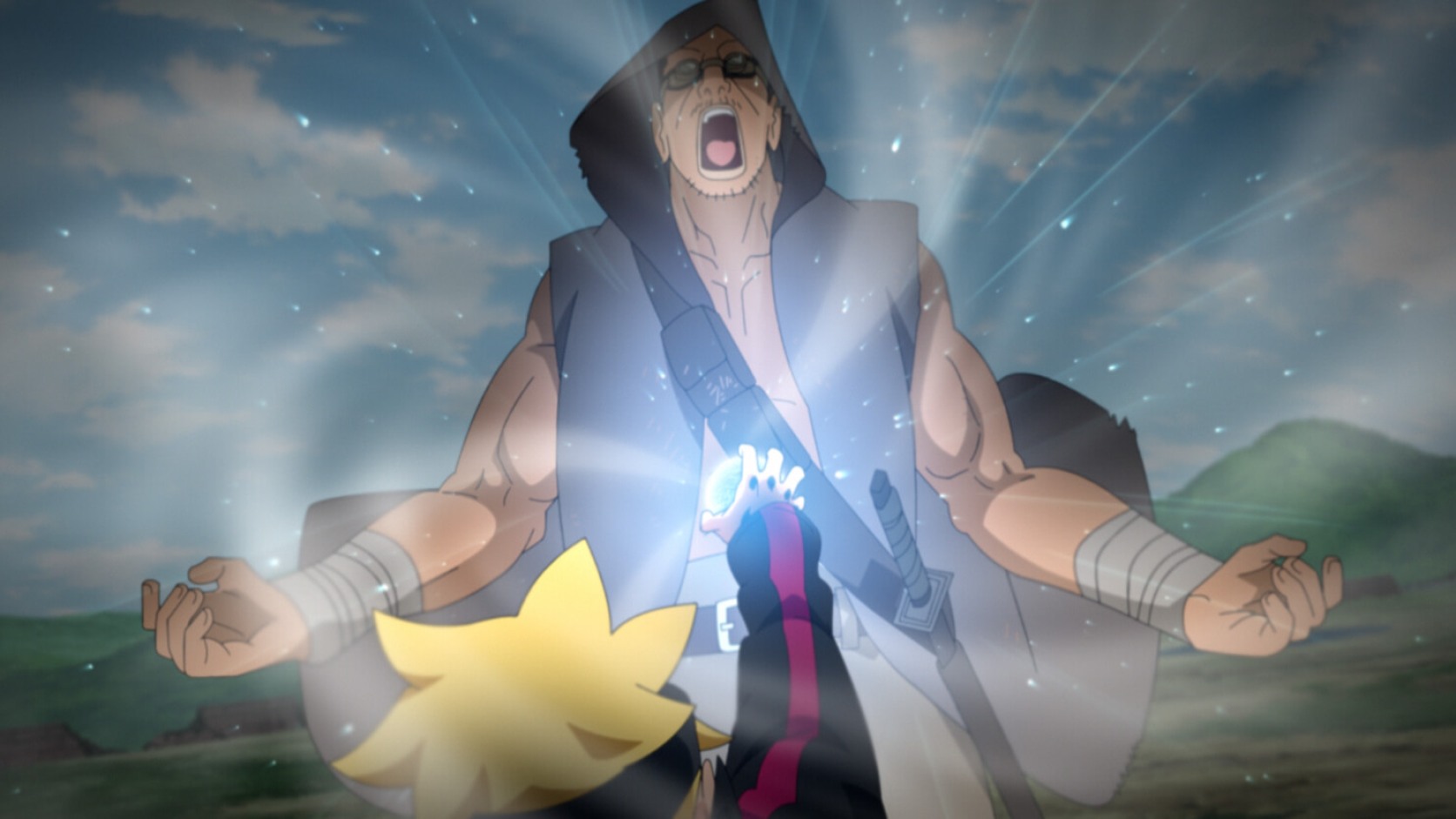
A Heavy Loss
Kagura is fatally injured, Boruto’s Karma answers grief with force, and a final request asks the survivors to protect a future larger than revenge.
Series: Boruto: Naruto Next Generations
Episode: 246 · A Heavy Loss
Arc: Great Sea Battle of the Hidden Mist Village
Release: April 24, 2022
Previous: Episode 245 · Funamushi’s Tenacity
Directory: All 293 Boruto episodes
Bottom line
Boruto Episode 246 makes the cost of this war personal and irreversible. Kagura is fatally injured during the battle with Funamushi. Boruto’s grief turns immediately into rage, his Karma activates, and he charges the person responsible. The Funato squad retreats, but retreat cannot undo the wound. Kagura uses his final moments to make one last request of the friends and former prisoners gathered around him.
The episode wants the death to become fuel for Boruto. Kagura’s final act asks for something harder: do not let another person’s violence decide what kind of people the survivors become.
RaeRae’s one-minute verdict
“A Heavy Loss” hurts because Kagura had only begun receiving a future larger than punishment. He returned to a childhood home, carried Hiramekarei with trust, released the trio’s curse marks, and tried to protect civilians. Then the story takes him at the exact moment his life has become most clearly his own.
Boruto’s rage is understandable. Karma is not grief care. Revenge will not finish Kagura’s work. Protect the living, honor Kagura’s request, and make the institutions that placed young people in this battle answer too.
Kagura is fatally injured
The official synopsis states the consequence plainly. Funamushi’s attack leaves Kagura with a fatal wound. The language matters because stories sometimes treat a young fighter’s death as an inspiring upgrade for everybody else.
Kagura is not a lesson wearing a body. He is the person lost.
The battle did not have to reach him
Funamushi chose a full assault on a civilian village. The Hidden Mist failed to provide enough defenders before scouts arrived. Commanders on both sides created the conditions that placed Kagura within lethal reach.
Calling the death inevitable would protect too many decisions from scrutiny.
Funamushi remains responsible
Grief over Tenma and loyalty to the Funato may explain Funamushi’s choices. He still directs the attack and inflicts the fatal harm. Emotional context belongs beside responsibility, not in place of responsibility.
Pain can be real while the violence produced from pain remains wrong.
Boruto watches the future disappear
Kagura represented proof that a person burdened by bloodline, fear, imprisonment, and public suspicion could build another identity. Boruto does not only lose a friend. He sees a possible future stolen at the moment that future felt real.
Rage often arrives where hope was interrupted.
Karma activates inside grief
Boruto’s Karma responds while he is emotionally overwhelmed. The power may increase his ability to strike back, but activation during rage should frighten every adult responsible for him.
A dangerous power becoming available at the least regulated moment is a safety crisis, not a heroic convenience.
Power does not process loss
Karma can help Boruto attack Funamushi. Karma cannot let him say goodbye, absorb shock, comfort Kagura, protect the trio’s legal future, or understand what happened.
The ability to act is not the same as the ability to heal.
Boruto charges Funamushi
The impulse is immediate: reach the person who caused the wound and make him pay. Such a charge may expose Boruto, abandon civilians, divide the team, and produce another death Kagura never requested.
Revenge makes the target feel simple while the consequences remain wide.
Sarada should interrupt the spiral
Sarada has to lead even while grieving. She should pull Boruto back if his charge endangers the team, assign medical support, secure retreat routes, and maintain awareness of civilians.
Leadership can mean becoming the person a furious friend resents for five minutes so that friend survives the day.
Mitsuki must not follow rage automatically
Mitsuki’s loyalty to Boruto could draw him into the charge. Protecting Boruto may instead require restraint, extraction, and refusal to reinforce a revenge decision.
Devotion should keep someone alive, not validate every dangerous impulse.
The trio lose the person who trusted them
Buntan, Hebiichigo, and Kyoho lose more than a supervisor. Kagura removed their curse marks, asked rather than commanded, and imagined them beyond their sentences. His death threatens the fragile bridge between their present and freedom.
The state must not let that bridge die with him.
Buntan may expect the promise to disappear
She already doubted the sentence reduction. Kagura’s death may confirm her fear that no living official will honor the terms or remember the contributions. Grief arrives together with legal terror.
Somebody independent must secure the records immediately.
Hebiichigo may read the death as warning
Kagura trusted the system enough to work within reform and still died protecting a village that lacked support. Hebiichigo may see proof that trust only makes people easier to use.
Her reaction should be heard before being labeled selfish or disloyal.
Kyoho needs room to grieve visibly or quietly
People express shock differently. Kyoho may freeze, withdraw, become angry, or focus on a task. No response should be judged against the louder grief around him.
Grief is not a performance with one correct volume.
Kagura gives one final request
His last request carries emotional force because everybody knows time is ending. Survivors may treat the request as a command they can never question. The request should be honored through its values, not used to control people from beyond his death.
Love can guide the living without becoming another chain.
Last words are not public policy
Kagura may ask for protection, mercy, friendship, or a future for the trio. Whatever the exact request, the Mist must create lawful decisions through evidence and rights. Officials cannot use his death selectively when convenient.
His voice matters. His voice should not excuse the state from doing its own work.
The Funato retreat does not equal justice
Funamushi’s squad eventually withdraws. The immediate attack ends, but Kagura remains dying, residents remain harmed, and the political conflict remains active.
Enemy departure is a tactical event. Justice requires truth, care, accountability, and repair.
Medical response should continue without spectacle
The team should provide every possible intervention while protecting Kagura’s dignity and privacy. Friends may want to gather close, but medics need room to work and Kagura should decide who remains if he can communicate.
A person’s final moments do not belong automatically to the audience.
Pain relief is part of care
When survival becomes unlikely, treatment should include comfort, clear explanation, and relief from pain or panic. Shinobi culture often treats endurance as virtue even at death.
Nobody should suffer more to make bravery visible.
Kagura deserves truthful information
Medical staff should not offer false certainty or hide what they know. Kagura deserves language suited to his condition and the opportunity to express wishes about people, possessions, messages, and his body.
Compassion can be honest.
His friends deserve support during the goodbye
Boruto and the others are young people witnessing traumatic death. An adult or trained medic should explain what is happening, give them tasks only if helpful, and prevent anyone from believing the outcome is their personal failure.
Presence matters more than perfect words.
The village witnesses another cost
Residents asked to help defend their home now see a young protector die. Gratitude may mix with guilt, fear, anger, and pressure to memorialize him in a particular way.
The community should not be told that Kagura died because they failed or that his death creates a debt of loyalty.
Kagura’s body belongs to Kagura and his chosen people
The Mist may want a ceremonial funeral, the village may want a memorial, and Chojuro may claim public responsibility. Those plans should follow Kagura’s known wishes and consultation with people closest to him.
The state does not gain ownership because a shinobi died in service.
Hiramekarei becomes evidence and inheritance
The sword entrusted by Chojuro carries combat evidence, political meaning, and personal history. The weapon should be secured, documented, and returned through a transparent process.
Nobody should use Kagura’s death to turn the sword into propaganda before the investigation is complete.
Chojuro must be told by a person
The Mizukage should receive a direct, accurate account rather than rumor or a sanitized report. The notification should include Kagura’s condition, actions, final request, and the failures surrounding the defense.
Leadership means receiving the human cost without hiding behind summaries.
Chojuro’s grief cannot close the inquiry
He cared for and trusted Kagura. Personal grief may make scrutiny feel cruel. The opposite is true. Love for Kagura should intensify the demand to understand why support was insufficient and why Kagura faced this attack.
Mourning and accountability belong together.
The Mist deployed young people into war
Kagura, Boruto, Sarada, Mitsuki, and others carry military responsibilities while still young. Their competence does not erase the adult decisions that normalized deployment.
A system cannot call children exceptional every time the system needs them to absorb danger.
Reinforcement failure needs names and dates
Who received the coded warning? When did Chojuro’s forces learn about the village? What support was requested? What arrived? Which route or command delay prevented adequate protection?
Specific records turn tragedy from a vague lesson into preventable failure.
Funamushi’s powerful jutsu had foreseeable consequences
The previous battle showed that he was willing to escalate with large-scale water techniques. Command should have anticipated renewed force and adjusted medical, evacuation, and defensive plans.
Foreseeable danger creates responsibility before the fatal moment.
Boruto needs immediate containment without punishment
Karma activation during rage may require teammates to limit his movement or chakra use. Such intervention should protect him and others rather than treat grief as misconduct.
Safety can be firm without humiliating a traumatized child.
Boruto needs a medical examination
Karma may affect his body, memory, or control. Medics should assess him privately after the immediate threat, document activation, and explain findings in language he understands.
He should not return to duty because the visible fight ended.
Boruto needs trauma care before debriefing
An operational account can wait until he has slept, eaten, received care, and has a trusted adult present. Immediate interrogation may distort memory and deepen guilt.
Accuracy improves when the witness is treated as a person.
Survivors need separate interviews
Each person should describe the battle independently before group discussion shapes memory. Investigators must distinguish fact, perception, and inference without accusing people for normal inconsistencies under stress.
Traumatic memory is not a clean recording.
Funamushi should face due process
If captured, he should be charged through a lawful process that examines the attack, civilian harm, and Kagura’s death. Torture or summary execution would repeat the revenge logic the defenders condemn.
Accountability becomes credible when rights survive anger.
Revenge will recruit Kagura if survivors surrender his memory
Boruto and others may say they are fighting for Kagura while pursuing choices Kagura opposed. The dead are easy to recruit because they cannot correct the living.
Honor his actual values: protection, trust, chosen change, and a future beyond inherited violence.
Kagura spent this arc making room for people other institutions had already reduced to labels. He saw more than “prisoner” when he looked at Buntan, Hebiichigo, and Kyoho. He saw more than a feared bloodline when he imagined his own future. A revenge campaign would flatten him into one label too: victim. Remembering him honestly means keeping his humor, doubt, leadership, mistakes, tenderness, and unfinished plans beside the violence that ended his life.
Nobody honors a whole person by preserving only the moment that makes retaliation easiest.
The trio should not be rearrested
Kagura’s death removes the person who temporarily released their marks. Officials may attempt to restore custody immediately. That response would punish them during grief and erase the trust demonstrated in battle.
Preserve their freedom while an independent review decides lawful next steps.
The curse marks must remain off
No official should reactivate or replace the marks. Kagura’s choice and the trio’s conduct show that lethal bodily control was unnecessary. Permanent removal, medical follow-up, and written confirmation should begin now.
Kagura’s death cannot become the excuse to reverse his most humane decision.
Sentence credit needs immediate preservation
Mission records should document every action taken by Buntan, Hebiichigo, and Kyoho. Copies should go to independent counsel before records can be lost or reinterpreted.
Their freedom should not depend on whether an official remembers Kagura kindly.
Kagura’s petition should be completed
If he advocated for acquittal or sentence relief, the process should continue with his evidence preserved. His death does not invalidate the facts supporting the request.
Institutions should not make reform die with the reformer.
The village needs grief support too
Residents witnessed combat and death near homes, roads, and children. Mobile counselors, community gatherings, private support, and culturally appropriate mourning should be funded.
The shinobi may leave. The village will keep waking in the place where the battle happened.
Memorials should follow community consent
A statue or named building may help some people and burden others. Residents and Kagura’s chosen loved ones should decide together. Funds for a memorial should never replace compensation or mental health care.
Memory deserves resources without consuming recovery.
The site of death should not become tourism
Outsiders may visit, photograph, or romanticize the location. The village should control access and protect residents from having grief turned into entertainment.
Fandom inside the story can be exploitative too.
Media reporting should protect privacy
Public interest in a shinobi death does not require showing Kagura’s body, medical details, or the raw reactions of children. Reporting should verify facts and examine policy failures.
The most intimate pain is not public property.
The official report must name civilian harm
A battle report focused only on fighters would erase damaged homes, interrupted livelihoods, displacement, and trauma. Residents should contribute testimony and review factual descriptions affecting them.
Kagura died protecting people whose losses also matter.
Compensation cannot wait for the war to end
Families need shelter, food, tools, wages, medical care, and repairs now. Emergency funds should not depend on a final political settlement.
People cannot rebuild with promises scheduled after the conflict becomes less visible.
The Funato families will grieve too
Retreating fighters may carry casualties home. Their families deserve truthful notification and freedom from propaganda demanding revenge. Recognizing their grief does not dilute responsibility for the attack.
Every unprocessed loss can become another recruitment speech.
Tenma and Kagura cannot become matching excuses
Funamushi invokes Tenma’s loss through revenge. Boruto may now invoke Kagura the same way. The names change while the mechanism stays identical.
Breaking the cycle means refusing to make one death payment for another.
Ikada will receive devastating news
Ikada cares about Boruto and has ties to the Funato. Learning that Kagura died through Funamushi’s attack may force him between family loyalty, grief, guilt, and anger. Nobody should demand an immediate public position.
He deserves safety and time before adults recruit his reaction.
Seiren’s condition complicates everything
Seiren is gravely injured while her ally kills Kagura in retaliation. The families on both sides now hold pain connected through repeated violence.
Medical care for Seiren and accountability for Funamushi can coexist.
Araumi may answer loss with escalation
Funato leadership may interpret Tenma’s death and Seiren’s injury as reasons for broader war. Kagura’s death may push the Mist in the same direction. Leaders who escalate should be required to state the objective, civilian cost, alternatives, and endpoint publicly.
Grief should not receive unchecked command authority.
Ceasefire talks become more urgent, not less
A fresh death makes negotiation politically harder and morally more necessary. Neutral mediators should seek humanitarian corridors, prisoner exchanges, protection for villages, and pauses for the wounded.
Talking after loss is not betrayal. Talking prevents the next family from joining the count.
Boruto should not promise never to forgive
He may feel that forgiveness would betray Kagura. Nobody should pressure him toward forgiveness, and nobody should turn permanent hatred into proof of loyalty.
Healing does not require reconciliation with Funamushi. Healing does require freedom from a vow controlling every future choice.
Anger needs a safe place to exist
Boruto can be furious without acting on every impulse. Adults should let him speak, train safely, cry, withdraw, and ask questions. Suppressed anger may return through Karma or reckless missions.
Care should make emotion survivable rather than forbidden.
Survivor guilt will lie to the team
Friends may believe one faster move, stronger attack, or different decision would have saved Kagura. Investigation can identify genuine lessons without validating impossible personal responsibility.
Guilt often offers imaginary control because helplessness feels worse.
Rest should be mandatory
The survivors should not be sent immediately into another pursuit. Sleep deprivation and grief impair judgment, memory, and physical control. Replacement teams should cover security.
The mission does not become safer because exhausted teenagers insist they can continue.
What the episode does well
The story gives Kagura’s death weight through relationships built across the arc. Karma activation shows how grief can become dangerous power, and the final request keeps Kagura’s values present without undoing the loss.
The episode hurts because a future was visible before disappearing.
Where the story should push harder
The narrative should examine the adults and systems that placed Kagura here, not only Boruto’s emotional response. The trio’s freedom, civilian losses, medical care, and Chojuro’s responsibility need consequences beyond the battlefield.
Grief becomes thinner when policy vanishes from the frame.
What Kagura deserved
Kagura deserved adulthood, chosen work, friendship, accountability without permanent stigma, and the chance to carry Hiramekarei for years rather than moments. He deserved reform that did not rely on his personal sacrifice.
Potential is not compensation for a life cut short.
What Boruto deserves
Boruto deserves safety from Karma, trauma care, honest answers, time away from duty, and adults willing to stop him from turning grief into revenge. He deserves to remember Kagura without being consumed by the final battle.
Friendship should remain larger than the wound.
What the trio deserve
Buntan, Hebiichigo, and Kyoho deserve permanent freedom from lethal marks, preserved sentence credit, legal representation, medical care, and protection from officials using Kagura’s death to restore control.
Honor Kagura by completing the future he tried to open.
RaeRae’s final ruling
“A Heavy Loss” is not only sad because Kagura dies. The loss is heavy because institutions finally trusted him enough to give him responsibility without supporting him enough to keep him alive. Funamushi makes the fatal choice. The Mist created the deployment conditions. Boruto’s Karma tries to turn grief into immediate force.
Stop the revenge charge. Treat the wounded. Preserve Kagura’s words and the trio’s records. Keep the curse marks off. Investigate the defense failure. Fund the village’s recovery. Give Boruto real trauma care. Bring Funamushi through due process instead of another execution performed in Kagura’s name.
Kagura’s life meant more than the anger produced by his death. Let the survivors prove that truth by protecting the future he believed they could still choose.
Sources and lawful viewing
Naruto Official lists “A Heavy Loss” as Boruto Episode 246 and states that Kagura is fatally injured, Boruto activates Karma in rage, the Funato retreat, and Kagura makes a final request. Crunchyroll carries the episode where regional availability permits and lists an April 24, 2022 release. Streaming details can vary by country.
Official episode reference: Naruto Official episode guide
Licensed episode route: Crunchyroll licensed series page
After watching, ask whether Boruto’s rage honors Kagura, who besides Funamushi bears responsibility for the fatal conditions, and whether the Mist will preserve Kagura’s final act of trust by keeping the trio free from lethal control.