
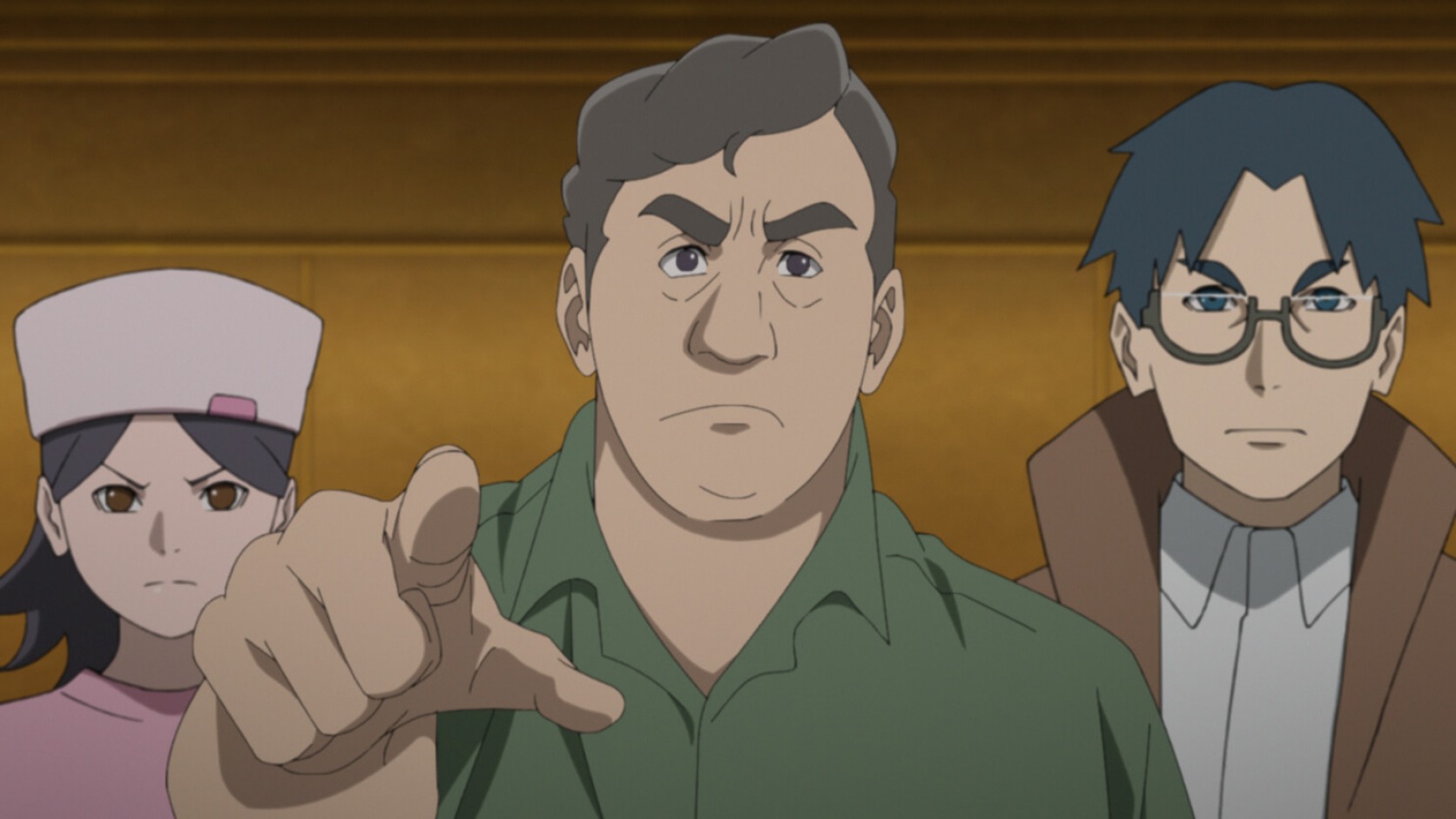
A Killer on the Ship
A shipboard murder turns Kyoho into the easiest suspect, testing whether the Mist values evidence and due process when fear points toward a supervised former prisoner.
Series: Boruto: Naruto Next Generations
Episode: 238 · A Killer on the Ship
Arc: Great Sea Battle of the Hidden Mist Village
Release: February 27, 2022
Previous: Episode 237 · The Mobile Fortress
Directory: All 293 Boruto episodes
Bottom line
Boruto Episode 238 turns an evacuation ship into a locked room and immediately shows how fear can become a shortcut to accusation. A man is murdered. Evidence appears to point toward Kyoho. Kyoho says he is innocent. Kagura believes him enough to demand an investigation, while Boruto and Iwabee stand guard and everyone else searches for clues.
That sounds like a mystery. RaeRae sees something even more urgent: a test of whether the Hidden Mist believes due process belongs to unpopular people. Kyoho has a criminal history, an intimidating body, and very little institutional power. Those facts make him easy to blame. They do not make him guilty.
RaeRae’s one-minute verdict
“A Killer on the Ship” works because the episode understands that evidence must be examined, not merely displayed. Kagura’s trust prevents the first accusation from becoming the final answer. Boruto and Iwabee’s guard duty keeps Kyoho contained without declaring the case solved. The search gives the ship a chance to choose investigation over panic.
The episode also exposes how quickly frightened communities can place every old fear onto one supervised man. That response deserves compassion and correction, not indulgence.
A murder changes the evacuation
The passengers escaped forced labor and a cannon only to encounter death aboard the vessel meant to carry them home. Safety has already been broken repeatedly. A murder inside the ship makes every corridor feel dangerous and every unfamiliar face feel suspicious.
Trauma explains that atmosphere. Trauma cannot decide guilt. Authorities need to protect frightened passengers while refusing to turn fear into a substitute for proof.
Kyoho becomes the easiest suspect
Kyoho is physically large, socially isolated, formerly incarcerated, and already marked by stories about past violence. An accusation can stick to him before anyone reconstructs the crime.
That pattern extends far beyond anime. Systems often treat a person’s record, appearance, disability, class, or reputation as evidence of a new offense. Suspicion may justify careful inquiry. Suspicion does not justify a predetermined verdict.
Evidence needs a chain of custody
Whatever points toward Kyoho must be documented: who found the evidence, where, at what time, who touched the area, and whether the object could have been moved. A crowded evacuation ship is a contamination nightmare. Passengers and crew have crossed shared spaces under stress.
Without a clear chain of custody, physical evidence can look decisive while proving far less than people assume.
Kagura’s belief buys time for truth
Kagura does not simply announce that Kyoho is innocent because they share a mission. He refuses to let the accusation end the investigation. That distinction matters. Trust can create the breathing room necessary for evidence to be tested.
Leadership sometimes means slowing down a crowd that wants certainty more than accuracy.
Belief is not the same as favoritism
Kagura supervises Kyoho, so his confidence could be dismissed as personal bias. A fair process should recognize that relationship while also recognizing Kagura’s direct knowledge of Kyoho’s recent conduct.
The answer is not to silence Kagura or let him control every decision. The answer is independent investigation with room for relevant testimony.
Boruto and Iwabee are guards, not judges
Their assignment is to watch Kyoho while clues are gathered. That limited role protects everyone when handled correctly. Kyoho remains available for questioning. Passengers receive immediate reassurance. Investigators can work without a mob forming around the suspect.
Guarding becomes abusive if Boruto and Iwabee treat containment as permission to punish, threaten, or humiliate him. Authority needs boundaries even during an emergency.
Kyoho deserves to know the accusation
Due process begins with clear information. Kyoho should know what happened, what evidence supposedly connects him to the death, what restrictions apply, and who will decide what comes next.
A person cannot meaningfully respond to a case kept vague. “Everyone knows what you did” is not notice. That sentence is social pressure pretending to be procedure.
Kyoho’s silence should not become guilt
Kyoho is not a polished speaker. Fear, trauma, shame, disability, or distrust may affect how he communicates. Hesitation does not prove deception. An awkward answer does not prove violence.
Investigators need questions designed for accuracy rather than performance. Truth should not depend on whether a frightened person can look calm enough for an audience.
Past harm does not prove present harm
Kyoho’s history belongs in a complete risk assessment, but a prior offense cannot become automatic proof of every future accusation. Rehabilitation becomes meaningless if institutions promise change while treating the record as permanent guilt.
Accountability remembers the past. Justice still evaluates the present case on present evidence.
The curse mark makes detention more dangerous
Kyoho already carries a lethal curse mark controlled through the Mist’s supervision system. Any accusation therefore happens inside a structure where authorities possess extraordinary power over his body.
That power demands more safeguards, not fewer. A mistaken command or impulsive punishment could become an execution without trial.
No death switch belongs in an investigation
Authorities should never use the curse mark to force a confession, test obedience, or frighten Kyoho into talking. Coerced statements are unreliable and abusive. A confession extracted under threat of death tells us what someone will say to survive.
Truth needs conditions where a person can speak without bodily terror controlling every word.
The passengers deserve immediate protection
Due process for Kyoho does not require ignoring everyone else. The ship needs secured areas, head counts, medical checks, controlled movement, and a way for passengers to report information without public confrontation.
Safety and fairness are not opponents. Careful procedure serves both.
Survivors may misremember under stress
People escaping occupation have endured exhaustion, fear, noise, crowding, and disrupted sleep. Memory under those conditions can be sincere and incomplete. Witnesses may blend moments or repeat something heard from another passenger.
Investigators should document accounts separately, avoid leading questions, and resist treating confidence as accuracy.
Rumor travels faster inside a closed ship
Nobody can leave. Every whispered claim reaches another frightened person. A rumor about Kyoho can become accepted truth before investigators finish checking the room.
Ship leadership needs regular factual updates. Silence creates a vacuum, and fear will fill that vacuum with the most familiar prejudice available.
Public updates must protect privacy
Passengers need to know that a death occurred, that the area is secured, and that an investigation is underway. They do not need graphic details or unverified accusations broadcast through the vessel.
Transparency is not gossip. Responsible communication shares what people need for safety while protecting the dignity of the dead and the rights of the accused.
The victim cannot become a plot device
A mystery can focus so tightly on the suspect that the person who died becomes scenery. The victim had a name, relationships, history, and people who may be waiting for them. Their body deserves respectful handling and proper examination.
Justice should center what was taken, not only the excitement of discovering who caused the loss.
The family deserves a careful notification
Officials should identify and notify the victim’s family before rumors reach them. A trained person should provide accurate information, support, privacy, and a direct contact for questions.
No family should learn about a loved one through shipboard speculation or an administrative notice without care.
The scene needs medical expertise
Shinobi observation is not the same as forensic examination. A medical professional should determine likely cause and time of death, document injuries, and preserve relevant samples.
Combat skill can identify danger. Medical skill can prevent an assumption about the weapon or timing from sending the investigation toward the wrong person.
The ship’s movement complicates time
A vessel shifts, vibrates, changes speed, and moves people through narrow shared routes. Objects slide. Sounds travel strangely. A witness may think noise came from one room when the source was elsewhere.
Reconstructing the timeline requires the ship’s log, crew movements, route changes, and machinery records alongside personal accounts.
Every passenger is not equally suspicious
Fairness does not mean pretending the entire ship has identical access or opportunity. Investigators should map who could reach the scene, who knew the victim, and who had time to act.
Evidence should narrow possibilities. Prejudice should not choose the starting answer and force every clue to fit.
The real killer benefits from a rushed accusation
Someone who stages evidence against Kyoho understands the ship’s bias. The frame works only because people are ready to believe that the large former prisoner must be dangerous.
That makes prejudice part of the method. A fair investigation protects Kyoho and removes a tool the actual killer hoped to use.
Kagura knows rehabilitation requires trust
Kagura has asked Kyoho to act like a member of a team. When the first accusation arrives, Kagura does not discard that relationship. Trust that vanishes at the first difficult moment was never rehabilitation.
Trust should remain open to evidence. Trust should also resist panic.
Buntan and Hebiichigo are watching the system
How the Mist treats Kyoho tells Buntan and Hebiichigo what their own futures look like. If one accusation erases every act of courage, then the promise of reintegration is hollow.
Procedural fairness affects more than one suspect. Fairness determines whether supervised people have any reason to believe change will be recognized.
Boruto’s instinct to believe people has limits
Boruto often trusts from the heart. That quality can interrupt cruelty. A murder investigation still needs more than friendship. Boruto should protect Kyoho’s rights without declaring evidence irrelevant.
Compassion is strongest when paired with disciplined inquiry.
Iwabee brings necessary skepticism
Iwabee may approach the guard assignment with sharper suspicion. That does not automatically make him cruel. A team needs somebody willing to test assumptions on every side.
The standard is whether skepticism remains attached to evidence or becomes permission to stereotype Kyoho.
Guard duty needs rotation and accountability
Boruto and Iwabee are young, tired, and coming from battle. They should not hold an indefinite watch without relief. Fatigue creates mistakes, irritation, and missed details.
A written log, scheduled rotation, food, water, and supervisor check-ins protect Kyoho, the guards, and the investigation.
Nobody should question Kyoho alone
Any formal interview should include an advocate or independent witness. Questions and answers should be documented. Kyoho needs breaks, water, and a clear statement that violence or curse-mark activation will not be used.
Accountability for questioning protects investigators from false claims too. Good procedure serves everyone.
The Mist needs an actual justice system
Shinobi command cannot improvise criminal procedure every time violence occurs. The village needs trained investigators, defense rights, evidence rules, judges independent from operational commanders, and appeal processes.
A Kage or mission leader should not be police officer, prosecutor, judge, and executioner in one body.
Emergency conditions do not erase rights
The ship has limited space and immediate danger. Some procedures may need adaptation. Core protections remain: no torture, no forced confession, no punishment before findings, access to information, medical care, and an impartial decision.
Rights designed to disappear during difficulty are privileges, not rights.
The ship’s captain has public duties
The captain must preserve navigational safety while supporting the investigation. Crew access, locked areas, manifests, and logs need review. The captain should not hide operational mistakes to protect reputation.
Moving the ship safely and preserving evidence are parallel responsibilities.
Crew members need separate interviews
Crew know the vessel’s hidden routes, storage spaces, maintenance panels, and schedules. That knowledge makes their testimony essential and means access must be examined carefully.
Collective loyalty among crew should not turn into a shield against questions. Respectful inquiry is not an accusation.
Search teams need assigned zones
Everyone rushing through every room would destroy evidence and frighten passengers. Teams should receive specific zones, documentation tools, and instructions not to move objects without recording them.
Coordination makes the search slower in appearance and faster in truth.
Sarada should lead without absorbing everything
Sarada has strong investigative instincts and a commitment to fairness. Leadership does not mean she must personally inspect every clue, calm every passenger, and resolve every disagreement.
Delegation protects the investigation and protects Sarada from becoming the only structure holding the response together.
Mitsuki can observe without presuming
Mitsuki notices details other people miss. His calm presence can help separate behavior from the stories others attach to behavior.
Observation still needs humility. A person’s expression or posture cannot reveal guilt with magical certainty. Evidence must remain larger than intuition.
Denki can build the timeline
Denki’s systems thinking is perfect for organizing movement, logs, room access, and witness accounts. A visual timeline can expose contradictions without requiring a dramatic interrogation.
Technical skill becomes public care when used to protect accuracy.
Metal Lee understands visible anxiety
Metal knows how fear can change breathing, movement, speech, and focus. His experience should make the group cautious about reading nervousness as deception.
Many innocent people look frightened when accused. That reaction proves that accusation is frightening.
The rescued residents need trauma-informed care
Searching rooms and restricting movement may remind passengers of captivity. Officials should explain each action, request cooperation respectfully, and provide private spaces where possible.
Safety measures can reproduce harm when nobody considers how survivors experience authority.
Children aboard the ship need protection
Children should not hear graphic rumors, witness confrontations, or become informal messengers between adults. Caregivers need accurate guidance and access to calm spaces.
Adults must not ask children leading questions because a child happened to be near a corridor. Interviews require specialized care.
Disabled passengers need accessible instructions
Updates should be available in forms passengers can understand. People with hearing, visual, mobility, or cognitive disabilities need accessible routes and direct support.
An emergency plan that works only for the fastest and least frightened passenger is not complete.
Kyoho’s body should not be treated as a weapon
People see his size before they hear his words. That visual assumption turns his body into evidence against him. Kyoho should not have to shrink, bow, or perform harmlessness to receive basic fairness.
Danger is an action and a circumstance, not a body type.
The killer exploits social hierarchy
Framing someone with little credibility is easier than framing a respected leader. The crime therefore reveals who the community believes can be sacrificed without questions.
Solving the murder should lead to a second inquiry: why was the false story so believable to so many people?
An apology will need action
If Kyoho is cleared, “sorry about that” will not repair public accusation, confinement, fear, or damage to his rehabilitation record. Corrections should be public. Records should state the finding clearly. Services should address the harm.
Repair means changing the conditions that allowed the mistake.
The victim and Kyoho both deserve justice
Protecting Kyoho from wrongful blame does not compete with finding who killed the victim. A false accusation delays truth and lets the actual killer remain dangerous.
Due process is not a favor to suspects. Due process is how a community protects the integrity of justice.
The actual killer needs a lawful arrest
Once evidence identifies the perpetrator, the team should secure the person without revenge violence, preserve the basis for arrest, provide medical care, and prevent public retaliation.
Certainty at the end of an episode still needs procedure after the credits.
Motive cannot replace proof
Investigators may discover conflict, fear, or allegiance that explains why someone would kill. Motive supports a case. Motive alone does not prove opportunity or action.
Many people have reasons to be angry. The justice system must prove who crossed from feeling into conduct.
Confession should be corroborated
Even a confession needs comparison with physical evidence and the timeline. People confess falsely under fear, confusion, loyalty, or coercion. A killer may also lie about details to protect another person.
Corroboration protects the record from another convenient shortcut.
The ship needs an after-action review
Leaders should examine how the scene was secured, how rumors spread, whether Kyoho’s rights were protected, and whether passengers received appropriate care. Mistakes need written corrections before the next emergency.
An after-action review should improve systems rather than punish the lowest-ranking person available.
Kyoho needs continuing support
Being publicly suspected can reactivate trauma and reinforce the belief that society will never see anything beyond his record. He needs an advocate, mental health care, and control over how the incident is discussed later.
Exoneration is a legal outcome. Recovery is a longer human process.
Kagura’s program needs independent oversight
Kagura’s belief helps here, but rehabilitation cannot depend on whether one supervisor likes or understands a participant. Independent reviewers should monitor curse marks, assignments, discipline, progress, and release decisions.
Oversight turns personal mercy into enforceable protection.
The curse marks must be removed
Episode 238 makes the danger undeniable. An accusation could trigger fear-driven punishment before facts emerge. No legal system should place instant lethal force inside a supervised person’s body.
Remove the marks. Replace coercion with lawful conditions, services, and review.
The Mist owes a public standard for evidence
Residents should know what authorities require before restricting someone, bringing charges, or imposing punishment. Secret standards allow reputation to become proof.
Clear rules protect the public from arbitrary power and help victims understand why an investigation takes time.
What Boruto should carry forward
Boruto should remember that believing a friend means protecting the process, not forcing a desired answer. He can stand beside Kyoho and still follow evidence wherever the evidence leads.
That balance is mature loyalty.
What Iwabee should carry forward
Iwabee should remember how quickly a guard can become part of someone else’s fear. Restraint, documentation, and respectful communication are not softness. They are professional discipline.
Power looks strongest when controlled.
What RaeRae is keeping
I am keeping Kagura slowing the rush to judgment, Boruto and Iwabee holding a limited guard role, and the shipwide search for evidence. I am keeping the story’s willingness to make Kyoho more than an intimidating silhouette.
I am also keeping every uncomfortable question about curse marks, criminal records, frightened witnesses, institutional bias, and the ease with which a community can call prejudice common sense.
RaeRae’s final ruling
“A Killer on the Ship” is not only asking who committed murder. The episode asks whether people will investigate once they have found a suspect who feels convenient. Kagura’s refusal to accept that shortcut is the moral center.
Protect the passengers. Honor the victim. Preserve the scene. Test the evidence. Give Kyoho notice, counsel, care, and a genuine presumption of innocence. Find the actual killer through facts. Then examine the system that almost let reputation close the case. That is justice larger than a mystery reveal.
Sources and lawful viewing
Naruto Official lists “A Killer on the Ship” as Boruto Episode 238 in the Great Sea Battle of the Hidden Mist Village arc and provides the synopsis and gallery. Crunchyroll carries “A Killer on the Ship” where regional availability permits. Release and streaming details can vary by country.
Official episode reference: Naruto Official episode guide
Licensed episode route: Crunchyroll licensed series page
After watching, ask what counted as evidence, what counted as prejudice, and whether Kyoho ever received the presumption of innocence that every accused person deserves. Then ask how quickly a lethal curse mark could turn a bad assumption into irreversible state violence.