
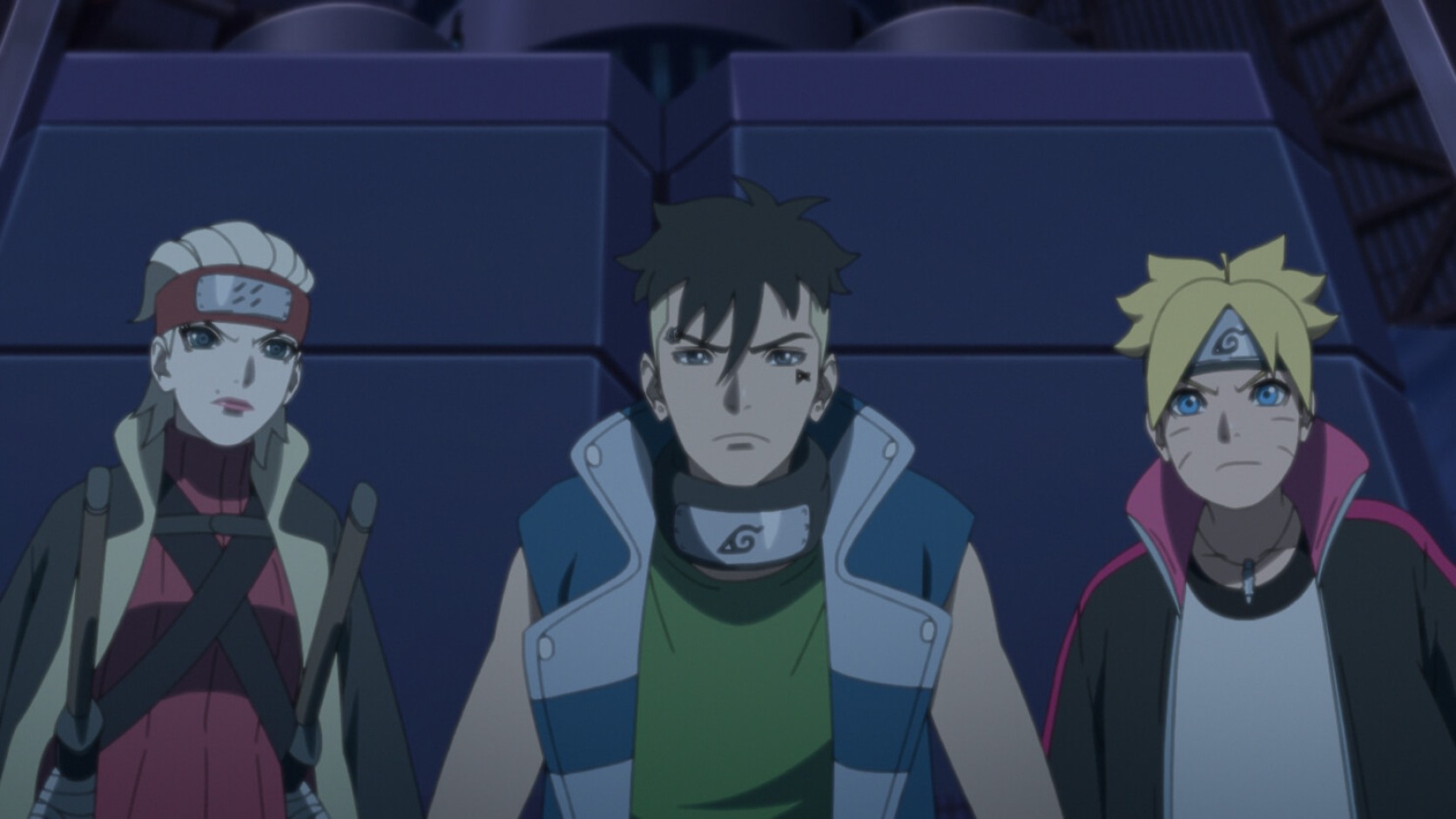
The Mobile Fortress
A Funato cannon threatens the Dotou Island evacuation while Boruto, Kawaki, Kagura, and three supervised former prisoners carry a public system’s unfinished responsibilities.
Series: Boruto: Naruto Next Generations
Episode: 237 · The Mobile Fortress
Arc: Great Sea Battle of the Hidden Mist Village
Release: February 20, 2022
Previous: Episode 236 · Cut and Run
Directory: All 293 Boruto episodes
Bottom line
Boruto Episode 237 puts a cannon between an evacuated community and the open sea, then asks six people to stop a fortress from turning rescue boats into targets. Boruto, Kawaki, and Buntan discover the weapon. Kagura arrives with Hebiichigo and Kyoho. Tenma Funato blocks the route. Every second of the fight is attached to people who cannot defend themselves from military hardware.
That human connection saves “The Mobile Fortress” from becoming a machine-versus-jutsu showcase. I like the teamwork. I love seeing the former New Seven Swordsmen treated as people with skill, judgment, and something to contribute. I still refuse to confuse their courage with approval of the curse marks controlling their bodies.
RaeRae’s one-minute verdict
The action lands because the goal is specific: destroy the weapon before the fortress fires on friends and civilians. Boruto’s urgency makes emotional sense. Kagura’s reinforcements matter. Buntan, Hebiichigo, and Kyoho prove that rehabilitation grows through meaningful trust, not humiliation.
Tenma turns grievance into permission for mass harm. The Hidden Mist responds with a tiny group that includes children and supervised former prisoners. Neither side gets a free pass from me.
The cannon makes every boat a hostage
A weapon with enough range and power to threaten an evacuation changes the meaning of the surrounding water. The sea stops being an escape route and becomes an exposed field controlled by whoever holds the trigger. Civilians who survived occupation are now trapped inside another person’s military calculation.
That is why destroying the cannon is protection rather than spectacle. The target is not valuable because the machine looks impressive. The target matters because removing the weapon restores movement to people who need safety.
Boruto’s anxiety is information
Boruto becomes anxious when he understands who the fortress can reach. His worry is not weakness. His body is registering the distance between the team and the people they promised to protect. Anxiety becomes useful when the group listens without letting panic seize command.
Adults often tell young people to calm down when the young person has accurately identified danger. A better response asks what the fear is warning everyone about.
Kawaki keeps urgency from becoming recklessness
Kawaki knows that rushing a weapon without understanding the mechanism can make the threat worse. He has lived around engineered violence and powerful systems. His caution carries knowledge rather than cowardice.
Boruto needs someone who can challenge the impulse to solve every danger through immediate motion. Kawaki needs people who remind him that caution must still lead somewhere. Together, they create a stronger decision than either boy could make alone.
Buntan is already doing the work
Buntan does not need a sentimental speech to prove change. She boarded the fortress, assessed danger, and stayed focused on protecting people outside. Her conduct is evidence.
The Mist should be evaluating that evidence through a transparent legal process. A lethal curse mark is not an evaluation. A death switch cannot measure rehabilitation, remorse, or public safety.
Kagura brings people, not disposable weapons
Kagura arrives with Hebiichigo and Kyoho because the situation requires their abilities. He sees more in them than their convictions. That trust matters.
Yet Kagura still operates inside a system that can kill them for disobedience. Personal respect softens the experience without correcting the structure. One compassionate supervisor cannot make coercive policy humane.
Hebiichigo’s blades look spectacular
Hebiichigo receives an image that lets her skill take up space. Good. Women with difficult histories are too often flattened into betrayal risk, romance, or redemption decoration. Her combat ability belongs to her character.
The episode should also leave room for her fear, anger, and skepticism. Competence does not cancel vulnerability. A woman should not have to perform fearlessness to earn a future.
Kyoho’s strength protects a shared plan
Kyoho’s body is not framed only as something frightening. His strength contributes to a coordinated effort. He is not the whole solution, and he is not a problem the heroes have to manage.
That distinction matters for reintegration. People cannot build new identities when every institution keeps dragging them back into a single public image.
The six-person team is built from different histories
Boruto comes from status and love. Kawaki comes from abuse and bodily control. Kagura carries inherited violence and public responsibility. Buntan, Hebiichigo, and Kyoho carry criminal histories plus state supervision. Those differences could fracture the mission.
Instead, the team uses varied experience to understand the fortress. Cooperation does not require pretending everyone arrived through the same door.
Tenma stands in front of a choice
Tenma is not merely a boss fight placed between the heroes and the cannon. He chooses to defend a weapon aimed toward vulnerable people. Whatever loyalty, grief, or family obligation shaped him, that choice has consequences.
Understanding his context should deepen accountability. Context explains how a person reaches a decision. Context does not turn civilian harm into an acceptable expression of pain.
Family loyalty becomes dangerous when nobody can refuse
The Funato clan organizes identity, grief, and command through family. That can create belonging. That can also make disagreement feel like betrayal of blood itself. When a leader’s plan endangers civilians, loyalty should not require silence.
A healthy family makes room for moral refusal. An armed hierarchy punishing refusal is using kinship as control.
Araumi’s war consumes his children too
Araumi Funato’s campaign is presented as resistance to the changing Land of Water. His children and followers bear the operational risk. They fight, kill, and may die while carrying his vision.
Parents do not stop owing care because their children become adults. Turning children into extensions of a patriarch’s grievance is not honor. That is inheritance without consent.
The fortress crew has responsibility
The cannon needs operators. The ship needs engineers. Orders move through ranks. Every worker does not hold equal power, but “following orders” cannot erase every moral choice.
Accountability should move upward toward planners and commanders while still examining who loaded, aimed, maintained, and protected the weapon. Proportional responsibility is stronger than collective punishment.
Destroying the weapon is not destroying evidence
The immediate priority is preventing a strike. Afterward, surviving components, records, and testimony should be preserved when safely possible. Investigators need to know who designed the cannon, who supplied materials, and whether more versions exist.
A dramatic explosion can protect lives and accidentally erase the procurement trail. Public safety needs both immediate defense and later investigation.
Somebody paid for this machine
The fortress represents enormous resources. Metal, fuel, labor, transport, plans, tools, food, and wages had to come from somewhere. The Funato did not build this threat through anger alone.
Follow the contracts. Follow the smugglers. Follow the officials who ignored unusual shipments. A war machine always leaves an economic trail before leaving wreckage.
The Mist’s intelligence system failed early
A mobile fortress should not surprise the government only after reaching occupied waters. Either intelligence missed the construction, leaders dismissed warnings, or information never reached the people with authority to act.
Each possibility requires a different repair. “We were surprised” is not a complete public explanation.
Evacuation boats need layered protection
One team attacking one weapon is not enough protection for a civilian convoy. The boats need escorts, medical supplies, backup routes, communications, flotation equipment, and procedures for mechanical failure. People should know which vessel holds family records and emergency care.
Heroic intervention can buy time. Prepared systems keep that time from being wasted.
Sarada’s rescue remains part of this battle
Sarada is not standing beside Boruto during the fortress fight, but her work gives the fight purpose. She, Mitsuki, and Team 5 helped residents leave Dotou Island. The cannon threatens the people they moved.
Stories sometimes separate combat from care and award glory only to the combat side. Episode 237 works best when viewers remember that the evacuation is the center, not background.
Mitsuki’s absence from the fight is not lesser work
Mitsuki staying with the rescue does not make his contribution smaller. Protection requires people at every point along the route. Somebody must remain with civilians while others confront the weapon.
Teams fail when everyone chases the most visible danger and leaves essential care uncovered.
Team 5 helped create the chance to fight
Denki, Iwabee, and Metal helped free and move islanders. Their earlier endurance gave the fortress team a clear reason and a window to act. The cannon fight depends on work already done.
Credit should follow the full chain of protection. The person delivering the final blow is not the only person responsible for success.
The former prisoners are protecting strangers
Buntan, Hebiichigo, and Kyoho are risking themselves for people who may know their reputations and fear them. That does not erase past harm. The choice still demonstrates a present commitment to others.
Rehabilitation becomes real through repeated choices, repair, support, and lawful review. The state should document progress without demanding death-defying performance as the admission price.
Consent cannot exist under a death switch
Every brave act by the supervised trio happens beneath the curse-mark system. We cannot know what each person would choose with genuine freedom because refusal carries an extreme consequence.
That uncertainty is the system’s fault, not theirs. The Mist created conditions that contaminate consent and then asks observers to celebrate compliance.
Kagura’s authority needs boundaries
Kagura may trust them. He also possesses power over their movement and survival. Healthy supervision requires written rules, independent review, appeal rights, medical oversight, and boundaries no individual officer can cross.
Good character is not a substitute for checks and balances. Public systems must remain safe when a kind supervisor is replaced by a cruel one.
Child soldiers remain the hidden normal
Boruto and Kawaki are central to disabling a military weapon. Their competence makes the sequence exciting. Their age makes the deployment disturbing.
The shinobi world has normalized children carrying adult security failures. Praise for courage should never silence questions about why adults created the assignment.
Boruto’s status does not protect him enough
Being the Hokage’s son gives Boruto social privilege, access, and a safety net many children lack. None of that makes a cannon less lethal. Status cannot replace proper protection.
If even the leader’s child is routinely placed inside military crises, the culture has mistaken inherited duty for acceptable risk.
Kawaki has already survived too much
Kawaki’s ability to function around engineered weapons grows from trauma no child should have experienced. Adults benefit from that survival knowledge during the mission.
The ethical response is not endless gratitude for his usefulness. The ethical response includes treatment, rest, choice, and a life where trauma expertise stops being required for belonging.
Tenma’s defeat cannot end the inquiry
Stopping Tenma solves an immediate barrier. Investigators still need to examine command orders, weapon targets, casualty intent, financing, and the chain of occupation. A defeated commander cannot become a convenient container for everyone else’s responsibility.
Justice follows networks, not only memorable faces.
Funato fighters deserve individualized review
Some fighters may have planned civilian attacks. Some may have guarded forced labor. Some may have joined under pressure. Some may have tried to limit harm. Treating everyone as identical would reproduce the collective logic driving the conflict.
Individualized review protects due process and produces better intelligence about how the organization worked.
The residents deserve a voice in justice
Dotou Island survivors should not learn about prosecutions through rumor. They need access to records, representation, victim services, and opportunities to describe harm without being forced into public exposure.
Justice done around victims rather than with them can become another institution claiming ownership of their story.
The gold must return to community control
The forced mining operation extracted wealth through fear. Recovering the gold is not enough. Authorities must document ownership, compensate labor, repair damaged land, and prevent powerful offices from absorbing the resource.
A government cannot call the island liberated while keeping the product of captivity.
Environmental damage follows the fortress
Destroying a massive weapon at sea can spread fuel, metal, chemicals, and debris. Fishing grounds and shorelines may carry the consequences long after the battle music ends.
The response needs environmental assessment, cleanup funding, and transparent monitoring. Water communities cannot rebuild on poisoned water.
Casualty care must include enemies
Once a fighter no longer poses a threat, medical care should not depend on clan affiliation. Treating wounded Funato members is not betrayal of victims. Humane standards become meaningful precisely when anger makes cruelty tempting.
Care can coexist with arrest, evidence preservation, and prosecution.
Prisoner treatment will test the Mist again
The Hidden Mist already uses lethal curse marks on supervised former prisoners. Any captured Funato members will reveal whether leaders learned anything about lawful detention.
No torture. No disappearance. No collective punishment. No death switch dressed as rehabilitation. Security policy should not copy the coercion leaders claim to oppose.
Public records should name institutional failures
After the crisis, an independent review should establish when officials learned about the fortress, what defenses existed, how Dotou Island lost contact, and why the rescue force was so thin. Findings need publication, deadlines, and assigned responsibility.
A report without consequences becomes a ceremony for forgetting.
Reconstruction needs island leadership
Officials from the mainland should not arrive with a finished plan and call consultation complete. Residents know local routes, livelihoods, family networks, and environmental conditions.
Funding should follow community priorities. Recovery imposed from above can repeat the same disrespect that made occupation easier.
Trauma care belongs to the whole team
The civilians need support. So do Team 5, Sarada, Mitsuki, Boruto, Kawaki, Kagura, Buntan, Hebiichigo, and Kyoho. Exposure to threat, forced choices, and possible death does not disappear when everyone reaches land.
Debriefing should include mental health care, not only tactical evaluation.
Hero praise can hide labor
The episode gives viewers a clear action team. Behind them are boat crews, healers, mechanics, messengers, residents guiding neighbors, and people keeping children calm. Those contributions rarely receive dramatic framing.
Community survival is collective labor. A healthy public story remembers more than the fighters closest to the explosion.
The weapon’s destruction buys responsibility
Stopping the cannon creates an opening. Leaders can use that opening to secure routes, communicate with families, gather evidence, and coordinate relief. Or they can chase the next battle and leave civilians waiting again.
Victory is measured by what safety becomes possible afterward.
That opening also belongs to the islanders. Residents should not have to wait for shinobi leaders to decide when ordinary life may resume. Community representatives need direct access to route information, relief schedules, environmental findings, and reconstruction money. Parents should know where children will sleep. Workers should know whether wages and stolen resources will be returned. Fishers should know whether the water is safe. A battle can create a protected hour, but only accountable public work can turn that hour into a future. If leaders use the pause merely to reposition fighters, then the fortress has stopped while the emergency continues.
The episode understands visible and invisible power
The fortress is visible power: steel, range, force, and intimidation. The curse marks are invisible power carried under skin. Both shape choices through the possibility of death.
The heroes oppose one form while serving inside another. That contradiction gives the arc more to say than a simple pirate-versus-village conflict.
Rehabilitation needs freedom to become credible
Buntan, Hebiichigo, and Kyoho show courage during the mission. The Mist should respond by accelerating a lawful, independently reviewed path toward freedom. Progress cannot remain an endlessly moving target controlled by one officer.
Rehabilitation without an exit is permanent punishment wearing hopeful language.
Kagura’s dream deserves structural support
Kagura wants the Bloody Mist’s legacy to end. He believes people can choose something better. I believe him. Dreams survive only when institutions convert them into rights, budgets, training, oversight, and enforceable policy.
Otherwise, Kagura becomes one good person holding back a system built to outlast him.
Tenma should have been offered another political route
Recognizing Tenma’s responsibility does not prevent us from asking what nonviolent routes existed for communities harmed by modernization. Were fishing families heard? Was compensation available? Could traditional livelihoods influence policy?
Governments reduce recruitment into armed movements when grievance has credible democratic channels. That prevention does not excuse anybody who chooses civilian harm.
Modernization needs consent and repair
The Land of Water cannot call every development project progress if coastal residents lose work, access, or identity. Public investment should include impact reviews, labor transitions, environmental protections, and local decision-making.
Peace built on ignored communities will keep producing openings for people like Araumi.
What Boruto learns here
Boruto learns that protecting friends may require attacking a machine rather than confronting the person who hurt them directly. He also learns that former enemies can become necessary partners without pretending the past disappeared.
That is a more mature form of heroism than charging toward the loudest opponent.
What Kawaki learns here
Kawaki sees trust operating across histories that should make trust difficult. Kagura relies on the supervised trio. Boruto relies on Kawaki. Everyone depends on people outside the room.
Trust is not blind faith. Trust becomes a shared practice supported by observation, communication, and room to disagree.
What the Mist must learn
Weapons require early detection. Islands require resilient communication. Evacuations require civilian planning. Rehabilitation requires rights. Children require protection. Survivors require repair.
No sword technique can replace those lessons. Government capacity is also a form of defense.
What RaeRae is keeping
I am keeping the sharp mission goal, the connection between action and civilian safety, and the six-person team built across different histories. I am keeping Buntan, Hebiichigo, and Kyoho as active participants whose skills affect the outcome.
I am also keeping the discomfort. Their bravery does not bless the curse marks. Boruto and Kawaki’s success does not make child deployment acceptable. One destroyed cannon does not repair a failed regional security system.
RaeRae’s final ruling
“The Mobile Fortress” delivers a satisfying fight because the episode never lets the cannon become a toy. The weapon threatens people Sarada, Mitsuki, and Team 5 worked to save. Boruto’s fear, Kawaki’s caution, Kagura’s trust, and the former prisoners’ courage all point toward the same responsibility.
Destroy the cannon. Protect the boats. Preserve the evidence. Treat the wounded. Return stolen wealth. Investigate the supply chain. End the curse marks. Give the children care instead of another emergency assignment. That is what victory has to mean after the fortress stops moving.
Sources and lawful viewing
Naruto Official lists “The Mobile Fortress” as Boruto Episode 237 in the Great Sea Battle of the Hidden Mist Village arc and provides the synopsis and gallery. Licensed services carry the episode where regional availability permits. Release and streaming details can vary by country.
Official episode reference: Naruto Official episode guide
Licensed episode route: Crunchyroll licensed series page
After watching, ask who built the cannon, who funded the fortress, and who failed to notice the threat before civilians entered its range. Then ask whether the Mist can celebrate supervised people’s courage while keeping death inside their bodies.