
Sacrifice
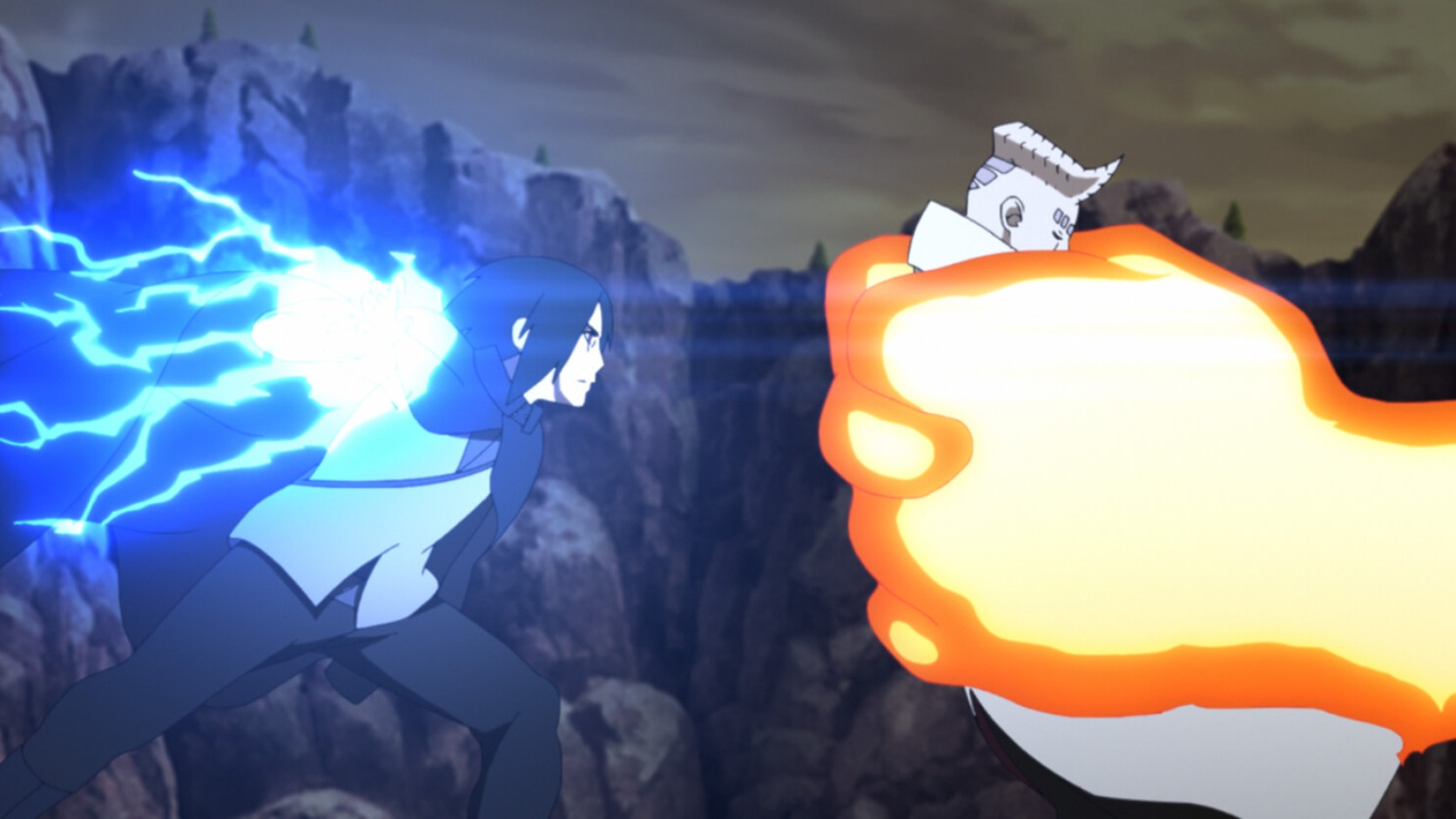
Boruto moves Isshiki away from Konoha, Naruto and Sasuke follow, and the enemy’s need for Momoshiki’s vessel turns one endangered child into the battle’s leverage.
Series: Boruto: Naruto Next Generations
Episode: 216 · Sacrifice
Arc: Kawaki: Otsutsuki Awakening
Release: September 19, 2021
Previous: Episode 215 · Prepared
Directory: All 293 Boruto episodes
Bottom line
Boruto Episode 216 moves the fight away from Konoha, but distance does not move the moral problem. Boruto uses Karma to drag Isshiki into another dimension. Naruto and Sasuke follow because leaving their son and student alone would be unthinkable. The village becomes safer for the moment, while three people land in a place with no medical team, no reinforcements, and no easy route home.
The title says “Sacrifice,” and everybody has a candidate. Boruto risks becoming Momoshiki. Naruto and Sasuke place their lives between Isshiki and Kawaki. Kawaki waits in a shelter while Amado explains why Boruto may be the key. Isshiki needs Boruto alive as Momoshiki’s vessel and future Ten-Tails offering. That limitation gives Boruto leverage. The same fact proves that Otsutsuki strategy sees children as equipment with pulse rates.
The title arrives before the bill
“Sacrifice” tells viewers that somebody will pay, but the word does not say who chose the payment or who benefits.
That missing information matters. Voluntary risk, coerced risk, and a powerful person spending someone else can all wear the same noble label.
Boruto moves the battlefield
Using Karma to open a portal protects Konoha from becoming the arena. Civilians gain distance from Isshiki’s immediate violence.
The move is brave, tactically useful, and terrifying. Boruto crosses first with the enemy because the portal comes from the mark threatening his own body.
The village is safer, not safe
Isshiki leaves Konoha physically, but Kawaki remains the objective. The defenders have bought space rather than ended pursuit.
Public safety still requires shelters, verified updates, guarded routes, and preparation for the enemy’s return. Relief should not dismantle the response.
Another dimension removes support
Naruto, Sasuke, and Boruto enter terrain without familiar landmarks, sensory teams, hospitals, or ordinary communications. Any injury becomes harder to treat.
Moving danger away from residents also concentrates risk around the people who moved the danger. Strategy always has a destination for the cost.
Naruto follows his son
The Hokage could frame Boruto as a combat asset and focus only on Isshiki. Naruto enters because Boruto is his child and cannot face the enemy alone.
That distinction matters. Leadership should never erase fatherhood when a child carries strategic power.
Sasuke follows his student
Sasuke understands dimensional combat and Otsutsuki tactics, so his presence makes operational sense. Mentorship adds another obligation.
He accepted responsibility for Boruto’s training and Karma risk. Following through means more than helping him attack. Sasuke must protect Boruto from the battle and from Momoshiki.
Boruto creates the opening adults needed
Naruto and Sasuke could confront Isshiki in Konoha, but civilian lives would sit beneath every exchange. Boruto supplies the route nobody else can open in that moment.
His contribution deserves recognition without romanticizing why a teenager holds that ability. Karma came through invasion, not a safe training program.
Useful power can hide violated consent
Karma gives Boruto access to dimensional movement. Karma also advances Momoshiki’s claim over his body.
Calling the mark useful without naming the invasion would repeat Kara’s language. A weapon does not become ethical because the victim can point part of the weapon back.
Isshiki cannot simply kill Boruto
Amado explains that Boruto matters as Momoshiki’s vessel and as a future sacrifice for the Ten-Tails. Isshiki’s larger plan restricts his immediate choices.
The knowledge creates leverage. Boruto’s value to the enemy may protect him from one form of violence while exposing him to several others.
Protection based on usefulness is fragile
Isshiki may avoid killing Boruto, but he can disable, restrain, threaten, or manipulate him. A rule against death is not a promise of safety.
Defenders should exploit the limitation without mistaking the enemy’s need for care.
Amado calls Boruto the key
The phrase sounds hopeful inside a shelter where everyone lacks control over the battle. A key opens a path.
A key is also an object used by someone else. Amado’s wording fits a man who repeatedly explains people through function.
Kawaki hears his brother reduced to function
Kawaki knows what “vessel” language does to a person. Kara used compatibility to turn his pain into a technical requirement.
Hearing Boruto described through strategic value may deepen his fear and guilt. The family member who protected him has entered the same machinery.
The shelter protects Kawaki’s body
Anti-Byakugan measures and secrecy aim to block Isshiki’s search. Physical protection remains necessary.
Kawaki also needs explanation, emotional support, and someone willing to hear what waiting does to him. A bunker can prevent capture while still feeling like another locked room.
Waking into uncertainty is cruel
Kawaki regains awareness after the attack has already moved elsewhere. Other people made decisions involving his body, family, and future while he could not participate.
Medical necessity may explain the absence. Adults still owe him a full account without treating questions as disobedience.
Shikamaru carries the village side
With Naruto and Sasuke gone, leadership cannot freeze. Shikamaru must protect Kawaki, coordinate Konoha, assess Amado, and prepare for bad outcomes.
Backup authority is not secondary work. A village survives when command continues beyond one legendary leader.
Amado remains both expert and suspect
His knowledge of Isshiki, Karma, vessels, and the Ten-Tails helps Konoha understand the fight. His history of secrets makes every explanation incomplete until verified.
Urgency can justify using his intelligence. Urgency cannot require worship.
Ask who benefits from every fact
Amado may tell the truth and still select which truth arrives first. Information order shapes decisions.
Konoha should record his claims, compare predictions with events, and keep asking what he gains if Naruto, Sasuke, Boruto, or Kawaki follows a particular route.
Isshiki treats children as agricultural inputs
The Ten-Tails plan reduces a living Otsutsuki vessel to the sacrifice needed for a Divine Tree. Worlds and bodies become materials for harvest.
That scale can sound cosmic enough to blur the cruelty. The plan still begins with taking a child who wants to live.
Cosmic ambition remains ordinary domination
Isshiki’s goal reaches beyond one village, but the governing belief is familiar: powerful people deserve continuation, and vulnerable people can pay.
The size of the plan does not make the ethics complicated. Ownership of another person remains wrong in any dimension.
Boruto’s leverage comes from being endangered
The enemy needs him alive because Momoshiki is consuming him. That is not a lucky superpower.
Boruto turns exploitation into a tactical boundary, which shows courage. Adults should not celebrate the boundary so loudly that they forget to seek freedom from Karma.
A hostage can still make choices
Boruto faces limits created by Isshiki and Momoshiki, yet he chooses when to open the portal and how to place himself.
Agency under coercion remains real. Coercion also remains real. Respect requires holding both truths.
Naruto and Sasuke cannot overpower the rules
Their strength does not guarantee control of the fight. Isshiki’s speed, shrinking techniques, rods, and physical force keep dismantling ordinary responses.
The episode refuses the comforting idea that veteran legends automatically solve the next generation’s danger.
Teamwork needs more than synchronized attacks
Naruto and Sasuke know each other’s timing, while Boruto brings a different ability and a different vulnerability. Coordination must include protection and communication.
A combination attack means little if Isshiki isolates Boruto or Momoshiki changes the person inside the formation.
Sasuke studies limitations
Raw force has failed against Isshiki before. Sasuke’s value lives in observation, positioning, substitution, dimensional knowledge, and willingness to test assumptions.
Intelligence work during combat can reveal a rule worth more than another explosion.
Naruto absorbs the visible pressure
Naruto places himself where Isshiki’s attention and attacks land. That protects Boruto and supports Sasuke’s analysis.
Tank language can make the role sound mechanical. Every hit still reaches a body with a family waiting for him.
Boruto watches legends struggle
The adults who define safety in his life cannot control the enemy. That sight can produce panic, urgency, and a desire to prove usefulness.
Nobody should confuse the pressure of watching a parent get hurt with calm consent to escalating personal risk.
The fight exposes preparation gaps
Episode 215 organized the response. Episode 216 shows what the plan cannot guarantee after the portal closes.
No local reinforcements, uncertain return routes, and dependence on Boruto’s Karma make the operation fragile. Preparation should include failure states, not only the preferred sequence.
A return route must remain a priority
Winning the encounter means little if the survivors cannot leave the dimension. Boruto may need consciousness, chakra, and control of Karma to reopen a portal.
Protecting his ability to return everyone should shape positioning and energy use from the beginning.
Medical support stops at the portal
Serious injuries cannot receive immediate treatment in an empty dimension. Every fighter should know what stabilization supplies or techniques remain available.
Heroic stories often skip logistics until somebody collapses. Bodies never skip logistics.
Communication failure isolates families
Hinata, Himawari, Kawaki, and the village cannot receive ordinary updates from the battlefield. Silence becomes the only report.
Leaders in Konoha should tell families what silence means and what remains unknown. False reassurance turns uncertainty into betrayal later.
Prayer is not a public plan
People left behind can hope for Naruto, Sasuke, and Boruto to return. Hope has emotional value.
Shikamaru and the village still need contingency plans for leadership loss, renewed attack, civilian care, and Kawaki’s protection. Faith cannot replace preparation.
Kawaki may blame himself
Isshiki attacked because he wants Kawaki, and Boruto moved the battle while protecting him. Trauma can translate those facts into personal guilt.
Adults must name the cause correctly. Isshiki chose invasion. Boruto chose solidarity. Kawaki did not create either obligation.
Survivor guilt can become a security threat
If Kawaki believes surrender would bring everyone home, he may resist protection or seek a route toward Isshiki. Emotional care directly supports physical security.
Guards should watch for despair without treating every feeling as suspicious behavior.
Protection needs trust
A secure room fails when the protected person believes captors and defenders make decisions the same way. Kawaki needs reasons to trust the people controlling access.
Clear explanations, consistent rules, and respect for small choices build cooperation faster than commands.
Shikamaru should challenge Amado aloud
Even correct information deserves questions about evidence, uncertainty, and motive. Kawaki also needs to hear that Konoha does not accept Amado’s framing automatically.
Visible scrutiny tells the child in the room that experts do not own the conversation.
Boruto’s life cannot become collateral twice
Momoshiki already threatens to erase him. Isshiki now preserves him for a later sacrifice.
The defenders must avoid a third reduction where Konoha spends Boruto because the enemy happens to need him. Saving the village should include saving the boy.
Sacrifice should require ownership of the choice
People may choose risk for family, community, or principle. That decision carries moral force when the person understands the cost and can refuse.
Leaders who arrange someone else’s loss should not borrow the nobility of the person who pays.
Children cannot carry institutional debt
Boruto was born into a village protected by generations of sacrifice. Kawaki receives safety after years of abuse.
Neither boy owes his body as repayment. Public institutions exist to protect children, not maintain a ledger against them.
Naruto’s legacy creates pressure
Boruto knows his father repeatedly risked everything for the village. Following that model can feel like proof of love and worth.
Naruto should make clear that inheritance includes compassion, judgment, and survival, not only willingness to die.
Sasuke’s legacy creates another pressure
Sasuke has spent years treating personal danger as the cost of atonement. Boruto admires him.
A mentor carrying guilt must take care not to teach self-destruction as professionalism.
Isshiki weaponizes asymmetry
The defenders care about one another, civilians, and the future. Isshiki cares about reaching Kawaki before his own body fails.
He can exploit every bond as hesitation while treating destruction as free. Ethics create constraints, but those constraints remain the reason Konoha deserves defense.
Caring is not the tactical weakness
Villains often appear efficient because they discard people. That efficiency hides fragile loyalty, poor information, and resistance created by abuse.
Boruto’s portal exists in service of relationships. Kawaki’s refusal to belong to Isshiki grew through care. Connection creates strategy too.
The empty dimension clarifies the stakes
Without village streets in the background, the confrontation looks clean. The reasons for fighting remain elsewhere: Kawaki in shelter, families waiting, civilians breathing because the battlefield moved.
An empty arena should not make the violence feel consequence-free.
Every injury reaches Konoha later
Naruto, Sasuke, and Boruto carry leadership, family, knowledge, and relationships. Damage to them will reshape the village even if no building falls.
Human infrastructure matters as much as physical infrastructure.
The word final should make everyone cautious
Characters may describe the battle as the final confrontation with Isshiki because his life is running out. Certainty can narrow attention.
Kara’s remaining knowledge, Momoshiki’s progression, the Ten-Tails, and the aftermath will not vanish because one enemy reaches a deadline.
Winning means denying the new Karma
The clearest objective remains keeping Isshiki from marking Kawaki again. Damage to Isshiki helps only when damage supports that denial.
Combat pride cannot outrank the child’s freedom.
Time belongs to the defenders
Isshiki’s failing vessel means every delayed minute has value. Naruto and Sasuke can pursue survival, obstruction, and distance rather than immediate domination.
Sometimes endurance is the offensive strategy.
Boruto should know the objective
If the plan depends on delay rather than killing Isshiki immediately, Boruto needs that information. Young fighters cannot make sound choices while adults hide the actual win condition.
Clear goals reduce impulsive sacrifice disguised as necessary action.
Containment remains part of the mission
Momoshiki could surface if Boruto loses consciousness or exhausts himself. Sasuke’s promise to intervene cannot remain abstract.
The team needs positioning, signals, and a method that protects Boruto while preventing harm to everyone nearby.
Intervention should aim to save Boruto
Stopping Momoshiki does not automatically require treating Boruto as already lost. Language matters before crisis.
Plans should begin with restraint, recovery, and return of control. Lethal force belongs at the farthest boundary, not the first assumption.
Amado’s explanation changes Kawaki’s fear
Learning why Isshiki needs Boruto may offer hope about immediate survival and create terror about Boruto’s future.
Information can relieve one uncertainty while opening another. Kawaki deserves emotional space for both reactions.
The adults should name Momoshiki’s violence
Technical explanations about extraction and vessels can make possession sound like a process happening without an aggressor.
Momoshiki is attempting to erase Boruto. Naming that violence prevents the child from feeling responsible for the invader’s actions.
Konoha needs care after the portal closes
Residents may return to routines once immediate destruction stops. The alarm, evacuation, and disappearance of the Hokage will still leave fear.
Officials should keep shelters staffed, communicate honestly, and prepare support rather than declaring success too early.
Leadership succession should already be clear
Naruto entered another dimension with no guaranteed return. Konoha cannot wait for confirmation of death or survival before knowing who holds authority.
Named succession protects the village and reduces rumor-driven power struggles.
Intelligence should survive the fighters
Sasuke holds knowledge about Isshiki’s techniques and Boruto’s Karma. That knowledge needs secure copies or trained counterparts in Konoha.
One person should never become the only archive for a civilization-level threat.
The episode earns its anxiety
The danger does not come only from power levels. Competing obligations create the tension: protect Konoha, protect Kawaki, preserve Boruto, delay Isshiki, and keep a route home.
No single attack satisfies all five.
Combat footage should reach the shelter carefully
Kawaki and Shikamaru need reliable information, yet a raw view of Boruto, Naruto, and Sasuke suffering could intensify panic without improving any decision. Amado already used a live battle feed to control the pace of disclosure during Koji’s fight.
Konoha should decide who interprets incoming intelligence, which details Kawaki needs immediately, and how uncertainty gets labeled. Protecting him from manipulation does not require hiding reality. The goal is information that supports choice rather than spectacle that traps him inside helplessness.
Isshiki may use their love as navigation
The enemy knows Kawaki formed bonds with Naruto and Boruto. Any visible injury, threat, or message could draw Kawaki out of shelter more effectively than a sensor search.
Defenders should prepare for coercive communication. Kawaki needs to hear in advance that Naruto and Boruto do not want rescue through surrender. A clear promise made before manipulation begins can become part of the shelter’s security.
The mission needs a definition of rescue
If Boruto loses control, Naruto falls, or Sasuke becomes stranded, the team may face goals that compete with delaying Isshiki. Nobody can calculate every outcome beforehand.
They can agree that rescue means preserving personhood, not merely keeping a useful body alive. Boruto under Momoshiki is not mission success. Kawaki re-marked but breathing is not mission success. The definition should match the people they claim to protect.
Waiting is work too
Kawaki cannot punch through dimensions or assist the battle directly, but remaining hidden denies Isshiki the one resource he needs. Staying in the shelter may be the hardest useful action available.
Stories often reward visible sacrifice and overlook disciplined restraint. Kawaki resisting the urge to run toward family deserves the same respect given to fighters charging forward.
What the episode gets right
Episode 216 makes Boruto essential without pretending essential means safe. His portal saves civilians, his status limits Isshiki, and his Karma remains a route for Momoshiki.
The fight also shows Naruto and Sasuke struggling against an enemy whose rules matter more than reputation. Strategy must grow from the loss of control.
Where the episode needs care
The title can encourage viewers to admire sacrifice before asking whether adults built every alternative. Boruto’s willingness should not close that inquiry.
Amado’s “key” language also needs resistance. Children are not tools simply because their bodies unlock strategic options.
RaeRae verdict
Boruto Episode 216 earns four and a half bowls of ramen out of five. The portal move is exactly the kind of choice Boruto makes when love and panic hit at the same time: smart, brave, necessary, and loaded with consequences nobody can promise to contain. He saves Konoha from becoming the battlefield by making himself part of the battlefield.
The episode’s real fight is over who gets to define sacrifice. Isshiki wants Boruto and Kawaki as materials. Amado explains them as keys and vessels. Naruto and Sasuke follow because they see a son and student. Konoha wins the moral argument only when protection remains centered on those human relationships, even while every tactical calculation begs to reduce the boys to what their bodies can do.
Before the next episode
Episode 217, “Decision,” begins with Naruto, Sasuke, and Boruto under crushing pressure. Watch which choices emerge because every safer option has failed and which costs remain hidden until somebody agrees.
Do not confuse a last resort with a clean solution. Desperation explains why someone chooses. Desperation does not erase the price.
Sources and lawful viewing
The official Naruto site provides the Episode 216 synopsis and gallery. Crunchyroll carries “Sacrifice” where regional availability permits. Release and streaming details can vary by country.
Official episode reference: Naruto Official episode guide
Licensed episode route: Crunchyroll licensed series page
After watching, ask whether every person called a sacrifice owned the choice. Boruto can be brave, Naruto can be loving, Sasuke can be loyal, and the system around them can still demand too much.