
Decision
Baryon Mode lets Naruto attack Isshiki’s remaining lifespan, but a last resort built from Naruto and Kurama’s life force makes the price part of every strike.
Series: Boruto: Naruto Next Generations
Episode: 217 · Decision
Arc: Kawaki: Otsutsuki Awakening
Release: September 26, 2021
Previous: Episode 216 · Sacrifice
Directory: All 293 Boruto episodes
Bottom line
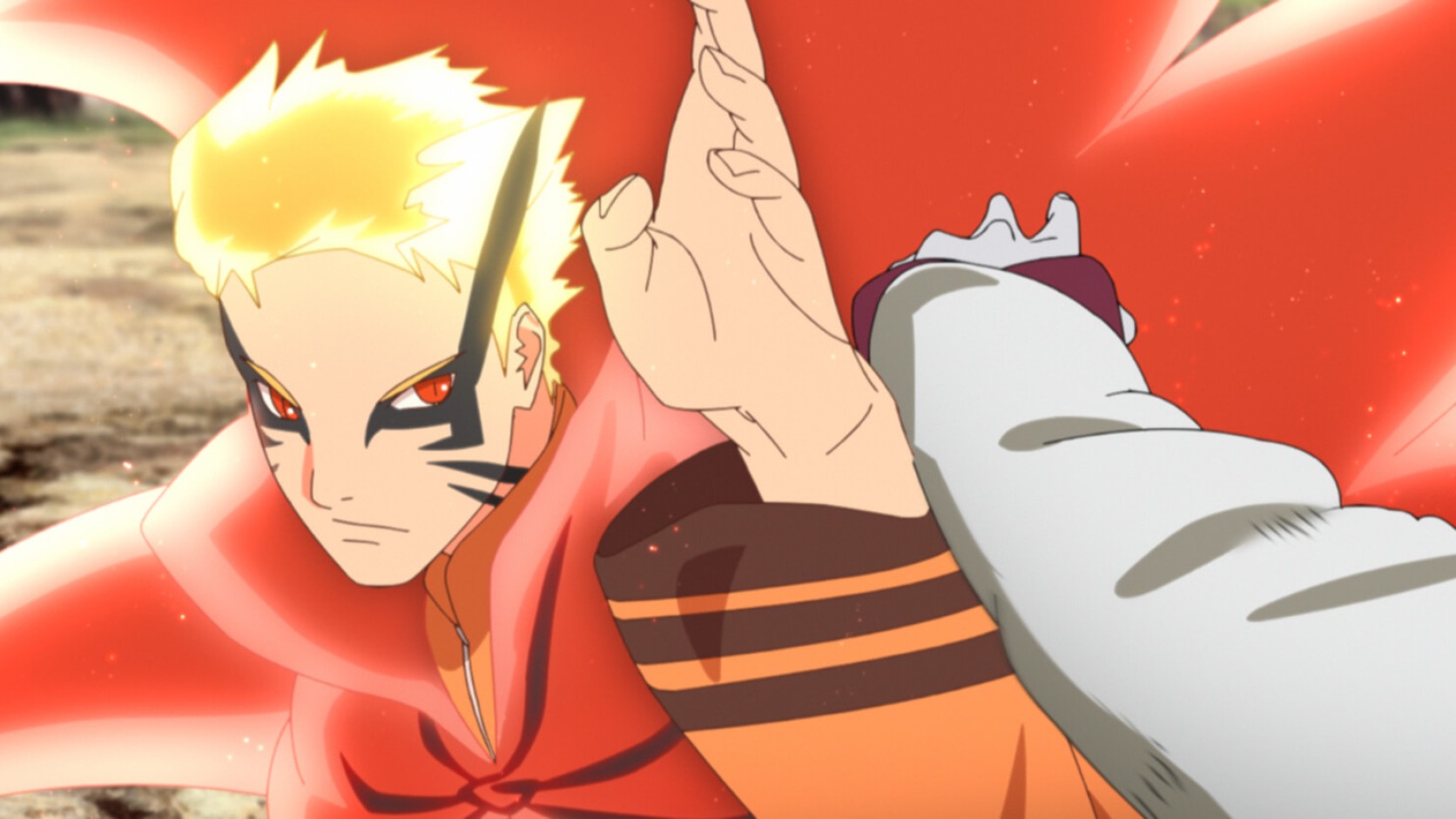
Boruto Episode 217 gives Naruto the transformation fans will clip forever and wraps that spectacle around a brutal question: what counts as consent when the only offered choice is certain defeat or a power that could end your life? Baryon Mode lets Naruto overwhelm Isshiki, but the new strength does not come from another storage tank of chakra. Naruto and Kurama consume life force to create energy, and every contact shaves time from an enemy whose body already has hours left.
That strategy is brilliant because Naruto does not need to defeat infinity. He needs to make Isshiki’s deadline arrive before Kawaki becomes a vessel again. Then Isshiki finds the chakra connection between Naruto’s prosthetic arm and Kawaki and pulls the child out of Konoha’s shelter. The episode turns its own triumph inside out. Naruto’s love for Kawaki created the bond that helped the boy heal. Isshiki reads the same bond as a tracking route.
The title refuses to name the chooser
“Decision” sounds clean until viewers ask who supplied the facts, who controlled the clock, and who would bear the cost.
Naruto chooses Baryon Mode. Kurama defines the option. Isshiki creates the emergency. Those roles cannot collapse into one heroic word.
Naruto and Sasuke reach the wall
Their familiar combinations fail because Isshiki sees, shrinks, counters, and strikes faster than their usual answers can develop. Reputation cannot bridge the gap.
The episode earns the last resort by showing the ordinary arsenal collapse first.
Boruto cannot force a miracle
He tries to protect Naruto and Sasuke while carrying Karma and the risk of Momoshiki. Courage does not make his body able to solve every problem.
Failure here does not diminish him. A teenager should never have been responsible for producing the miracle adults need.
Kurama offers forbidden arithmetic
Baryon Mode combines Naruto’s chakra and Kurama’s chakra through a process compared with nuclear fusion. The result creates a new kind of energy by consuming the source.
That explanation makes the form more than a larger battery. Power and lifespan enter the same equation.
The form spends life, not stamina
Ordinary exhaustion allows rest and recovery. Baryon Mode burns a resource that cannot simply refill after sleep.
The distinction matters because battle language often hides permanent cost beneath temporary words such as drain.
Kurama says Naruto could die
Naruto receives warning that the mode may end his life. He understands the danger and accepts because Boruto, Sasuke, Kawaki, and the village face immediate catastrophe.
That knowledge supports consent. Whether the disclosure contains every relevant detail remains a separate question.
Consent needs complete information
A person cannot weigh a sacrifice fairly when another party controls the mechanism and withholds material facts. Urgency may shorten the conversation without making accuracy optional.
Kurama owes Naruto the clearest explanation available, especially when their lives and bodies have been linked since infancy.
Their partnership carries old wounds
Naruto once held Kurama through a seal imposed by adults. Kurama once experienced Naruto as another jailer inside a long history of human control.
They built trust across years. A life-costing choice tests whether that partnership now functions through mutual respect rather than old coercion.
Trust is not permission to hide the price
Deep relationships sometimes create the temptation to decide what another person can handle. Protection through omission can still violate agency.
Naruto trusts Kurama enough to act. That trust makes honest disclosure more important, not less.
Naruto chooses people, not glory
He does not activate Baryon Mode to defend a title or prove that the Hokage remains strongest. He acts because people he loves have no remaining defense.
Motive matters. Love explains the choice without automatically making every condition around the choice fair.
The transformation looks like certainty
Naruto’s new silhouette, red chakra, focused movement, and sudden dominance create the visual language of an answer.
The underlying mechanism remains an ending. Spectacle can make viewers cheer before grief catches up.
Baryon Mode changes the kind of fight
Naruto no longer needs to trade the largest attacks. Physical contact drains Isshiki’s already limited lifespan.
Every clean strike becomes a subtraction problem. Precision outranks volume.
The countdown becomes a weapon
Amado’s estimate gave Konoha information about Isshiki’s defective vessel. Baryon Mode turns that information into a combat strategy.
Knowledge matters because strength finally serves the actual win condition: keep Kawaki free until the deadline reaches zero.
Naruto fights smaller and smarter
The mode rewards controlled movement, economical attacks, and close contact. Wasting chakra on dramatic excess would shorten Naruto’s window.
Restraint becomes part of power. That choice gives the animation weight beyond speed.
Every hit carries two costs
Contact reduces Isshiki’s lifespan while Baryon Mode consumes Naruto and Kurama’s life force. Both clocks move during the same exchange.
The battle asks which side runs out first. Nobody receives a free punch.
Isshiki finally experiences fear
His superiority depends on assuming that time will last long enough to reclaim Kawaki. Naruto attacks the assumption rather than the ego.
Watching certainty collapse feels satisfying because Isshiki has treated other lives as extensions of his own future.
Mortality reaches the man who stole bodies
Isshiki escaped death by occupying Jigen and preparing Kawaki. Baryon Mode forces him to feel a limit he kept transferring to other people.
The symmetry works without pretending suffering automatically creates justice.
Naruto does not become entitled to another life
He pays through his own body rather than selecting a subordinate, prisoner, or child to absorb the cost.
That difference separates sacrifice from exploitation. Ownership of the choice matters.
Kurama also owns part of the body
Baryon Mode consumes energy produced through both partners. Naruto cannot be the only person whose consent counts.
Kurama’s willingness deserves the same attention as Naruto’s heroism. A tailed beast is not an internal fuel supply.
Jinchuriki history makes this heavier
Villages captured tailed beasts, sealed them into children, and praised the resulting weapons as protection. Naruto and Kurama transformed that imposed arrangement into friendship.
A final technique should honor both persons rather than return Kurama to the role of expendable resource.
The village sees Naruto as infrastructure
Konoha depends on his strength, political authority, relationships, and symbolic reassurance. Losing him would affect far more than one battle.
Public dependence can pressure a leader toward self-sacrifice while leaving succession and care neglected.
Leadership requires a plan beyond the leader
Shikamaru and others must maintain evacuation, Kawaki’s protection, intelligence, and command while Naruto fights elsewhere.
Baryon Mode should not become an excuse for every system to wait on one man.
Sasuke recognizes the cost through observation
He sees Naruto’s power rise while the duration remains dangerously narrow. Sasuke’s role shifts toward reading the mechanism and protecting openings.
Friendship during crisis includes noticing when strength is consuming the friend using strength.
Boruto watches his father burn time
From Boruto’s view, the impossible rescue arrives through a form that could kill Naruto. Relief and terror occupy the same frame.
No child should be expected to process that sight as pure inspiration.
Heroism creates family trauma
Naruto’s decision may save everyone, yet Hinata, Himawari, and Boruto still face the possibility of losing him without a goodbye.
Public gratitude does not cancel private grief.
Kawaki feels the chakra weaken
Naruto’s prosthetic arm connects to his chakra, so Kawaki senses changes from the shelter. Care becomes a line carrying fear across dimensions.
The bond gives emotional truth to a technical detail. Kawaki knows something is wrong before anyone can offer comfort.
The prosthetic was an act of welcome
Naruto shared chakra to help Kawaki use an advanced arm. The gift told him that disability would not reduce belonging.
Isshiki later exploits the connection. Abuse of a caring system does not make the care a mistake.
Security reviews should not punish connection
Konoha should examine how the chakra link exposed Kawaki’s location. The answer cannot be isolation, confiscation without replacement, or blame.
Safety needs redesign that preserves function and dignity.
Isshiki reads relationships as tools
Naruto sees the arm as support. Kawaki experiences the chakra as family. Isshiki sees a locator.
The same connection reveals each person’s values through the use they imagine.
Pulling Kawaki breaks the shelter promise
The anti-Byakugan room and guards were supposed to keep him beyond Isshiki’s reach. Space-time power and the chakra link bypass that confidence.
Security failed without Kawaki doing anything wrong.
Kawaki should not carry the failure
He may believe his bond with Naruto endangered everyone or that accepting the prosthetic created the route. Isshiki chose to weaponize care.
Adults must name that responsibility clearly before shame fills the silence.
A protected person needs contingency choices
Shelter plans should cover forced displacement, compromised secrecy, communication loss, and direct contact with the attacker.
Kawaki deserves rehearsed options rather than an order to improvise after abduction.
Amado knew Isshiki studies chakra
His expertise should include possible tracking routes through Kawaki’s technology, modifications, and known connections. Konoha needs to ask whether the prosthetic risk was foreseeable.
Useful intelligence does not excuse an omitted warning.
Shikamaru needs the full threat map
Protecting Kawaki required more than blocking visual detection. Chakra links, space-time abilities, technology, and emotional manipulation all belonged in the model.
Layered defense fails when one expert keeps layers private.
The episode turns love into vulnerability
Naruto’s bond with Kawaki gives the boy healing, belonging, and a reason to resist Isshiki. The same bond exposes a location.
That does not prove attachment weak. Attachment creates stakes worth defending.
Isolation would hand Isshiki a different victory
Removing every relationship might reduce tracking routes while destroying the life Konoha claims to protect.
A safe vessel with no family would still reflect Isshiki’s worldview more than Naruto’s.
Decision under duress remains a decision
Naruto has seconds, not days, to evaluate Baryon Mode. Pressure constrains freedom without erasing his agency.
Fair analysis should respect his yes and examine why every alternative disappeared.
Last resorts require earlier accountability
When leaders reach only one remaining option, investigators should ask which prior choices narrowed the field. Kara’s abuse, Amado’s secrecy, and Konoha’s dependence on a few fighters all shape the moment.
The last decision never begins at the last second.
Sacrifice should not become policy
Naruto repeatedly saves institutions through personal risk. A system can grow comfortable when one generous person always fills the gap.
Admiration should lead to better structures, not another expectation that he will pay next time.
Baryon Mode rewards contact over destruction
Naruto does not need to level the dimension or outlast an infinite reserve. Each touch reduces the enemy’s time.
The mechanic aligns power with restraint, which makes the fight more interesting than another contest of blast size.
Isshiki adapts because survival sharpens him
Once he understands the lifespan drain, he searches for another route to Kawaki. Losing control makes him more dangerous rather than less intelligent.
The defenders cannot celebrate the reversal before the clock actually ends.
The stronger Naruto looks, the less time he has
Visual dominance normally signals safety. Baryon Mode flips that signal.
Every stunning movement consumes the reason the movement exists. The audience cheers and counts down at once.
Power cannot solve the consent problem
Naruto’s success against Isshiki does not answer whether Kurama disclosed every cost or whether the village relies too heavily on his willingness to die.
Winning a fight cannot retroactively make the decision process fair.
Kurama deserves his own interior life
He has memories, fears, preferences, and relationships beyond the chakra Naruto can use. The technique affects a person, not a power source.
The story owes him emotional weight equal to the mechanical explanation.
Naruto deserves protection from his own pattern
He runs toward sacrifice because abandonment shaped his childhood and saving others gave his pain meaning. That generosity can become self-erasure.
Friends should honor his values while challenging the belief that his life always belongs at the bottom of the ledger.
Boruto needs a different inheritance
Watching Naruto may teach him that love proves itself through willingness to disappear. Boruto already carries Karma and a dangerous urge to protect everyone.
Adults must teach him that survival, asking for help, and refusing exploitation also belong to the Uzumaki legacy.
Kawaki needs the same lesson
Abuse taught him that pain buys temporary safety and usefulness earns permission to exist. Naruto’s self-sacrifice can accidentally reinforce that equation.
Someone must explain that Naruto fights because Kawaki matters, not because Kawaki now owes an equal death.
The battle has two endangered boys
Kawaki faces a new Karma. Boruto faces Momoshiki’s extraction and Isshiki’s plan to preserve him for sacrifice.
Focusing on one vessel can make the other disappear. Konoha must protect both people.
Sasuke carries a containment promise
Boruto asked his mentor to stop him if Momoshiki takes control. That promise sits behind every moment of exhaustion.
Sasuke must fight Isshiki while preserving enough judgment and strength to protect Boruto from the threat inside him.
Baryon Mode changes team priorities
Naruto becomes the best route for draining Isshiki’s clock, so Sasuke and Boruto should support contact rather than chase individual glory.
Good teamwork reorganizes around the winning mechanism.
Time estimates need constant revision
Isshiki’s displayed lifespan falls faster through contact, while Baryon Mode’s duration depends on disciplined movement. The team needs updated assumptions.
Old estimates become dangerous when the mechanism changes mid-battle.
Kawaki’s arrival changes the win condition
Before Isshiki pulls him into the dimension, delay alone could work. Once Kawaki stands within reach, every second carries a marking risk.
The strategy must protect distance, disrupt contact, and preserve Kawaki’s choices under direct coercion.
A child returns to his abuser’s reach
Kawaki’s terror is not only tactical. Isshiki represents years of pain, control, experiments, and threats.
The episode should let that history remain visible beneath the battle choreography.
Trauma affects movement
Freezing, compliance, anger, or desperate resistance can all emerge when Kawaki faces Isshiki again. None proves weakness.
Defenders should support him without demanding the perfect survivor response.
Naruto’s fading power may frighten Kawaki most
The person who promised protection now burns through visible strength while Isshiki closes in. Kawaki may interpret the scene as proof that caring for him destroys people.
That belief could become more dangerous than any order Isshiki gives.
The team must reject debt language
Nobody should tell Kawaki how much Naruto sacrificed “for him” as leverage over future choices. Love offered with a repayment demand becomes control.
Naruto’s decision belongs to Naruto.
Emergency planning needs emotional intelligence
Konoha built a shelter against eyes but not a complete defense against guilt, attachment, or coercion. Technical systems protect only part of a person.
Trauma-informed planning is security planning when the target knows the victim intimately.
The animation sells impossible weight
Baryon Mode moves with economy and force. Naruto’s attacks feel deliberate because every wasted motion matters.
The visual restraint supports the mechanic. Power looks controlled rather than noisy.
Spectacle should not swallow the warning
Fans can celebrate the transformation, choreography, and reversal. Those pleasures are real.
The story still labels the form a life-costing last resort. Admiration should not turn self-destruction into a routine upgrade request.
The mode needs a medical record
If Naruto returns, the medical team will need more than a description that he used enormous chakra. Baryon Mode changes life force itself, so ordinary exhaustion protocols may miss the damage.
Kurama’s explanation should be recorded as precisely as possible, including onset, duration, symptoms, chakra changes, and contact effects. Emergency medicine improves when legendary techniques stop living only as oral tradition between fighters.
Konoha should study without claiming ownership
Researchers may want to understand Baryon Mode after seeing its effect on Isshiki. Study could protect Naruto or help future patients with chakra depletion.
Curiosity does not create rights over Naruto or Kurama’s bodies. Any examination needs consent, privacy, a narrow purpose, and a refusal to turn a last resort into a weapons program.
A successful gamble can still be unacceptable policy
If Baryon Mode defeats Isshiki, leaders may remember the result more clearly than the conditions that made the choice desperate. Success can encourage repetition.
The proper lesson is not “life-burning techniques work.” The lesson is that intelligence about an enemy’s deadline created one narrow route, and Konoha should build enough capacity that no person becomes the routine fuel for survival.
The village needs an honest public account
Residents will see Naruto disappear, feel the emergency, and hear rumors about a new transformation. Silence may protect tactical details during the fight.
Afterward, officials should explain what danger occurred, why evacuation happened, and what support exists, while protecting Boruto and Kawaki’s medical privacy. Public trust grows through truthful boundaries, not heroic mythology replacing every fact.
Recovery cannot become a victory parade
Even if Isshiki’s clock reaches zero, Naruto, Sasuke, Boruto, and Kawaki may return injured, frightened, or changed. Immediate celebration can pressure survivors to perform gratitude before they understand their own losses.
Medical stabilization, private family contact, trauma support, and rest should come before speeches. The village can honor survival without demanding smiles from the people who paid for survival.
What the episode gets right
Episode 217 ties its new power to strategy. Naruto wins exchanges because contact drains Isshiki’s clock, not because a surprise color automatically beats every rule.
The prosthetic connection also turns an established act of care into plot consequence without declaring care foolish.
Where the episode needs care
Kurama controls the explanation of Baryon Mode, so the completeness of that explanation matters. Trust cannot substitute for informed consent.
The episode also risks framing Kawaki’s arrival as a tactical twist while minimizing the trauma of forced return to his abuser.
RaeRae verdict
Boruto Episode 217 earns five bowls of ramen out of five. Baryon Mode looks incredible, but the episode earns that image by making every movement cost something. Naruto finally forces Isshiki to live inside a countdown, and the man who treated bodies as spare rooms discovers that mortality can touch him too.
Then love becomes the route Isshiki exploits. Naruto gave Kawaki a prosthetic connection as care, not surveillance. Isshiki follows that connection and drags the child back into reach. The answer cannot be less love. The answer has to be safer care, fuller truth, and a refusal to let sacrifice become the only language this family knows.
Before the next episode
Episode 218, “Partner,” begins after Isshiki’s confrontation reaches its breaking point and the survivors face another threat from inside their own group. Watch how the story defines partnership when control, consciousness, and survival stop aligning neatly.
The battle’s physical result will not settle every cost. Pay attention to who receives truth, who receives comfort, and who remains expected to be strong.
Sources and lawful viewing
The official Naruto site provides the Episode 217 synopsis and gallery. Crunchyroll carries “Decision” where regional availability permits. Release and streaming details can vary by country.
Official episode reference: Naruto Official episode guide
Licensed episode route: Crunchyroll licensed series page
After watching, ask whether a decision remains fully yours when somebody else controls the price tag. Naruto’s courage deserves awe. Naruto and Kurama’s personhood deserve the harder conversation too.