
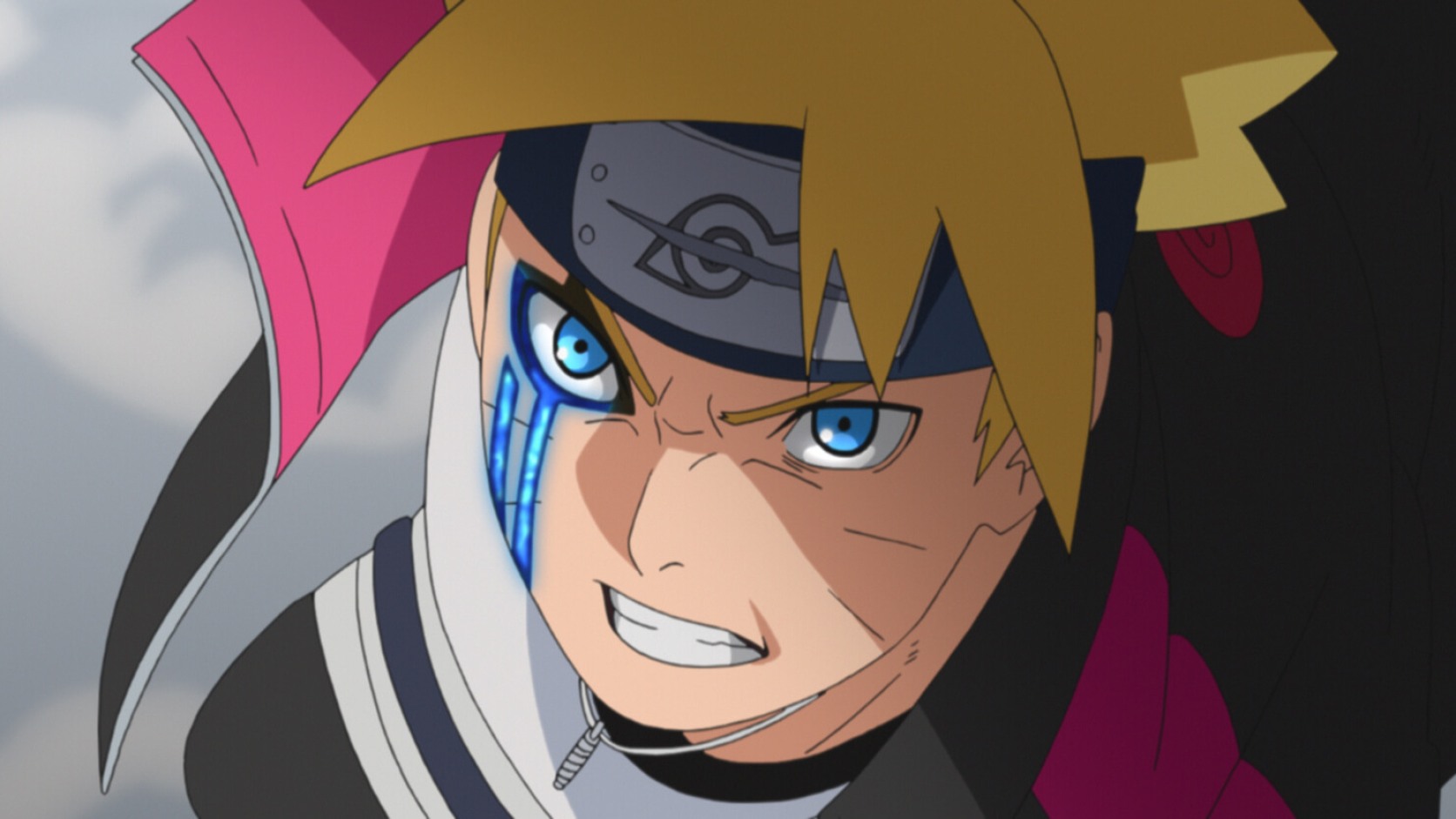
Prepared
Isshiki reaches Konoha with days left to reclaim Kawaki, while Boruto must decide whether Karma makes him part of the defense or Momoshiki makes him another danger.
Series: Boruto: Naruto Next Generations
Episode: 215 · Prepared
Arc: Kawaki: Otsutsuki Awakening
Release: September 12, 2021
Previous: Episode 214 · Predestined Fate
Directory: All 293 Boruto episodes
Bottom line
Boruto Episode 215 turns one ordinary word into an accusation. Konoha says everyone is prepared because alarms sound, civilians move toward shelters, shinobi take positions, and the two strongest men in the village step forward. Boruto stands outside that neat picture carrying Karma, Momoshiki, fear, and knowledge that the coming enemy wants another child’s body. A village can complete every checklist and still leave its children alone with the worst part.
Isshiki arrives with days left to live and one goal: reach Kawaki before the defective vessel fails. Naruto and Sasuke understand the scale of the threat. Boruto understands another piece. His Karma may offer a way to move the battle, but Momoshiki may seize him again. That does not make Boruto reckless for wanting a voice. That makes adult honesty, safeguards, and consent more urgent than another heroic speech.
The title asks a rude question
“Prepared” sounds confident. The episode immediately asks who received preparation, who received orders, and who merely received danger.
Konoha can organize bodies quickly. Emotional readiness, informed choice, and protection from exploitation require more than a siren.
Isshiki brings a deadline into Konoha
Isshiki cannot wait for a cleaner plan. His resurrection through Jigen left him with a body that will fail within days, so Kawaki becomes his only route beyond death.
That deadline gives the defenders a winning condition. Keep Kawaki free until Isshiki dies. Every decision should serve denial, delay, and survival rather than pride.
A desperate enemy is not a weak enemy
Limited time restricts Isshiki’s strategy, but desperation can increase civilian danger. He has no incentive to preserve streets, homes, schools, or trust while searching for Kawaki.
Konoha should treat the countdown as leverage without mistaking leverage for safety. A cornered god still breaks buildings.
Evacuation finally enters the frame
Residents move because the village understands that elite combat will not contain every consequence. That recognition matters.
Fandom discussions often jump straight to Naruto and Sasuke against Isshiki. Civilians do not become background decoration because stronger people occupy the center of the screen.
An alarm is only the beginning
Public warning needs routes, shelters, medical stations, family reunification points, and messages people can verify. Panic grows when residents know danger exists but cannot tell which instruction is real.
Konoha has survived invasions before. Repeated disaster should produce public systems, not only another generation of brave shinobi improvising under smoke.
Shelters need plans for this enemy
Ordinary walls may not stop chakra rods, shrinking attacks, or space-time movement. Emergency planners cannot promise invulnerability.
They can disperse people, reduce crowding, protect communication, stage medical teams, and prevent frightened families from running toward the battlefield. Honest limits create better safety than false certainty.
Kawaki is the target, not the weapon
Strategists describe Kawaki through compatibility, Karma, and vessel status because those facts shape the attack. Isshiki also sees him through those categories.
Konoha must reject the conclusion hidden inside that vocabulary. Kawaki is a child whose body another person claims. Protection begins by centering his right to remain himself.
Hiding Kawaki can still become confinement
A secure location makes tactical sense. Secrecy can also reproduce the cage Kawaki escaped if adults refuse explanation, choice, or human contact.
Safety should not require him to feel owned by a kinder institution. Tell him the plan, hear his knowledge, and make clear that protection is not punishment.
Kawaki knows the hunter
He lived under Jigen’s control, trained inside Kara, observed Isshiki’s habits, and survived years of coercion. That experience does not make him responsible for defeating his abuser.
His knowledge still deserves a place in planning. Ignoring him wastes intelligence and tells him that adults value his body more than his voice.
Information can protect without burdening
Kawaki needs honest updates about the attack, the hiding strategy, and the risks of capture. He does not need every civilian casualty placed on his shoulders.
Adults can share truth while naming responsibility correctly. Isshiki causes the danger. Kawaki’s existence does not.
Naruto faces two jobs at once
The Hokage must defend the entire village. A father must also protect Boruto and the child welcomed into his home.
Those duties do not cancel each other. They expose whether leadership can see individual children while managing a mass emergency.
Naruto cannot promise everyone safety
The scale of Isshiki’s power makes absolute reassurance dishonest. Naruto can promise effort, clear priorities, communication, and refusal to surrender Kawaki.
Children deserve truth calibrated to their understanding. Comfort should not depend on pretending adults control every outcome.
Sasuke reads the battlefield differently
Sasuke brings experience with Otsutsuki abilities, dimensional movement, and enemies who turn one opening into catastrophe. He also understands Boruto’s Karma risk better than most people present.
That knowledge gives him responsibility as a mentor. Training Boruto for danger cannot mean accepting any danger Boruto volunteers to face.
Boruto refuses the spectator chair
He watches adults decide that Naruto and Sasuke will handle the threat while Kawaki remains hidden. From Boruto’s view, his family, village, and brother are all inside the blast radius.
Wanting to act is emotionally honest. Calling that impulse childish would avoid the harder question of whether his power changes the available strategy.
Courage does not erase fear
Boruto fears losing control to Momoshiki again. He also wants to fight. Both statements can be true without one invalidating the other.
Real courage does not require emotional purity. Fear can supply accurate information about danger while commitment supplies a reason to continue.
Momoshiki changes consent
Boruto can consent to personal combat risk. He cannot fully control what Momoshiki may do through his body after consciousness slips.
Any plan using Karma must account for harm to Boruto, allies, civilians, and Kawaki. Consent remains necessary, but consent alone cannot carry every consequence.
A child should not design his own containment
Boruto needs adults to prepare thresholds for withdrawal, signs of takeover, restraint methods, medical response, and a person authorized to intervene.
Asking him to fight without those safeguards would turn bravery into unpaid emergency planning.
The headband carries a promise
Sasuke’s headband represents trust, mentorship, and a standard Boruto wants to meet. Symbols can steady someone before danger.
Symbols can also intensify pressure. Boruto may feel that accepting the headband requires him to prove worth through sacrifice. Sasuke should make survival part of the promise.
Returning alive must count as success
Shinobi culture praises completing missions under impossible conditions. That history can make death look like the cleanest proof of conviction.
Boruto needs another measure. Protect people, preserve choice, create an opening, and come home. A mentor should say the final part aloud.
Preparation includes a stopping rule
Teams often plan how combat begins and leave retreat to instinct. Isshiki punishes hesitation too quickly for vague boundaries.
Naruto, Sasuke, and Boruto need clear conditions for dimensional movement, separation, loss of consciousness, or failed containment. A stopping rule does not weaken resolve. A stopping rule protects judgment.
Karma is power and invasion
The mark can amplify Boruto, absorb techniques, and connect him to Otsutsuki abilities. The same mark carries another consciousness toward control of his body.
Treating Karma as a convenient upgrade would repeat Kara’s logic. Every use belongs beside the cost.
Isshiki and Momoshiki share a worldview
Both Otsutsuki treat human bodies as routes toward their own continuity. Kawaki and Boruto become vessels rather than people in that worldview.
The village must not answer by treating the boys as useful countermeasures. Opposition means rejecting the ownership logic, not borrowing a softer version.
Boruto’s usefulness creates pressure
When one young person has a rare ability, adults can frame participation as voluntary while making refusal feel impossible. Boruto knows what happens if Naruto and Sasuke fail.
An informed choice requires someone to say that the village’s survival is not his personal debt.
Kawaki may hear the same pressure
Even while hidden, Kawaki can believe that surrendering would spare Konoha. Years of abuse taught him to measure his value through what he can absorb for others.
Security planning should anticipate self-sacrifice. Guards must protect him from Isshiki and from the belief that giving himself back would count as gratitude.
Brotherhood raises the stakes
Boruto does not see Kawaki as an abstract strategic asset. He sees someone living in his home, eating at the table, arguing, learning, and becoming family.
That bond explains why an order to stay behind feels impossible. Family motivation deserves respect without automatic permission for combat.
Naruto’s example cuts both ways
Naruto built his life by running toward people everyone else abandoned. Boruto learned that value from him.
Naruto cannot celebrate fearless intervention across his own history and act surprised when his son follows the lesson. He must teach the difference between solidarity and carrying every crisis alone.
The village knows child soldiers too well
Konoha has sent young shinobi into lethal missions for generations. Rank, talent, and wartime need repeatedly turned childhood into a negotiable condition.
Episode 215 should make viewers uncomfortable when adults weigh Boruto’s power. Familiarity does not make the system harmless.
Emergency authority needs limits
An invasion allows leaders to issue fast orders, restrict movement, and control sensitive information. Those powers may save lives.
They also need records, review, and an end point. Crisis should not become a blank check for confinement or secrecy after Isshiki’s deadline passes.
Amado still controls critical knowledge
His predictions about resurrection and Kawaki’s disappearing Karma proved accurate. Now Konoha depends on his estimates of Isshiki’s lifespan, priorities, and abilities.
Confirmed expertise deserves operational weight. One successful forecast does not turn every statement into unquestionable truth.
Ask Amado for assumptions
A countdown matters only when planners understand how the estimate was built. What biological limits apply to Jigen’s body? Which variables could extend Isshiki’s life? What evidence supports the range?
Exact questions reduce the danger of turning scientific confidence into prophecy.
Koji’s absence should stay visible
The village gained information because Kashin Koji forced Isshiki to resurrect. Amado reached safety while Koji remained with the enemy.
Preparation should include an extraction question. A person does not become disposable once his mission produces useful data.
Konoha needs redundant intelligence
Naruto, Sasuke, Amado, Kawaki, and intelligence teams each hold different pieces of the threat model. Losing one person should not erase the plan.
Secure summaries, named backups, and clear command succession matter when the enemy can remove a leader in seconds.
The hospital needs its own battle plan
Mass injury can arrive while elite medical staff face pressure elsewhere. Power, blood supplies, medicine, patient records, and transport routes need protection.
Medical continuity may look less exciting than a Rasengan. Civilians surviving the aftermath will disagree.
Communication must survive destruction
Isshiki can damage towers, roads, and command centers faster than messengers can improvise. Konoha needs multiple ways to send authenticated instructions.
Residents should know which signals mean shelter, relocation, or all clear. Rumors can move faster than shinobi during panic.
Families need reunification rules
Parents and children may begin the alert in different districts. Running across Konoha to find one another can pull civilians directly toward danger.
Designated meeting locations and trusted updates protect families from making desperate guesses.
Disabled residents belong in the evacuation
Fast routes built around able-bodied adults leave elders, injured people, children, and disabled residents dependent on luck. A real village plan assigns assistance before the alarm.
Protection cannot mean saving only those who can sprint like shinobi.
Secrecy should remain narrow
Kawaki’s exact location needs tight protection. Residents still need enough information to shelter safely.
Leaders can separate operational secrecy from public silence. Hiding one address does not require hiding the existence of an attack.
Naruto stepping forward matters
The Hokage meets Isshiki directly instead of treating other shinobi as a disposable first wall. Leadership carries physical responsibility here.
That choice does not mean Naruto should fight without coordination. Personal courage works best when the evacuation, medical, and intelligence systems continue behind him.
Isshiki treats Konoha as an obstacle
He does not arrive with a political demand the village can negotiate in good faith. He wants access to Kawaki’s body before time expires.
Every resident becomes leverage or debris inside that goal. The cruelty comes from how completely he erases other people’s futures to preserve his own.
Mortality explains urgency, not entitlement
Isshiki faces death. Fear of ending can make his violence understandable as motivation.
No fear creates a right to overwrite a child. Mortality is a shared condition, not permission to steal someone else’s remaining life.
Denial can beat domination
Naruto and Sasuke do not need a prettier victory than Isshiki. They need to keep him away from Kawaki until his body fails.
Retreat, misdirection, dimensional removal, and delay may serve that objective better than proving who stands strongest in Konoha’s streets.
Moving the battlefield has a cost
Boruto’s Karma may create an escape from the populated village. That possibility makes his participation strategically relevant.
Using the route could isolate the fighters, eliminate medical support, and leave Boruto closer to Momoshiki’s influence. A solution can relocate risk without reducing risk.
Sasuke should name the trade
If Boruto’s ability becomes essential, Sasuke owes him a direct explanation of the goal, likely consequences, and containment plan.
Mentorship is not permission to speak in riddles when a child’s body becomes part of the battlefield.
Sarada and Mitsuki deserve honest boundaries
Boruto’s teammates may want to follow or may learn afterward that he entered danger without them. Operational secrecy can be necessary during an immediate attack.
Leaders should still prepare truthful communication. Trust fractures when teammates receive only commands and discover the real risk through damage.
Hinata and Himawari are not footnotes
Naruto and Boruto both move toward danger while their family enters the village emergency. Hero stories often leave the people waiting at home outside the moral frame.
Their fear, right to information, and evacuation needs remain part of the cost. Family cannot function only as motivation for male fighters.
The sensory division needs humility
Tracking an Otsutsuki who can conceal, shrink, and move unpredictably may exceed familiar detection methods. Confidence should remain proportional to evidence.
Layered sensors, visual reports, barriers, and civilian sightings create a stronger picture than dependence on one technique.
Every destroyed street changes the mission
Civilian rescue can interrupt pursuit. Fire, collapsed buildings, and blocked medical routes create new priorities while Isshiki keeps moving.
Commanders need authority to divide resources without treating rescue as a distraction from the “real” fight. Saving residents is the reason for the fight.
Preparation should protect records
Konoha holds medical data, mission histories, scientific research, and intelligence on Kawaki and Boruto. Kara has already shown interest in bodies and technology.
Emergency access should not expose those records. Backups and controlled permissions belong beside physical defense.
The episode understands tension before impact
Much of the power comes from waiting for contact while everyone chooses a role. The threat feels larger because preparation reveals what can be lost.
Action earns weight when the audience sees shelters filling, leaders calculating, and children arguing for agency.
Preparedness needs practice before crisis
Konoha cannot invent every evacuation habit after Isshiki appears above the village. Residents need drills, accessible maps, neighborhood leaders, stocked shelters, and clear expectations long before a god-level threat arrives.
The current response reveals impressive speed, but speed from shinobi does not prove readiness for everyone else. A shopkeeper guiding customers, a teacher accounting for children, and a medic reaching a backup clinic all depend on systems rehearsed during quieter days.
Accountability can wait without disappearing
Leaders cannot pause the invasion for a full hearing about Amado, Koji, Karma, or Kara. Immediate defense comes first because people are already in danger.
Delay should come with preservation. Record Amado’s claims, secure evidence, document orders, and name who will review the decisions after the emergency. “We had no time” explains a temporary shortcut. That sentence should never become a permanent grave for uncomfortable questions.
Kawaki needs an advocate inside the room
Security officials may prioritize concealment so completely that Kawaki’s preferences disappear. Naruto cares deeply, but the Hokage also carries village-wide obligations and may leave for combat.
Kawaki needs one adult whose assigned job is explaining decisions, hearing objections, monitoring trauma, and defending his personhood while others discuss tactical value. Advocacy is not softness. Advocacy prevents urgent institutions from confusing control with care.
Boruto needs the same independent voice
Sasuke is his mentor and Naruto is his father, yet both men also need Boruto’s possible dimensional ability. Love does not remove that conflict of interest.
Another trusted adult should ask whether Boruto understands the plan, feels free to object, and knows what happens if Karma destabilizes. A teenager saying yes in front of admired heroes may carry pressure he cannot easily name.
The village owes Kawaki ordinary life
Every security conversation focuses on keeping him alive through the next few days. Survival deserves priority, but protection should point toward a life beyond the countdown.
Kawaki needs school, friends, food without surveillance at the table, sleep without expecting punishment, and decisions that do not begin with vessel compatibility. Defeating Isshiki matters because those ordinary possibilities matter. Otherwise the village saves a body while forgetting the future inside that body.
Heroic secrecy can damage families
Naruto and Boruto may believe withholding details protects Hinata and Himawari from fear. Missing information can produce a different fear, one with no shape and no reliable boundary.
Families do not need operational secrets that could expose Kawaki. They do need truthful warning about absence, danger, communication limits, and where to seek help. Protection should not force loved ones to decode silence while alarms sound.
Survivors will need more than rebuilding
Even a short attack can leave residents with grief, displacement, nightmares, financial loss, and fear of another invasion. Repairing walls will not settle every wound.
Konoha should prepare counselors, housing, food support, records for missing people, and long-term care before the rubble appears. A village famous for endurance can still admit that surviving violence changes people.
The strongest fighters need support too
Naruto and Sasuke carry expectations so large that everyone may treat their readiness as automatic. Both men understand that failure could expose their children, their village, and the wider world.
Clear objectives, backup communication, medical preparation, and permission to choose strategic retreat support them better than worship. Legends remain people. Treating them as infinite resources repeats the same logic used against Boruto and Kawaki at a grander scale.
Readiness should distribute power
When every critical decision depends on Naruto, Sasuke, or Amado, the defense becomes fragile. A single injury, disappearance, or deception can break the entire chain.
Preparation means teams understand their own authority, neighborhoods can act without waiting for the Hokage, and medical leaders can redirect resources as conditions change. Shared responsibility does not diminish Naruto’s leadership. Shared responsibility helps the village survive when one leader cannot answer.
What the episode gets right
Episode 215 refuses to make Boruto’s choice simple. He can help, and Momoshiki can turn that help into disaster. Fear does not disqualify him, and power does not automatically qualify him.
The evacuation also widens the story beyond three legendary fighters. Konoha contains people who cannot punch an Otsutsuki and still deserve the full force of public protection.
Where the episode needs care
The shinobi framework can normalize sending Boruto because danger already exists. That reasoning confuses necessity with fairness.
When adults need a child’s rare power, the writing should keep the coercive pressure visible. A brave yes can coexist with an unjust situation.
RaeRae verdict
Boruto Episode 215 earns four and a half bowls of ramen out of five. The episode puts a clock over Konoha, but the best tension lives inside Boruto. He wants to protect his father, his brother, and his village while fearing that Momoshiki may use his body against every person he loves. That conflict deserves more than applause for bravery.
Prepared should mean more than Naruto and Sasuke standing ready to trade blows. Prepared means civilians have routes, Kawaki receives protection without becoming property, Boruto receives honest choices and safeguards, and leaders know when survival matters more than spectacle. Konoha has the weapons. Episode 215 asks whether Konoha has learned enough to protect the people carrying those weapons.
Before the next episode
Episode 216, “Sacrifice,” carries the confrontation away from preparation and into direct cost. Watch who gets asked to pay, who volunteers, and whether the adults around Boruto remember that willingness does not erase their duty of care.
The battle may become larger. Keep watching the small promises: protect Kawaki, preserve Boruto’s agency, and bring people home.
Sources and lawful viewing
The official Naruto site provides the Episode 215 synopsis and gallery. Crunchyroll carries “Prepared” where regional availability permits. Release and streaming details can vary by country.
Official episode reference: Naruto Official episode guide
Licensed episode route: Crunchyroll licensed series page
After watching, ask what preparation looks like when children carry the village’s most dangerous power. A checklist can move people. Care decides whether those people remain human inside the plan.