
Becoming a Student
Naruto turns chakra into daily support for Kawaki’s prosthetic arm, and Kawaki answers that care by choosing to become a learner instead of somebody else’s vessel.
Series: Boruto: Naruto Next Generations
Episode: 200 · Becoming a Student
Arc: Vessel
Release: May 23, 2021
Previous: Episode 199 · Overload
Directory: All 293 Boruto episodes
Bottom line
Boruto Episode 200 understands that surviving rescue is not the same as receiving care. Kawaki lost an arm protecting Himawari, so Konoha must answer the injury with medicine, adaptive technology, rehabilitation, and choices that belong to him. Naruto offers a prosthetic originally designed for his own chakra and keeps the limb functioning by sharing energy continuously. The gesture makes chakra as connection literal, but the arrangement also creates dependency that adults must manage honestly. Kawaki responds by asking Naruto to teach him ninjutsu. That request matters because Kara trained his body for ownership, while studenthood requires consent, instruction, mistakes, and a future chosen by the learner. Elsewhere, Delta tells Jigen that Boruto also carries Kāma, turning the boys’ shared condition into fresh intelligence for an abuser.
The episode begins after heroism hurts
Kawaki protected Himawari from Delta’s destructive beam and paid with his arm. Episode 200 does not allow that sacrifice to disappear beneath applause. His body carries the consequence after the battlefield clears.
Stories often praise a protective act and skip the medical labor afterward. This episode stays with treatment, adaptation, and the emotional meaning of losing function. Heroism creates obligations for the community that benefited.
Kawaki’s injury is not a moral reward
Losing an arm does not prove that Kawaki is finally good. He was already a person deserving safety before sacrifice. The injury shows a choice under pressure, not a price required for belonging.
Any household that treats pain as an entrance fee has recreated abuse. Naruto’s care must remain unconditional rather than repayment for Himawari’s survival.
Himawari’s safety carries complicated gratitude
The Uzumaki family can feel grateful that Kawaki intervened and horrified by what the intervention cost. Gratitude should never become pressure for him to minimize pain.
Himawari also should not carry guilt for being protected. Delta fired the weapon. Kara created the danger. Responsibility belongs with the adult aggressor and the organization supporting her.
Medical care comes before training
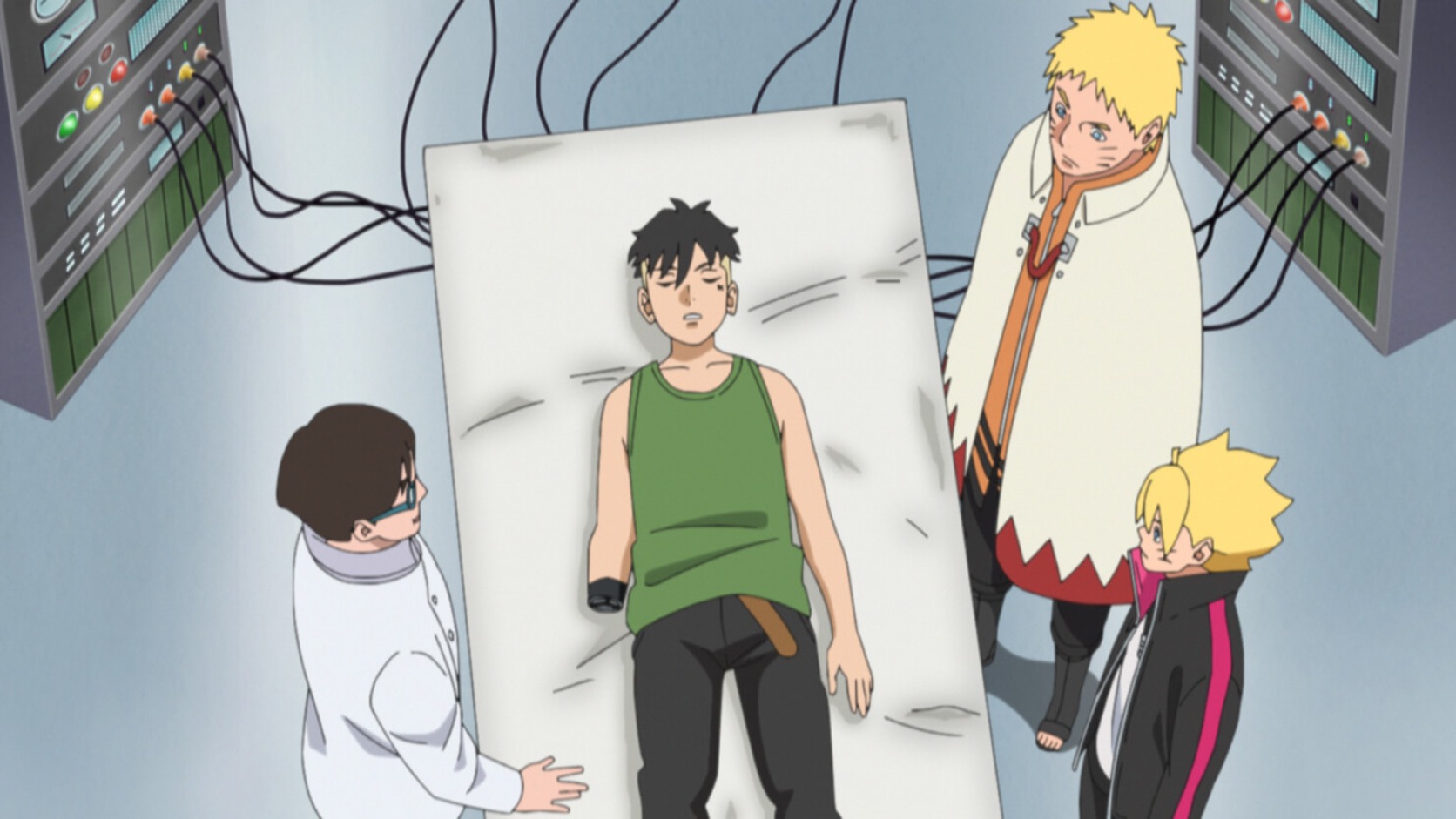
Kawaki’s body needs stabilization and assessment before anyone celebrates future combat. The treatment room places clinicians, equipment, and observation around him.
That order matters. Shinobi culture often rushes injured people toward usefulness. Recovery should center function, comfort, consent, and long-term health before mission readiness.
The hero image keeps care visible
Kawaki lies on a medical bed while Naruto and Boruto remain beside him. Machines and clinicians fill the frame. No attack distracts from the aftermath.
The image treats recovery as part of the story rather than empty space between fights. A body changed by violence deserves narrative attention after the dramatic moment ends.
A missing arm changes daily life
Combat ability is only one consequence. Dressing, eating, bathing, sleeping, balance, pain, and ordinary movement may all change. Kawaki needs support that does not assume his only goal is returning to battle.
Disability cannot be reduced to a temporary plot obstacle. Even with advanced prosthetics, adaptation involves practice, frustration, maintenance, and agency.
The prosthetic was designed for Naruto
Katasuke’s available arm matches Naruto’s chakra and use case, not Kawaki’s body. Offering the device solves an immediate access problem while revealing a gap in personalized care.
Assistive technology works best when built around the user rather than forcing the user around existing hardware. A borrowed solution can help now without becoming the permanent standard.
Naruto offers technology and energy together
The prosthetic cannot move on its own for Kawaki because the device depends on Naruto’s chakra. Naruto supplies that energy through an ongoing connection.
The gesture turns his earlier lesson into physical function. Chakra binds two people not through poetry, but through a hand that can move because another person chooses to keep supporting the circuit.
Shared chakra is intimate support
Energy passing from Naruto into Kawaki crosses bodily boundaries. Consent matters, even when the purpose is generous. Kawaki needs to understand what the connection does, what sensations may occur, and how to stop.
Care becomes ethical when information accompanies help. A gift should not create access the recipient never agreed to grant.
Dependency needs honest language
The arm works only while Naruto supplies chakra. Kawaki may hear that condition as another form of ownership because Kara made survival depend on powerful adults.
Naruto should name the arrangement clearly: temporary support, no debt, no obedience required, and an active plan for a more independent device. Predictability separates assistance from control.
A generous gift can still create pressure
Kawaki may feel unable to disagree with the person powering his arm. Gratitude can distort consent even when Naruto never threatens withdrawal.
Adults must watch for that imbalance. Naruto’s responsibility includes reassuring Kawaki that conflict will not cost him function.
The prosthetic should belong to Kawaki’s choices
He should decide when to wear the arm, how much training feels manageable, what appearance he prefers, and who may examine the device. Medical teams can advise without treating his body as shared property.
Kara already turned modification into compulsory access. Konoha must build the opposite relationship around consent and privacy.
Katasuke’s work has changed meaning
Scientific Ninja Tools once represented Boruto’s shortcut and Ao’s weaponized resentment. Here adaptive technology restores function after injury.
The tool remains morally shaped by use. Science can support dignity when design answers the person rather than a military hierarchy.
Rehabilitation deserves time
Receiving a prosthetic does not produce instant fluency. Kawaki must learn pressure, balance, reach, grip, and the device’s response to Naruto’s chakra.
Frustration should be expected rather than treated as ingratitude. Progress may fluctuate with pain, fatigue, and emotional state.
Pain management should not be invisible
The episode focuses on the remarkable connection, but a severed limb and new interface can involve serious pain. Kawaki deserves assessment that does not assume he will simply endure.
Children trained to hide pain may underreport symptoms. Clinicians need trauma-aware questions, privacy, and repeated opportunities to answer.
Boruto sees the cost of the battle
Standing beside Kawaki’s bed forces Boruto to face what protecting Himawari required. Their rivalry now includes an undeniable act of care.
He does not owe instant forgiveness for every earlier harm. He does owe an honest update to his judgment. Kawaki chose his sister’s life over his own intact body.
Boruto should not turn gratitude into debt
Kawaki’s sacrifice does not mean Boruto must surrender boundaries or call him family on command. Genuine gratitude can coexist with unresolved anger.
Relationships become safer when one heroic act does not buy unlimited forgiveness. Repair still happens through future behavior.
Naruto’s chakra becomes practical parenting
He cannot undo the injury, so he offers part of his daily capacity to restore function. Parenting appears as recurring support rather than one dramatic rescue.
The commitment continues after everyone leaves the treatment room. Naruto must maintain the chakra link while balancing work, sleep, and distance.
Continuous support has a cost
Even Naruto’s reserves are not a reason to treat the arrangement as free. Ongoing chakra use, attention, and proximity create workload.
Konoha should plan backups and a permanent device. A solution depending on one leader becomes fragile for both patient and provider.
Public office complicates private care
The Hokage may need to travel, fight, negotiate, or respond to emergencies. Kawaki’s arm cannot safely depend on Naruto’s uninterrupted availability forever.
Good care separates generosity from sustainable design. Naruto can bridge the gap while the scientific team develops independence.
Kawaki experiences power without punishment
Naruto supplies energy that helps him move rather than forcing him to perform. The connection offers function without demanding combat.
That experience contradicts Kara’s lessons. Power can enter a relationship as support rather than leverage.
Chakra becomes a binding force literally
Episode 196 introduced Naruto’s explanation that chakra connects people. The prosthetic turns the idea into a visible system: Naruto’s chakra crosses distance and activates Kawaki’s hand.
The metaphor works because the bond creates ability. Connection expands what Kawaki can do instead of narrowing his choices.
A bond should increase autonomy
Healthy support may involve temporary dependence, but the direction should move toward greater agency. Naruto’s chakra lets Kawaki participate in daily life while a better solution develops.
Kara’s bond through Kāma moves the opposite way. Greater activation increases another being’s claim over the body.
Kāma and the prosthetic form competing connections
Both systems cross bodily boundaries and transmit power. One was imposed to prepare possession. The other is offered to restore function after consent.
Technology alone cannot explain the moral difference. Purpose, transparency, choice, and the right to stop decide which bond supports personhood.
Kawaki remembers Naruto’s lesson
The shared chakra makes earlier words believable. Naruto did not describe connection as sentimental decoration. He uses his own energy to make another person’s life easier.
Trust grows when language predicts conduct. Kawaki can compare what adults say with what their power actually does.
He asks to learn ninjutsu
Kawaki’s request to become Naruto’s student is one of the arc’s clearest acts of agency. He identifies a skill, chooses a teacher, and imagines a future built through learning.
A vessel waits for activation by someone else. A student participates in growth.
The request belongs to Kawaki
Naruto does not draft him into shinobi training as repayment for care. Kawaki asks. That direction matters because consent cannot be inferred from talent or need.
He may want strength to resist Jigen, protect the household, understand chakra, or become more like Naruto. Multiple motives can coexist.
Naruto must separate mentor and guardian roles
Teaching creates another power relationship on top of housing, supervision, medical support, and chakra dependence. Naruto needs especially clear boundaries.
Kawaki should be able to refuse a lesson without fearing loss of shelter or prosthetic function. Role clarity protects the student’s choice.
Training should start below combat
Foundations such as chakra control, body awareness, breath, stance, and safe disengagement may help more than another intense spar. Kawaki already knows violence.
Education should expand his options rather than polishing only the skills Kara valued.
Studenthood includes the right to fail
Kara punished failure because Kawaki’s worth depended on performance. Naruto’s classroom must make mistakes survivable.
Feedback can be direct without becoming humiliation. A student learns when correction points toward a next attempt instead of threatening identity.
Boruto will have to share his father
Naruto becoming Kawaki’s teacher may reopen Boruto’s old pain about scarce attention. The arrangement needs conversation rather than an assumption that Boruto has outgrown every wound.
Supporting Kawaki should not require Boruto to pretend his history disappeared. Naruto can teach one child while acknowledging what another child missed.
Mentorship is not replacement
Kawaki is not replacing Boruto as Naruto’s son, and Naruto is not replacing every adult Kawaki lost. Relationships do not need to erase previous bonds to become real.
Naming that truth can reduce competition. Care is not a single seat someone must win.
Delta reports Boruto’s Kāma
Away from the treatment room, Delta tells Jigen that Boruto carries the same kind of mark. Information from the family’s crisis travels back to the abuser.
Boruto becomes more valuable to Kara precisely because his body contains something he never requested. The danger widens from Kawaki to both boys.
Jigen’s smile is an ownership calculation
He does not respond to Boruto as a frightened child or developing shinobi. He sees possibility inside the mark.
That reaction mirrors every institution that celebrates access to a gifted body before asking what the person wants. Interest can become predatory when power removes consent.
Kara treats medical facts as intelligence
Boruto’s Kāma status concerns his health and bodily autonomy. Delta turns that fact into operational data for Jigen.
The episode creates a sharp privacy contrast. Konoha uses technology to restore Kawaki’s function. Kara uses information to expand control over another child.
Konoha needs information safeguards
Koji entered the village, Delta reached the training ground, and Kara learned about Boruto. Security cannot stop at a repaired barrier.
Medical records, research findings, household routines, and mission reports all require careful access. Protecting bodies includes protecting information about bodies.
Kawaki may fear another retrieval attempt
Losing an arm does not remove the threat. Delta survived long enough to report, and Jigen remains interested.
Recovery plans should address fear, sleep, safe rooms, response contacts, and the possibility that ordinary sounds now trigger memories of the attack.
Himawari needs follow-up too
Kawaki’s injury happened while protecting her. She may carry guilt or feel responsible for his new disability.
Adults should tell her clearly that Delta caused the harm and Kawaki made his own protective choice. Gratitude does not require self-blame.
Rehabilitation should include the household
Family members need practical guidance about helping without taking over. Kawaki may want assistance sometimes and privacy at other times.
Asking before helping preserves dignity. Accessibility works best when support responds to the person rather than assumptions.
The new arm should not hide the loss
A working prosthetic can tempt everyone to act as though the injury has been erased. Function does not cancel grief, pain, maintenance, or changed body image.
Repair should make room for loss instead of demanding cheerful inspiration.
Disability is not a lesson for other characters
Kawaki’s injury may teach Boruto about sacrifice and Naruto about responsibility, but his body does not exist to improve them.
The story owes him interiority, choices, and a future beyond inspiring the household. Studenthood helps by giving him an active direction.
The episode moves from patient to student
Kawaki begins on a bed surrounded by adults examining damage. He ends by asking for knowledge. The shift returns initiative without rushing medical recovery.
He can be injured and ambitious at the same time. Disability does not remove future goals.
Becoming a student means choosing inheritance
Jigen tried to make Kāma Kawaki’s only inheritance. Naruto offers techniques, ethics, stories, and a relationship that can be questioned.
Kawaki chooses which model he wants to learn. That choice does not erase the mark, but choice begins writing a competing future.
The episode stays quieter after a huge fight
The slower pace lets consequences breathe. Machines, conversations, memory, and a request for training replace explosions.
Quiet does not mean filler. Recovery and consent decide what the battle victory actually preserved.
Episode 201 belongs to the next step
The vase repair and Kurama’s direct conversation with Kawaki come next. Episode 200 ends with the prosthetic bond, Kawaki’s mentorship request, and Jigen’s new interest in Boruto.
Keeping that boundary clear lets “Becoming a Student” own the movement from imposed modification toward chosen education.
A prosthetic fitting is not a one-time handoff
Kawaki will need follow-up for skin condition, pressure points, range of motion, pain, and changes as his body grows. A device that fits today may become unsafe later. Maintenance belongs inside care from the beginning.
Konoha should also train more than one clinician to support the system. Expertise concentrated in a single laboratory creates the same fragility as chakra concentrated in Naruto.
Independent power should be the design goal
Naruto’s chakra bridge solves an immediate problem, but Kawaki deserves an arm that does not stop when the Hokage sleeps, travels, or becomes injured. Independence protects both people.
Research should not use that goal as permission for experimentation without consent. Kawaki can help define requirements and decide which testing he accepts.
The borrowed arm carries Naruto’s history
Naruto’s own prosthetic followed the war and the loss of his original arm in the final clash with Sasuke. Giving Kawaki a related device creates a quiet connection between two people whose bodies carry the aftermath of larger conflicts.
The gesture shares more than chakra. Naruto offers equipment shaped by his recovery without claiming their injuries mean the same thing.
Kawaki can refuse inspiration
People around him may point to Naruto as proof that limb loss never limits greatness. That comparison could encourage him, but encouragement should not become a demand to recover on Naruto’s schedule.
Every disabled person experiences body, pain, technology, and identity differently. Naruto’s example is available, not compulsory.
Student records should protect privacy
If Kawaki begins formal training, instructors may need information about his prosthetic, Kāma, trauma triggers, and safety plan. Need-to-know access should remain narrow.
Curiosity from other students or staff does not create entitlement. The village can prepare teachers without turning his history into gossip.
Training can support rehabilitation without replacing therapy
Chakra exercises may improve coordination, confidence, and understanding of the prosthetic. Ninjutsu cannot address every consequence of captivity, amputation, and fear.
Kawaki deserves medical, psychological, social, and educational support without one discipline pretending to solve the whole person. A strong mentor knows when another professional belongs in the plan.
Naruto’s yes should include conditions for safety
Accepting Kawaki as a student means setting a pace, defining goals, planning for Kāma activation, and deciding how the prosthetic affects practice. Structure communicates seriousness.
Clear expectations can feel safer than unlimited permission. The difference from Kara is that rules are explained, revisable, proportionate, and never tied to Kawaki’s right to remain housed.
RaeRae’s verdict
“Becoming a Student” gives the Delta fight an aftermath worthy of the sacrifice. Kawaki’s missing arm is not treated as a shiny redemption badge. Medical care, assistive technology, ongoing support, and future training all become responsibilities Konoha must carry. Naruto’s chakra-powered prosthetic is tender because connection restores function, but the arrangement also needs a path toward independence so generosity never becomes another cage.
Kawaki’s request to learn ninjutsu is the emotional victory. Kara made his body useful without allowing him to become a learner. Naruto can give him something Jigen never offered: the right to ask why, fail safely, choose what strength means, and grow toward a future that belongs to him. Delta’s report reminds us that Kara still sees both boys as opportunities. The difference now is that Kawaki has chosen a teacher who sees a student.
Sources and lawful viewing
Official episode reference: Naruto Official episode guide
Licensed episode route: Crunchyroll licensed series page
The official guide identifies Episode 200 as “Becoming a Student” and summarizes Kawaki receiving Naruto’s chakra-powered prosthetic after losing an arm, asking Naruto to teach him ninjutsu, and Delta reporting Boruto’s Kāma to Jigen. Crunchyroll lists the licensed episode with a May 23, 2021 release date. Availability and language options can vary by region.