
Overload
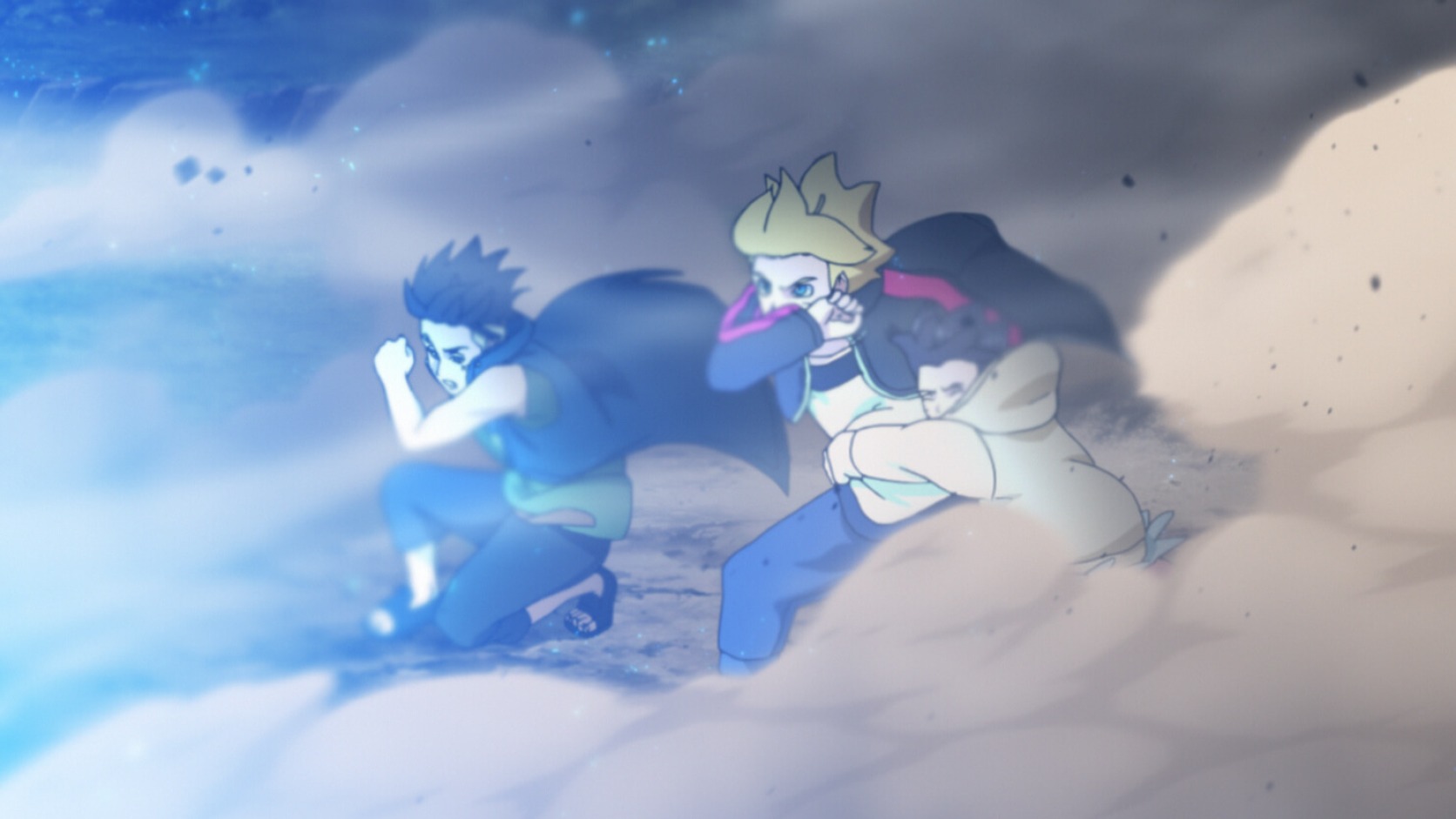
Naruto finds the ceiling in Delta’s perfect defense while Boruto and Kawaki absorb the battle’s human cost by shielding Himawari together.
Series: Boruto: Naruto Next Generations
Episode: 199 · Overload
Arc: Vessel
Release: May 16, 2021
Previous: Episode 198 · Monsters
Directory: All 293 Boruto episodes
Bottom line
Boruto Episode 199 makes overload a question of systems, not a contest over who can shout the loudest. Delta can absorb ninjutsu through scientific technology built into her eyes, so Naruto answers by feeding that system more chakra than the storage can safely contain. The strategy is smart, controlled, and terrifying. Behind him, Boruto and Kawaki shield Himawari from a battle whose shockwaves keep reaching the children no matter how carefully Naruto tries to manage the field. The episode celebrates tactical intelligence while exposing the failure beneath the spectacle: one powerful parent is still carrying evacuation, combat, intelligence, and child protection alone. Winning the exchange does not make that structure safe.
The title belongs to every system on the field
Delta’s absorption mechanism faces physical overload. Naruto carries more simultaneous responsibilities than one person should manage. Boruto and Kawaki absorb information, fear, and force while trying to protect Himawari. Konoha’s security system has already failed under a sophisticated intrusion.
“Overload” therefore describes capacity pushed past design. The episode asks what happens when strength becomes an excuse to keep adding demands until a body, weapon, family, or institution breaks.
Delta’s absorption looks like an absolute defense
Ninjutsu disappears into her eyes before force can reach her body. Against a shinobi culture built around chakra techniques, the ability appears to cancel the basic language of combat.
Absolute defenses often depend on hidden conditions. Delta can absorb energy, but absorption requires somewhere for that energy to go. Naruto stops treating the visible effect as magic and starts asking what mechanism supports the effect.
Naruto studies while fighting
He watches timing, direction, recovery, and Delta’s confidence. Every exchange becomes data. His intelligence is practical rather than theatrical because analysis happens while he also monitors the children.
The best fighters do not merely possess more power. They revise assumptions under pressure. Naruto’s years of experience show through his willingness to test rather than panic.
Raw force is not his first answer
Naruto could open with maximum destruction, but the training ground contains Boruto, Himawari, and Kawaki. The village lies beyond the trees. Restraint shapes every option.
That constraint makes his later escalation meaningful. Greater force comes after he identifies a narrow purpose, not because anger deserves a bigger visual.
Delta wants him emotionally careless
She taunts, threatens, and targets the relationships behind Naruto’s restraint. A furious parent may reveal an opening while trying to end danger quickly.
Naruto’s calm is protective labor. He feels rage without allowing Delta to select his response. Emotional control is not emotional absence.
Her body converts violence into capacity
Delta’s modifications let her receive incoming chakra, store energy, regenerate, and attack through systems ordinary bodies do not have. Every enhancement creates dependencies and limits.
Kara presents modification as superiority, but a body designed as a weapons platform still operates within material conditions. Engineering can redistribute vulnerability, never abolish vulnerability.
Naruto attacks the design assumption
Delta’s system assumes incoming energy will remain within a manageable range. Naruto recognizes that his chakra reserves can exceed the expected ceiling.
The strategy does not negate science. The strategy uses science. Capacity, heat, storage, throughput, and failure remain relevant even when the visuals look mythic.
The Giant Rasengan becomes a stress test
Naruto launches a massive Rasengan knowing Delta will absorb the technique. The attack targets her storage architecture rather than her skin.
That choice turns an apparent failure into the plan. Absorption only protects Delta if she can process everything offered. Naruto makes defense perform until performance becomes failure.
More power is useful because the purpose is precise
“Bigger attack” can be lazy storytelling when size substitutes for strategy. Here scale answers a technical question. Naruto needs enough chakra to exceed Delta’s capacity.
Purpose distinguishes controlled escalation from spectacle. He is not proving masculinity or rank. He is forcing a weapon system to reveal its limit.
Delta’s confidence becomes a vulnerability
She trusts technology that has worked against every normal amount of ninjutsu. Success hardens into assumption.
Overconfidence is not merely personality. Institutions create overconfidence when tests never include exceptional loads. Kara built an advanced tool and still appears to have underestimated the range of power outside its laboratories.
No defense deserves blind faith
Konoha trusted a sensory barrier that Koji bypassed. Delta trusts absorption that Naruto can overload. Both failures come from treating one protective layer as final.
Reliable safety uses redundancy, monitoring, and honest failure testing. A perfect barrier exists only until someone finds the condition designers ignored.
The children remain too close
Boruto, Kawaki, and Himawari endure shockwaves from attacks exchanged nearby. Their position turns every escalation into a protection problem.
Naruto may be able to control his aim, but Delta has no duty of care. A plan that depends on the attacker respecting boundaries is not a complete plan.
Kawaki shields Himawari
The boy who nearly attacked a child after being startled now places himself between Himawari and incoming force. That contrast shows growth without pretending his earlier reflex vanished.
Protection becomes a choice made under pressure. Kawaki does not need a speech about belonging because his body answers where he wants danger to stop.
Boruto shields her too
Boruto joins Kawaki around Himawari. The boys who were fighting each other moments earlier coordinate around a shared responsibility.
Sibling care becomes the practical bridge between them. They may disagree about the vase, Kāma, and trust. Neither disagrees that Himawari should be protected.
Himawari should not need two child shields
Their courage matters, but the image also indicts the emergency structure. Two children are improvising protection for a younger child during an S-rank confrontation.
Heroic behavior should never prevent adults from asking why children had to become the barrier. Praise and system review can coexist.
Kawaki learns belonging through responsibility
He is not protecting Himawari to earn food or shelter. Naruto’s care has not been presented as a debt. His action can therefore become genuine responsibility rather than coerced repayment.
Chosen contribution feels different from usefulness demanded by captors. Kawaki decides whose safety matters to him.
Boruto sees Kawaki act like family
Words about gratitude would not persuade Boruto as strongly as behavior around Himawari. Kawaki’s position provides evidence that his concern extends beyond himself.
Trust grows through observable choices. Boruto can remain cautious while updating his judgment. Protecting his sister does not erase every conflict, but refusing to notice would be dishonest.
The hero image centers the consequence
The canonical frame shows Boruto and Kawaki bent around Himawari as force passes over them. Naruto and Delta are outside the image, yet their battle fills every inch.
That composition keeps the article focused on who absorbs the cost of adult power. The biggest technique is not the only story.
Delta’s beams deny ordinary healing
Her eye attacks can negate regenerative power, threatening a fighter who normally survives enormous damage. The weapon targets recovery itself.
That design carries a brutal philosophy. Harm becomes more valuable when the victim cannot repair. Kara engineers attacks around permanent consequence.
Regeneration has shaped Naruto’s risk calculations
Naruto’s healing and durability allow strategies that would kill another shinobi. Delta removes that safety margin.
Experienced fighters can become vulnerable when an opponent disables the system underneath familiar confidence. Adaptation requires recognizing that yesterday’s survivable risk may be fatal today.
Kawaki’s warnings remain essential
He understands Delta’s technology and cruelty from direct exposure. Naruto’s power does not replace that intelligence.
Listening to Kawaki also redistributes agency. The person Kara calls an object becomes a knowledgeable participant in his own protection.
Expertise born from abuse carries a cost
Kawaki knows which weapons to fear because he lived near Kara’s experiments. The village benefits from knowledge he never should have needed.
Adults must not romanticize that expertise as a gift from hardship. Useful information can emerge from trauma while the trauma remains an injustice.
Delta treats capacity as identity
Her confidence rests on being stronger, faster, harder to injure, and more technologically advanced than ordinary opponents. When Naruto targets a limit, he threatens both the weapon and the self-image built around the weapon.
A person reduced to performance may experience technical failure as personal annihilation. Kara does not seem to offer identities outside usefulness.
Naruto refuses the performance trap
He does not need Delta to admit his superiority. His goal is protecting the children and ending her capacity to take Kawaki.
Mission clarity prevents ego from extending the fight. Victory is safety, not applause from an enemy.
Overloading a body raises ethical questions
Delta chose the attack and remains responsible for the threat. Naruto still directs enormous energy into a system integrated with her body.
Necessary force should remain proportionate to stopping danger. The episode frames the tactic as a response to an active lethal threat, not punishment for belonging to Kara.
Scientific modification complicates consent
Viewers do not yet know every condition under which Delta received her enhancements. She appears to embrace their power, but institutional pressure can shape what counts as a choice.
Uncertainty about her history does not excuse targeting children. Uncertainty should stop fandom from assuming modification makes suffering deserved.
The battle exposes unequal care obligations
Naruto must protect bystanders, preserve the village, learn Delta’s tools, and restrain his own power. Delta can attack any vulnerability because Kara’s mission treats collateral damage as useful pressure.
Ethical fighters carry more constraints. Those constraints can look like disadvantage, yet they define why victory matters.
Restraint requires resources
Naruto’s extraordinary chakra gives him options other defenders would lack. Moral expectations must therefore be paired with training, staffing, and tools that make restraint possible.
Telling ordinary shinobi to protect everyone without providing capacity would convert ethics into blame. Systems need to fund the behavior they demand.
Konoha needs an evacuation doctrine
The village should not improvise child removal after an Inner reaches a training ground. Routes, signals, protected shelters, and assigned responders should already exist.
Naruto’s individual competence cannot substitute for a plan available when he is absent, injured, or himself the target.
The sensory failure needs a technical review
Koji’s recognized chakra crossed the barrier, and Delta followed through direct force. Different methods defeated different assumptions.
Review should ask how alerts were categorized, who received them, what response time followed, and why the threat reached the Hokage’s family before backup controlled the perimeter.
Backup is conspicuously absent
A battle at this scale should draw elite response, medical preparation, and civilian containment. Naruto appears isolated because the story centers his fight.
The dramatic choice also reveals institutional dependence on him. A village that waits for one hero to solve every crisis has built overload into governance.
Hokage labor has no safe ceiling
Naruto is leader, fighter, father, intelligence analyst, jailer, protector, and diplomatic decision-maker around Kawaki. Each role could fill a team.
His strength encourages everyone to add another duty. Exceptional workers often become the excuse for understaffed systems until one failure harms everyone.
Boruto inherits the cost of that structure
He watches his father absorb public danger while trying to protect private family. The scene may reinforce Boruto’s pride and his fear that Hokage duty always reaches home.
Children of public figures should not have to treat lethal intrusion as the price of service. Institutional protection must include families without turning them into symbols.
Kawaki sees Naruto risk real harm
Kara offered protection when Kawaki remained useful. Naruto fights even though sheltering him brings danger.
That difference gives Kawaki another piece of evidence: care does not disappear when the cost rises. He may still expect a later bill, but the moment contradicts his history.
Delta cannot absorb relationship
Her eyes can consume chakra, yet she cannot process why Boruto and Kawaki protect Himawari or why Naruto protects Kawaki. Those choices fall outside Kara’s model of control.
The emotional limit mirrors the technical limit. Delta understands intake, storage, and force. Mutual care exceeds the categories she trusts.
The fight remains unfinished
Naruto’s overload strategy damages Delta’s advantage, but the episode does not close every threat. Her weapons, regeneration, and willingness to target children remain in play.
Episode 200 carries the immediate consequence forward. This article stays with the capacity contest and the family’s exposure during that escalation.
Strategy should not erase fear
Naruto’s plan is satisfying because he turns Delta’s defense against her. Tactical pleasure can coexist with attention to Himawari’s terror and Kawaki’s history.
Fandom does not need to choose between enjoying the fight and examining who bears the risk. A strong episode supports both readings.
Winning data needs documentation
Konoha should record how Delta absorbs chakra, signs of capacity saturation, the function of her beams, observed recovery, and Kawaki’s warnings. Knowledge must survive beyond Naruto’s memory.
Shared records prevent the next defender from rebuilding the lesson under fire. Security improves when information becomes institutional rather than heroic folklore.
Kawaki’s contribution deserves consent and credit
His intelligence helps Naruto survive the encounter. Any debrief should acknowledge that contribution without exposing more of Kawaki’s history than necessary.
Credit supports agency. Confidentiality supports safety. Neither should depend on the child performing gratitude.
Himawari deserves an aftermath centered on her
After immediate danger, adults should ask what she saw, what she needs, and whether she feels safe returning to ordinary spaces. A quiet child can carry fear without disrupting anyone.
Her recovery cannot be reduced to proving Kawaki belongs. She is a person affected by Kara’s attack, not supporting evidence in someone else’s arc.
Boruto and Kawaki need permission to be scared
Both boys act protectively, which can hide their own fear. Competence during crisis does not cancel emotional impact.
They should not have to maintain a heroic performance after the fight. Processing fear can strengthen future judgment and reduce reckless attempts to regain control.
The episode critiques infinite capacity
Delta fails because absorption has a ceiling. Naruto’s family and office also have ceilings, even if the story often treats his endurance as endless.
Every system needs a limit, a release valve, and people willing to stop adding load. Strength without boundary becomes a route to collapse.
Naruto’s reserves are history, not a cheat code
His enormous chakra comes from Uzumaki vitality, years of training, partnership with Kurama, and experience surviving systems that tried to use the Nine Tails through him. The reserve carries biography.
Calling the solution effortless would erase that history. Naruto can overwhelm Delta’s capacity because he spent a lifetime learning how to live with power once imposed on his body.
Kurama’s cooperation changes the technique
Naruto does not simply extract energy from a captive beast. Their partnership allows controlled access to reserves that once exploded through anger and isolation.
That history contrasts with Delta’s relationship to technology. Naruto’s greatest capacity comes from negotiated trust between two beings. Kara’s capacity comes from engineered function under hierarchy.
Absorption cannot replace judgment
Delta’s eyes solve one tactical problem so effectively that she leans on the answer even after Naruto reveals a different scale. Tools become dangerous when users stop evaluating context.
Boruto learned a related lesson during the Chūnin Exams. Technology can extend ability, but convenience without understanding makes the user dependent on conditions they cannot control.
A capacity limit should be visible to the user
Responsible engineering includes warnings, monitoring, and safe failure modes. Delta’s system appears to reach dangerous saturation only after Naruto commits an extraordinary volume of chakra.
Kara may consider bodily damage acceptable because members themselves are replaceable assets. A design that protects the mission while sacrificing the user reveals institutional values more clearly than any slogan.
The field needs a perimeter after this battle
Even if Delta falls, Koji remains somewhere inside Konoha and Kara now knows enough to attempt another approach. Immediate victory cannot become permission to relax.
Responders should secure the children, search for secondary threats, preserve evidence, and prevent curious civilians from entering damaged ground. Aftermath management belongs to the battle plan.
Family courage cannot become expected labor
Boruto and Kawaki protect Himawari because they care. Adults should honor that choice without building future plans around the assumption that the boys will always absorb danger first.
Children who perform well during crisis are often handed more crisis. Their competence should earn support, rest, and a safer structure, not promotion into unpaid emergency services.
The most important overload is preventable
Delta’s eye capacity is a fixed technical weakness Naruto can exploit. The overload placed on the Uzumaki household comes from decisions that can change. Konoha can add responders, repair detection, improve evacuation, and distribute Kawaki’s protection across trained adults.
Calling Naruto uniquely capable should begin resource planning, not end the conversation. A village that loves its hero should stop making him the only wall.
Every person behind that wall needs an assigned route to safety, and every defender beside that wall needs enough information to act before another attacker reaches the children. Prepared support is how admiration becomes actual care.
RaeRae’s verdict
“Overload” delivers a clever combat answer and a sharper family image. Naruto defeats the fantasy of perfect absorption by treating Delta’s technology as a system with capacity. Boruto and Kawaki answer the battle’s human cost by folding themselves around Himawari. One strategy protects the field. The other protects the person most likely to disappear beneath spectacle.
The episode also leaves an uncomfortable truth. Children remain close enough to become shields because Konoha’s defenses and response layers did not move fast enough. Naruto can compensate through extraordinary power, but extraordinary power is not a public safety plan. Overload becomes the warning running beneath the victory: Delta’s eyes can take only so much chakra, and one family can carry only so much danger before protection needs to become institutional.
Sources and lawful viewing
Official episode reference: Naruto Official episode guide
Licensed episode route: Crunchyroll licensed series page
The official guide identifies Episode 199 as “Overload” and summarizes Naruto continuing his fight against Delta, her destructive beams and ninjutsu absorption, and Naruto answering with a Giant Rasengan. Crunchyroll lists the licensed episode with a May 16, 2021 release date. Availability and language options can vary by region.