
Bickslow
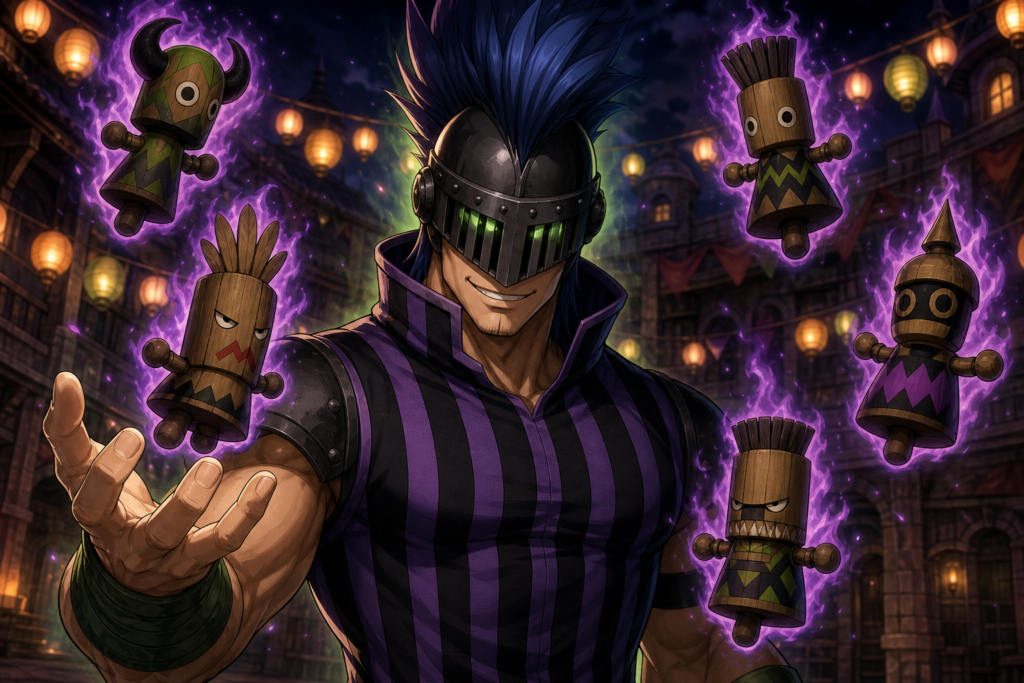
CVM Sekai character profile
Bottom line
Bickslow has five soul-animated doll vessels, a glowing visor and enough theatrical energy to make subtlety file a restraining order. He is still making choices. Bickslow’s Seith Magic moves souls into nonhuman objects and lets him direct five recurring doll vessels. Figure Eyes is a separate ability that can control another person’s soul through exposed eye contact under defined conditions. During the Battle of Fairy Tail, he willingly supports Laxus‘s coercive takeover and attacks Lucy and Loke.
The visor, the dolls and the wild performance do not reduce his agency. Comedy is not diminished capacity. His later defense of Fairy Tail matters because later conduct matters. His defeat does not function as an apology. Tempester’s attack does not become moral repayment. Whiteout in 100 Years Quest does not count as karma.
Bickslow’s profile works when we treat him as a competent, strange adult whose soul magic raises real questions about vessels, control and consent.
Who Bickslow is
Bickslow is a Fairy Tail mage and member of the Raijinshū, also localized as the Thunder God Tribe. He serves alongside Freed Justine and Evergreen under Laxus Dreyar.
His primary magic is Seith Magic, also described through Human Possession terminology in licensed and translated discussion. He places souls into object vessels and commands a recurring set of five small nonhuman dolls. He also possesses Figure Eyes, a separate eye-based control technique. His visor restrains access and prevents casual eye contact from activating the ability.
His Japanese performer is Yoshihisa Kawahara. This profile keeps Japanese performance scope only. Public official pages reviewed for this package do not expose a stable full vital sheet or a directly indexed exact manga debut entry. This profile does not import unsourced age, height or first-chapter numbers.
Name, design and the five-count rule
TV Tokyo’s official cast list identifies him as ビックスロー, rendered Bickslow in licensed English material. His design announces the contradiction before the story explains it. A blue-black mohawk crest, face-covering visor, striped black-and-purple clothing and green wraps make him look like the guild member most likely to arrive with his own sound effects.
Then the magic gets precise. Bickslow operates with five recurring doll vessels. Five matters. The group is not a decorative swarm that changes count whenever the frame gets busy. Each vessel supports the distributed combat system, and each separate soul flame helps the audience read who is active.
The dolls are small nonhuman objects, not trapped children. His habit of calling them babies is characterization, not a biological claim. That language shows attachment and theatrical affection while the visual design keeps the vessels clearly artificial.
The visor performs three jobs. The visor creates a memorable silhouette, limits casual eye contact and signals when Figure Eyes becomes a live threat. Fashion, safety mechanism and tactical warning all occupy the same object.
That is strong character design because nothing important has to stop the story for a lecture. The audience sees covered eyes, five moving vessels and a man who treats battle like stage work. We already understand that control, count and performance matter.
Soul magic without fake horror
Soul-based magic can tempt a profile into cheap horror language. Bickslow does not need it. The unsettling part is not a made-up claim that he steals dead children or resurrects anybody he wants. The unsettling part is how calmly his magic distributes agency across prepared bodies while Figure Eyes threatens to take agency from a living opponent. Those are two different ethical problems.
Object vessels raise questions about identity, continuity and replacement. If one body breaks and the soul moves, what counts as the continuing unit? Figure Eyes raises the sharper consent problem because another person becomes the target of control. The series does not answer every metaphysical question. The series gives enough mechanics to make the distinction matter in combat.
Bickslow’s comedy also changes the temperature without removing the stakes. He can be funny because his dolls bounce, chant and move with personality. He can still be dangerous because a joke-shaped entrance does not make soul control harmless. Fans deserve both readings at once.
Calling him comic relief only throws away the mechanics. Calling him a horror villain only throws away the guild life, team chemistry and later defense. He is a supporting mage whose weirdness is deliberate, whose control powers require boundaries and whose moral record cannot hide behind presentation.
Five dolls, not five children
Bickslow calls his dolls his “babies.” They are nonhuman vessels. The wording matters because loose summaries sometimes make the magic sound as though he commands trapped children. The canonical visual system uses small doll-like objects animated through souls. The locked hero preserves exactly five distinct wooden vessels and five separate soul flames.
The recurring formation stays at five dolls, while exact vessel bodies and formations can vary. This profile does not manufacture a licensed doll-name roster where the public official sources do not provide one. That flexibility is part of the magic.
The soul is the continuing magical unit. The object is a vessel that can be destroyed, replaced or displaced. Bickslow therefore fights through distributed bodies. An opponent who destroys one doll can reduce a formation without necessarily defeating the mage. An opponent who reaches Bickslow may interrupt command at the source. The system is tactical, not random decoration.
Seith Magic and Human Possession
Seith Magic involves control over souls in relation to object vessels. Bickslow uses it to animate and direct his dolls. The magic supports ranged attacks, formations and movement from multiple angles.
Seith Magic should not be inflated into unrestricted necromancy. The series does not establish that Bickslow can seize any dead person, restore life or command every soul without conditions. His recurring combat system centers on prepared nonhuman vessels.
The distinction protects the actual magic from sensationalism. Its practical strengths include distributed attacks, unusual angles, coordinated formations and the ability to continue pressure while Bickslow moves separately.
Its limits include vessel destruction, separation, command range, magical reserves and the vulnerability of a formation whose pattern an opponent learns. Five dolls create options. They do not create six Bickslows.
Figure Eyes is a separate control system
Figure Eyes allows Bickslow to control another person’s soul through exposed eye contact under defined conditions. The visor matters because it controls access.
That visual cue tells the audience the ability is not always operating. Removing or shifting the restraint creates danger. Avoiding his gaze creates counterplay. Figure Eyes should not be merged with Seith Magic merely because both involve souls.
Seith Magic animates prepared object vessels. Figure Eyes targets another person through visual contact. The ethical stakes differ too. Doll animation uses a combat system Bickslow maintains. Figure Eyes attempts to override another person’s agency. The second power makes consent central.
The consent issue also explains why the visor is more than fashion. The visor is a safety mechanism, tactical reveal and reminder that control magic requires restraint outside battle.
How opponents create counterplay
Bickslow’s powers look overwhelming until the conditions become legible. Against the dolls, an opponent can break formation, destroy vessels, force separation or pressure Bickslow before coordinated attacks settle into rhythm. The five bodies multiply angles, not magical reserves without limit.
Against Figure Eyes, visual contact is the danger. The visor makes the condition readable and gives opponents a practical choice: manage the gaze, interrupt the reveal or attack through a partner whose position changes the line of sight.
That clarity is important. Control magic becomes dramatically useless when the rule changes after every counter. Bickslow stays interesting because his advantages and vulnerabilities belong to the same design.
Preparation favors him. Confined spaces can give the dolls multiple attack paths. Surprise lets theatrical noise hide tactical placement. Team support from Freed and Evergreen can restrict movement until the eye-contact threat becomes harder to avoid.
Isolation hurts him. Broken vessels reduce coverage. An opponent who understands the count can watch for missing angles. Direct pressure makes it harder to conduct five moving pieces while protecting his own body.
This is also why raw power rankings miss the point. A stronger mage can still lose to a condition they do not understand. A less destructive fighter can win by reading the formation faster. Bickslow is not secretly one of Fairy Tail’s limitless reality warpers. He is a specialist. The battlefield gets dangerous when everybody else treats the weird guy and his five dolls like background decoration.
The Raijinshū as a real team
Bickslow, Freed and Evergreen form the Raijinshū under Laxus. Their abilities complement one another. Freed writes barriers and effects. Evergreen controls through Stone Eyes and uses Fairy Magic. Bickslow distributes soul-based attacks and threatens direct control through Figure Eyes. Bickslow’s irreverence contrasts with Freed’s formality and Evergreen’s pride. That contrast should not turn him into comic furniture.
He understands formations, timing and team pressure. The theatrical behavior can distract opponents, but it does not mean he lacks tactical judgment. His performance also does not mean he lacks moral judgment. During the Battle of Fairy Tail, all three choose to support Laxus. Different personalities do not create different levels of consent by themselves.
Battle of Fairy Tail: willing participation
Bickslow willingly joins Laxus’s coercive takeover. He attacks Lucy and fights Loke after Leo’s identity and guild loyalty are established. The event is not a harmless internal tournament. Guild members are trapped, hostages are petrified and Magnolia becomes the field for Laxus’s power struggle. Bickslow participates because of loyalty and confidence in the plan.
Those motives explain his position. They do not erase agency. The fight with Lucy and Loke also makes the soul theme unusually precise. Lucy is a Celestial Spirit mage whose relationships depend on contracts with spirits. Loke is Leo, a spirit who has built a human-facing guild identity.
Bickslow’s magic works through souls and vessels. Loke is not one of his prepared dolls. The profile should preserve the exact mechanical interaction from the licensed scene instead of guessing that one soul system automatically controls another. Magic categories are not a buffet where the word “soul” means every rule is interchangeable.
Lucy and Loke retain agency
Lucy is a target during the coup. Her Celestial Spirit partnerships resist Bickslow’s attempt to control the fight. Loke acts from guild loyalty and his own will.
The encounter should not be summarized as “Bickslow loses to Loke” with Lucy removed. Lucy brings the contract relationship and battlefield decisions that make Loke’s presence possible. Loke brings Regulus, close combat and personal investment in Fairy Tail.
Bickslow’s defeat reveals limits in both doll coordination and Figure Eyes against opponents who can avoid, interrupt or counter his conditions. The victory belongs to the people resisting control, not to an abstract compatibility chart.
Defeat is not repair
Losing does not make Bickslow accountable. Defeat leaves him defeated. Repair begins later through conduct. Laxus is expelled. Bickslow, Freed and Evergreen remain in Fairy Tail. They have to live among people they helped trap and attack.
The story does not give Bickslow a long formal apology arc. The story gives him continuing membership, later defense and team loyalty under changed conditions. That evidence matters, but it should not be treated as instant absolution.
Community repair often looks like repeated ordinary behavior. The person shows up differently. The people harmed are not required to forget. Fairy Tail’s forgiveness is strongest when it leaves room for memory.
Tenrou Island and ensemble defense
Bickslow participates in the Tenrou Island period and works with Freed during the Grimoire Heart assault. The broader role is clear: Bickslow and Freed use coordinated power to defend the guild. That is a team stand, not permission to hand Bickslow somebody else’s decisive action. That reversal matters as evidence of changed conduct. The reversal does not transform the Battle of Fairy Tail into necessary training for heroism.
Fairy Sphere later suspends Bickslow and the Tenrou group outside ordinary time for seven years. They return to a guild that has declined while others carried it. Survival protects the team. Survival does not make them the only people whose loyalty counts.
Grand Magic Games era
Bickslow continues as a Fairy Tail mage during the Grand Magic Games period. His doll system is visually suited to public spectacle, but usefulness does not depend on arena time. Distributed attack, surveillance and formation pressure can support missions outside a formal match. The profile should resist promoting every appearance into a major victory. Supporting character does not mean failed main character. The phrase means the narrative assigns a different scale.
Tartaros and Tempester
Tempester’s attack and anti-magic particles critically affect Bickslow, Freed and Evergreen. Laxus bears severe physical cost while protecting them. The sequence shows interdependence. The three are not invulnerable attendants orbiting Laxus. They become people he chooses to protect at cost to himself. That development gives later loyalty moral substance.
Later loyalty is not payment for the coup. Suffering does not erase earlier harm. Bickslow being poisoned or endangered is not the universe balancing a spreadsheet. The story works better when the event is allowed to be victimization and relationship evidence at the same time.
Blue Pegasus during dissolution
After Fairy Tail dissolves, Bickslow and related teammates spend time connected with Blue Pegasus. Blue Pegasus is a real guild, not a holding room for Fairy Tail jokes. Its culture differs, but temporary affiliation still involves labor, colleagues and institutional shelter. Bickslow’s Fairy Tail identity can remain emotionally important while he works elsewhere. Displacement does not require pretending the temporary home is fake.
Alvarez and tactical scale
Bickslow participates in the Alvarez conflict through doll support and ensemble defense. The war’s scale includes continent-level magic and a very large cast. The profile should not invent a major solo victory because his page needs another heading.
His tactical strengths remain real: multiple angles, coordination, soul-vessel mobility and the threat of Figure Eyes. Accuracy is not disrespect. Bickslow contributes through ensemble defense and soul-vessel tactics; giving him somebody else’s finishing blow would be.
Bickslow in 100 Years Quest (spoilers)
During the Aldoron conflict, Whiteout compromises Fairy Tail members and turns allies against one another. The official Episode 10 summary states that Gray faces the Raijinshū.
Bickslow’s controlled role creates a direct contrast with Figure Eyes. He has a technique that can override another person’s soul through eye contact. Under Whiteout, his own agency is compromised.
The situations are not moral equivalents. During the Battle of Fairy Tail, Bickslow chooses coercion. Under Whiteout, coercion is done to him. Calling the second event karma would treat victimization as moral repayment. A better analysis uses the parallel to clarify consent. His later sequel role remains proportional. The story does not turn him into a hidden Dragon God or Diabolos specialist.
Relationship atlas
Laxus Dreyar
Leader and friend whose coup Bickslow chooses to support. Later loyalty matters only alongside changed conduct and independent judgment. Their friendship improves when loyalty stops requiring participation in coercion.
Freed Justine
Raijinshū leader and tactical partner. Freed’s formality contrasts with Bickslow’s performance, but both share responsibility for the coup. Different personalities do not create different standards for consent.
Evergreen
Teammate with distinct magic and agency. She is not a decorative third member or interchangeable control specialist. Their later mutual protection matters because both must make choices beyond the old team hierarchy.
Loke and Lucy
Battle of Fairy Tail opponents whose spirit contracts and personal agency resist Bickslow’s soul-control system. The victory belongs to the people defending their choices, not merely to a favorable magic matchup.
Fairy Tail
Home, accountability community and institution Bickslow later defends after helping violate it. Membership creates repeated opportunities for repair while keeping the original harm inside living memory.
Blue Pegasus
Temporary workplace during dissolution. The connection deserves factual treatment rather than parody. A temporary home can matter without replacing Fairy Tail or turning Blue Pegasus into a joke.
Japanese performance and adaptation
TV Tokyo’s official cast page credits Yoshihisa Kawahara as Bickslow. The role balances theatrical comedy with control-magic threat. The performance must make strange behavior readable without suggesting the character lacks awareness.
Kawahara gives the character enough deliberate rhythm that the strange behavior reads as performance, not confusion. The voice can bounce with the dolls and then tighten when Figure Eyes or team loyalty makes the threat serious.
Animation is especially important for doll count, vessel identity, soul flames, eye-contact conditions and formations. Anime-expanded formations and vessel changes belong to adaptation continuity rather than being quietly folded into manga mechanics.
Bickslow appears across the franchise ensemble, but background presence is not inflated into a major film, OVA or game role without a credited or story-specific contribution.
Final verdict
Bickslow is weird on purpose. He is responsible on purpose too. His five dolls create a distributed combat system. Figure Eyes creates a separate threat through eye contact. The visor signals restraint. The Raijinshū gives him team structure. None of that removes the fact that he willingly joins Laxus’s coup. His later story provides evidence of change through defense, interdependence and ordinary guild service.
Changed conduct does not turn defeat into apology or suffering into payment. Bickslow’s soul magic makes the central question obvious: Who controls the body, and who owns the choice? The Battle of Fairy Tail answers badly because Bickslow chooses control.
Whiteout answers differently because control is done to him. The moral difference is consent. Not spectacle. Not loyalty. Not whether the dolls look funny. Consent.
Source ledger and clean boundaries
- TV Tokyo official 2014/2015 cast page, including Yoshihisa Kawahara as Bickslow: TV Tokyo: Fairy Tail staff and Japanese cast
- TV Tokyo official Tenrou episode page listing Freed and Bickslow: TV Tokyo: Battle of Fairy Tail episode record
- Kodansha Fairy Tail series catalog: Kodansha: Fairy Tail series
- Kodansha Fairy Tail: 100 Years Quest catalog and Volume 7 summary: Kodansha: Fairy Tail 100 Years Quest series and Kodansha: Fairy Tail 100 Years Quest Volume 7
- Official 100 Years Quest Episode 10, Gray against the Raijinshū: Official 100 Years Quest episode story
- Primary chronology and magic context: Hiro Mashima, Fairy Tail, volumes 1 through 63; sequel claims limited to published 100 Years Quest material and the official pages above.
Public official pages do not expose a stable full vital sheet, a directly indexed exact manga debut, a licensed indexed doll-name roster, every Figure Eyes condition or a complete Bickslow film, OVA and game roster. Those details stay bounded instead of being imported from fan databases and dressed up as certainty.