
Freed Justine
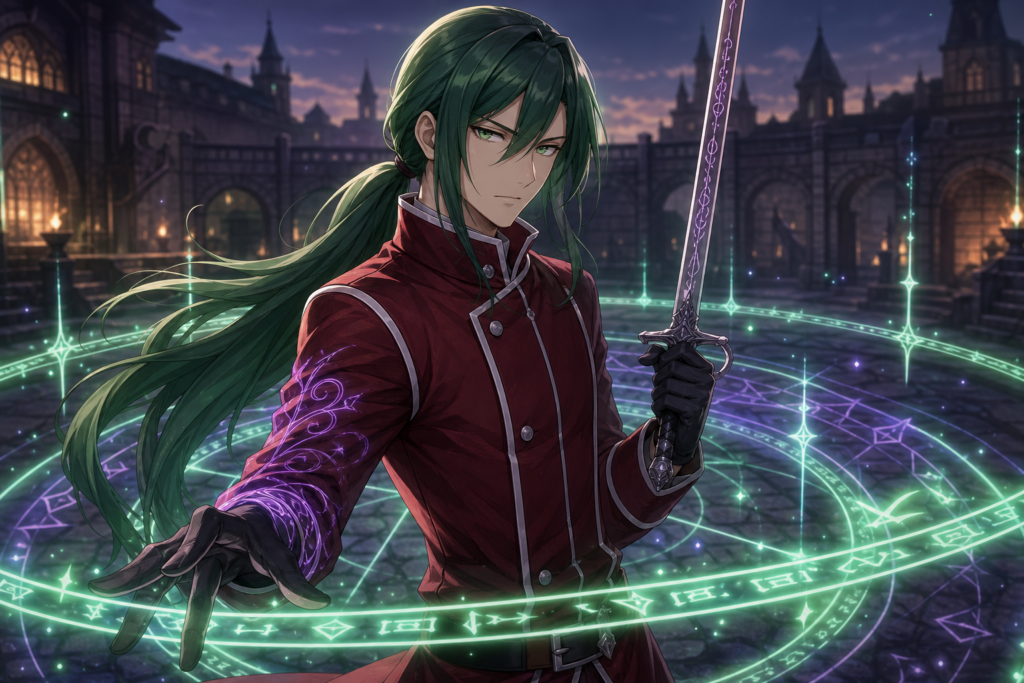
CVM Sekai character profile
Bottom line
Freed Justine can write rules onto a battlefield. His defining failure is letting Laxus write the rules inside his conscience. Freed is intelligent, disciplined and technically gifted. Dark Écriture lets him write effects onto bodies and spaces. Jutsu Shiki lets him create bounded enchantments with written conditions. His sword functions as a writing tool and a weapon.
During the Battle of Fairy Tail, he uses those skills to trap guild members and enforce Laxus’s coercive takeover. He is not a passive follower standing sadly in the background while someone else makes all the choices. He plans. He writes. He fights. He harms people. Later remorse matters because responsibility remains intact. Continued guild service matters because changed conduct lasts longer than an apology. Loyalty to Laxus can become valuable only after Freed learns that loyalty without independent judgment is obedience wearing a nice coat.
Who Freed Justine is
Freed Justine is a Fairy Tail mage and the leader of the three-person Raijinshū, also localized as the Thunder God Tribe. The team includes Bickslow and Evergreen and operates closely with Laxus Dreyar. Both group labels belong in an English profile because localization is not universal. Using only one as though every edition made the same choice creates a fake certainty.
Freed’s magic includes Dark Écriture, Jutsu Shiki enchantments and sword use. Those systems interact through writing but are not one unlimited rune power. His Japanese performer is Junichi Suwabe. This profile keeps Japanese performance scope only. Public official pages reviewed for this package do not expose a stable full vital sheet or a directly indexed exact manga debut entry. This profile leaves unsourced age, height and first-chapter numbers outside the record.
Name and localization
The official Japanese anime cast list identifies him as フリード, read as Freed. Licensed English material uses Freed Justine. That spelling matters because older fan translations and scattered databases sometimes use Fried. This profile uses Freed consistently. A character whose magic depends on exact writing deserves at least that basic courtesy. The group name needs more room. 雷神衆 is often rendered Raijinshū, while English localization also uses Thunder God Tribe. Neither label changes who the members are: Freed, Bickslow and Evergreen under Laxus’s wider command.
Keeping both labels is not indecision. Keeping both labels tells fans why two legitimate editions can sound different without pretending one reader imagined an entire team name. Localization has to balance sound, meaning and readability. Raijinshū preserves the Japanese term. Thunder God Tribe translates the thunder-deity meaning into immediate English. Freed leads the trio in practice, but leadership inside the team does not erase Laxus’s influence over the Battle of Fairy Tail plan. That nested hierarchy is exactly why his accountability matters. He is responsible both as a follower who obeys and as a leader whose own teammates act inside the structure he helps maintain.
Design: order you can see
Freed’s design makes discipline visible before he writes a single rule. His long dark-green hair is usually tied into a low ponytail, keeping a formal silhouette while still making him instantly readable beside Laxus, Bickslow and Evergreen. Green eyes, the crimson coat and the slender sword give him a controlled color story. Nothing about the design looks accidental or loose.
The sword matters because it does two jobs. The sword is a weapon, but the blade also works as the tool that writes his magic. That keeps Dark Écriture and Jutsu Shiki connected to physical action. Freed does not wave at the air and receive a fully drafted legal code from the universe. He has to draw, place and defend the conditions.
The contrast between green hair and a red coat also separates him from Laxus’s blond lightning silhouette. Freed may build too much of his identity around Laxus early on, but the character design never makes him a visual copy. His later appearances preserve that recognizable core more than they chase constant costume reinvention. That consistency fits him. Freed’s arc is not about becoming visually wild. Freed’s arc changes the purpose his control serves.
The clean coat, tied hair and precise sword can enforce a coup or protect a guild. The ethical difference is not in the outfit. The ethical difference lives in the decision behind the writing.
Dark Écriture, Jutsu Shiki and the sword
Freed’s magic requires distinctions. Dark Écriture writes magical effects onto a target, body or space. Depending on the inscription, it can alter conditions, inflict effects or transform Freed’s own combat state. Jutsu Shiki creates bounded enchantment fields governed by written rules. A person entering the area becomes subject to the stated conditions until the barrier is broken, altered, satisfied or overpowered.
His sword helps him write those inscriptions and fight at close range. That does not make every swing a separate sword-school technique. The same distinction does not make every rune Jutsu Shiki. The difference matters because counterplay depends on what kind of magic is operating. Levy McGarden can analyze and alter barrier logic without possessing Freed’s exact system. A physically stronger opponent may still be trapped by a rule. A reader may change the field without defeating Freed in a duel. Written magic becomes interesting when syntax has consequences. Otherwise it is just purple light with homework.
The Raijinshū and chosen hierarchy
Freed leads the Raijinshū with Bickslow and Evergreen under Laxus’s wider authority. The group has real tactical value. Freed provides structure and rule control. Bickslow uses Seith Magic, doll vessels and Figure Eyes. Evergreen combines Stone Eyes with Fairy Magic. They are not interchangeable attendants. Their different personalities also matter. Freed is formal and disciplined. Bickslow is theatrical and irreverent. Evergreen is proud and image-conscious. The team works because their abilities cover different kinds of control.
That coordination becomes morally dangerous when the shared plan is wrong. Group loyalty can distribute responsibility so thoroughly that each person feels like a piece rather than an author. The Battle of Fairy Tail removes that excuse. Freed’s contribution is too central to be accidental.
Laxus and the danger of admired authority
Freed admires Laxus. That admiration is not inherently unhealthy. Laxus is powerful, charismatic and capable of inspiring fierce loyalty. The problem begins when Freed treats Laxus’s approval as more important than Fairy Tail’s safety. Confucian ethics often value loyalty within hierarchy, but worthy loyalty includes moral correction. A subordinate who helps a leader commit harm is not practicing virtue simply because obedience is sincere.
Freed fails that test. He does not challenge Laxus early enough. He turns technical skill into infrastructure for coercion. His discipline becomes a delivery system for somebody else’s grievance. The story’s lesson is not “never be loyal.” The sharper lesson is that a loyal person still owns the moment he knows better and chooses harm anyway.
Battle of Fairy Tail: the architect of confinement
Freed’s barriers structure the Battle of Fairy Tail. He traps people inside Magnolia, imposes conditions on movement and helps turn guild members into participants in Laxus’s contest whether they consent or not. That is active planning. Evergreen petrifies women and uses them as hostages. Bickslow attacks Lucy and Loke. Freed’s written rules make the wider operation possible.
The coup also shows why written law is not automatically justice. A rule can be clear, technically consistent and morally abusive. Freed’s barriers are orderly. The event they enforce is not. This is an important institutional lesson. People often mistake procedure for fairness. If the person writing the rules controls the exits, the clock and the punishment, elegant syntax does not create consent. Freed knows how to define a boundary. He fails to recognize the boundary Laxus has crossed.
Mirajane and the human cost of the rules
Freed’s confrontation with Mirajane Strauss exposes the human cost of his choices. The larger crisis threatens Elfman and the guild. Mirajane returns to Satan Soul combat after a long period of mission withdrawal shaped by Lisanna’s apparent death. Freed faces not an abstract opponent but a sister responding to harm inside her family. His hesitation, defeat or later regret does not remove responsibility for creating the conditions that trigger the confrontation.
Mirajane’s power is not evidence that the victimized guild could always protect itself. The fact that somebody survives coercion does not make coercion less wrong. Freed’s encounter matters because his written control meets a person whose body has repeatedly been misread as monstrous. He tries to govern the field. Mirajane’s transformation demonstrates that the people inside his rules still carry histories he did not account for.
Levy McGarden and literacy as counterpower
Levy studies Freed’s enchantments and helps alter the barrier logic. The matchup is intellectual before it is physical. Freed writes rules. Levy reads them closely enough to create movement. Their magic systems remain distinct. Solid Script gives written words material or elemental effects. Jutsu Shiki defines conditions in a bounded area. Dark Écriture writes other effects and transformations.
The scene makes literacy a contested battlefield skill. Freed’s power is strongest when opponents cannot interpret the terms. Levy weakens his control by making the terms legible. That is how bad authority often works outside fantasy too. Confusion protects the rule-maker. Reading creates counterpower.
Aftermath: defeat is not repair
Laxus is expelled from Fairy Tail after the coup. Freed, Bickslow and Evergreen remain. That difference should not be mistaken for innocence. Makarov assigns the central consequence to the leader who designed the takeover. The Raijinshū still participated willingly. Freed’s defeat does not repair the barriers, the fear or the harm to guildmates. Remorse matters only if later conduct changes.
The series gives him that later work. He continues serving Fairy Tail. He defends people he once trapped. He remains loyal to Laxus after Laxus changes, but later loyalty operates inside a different moral context. The repair is cumulative. No single apology closes the account. No dramatic injury functions as moral payment. Changed conduct is boring compared with one grand speech. Repeated changed conduct is also how trust is actually rebuilt.
Tenrou Island and team responsibility
Freed participates in the Tenrou Island period and works with Bickslow during the Grimoire Heart assault. Working with Bickslow during the Grimoire Heart assault makes the point through ensemble defense, with neither teammate losing credit so the other can collect a fake solo victory. Freed now uses coordination to protect the guild rather than confine it.
That reversal does not erase the Battle of Fairy Tail. The reversal provides evidence of changed purpose. Fairy Sphere later suspends the Tenrou group outside ordinary time for seven years. Freed returns to a guild that has survived decline without many of its strongest members. The absence reinforces the value of institutions over elite teams. Fairy Tail cannot exist only when Laxus and the Raijinshū are present. Other members carry the years.
Grand Magic Games era and proportional role
Freed continues as a Fairy Tail and Raijinshū member during the Grand Magic Games era. His broader role remains tactical. Written barriers, sword work and team coordination give him options beyond raw output. The Games turn magic into public spectacle, but Freed’s best abilities do not always fit a scoreboard. A barrier can determine who reaches a fight before anybody scores a point. That distinction is useful in a franchise that sometimes treats visible destruction as the only readable power.
Tartaros and Tempester's consequences
Tempester’s attack and anti-magic particles critically endanger Freed, Bickslow and Evergreen. Laxus carries severe physical consequences while protecting them. The event demonstrates mutual loyalty after the Battle of Fairy Tail. Laxus is no longer using the team as instruments in a coup. He absorbs harm to keep them alive. That development matters. Laxus’s suffering is not repayment that cancels earlier wrongdoing.
Suffering is not a moral currency. A person cannot purchase retroactive innocence by getting hurt later. The sequence shows relationship change through action. Laxus protects. The Raijinshū survives. Their bond becomes less hierarchical and more reciprocal. Portraying the illness only as proof of friendship would still miss the bodily cost. Anti-magic particles are not symbolic confetti. People require treatment and recovery.
Guild dissolution and Blue Pegasus
After Fairy Tail dissolves, members scatter into different work and guild contexts. Freed and his teammates spend part of that period connected with Blue Pegasus, a legal workplace with its own members, culture and leadership rather than a joke-shaped waiting room.
Freed’s time there demonstrates that Fairy Tail identity survives institutional dissolution without making every outside affiliation fake. People can work elsewhere and still carry emotional loyalty to a former home. That choice is not betrayal. Working elsewhere is how displaced workers survive when the institution they loved no longer exists.
Alvarez: analysis inside a mass war
Freed participates in the Alvarez conflict through ensemble defense, tactical magic and guild coordination. The war’s scale does not turn him into a commander over Fairy Tail or a decisive solo finisher against every named opponent. His analytical value remains real. Written rules can shape access, delay enemies and create tactical conditions. Sword work lets him respond when inscription time disappears. Dark Écriture can increase his direct combat options at a cost.
Accuracy matters more than giving every supporting mage a fake war medal. Freed contributes to the war as an analytical fighter inside an ensemble, not as a commander who secretly won Alvarez between panels.
Limits of written magic
Freed’s power is formidable because language changes conditions, yet those conditions still require preparation, placement and enough time to write. His written magic has practical limits:
- Jutsu Shiki requires a bounded area and written conditions.
- Inscription takes time and can be interrupted.
- Rules can be read, altered, satisfied or overpowered under the correct circumstances.
- Dark Écriture transformations and effects consume magic and do not grant unrestricted reality control.
- Sword range and physical condition matter in direct combat.
- An ambiguous or poorly chosen rule can create unintended openings.
Freed is not an omnipotent contract writer. His best work depends on preparation. The Battle of Fairy Tail proves preparation without ethics can make him more dangerous, not more right.
Freed in 100 Years Quest (spoilers)
During the Aldoron conflict, the White Mage’s control causes Fairy Tail members to fight one another. The official Episode 10 summary states that Gray faces the Raijinshū while Natsu faces Gajeel and Lucy faces Mirajane’s group. Freed’s presence inside the controlled Raijinshū creates a relevant echo of his earlier role. In the Battle of Fairy Tail, he used written rules to restrict allies for Laxus. Under Whiteout, his own agency is compromised and he is used against allies.
The situations are not morally identical. One is willing participation. The other involves coercive control. That difference is the point. The sequel should not be used to declare that Freed has “received karma.” Victimization is not moral repayment. Coercion can deepen his understanding of control without balancing a cosmic ledger. His later sequel role remains proportional. The story does not turn him into a hidden Dragon God or Diabolos specialist.
Relationship atlas
Laxus Dreyar
Laxus is an admired leader and friend whose approval once mattered more to Freed than guild safety. That early loyalty becomes complicity during the coup, while their later bond matters because both men change their judgment and conduct instead of pretending admiration erased responsibility.
Bickslow
Bickslow is Freed’s Raijinshū teammate and frequent tactical partner. Their different demeanors sharpen the team rather than erase shared responsibility: Freed builds the rules and boundaries while Bickslow turns movement, sight and doll vessels into pressure inside those conditions.
Evergreen
Evergreen is a teammate with her own magic, pride and agency, not an interchangeable attendant or decorative member of Laxus’s entourage. Her Stone Eyes and Fairy Magic give the trio another form of control, and her choices carry the same moral weight as the men’s choices.
Mirajane Strauss
Mirajane is the Battle of Fairy Tail opponent whose response exposes the human cost of Freed’s rules. Her strength does not minimize his coercion; the confrontation instead shows how a cleanly written barrier can still threaten a family and force buried trauma back into the open.
Levy McGarden
Levy is the magical counterpoint who reads and alters barrier logic. Their distinct written systems make interpretation a form of power, allowing her to challenge Freed’s control through literacy and technical understanding rather than by copying his spells or overpowering every boundary.
Makarov and Fairy Tail
Makarov represents both authority and the community Freed helps violate, then chooses to serve through later conduct. Remaining in Fairy Tail gives Freed no instant absolution; continued service keeps him close to the people who can judge whether his changed behavior lasts.
Blue Pegasus
Blue Pegasus becomes a temporary workplace and community during displacement. The guild deserves treatment as a real institution rather than a joke layover because Freed’s ability to function there proves that emotional loyalty to Fairy Tail does not prevent practical survival elsewhere.
Japanese performance and adaptation
TV Tokyo’s official cast page credits Junichi Suwabe as Freed. The role depends on control. Formal speech, disciplined posture and measured magic make the Battle of Fairy Tail choices feel deliberate rather than chaotic. Suwabe’s controlled delivery suits a character who rarely wastes movement or language. The restraint makes Freed’s Battle of Fairy Tail choices feel planned, and it lets later embarrassment or loyalty register without turning him into a different person for comedy.
Adaptation analysis should distinguish manga canon from expanded anime missions and should name how visual boundaries, glyphs and sound make written rules legible. Freed appears across the franchise’s ensemble animation, but this profile does not turn background presence into a major film, OVA or game role without a credited or story-specific contribution.
Final verdict
Freed Justine is not dangerous because he lacks discipline. He is dangerous because discipline can make a bad order efficient. The Battle of Fairy Tail is his moral failure. He plans and enforces coercive rules because loyalty replaces judgment. His later story does not erase that failure. The later story shows what repair looks like when the person stays in the community he harmed. He serves. He protects. He continues working with Laxus after Laxus changes. He learns that written rules and strong hierarchy do not remove personal responsibility. Freed can define where people may move. His growth begins when he stops letting admiration define where he may think.
Source ledger and clean boundaries
- TV Tokyo official 2014/2015 cast page, including Junichi Suwabe as Freed: TV Tokyo: Fairy Tail staff and Japanese cast
- TV Tokyo official Tenrou episode page listing Freed and Bickslow: TV Tokyo: Battle of Fairy Tail episode record
- Kodansha Fairy Tail series catalog: Kodansha: Fairy Tail series
- Kodansha Fairy Tail: 100 Years Quest catalog and Volume 7 summary: Kodansha: Fairy Tail 100 Years Quest series and Kodansha: Fairy Tail 100 Years Quest Volume 7
- Official 100 Years Quest Episode 10, Gray against the Raijinshū: Official 100 Years Quest episode story
- Primary chronology and magic context: Hiro Mashima, Fairy Tail, volumes 1 through 63; sequel claims limited to published 100 Years Quest material and the official pages above.
Public official pages do not expose a stable full vital sheet, a directly indexed exact manga debut, every barrier condition, every Dark Écriture form’s licensed first-use name or a complete Freed film, OVA and game roster. Those details stay bounded instead of being imported from fan databases and dressed up as certainty.