
Levy McGarden
CVM Sekai character profile
Bottom line
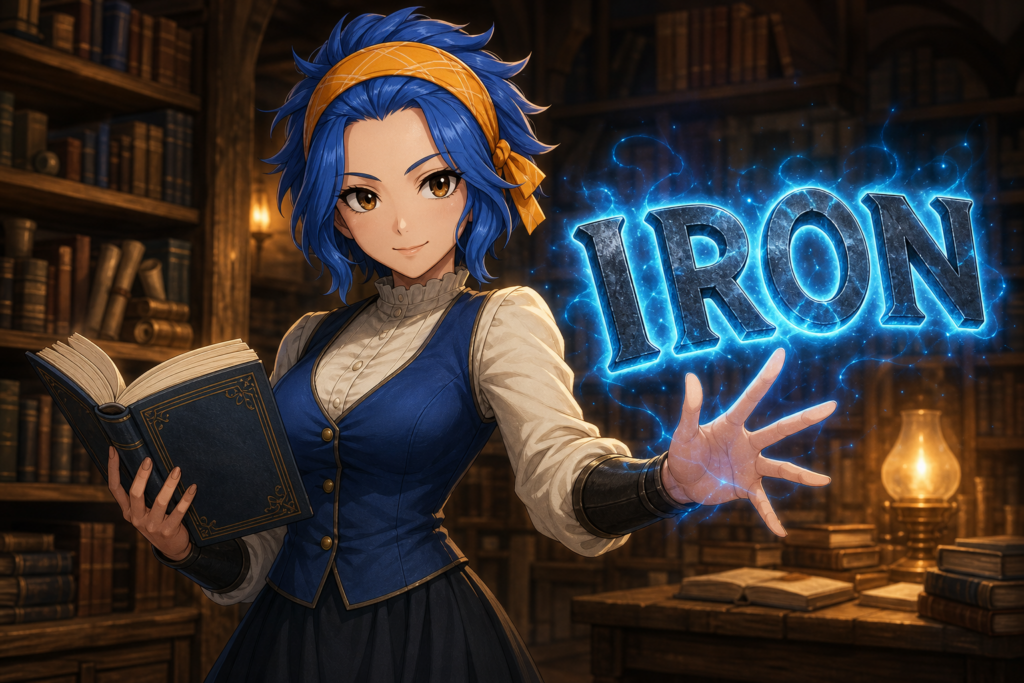
Levy McGarden can turn a word into iron. Fairy Tail fandom still manages to act surprised that reading matters in a magic system. Levy is a linguist, archive worker, Shadow Gear leader and Solid Script mage whose intelligence repeatedly changes what stronger fighters are able to do. She reads enchantments, rewrites rules, creates material effects through written language and turns knowledge into battlefield access.
Her relationship with Gajeel is important. That relationship is not the beginning of her character. Gajeel brutally attacks Levy, Jet and Droy during Phantom Lord. Later guild membership, protection, professional partnership, romance and sequel-era family do not travel backward through time and make that assault less real. The relationship works only when chronology stays intact: harm, justified distrust, repeated conduct, Levy’s agency, mutual choice and accountability.
Levy does not redeem Gajeel by loving him. He becomes capable of relationship by changing what he repeatedly does. She remains capable of choosing him without surrendering the truth about what happened. That is harder and more interesting than “the bully secretly liked the book girl.”
Who Levy McGarden is
Levy McGarden is a Fairy Tail mage, the leader of Shadow Gear and a specialist in Solid Script. Shadow Gear includes Jet and Droy. They are teammates with their own history, not decorative witnesses who vanish once Gajeel enters the profile. Levy’s magic gives written words physical or elemental effects. Language is both medium and instruction. The exact word matters. The mage’s knowledge matters. Time to write matters.
Her Japanese performer is Mariya Ise. This profile keeps Japanese performance scope only. Public official pages reviewed for this package do not expose a stable full vital sheet or a directly indexed exact manga debut entry. This profile leaves unsourced age, height and first-chapter numbers outside the record. Her real factual floor is richer: team leader, reader, writer, code-breaker, combat support mage, Magic Council operative for a period, Gajeel’s eventual partner and a sequel-era expectant mother within the boundary of published canon.
Shadow Gear comes first
Levy leads Shadow Gear with Jet and Droy. That team establishes her before romance. Jet brings speed. Droy uses plant-based magic. Levy supplies language, analysis and leadership. Their abilities give the unit mobility, control and intellectual flexibility. The trio also represents an ordinary working-guild layer that Fairy Tail needs. They are not S-Class celebrities or Dragon Slayers. They take jobs, maintain relationships and contribute to the institution’s continuity.
Levy’s leadership style is not loud. She reads the problem, names what matters and looks for an opening. In a series that loves shouting spell names while architecture explodes, quiet analysis can look less impressive than it is. Then a barrier stops everybody, and suddenly the woman who reads is the emergency department.
Lucy and the dignity of being taken seriously
Levy becomes one of Lucy Heartfilia’s closest intellectual friends. Books and writing connect them. Levy does not treat Lucy’s ambition to become an author as a cute hobby attached to a Celestial Spirit mage. She understands the labor and excitement of language. That matters because Lucy lives among people who love her but do not always share the private part of her creative life.
Levy can meet her there. Their friendship is not built on combat rank. Their friendship is built on recognition. Lucy is a writer. Levy is a reader whose judgment matters to her. Creative relationships need that kind of witness. A person who reads your work seriously is not doing less than the person who punches a demon beside you.
The series’ industry world also depends on documents, requests, contracts, archives and written rules. Levy’s literacy connects the emotional value of books to the practical economy of guild magic. Language is not decoration around adventure. Language tells the adventure what the job is.
Phantom Lord: name the harm plainly
During Phantom Lord’s attack on Fairy Tail, Gajeel brutally assaults Levy, Jet and Droy and publicly displays their injured bodies to provoke the guild. That is the beginning of their shared chronology. The scene is not flirting. The assault is not rough chemistry. The attack is violence used as a message. Levy is targeted as a Fairy Tail member. Jet and Droy are harmed with her. Their pain should not disappear because later canon gives Levy and Gajeel a relationship.
The assault also demonstrates how institutional conflict enters individual bodies. Phantom Lord wants to humiliate Fairy Tail, so its fighter makes guild members into public symbols. Levy’s later decisions deserve respect precisely because the initial harm stays visible. If a profile softens the assault to make the romance easier, it strips Levy of the agency required to choose anything later. Forgiveness means nothing if the story pretends there was nothing serious to forgive.
Gajeel joins Fairy Tail
Makarov later allows Gajeel to join Fairy Tail. Levy’s fear, anger and guardedness are warranted. The guild’s chosen-family ethic creates a real tension here. Fairy Tail can offer a former enemy a path toward different conduct. Fairy Tail also owes safety and respect to the people he harmed. Those duties must coexist. Gajeel’s membership does not create a debt Levy must repay with trust. Protection does not purchase romance. Service does not erase the assault.
What changes the relationship is repeated conduct over time. Gajeel takes risks for the guild. He accepts that people distrust him. He builds bonds beyond Levy, including Panther Lily. Levy watches what he does and makes her own choices. The timeline matters more than a redemption speech. Confucian ethics can frame repair through conduct inside relationship. Moral change is not only an inner feeling. Accountability is practiced through role, duty and repeated action. Gajeel becomes a different guildmate because he behaves differently across time. Levy remains the person who decides what that means for her.
Freed's runes and the power of reading rules
During the Battle of Fairy Tail, Freed Justine’s Jutsu Shiki enchantments trap participants inside written rules. Levy studies those rules and helps alter the conditions. This is one of her cleanest demonstrations of combat literacy. She does not overpower the barrier through larger magical output. She reads the system well enough to intervene in it.
Solid Script and Freed’s magic are not identical. Freed uses Dark Écriture, Jutsu Shiki and sword techniques with distinct mechanics. Levy’s ability to read or rewrite a rule does not mean she possesses his exact spell system. The scene works because knowledge creates counterplay. Magic with rules becomes more interesting when another mage can understand the rules. Otherwise, enchantment is just a wall the plot removes later. Levy turns interpretation into action. That is not support in the weak sense. That is changing who can move.
Tenrou Island: choosing Gajeel as a partner
Levy chooses Gajeel as her partner for the Tenrou Island S-Class trial. The choice signals trust. That choice does not announce that every wound is gone. Their teamwork during the Grimoire Heart crisis develops through danger, protection and mutual dependence. The final publication should keep exact opponent and spell attribution tied to the published volume rather than turning an ensemble conflict into a tidy couple’s victory.
What matters is that Levy is not assigned to Gajeel by fate. She chooses him as a professional partner. That does not remove the power of the earlier assault. The partnership demonstrates that Levy’s judgment has responded to later evidence. The relationship is strongest when her choice remains active rather than being framed as proof she was always secretly attracted to him. No. Trauma is not foreshadowing. Trust is something they build after it.
Seven missing years and Shadow Gear continuity
Fairy Sphere suspends Levy and the Tenrou group outside ordinary time for seven years. Jet, Droy and the rest of the outside guild live those years. The suspension changes Shadow Gear even if the protected members do not age normally. Teams are social structures. When one member disappears for seven years and returns physically unchanged, continuity does not snap back like a rubber band.
The guild has declined. Relationships have carried absence. People outside Tenrou have become older versions of themselves. Levy’s return therefore belongs to Fairy Tail’s broader theme of unequal time. Survival can protect a body while changing every relationship around it.
Grand Magic Games era: knowledge beyond the arena
Levy contributes during the Grand Magic Games period through research, support and guild participation. She is not a central tournament-team fighter, and the profile should not invent that role to make her look useful. The Games are surrounded by political secrets, hidden magical systems and a crisis involving Eclipse. Knowledge work matters even when the scoreboard does not award points for it.
Fandom often counts only official matches. The plot counts whoever understands the machinery before it kills everybody. Levy’s relationship with Gajeel also continues developing, but comic jealousy should not replace her work. Romance is one part of the era, not her job description.
Tartaros: writing air into survival
During Tartaros, Levy’s Solid Script becomes a direct survival tool amid anti-magic particles and a battlefield that threatens breathing itself. She creates an air intervention that assists Gajeel and others. The precise written word, timing and manga/anime rendering should follow the licensed scene. The meaning is clear without exaggeration: Levy’s language creates a condition life requires.
That is not merely romantic support for Gajeel. Air helps whoever needs air. The sequence also demonstrates the strength and limit of Solid Script. Levy can create a material or elemental effect through writing, but she needs consciousness, opportunity and enough magical capacity to produce the word. Interruption matters. Environment matters. Speed matters. Her power is not “anything she writes becomes permanently true.” Solid Script remains spellcasting through language. The difference keeps the magic from becoming a grammar-shaped infinity stone.
Magic Council work: relationship outside the guild
Levy and Gajeel later serve in a Magic Council context. The professional setting matters because it moves their relationship beyond Fairy Tail’s familiar social environment. They work inside an institution with investigation, enforcement and public responsibility. The exact translated unit name varies across unofficial references and should be used only if a primary licensed source confirms it. A general description of Council service is more accurate than a confident but unstable label.
The work also tests Gajeel’s change. A former Phantom Lord attacker operates within legal enforcement. That is not automatically proof of moral perfection. Council service is evidence that his public role and conduct have changed. Levy’s presence should not be reduced to keeping an eye on him. She brings language, analysis and field competence to the work. They are colleagues as well as an emerging couple.
Alvarez: decoding, survival and scale
Levy participates in the Alvarez war through support, decoding and battlefield survival. The conflict’s scale favors Dragon Slayers, S-Class mages and continent-level magic in the most visible clashes. Levy remains valuable without being inflated into a secret Spriggan finisher. Her strength is making conditions for other people to act: reading, interpreting, writing, protecting and connecting information.
War stories often romanticize the person at the front and ignore the person who gets the map right. Fairy Tail survives because both exist. Levy’s relationship with Gajeel carries especially high stakes during the war. Their emotional choices should remain tied to exact scenes and not be simplified into “love makes them stronger.” Fear, sacrifice and the possibility of loss matter because their trust has history.
Solid Script: mechanics and limits
Solid Script turns written words into magical effects associated with their meaning. Levy can create material or elemental manifestations, but the magic depends on writing, knowledge and situational opportunity. Its strengths include:
- Flexible effects through different words.
- Ranged and environmental application.
- Utility beyond direct damage.
- Interaction with written rules and magical texts.
- Research value outside battle.
Solid Script works through knowledge and rapid written execution, so Levy’s judgment matters as much as raw magical power. The system also carries practical limits:
- Time and motion required to write.
- Vulnerability to interruption.
- Magical stamina.
- The need to understand the intended word and effect.
- Matchups where an effect lacks sufficient scale or speed.
- Continuity and localization differences in exact spell wording.
Levy can analyze Freed’s runes without possessing Freed’s Jutsu Shiki. She can create iron without becoming an Iron Dragon Slayer. The form of the word does not collapse every related magic system into one category. That distinction is factual and creatively important. Fairy Tail’s magic system becomes mush if every text-based spell is treated as the same power with different handwriting.
Levy and Gajeel in *100 Years Quest*
The sequel confirms that Levy and Gajeel’s relationship has moved into family-building, including Levy’s pregnancy. That fact should be stated conservatively. The final profile must use the latest published chapter available at production time to describe timing, disclosure and outcome. The profile should not announce a birth, child name or status that canon has not explicitly provided.
Pregnancy also changes stakes without erasing Levy’s personhood. She is not transformed from scholar into womb. Her health, choices, work and relationship all matter. Gajeel’s protectiveness must remain accountable to Levy’s agency rather than turning her into a reason for him to fight. The sequel’s opening separates the traveling 100 Years Quest team from guild members at home. Gajeel and Juvia investigate Touka’s behavior at the guild while the core team is away. Levy belongs to that home-guild and family context rather than the traveling Dragon God mission. Later participation should remain proportional. Do not invent a Diabolos rivalry or Dragon God victory for her.
Relationship atlas
Jet and Droy
Jet and Droy are Shadow Gear teammates, fellow Phantom Lord victims and people with their own responses to Gajeel’s admission. Their history with Levy predates her romance, and they do not stop mattering because her personal life changes.
Gajeel Redfox
Gajeel is Levy’s attacker, later guildmate, chosen trial partner, colleague, romantic partner and sequel-era family. Every stage remains in chronological order, with repeated conduct supporting later trust while love never travels backward to rewrite the assault.
Lucy Heartfilia
Lucy is Levy’s literary friend and intellectual peer. Levy takes Lucy’s writing seriously, offers informed feedback and gives her a relationship outside combat hierarchy where creative work receives attention instead of becoming a punch line.
Freed Justine
Freed is a magical counterpoint whose enchantments Levy can read and alter. Solid Script, Dark Écriture and Jutsu Shiki remain distinct, which makes their contest a clash of literacy and rule systems rather than two identical writing spells.
Makarov and Fairy Tail
Fairy Tail gives Levy a home, a team and a recognized knowledge role. Makarov’s decision to accept Gajeel creates legitimate safety tension because institutional mercy for a former enemy must still account for the member he attacked.
Panther Lily
Panther Lily becomes Gajeel’s Exceed partner and a member of his close circle. Lily changes the team dynamic and gives Gajeel a relationship not mediated through Levy, preventing romance from swallowing every part of either character’s social world.
Japanese performance and adaptation
TV Tokyo’s official 2014/2015 cast page credits Mariya Ise as Levy. Levy’s adaptation depends on making intellectual action visible. Reading a barrier or writing a word can be less kinetically obvious than a punch. Animation, timing, typography, effects and sound must show the moment knowledge changes the field. Performance analysis stays tied to exact Japanese scenes instead of inventing episode-specific vocal technique without direct viewing evidence.
The anime also influences how the Phantom Lord assault, Gajeel’s later comedy and the Tartaros air sequence are emotionally balanced. Adaptation analysis should name those choices rather than letting later humor soften earlier violence by default. Official films, OVAs, games and spinoffs should be listed only when Levy’s actual presence is confirmed through a roster, credit or licensed work.
Final verdict
Levy McGarden turns language into matter. Her profile should turn chronology into accountability. She leads Shadow Gear before Gajeel attacks. She remains a scholar after romance begins. She is Lucy’s literary friend, a rune analyst, a field mage and a person whose knowledge repeatedly creates survival. Gajeel harms her. He later changes his conduct. She observes, distrusts, chooses, works beside him and eventually builds a family with him.
None of those facts cancels another. The romance is meaningful because Levy has agency at every stage. If we erase the assault, we erase the judgment required for her later choice. If we reduce her to a victim forever, we erase her right to respond to new evidence. Solid Script gives the perfect metaphor. Words have effects. So do actions. Neither disappears because somebody writes a happier sentence later.
Source ledger and clean boundaries
- TV Tokyo official 2014/2015 cast page, including Mariya Ise as Levy
- TV Tokyo official character portal
- Kodansha Fairy Tail series catalog
- Kodansha Fairy Tail: 100 Years Quest catalog
- Official 100 Years Quest Episode 1 and Episode 2, separating the traveling team from the guild-home investigation
- Official 100 Years Quest: Episode 9, Episode 10 and Episode 11, covering guild Whiteout and the allied conflict
- Primary chronology and magic context: Hiro Mashima, Fairy Tail, volumes 1 through 63. Sequel claims are limited to published 100 Years Quest material and the official pages above.
Public official pages reviewed here do not expose a stable full vital sheet, a directly indexed exact manga debut, a stable translated name for the Council unit, every Solid Script word’s licensed first-use name or a complete Levy film/OVA/game roster. Those details are omitted or bounded instead of imported from fan databases.