
Loke / Leo
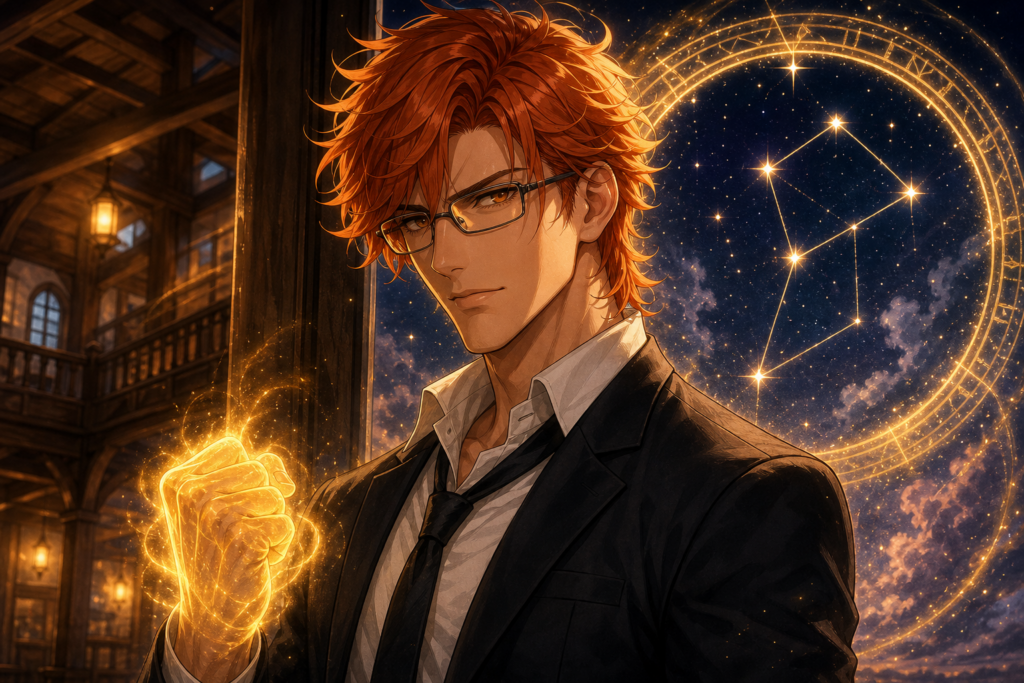
CVM Sekai character profile
Bottom line
Loke is Leo the Lion. Neither name cancels the other. Loke is the Fairy Tail guild member who flirts, jokes, fights and builds an Earth-land life. Leo is the Zodiac spirit who leads the twelve golden-key spirits and uses Regulus light in close combat. His central tragedy begins when he protects Aries from Karen Lilica’s abuse by refusing to return to the Celestial Spirit World until Karen releases her contract.
The motive is protective. The method has consequences. Karen can no longer summon another spirit while Leo remains in the human world. She takes a job anyway and dies. Later canon identifies the person who kills her, which means Leo is not her murderer. His action still belongs in the causal chain that leaves her unable to summon.
Both facts matter. Lucy saves Leo because she refuses a punishment that has become a slow death sentence. She does not argue that nothing happened. She argues that responsibility without mercy has turned into destruction. That is the ethical center of Loke’s story.
Who Loke and Leo are
Leo the Lion is a Zodiac Celestial Spirit and leader among the twelve golden-key spirits. Loke is the name and identity he uses while living as a Fairy Tail mage in Earth-land during exile. The guild identity is not a fake shell. He forms real relationships, takes guild work and risks himself for other members. When he returns to the Celestial Spirit World and later contracts with Lucy, his Fairy Tail loyalty does not vanish.
His magic centers on Regulus, golden light used to strengthen close combat and produce force through punches and related techniques. He also possesses the endurance expected of a powerful Zodiac spirit and can cross the gate independently in limited circumstances. His Japanese performer is Daisuke Kishio. This profile keeps Japanese performance scope only. Public official pages reviewed for this package do not expose a stable full vital sheet or a directly indexed exact manga debut entry. This profile leaves unsourced age, height and first-chapter numbers outside the record.
Karen Lilica and a contract built on abuse
Karen Lilica is a Celestial Spirit mage and Leo’s former contractor. She abuses Aries and attempts to force her into extended service. Celestial Spirit contracts are not ordinary weapon ownership. Spirits are people with names, fears, relationships and limits. A key grants contractual access. A key does not erase personhood. Leo intervenes because the contract system is failing Aries.
He crosses into the human world and refuses to return until Karen releases Aries. Because a Celestial Spirit mage cannot simply keep opening other gates while one spirit remains present, his protest blocks Karen’s ordinary summoning access. The tactic is coercive in response to coercion. Leo is trying to protect Aries from harm. He also makes a unilateral decision that affects Karen’s livelihood and physical safety. That does not make Karen’s abuse acceptable. That choice means protection can create new danger when the protector controls the terms alone.
Aries must remain a person
Aries is not merely the reason Leo feels guilty. She is the person being harmed. Her fear, reluctance and right to bodily limits make Leo’s intervention understandable. A profile that focuses only on whether Leo causes Karen’s death repeats the original problem by turning Aries into contract property again. The ethical sequence begins with her treatment.
Karen uses contractual power against a subordinate being. Leo challenges that power. The Celestial Spirit system does not provide an immediate safe resolution. Every option becomes dangerous because the person holding the key refuses to release the contract. Aries’s agency should remain visible in later relationships too. Lucy’s contract matters because Lucy approaches spirits as partners. Aries is not transferred from one owner to a nicer owner. She enters a different relationship structure. That distinction is why Lucy’s role changes the story.
Karen's death: intent, cause and guilt
Karen takes a job while unable to summon her spirits and is killed. Later disclosure identifies the killer. Leo is not the person who attacks and kills her. He is also not causally unrelated. His refusal to return keeps her from summoning. Karen chooses to accept work under those conditions. The killer chooses violence. Karen’s earlier abuse creates the conflict. Several decisions converge.
Responsibility is layered. Calling Leo a murderer collapses the actual killing into his protest. Calling him blameless erases the foreseeable danger of blocking a working mage’s access to magic. Leo’s guilt grows in the space between those bad simplifications. He intended to protect Aries. He did not intend Karen’s death. His action contributed to the conditions around it. He cannot reverse the outcome. That is moral injury, not a courtroom slogan.
Exile and the body running out of time
The Celestial Spirit King bars Leo from returning to the Spirit World. Leo remains in Earth-land and eventually joins Fairy Tail as Loke. The guild becomes more than cover. Fairy Tail gives him work, social identity and relationships during exile. He flirts aggressively and often turns charm into a performance. The jokes do not always respect boundaries. A tragic backstory should not become a hall pass for behavior that makes women uncomfortable.
The persona can still be read as concealment. Loke lives with a shrinking future. A Celestial Spirit cannot remain indefinitely in the human world without cost. His life force deteriorates. Flirtation, style and comedy let him perform abundance while his body is running out. He acts like tomorrow is guaranteed because he expects it is not. That does not excuse every joke. That deadline explains why the jokes become sadder once the audience knows the clock.
Fairy Tail is a real home
Loke’s Fairy Tail membership matters because it gives him relationships outside contract law. Guild members do not summon him through a key. They know him as a colleague. That changes the shape of belonging. In the Spirit World, Leo has office, hierarchy and rules. In Fairy Tail, Loke has messy friendship, jobs and chosen obligation.
Neither home replaces the other. His dual identity works because the series allows one person to belong to two systems. He carries guild loyalty back into his spirit life and Celestial Spirit responsibility into guild battles. The story’s cultural assumption is relational identity. A person can be different in different roles without one role being fake. Leo is not more authentic because it is his supernatural title. Loke is not more authentic because it is the life the audience meets first. He is both.
Lucy discovers the truth
Lucy recognizes that Loke is a Celestial Spirit and learns why he cannot return. He expects punishment to end in death. Lucy refuses that ending. Her intervention matters because she is not asking for a useful weapon. She is defending a person before he becomes her contracted spirit. She calls on the Celestial Spirit King and the other spirits as witnesses. The collective appearance turns private guilt into public testimony.
Lucy does not erase Karen or Aries. She challenges proportionality. Leo has already lived under exile, loss and physical decline. The punishment no longer protects Aries or repairs Karen’s death. The punishment destroys another life. A Buddhist lens helps here. Punishment cannot undo the past. Clinging to punishment as proof of moral seriousness can create fresh suffering without restoring what was lost. Mercy is not denial. Mercy is the recognition that consequence has limits too.
The Celestial Spirit King's decision
The Celestial Spirit King enforces the law that kept Leo exiled. He also responds to Lucy’s challenge and the spirits’ testimony. The decision allowing Leo to return should not be described as casual forgiveness. The system changes because Lucy demonstrates relational evidence: the spirits recognize Leo, the punishment has become lethal and his actions arose from protecting Aries.
The King remains sovereign, but the scene gives collective witness moral force. That is unusually important in a hierarchy. Authority listens. The ruling restores Leo’s access to the Spirit World and makes a future contract possible. Mercy does not declare Karen’s death meaningless.
Lucy's contract and personhood
Leo later contracts with Lucy. The ethical foundation comes before the key. Lucy fights for his life when she does not own his contract. That proves she sees him as a person rather than a resource. The later contract therefore carries trust built through conduct. Their teasing chemistry is part of the relationship, but it should not replace the ethical frame. Loke flirts. Lucy pushes back, jokes and commands as a Celestial Spirit mage. The partnership works because she respects spirit autonomy more consistently than Karen did.
Contract does not mean equality is automatic. Lucy still controls keys and summoning decisions. The series repeatedly shows that her best relationships depend on negotiation, affection and sacrifice beyond the formal rule. Leo’s ability to cross independently in some circumstances also complicates the system. He is not infinitely available. Independent gate crossing still costs magic and exists within limits.
Battle of Fairy Tail and Bickslow
During the Battle of Fairy Tail, Loke fights Bickslow. Bickslow participates willingly in Laxus’s coercive plan and uses Seith Magic through five doll vessels along with Figure Eyes. Loke’s resistance is therefore a guild-loyalty action, not a friendly exhibition. The fight tests Regulus in close combat and gives Loke a meaningful opponent after his identity reveal.
Bickslow’s magic also creates a thematic contrast. He places souls into vessels. Leo is a spirit who has lived inside a human-facing identity. Neither system should be flattened into the other, but both make the battle about what a body contains and who controls it. Exact techniques and finishing attribution should follow the licensed scene. The profile does not need to overname a move to prove the fight happened.
Oración Seis and Edolas-era support
Leo supports Lucy and Fairy Tail through later conflicts, including the Oración Seis and Edolas periods where canon gives him a concrete role. The key boundary is summoning. Some appearances occur through Lucy opening a gate. Others involve limited independent crossing. The final publication should identify which is which rather than treating Leo as permanently resident in Earth-land after his contract.
The distinction preserves stakes. Lucy’s magical reserves matter. Contract schedules matter. Spirit-world duration matters. If Leo can appear forever at no cost, Celestial Spirit magic stops being a system and becomes a group chat with punching.
Tenrou Island, Capricorn and Zoldeo
Tenrou Island broadens Leo’s history through the conflict involving Capricorn and Zoldeo. Capricorn is another Zodiac spirit whose identity and body have been entangled with a human mage’s actions. The sequence connects spirit autonomy, possession and contract history. Leo participates, but the resolution should not be credited to him alone. Capricorn’s own identity, Lucy’s role and the mechanics surrounding Zoldeo all matter.
The thematic value is strong without stealing anybody’s agency. Leo has lived through a human contractor abusing spirit power. Capricorn’s situation shows another form of human control over a spirit relationship. The arc keeps asking whether keys and contracts produce ownership. The answer, at its best, is no.
Grand Magic Games and Eclipse continuity
Leo contributes during the Grand Magic Games era as one of Lucy’s strongest Zodiac partners. The tournament and Eclipse crisis place Celestial Spirit magic inside state power, time magic and public spectacle. Exact battles and independent appearances should follow published scenes. The anime’s Eclipse Celestial Spirits material requires an explicit adaptation label. Anime-original developments can still matter to viewers and performance analysis. They cannot be silently merged into manga chronology. Continuity labels are not an insult to the adaptation. They are how we discuss what the adaptation actually created.
Tartaros: Lucy's cost remains Lucy's
During Tartaros, Lucy summons spirits under extreme pressure. Leo fights as part of that effort. The Celestial Spirit King later intervenes, and Aquarius’s key is sacrificed to make that intervention possible. Those actions belong to the people who perform them. Leo does not receive credit for the King’s attack. He does not receive Aquarius’s sacrifice. Lucy’s magical and emotional cost must remain central.
The sequence demonstrates the limits of contract magic. Lucy cannot summon unlimited spirits without draining herself. Spirits can fight beyond ordinary expectations, but the system still places enormous burden on the contractor. Leo’s strength supports her. Leo’s strength does not replace her agency.
Alvarez and ensemble defense
Leo participates in the Alvarez conflict through Celestial Spirit support and ensemble defense. The war’s scale includes Dragon Slayers, Spriggan magic, Fairy Tail’s founders and continent-level threats. Leo remains a powerful Zodiac combatant without becoming the secret answer to every front. Exact summoned appearances, independent crossings and Regulus techniques should remain tied to published scenes.
His role is valuable because Lucy’s team depends on relationships that can respond under pressure. A spirit’s presence is not a disposable special effect. Leo is a partner choosing to fight within the contract and circumstance.
Regulus, combat and limits
Leo uses Regulus light to enhance close combat and produce force through strikes. His strengths include speed, physical power, light-based attack and the endurance of a high-ranking Zodiac spirit. His limits include:
- Contract rules.
- Lucy’s magical reserves when summoned through her gate.
- Time and life-force costs in the human world.
- Limited, not unlimited, independent gate crossing.
- Matchup and opponent scale.
- The distinction between Zodiac leadership and ownership of other spirits.
Leo leads among the Zodiac spirits. He is not a king with unlimited command over their choices. His office gives responsibility. Leadership should not erase Aries’s agency or the Celestial Spirit King’s authority.
Loke and Leo in *100 Years Quest*
The sequel continues Lucy’s Celestial Spirit relationships while the core team travels on the 100 Years Quest. Leo should be included only where a published chapter or official episode gives him a meaningful contract, combat or spirit-world role. The official Episode 10 summary highlights Lucy using a new Star Dress Mix against controlled guildmates. That episode’s focus is Lucy’s expanding Celestial Spirit-derived magic, not proof that Leo personally leads the Aldoron operation.
Later material may call on him through Lucy’s keys or related techniques. Each appearance should stay at its actual scale. Do not invent a Dragon God victory, Diabolos rivalry, permanent human-world residency or relationship escalation that canon does not provide.
Relationship atlas
Lucy Heartfilia
Lucy becomes Leo’s contractor, advocate and trusted combat partner only after defending his right to live. Their teasing chemistry rests on that first act of personhood, so the gold key represents a relationship they chose rather than ownership disguised as kindness.
Karen Lilica
Karen is Leo’s former contractor and the mage who abuses Aries. His protest responds to that harm while also contributing to the conditions surrounding Karen’s later death, which keeps protective intent separate from consequences he never meant to create.
Aries
Aries is the person Leo protects, not a silent object that exists to explain his guilt. Her fear, autonomy and later contract with Lucy must remain visible because the original conflict begins with Karen treating a spirit’s limits as optional.
Celestial Spirit King
The Celestial Spirit King is the sovereign and judge who enforces Leo’s exile, hears collective testimony and revises the outcome. His decision becomes mercy informed by evidence rather than denial, showing that legitimate authority can reconsider a punishment without declaring the harm imaginary.
Gray Fullbuster
Gray is a guild friend and recurring foil whose connection with Loke gains meaning through specific shared scenes. Their banter and cooperation work best when tied to what they actually do together instead of being inflated into generic male camaraderie.
Fairy Tail
Fairy Tail becomes Loke’s chosen home during exile and remains a real part of his identity after his return to the Spirit World. Guild membership gives him peers who know him outside key ownership, while his later contract with Lucy lets both homes coexist.
Japanese performance and adaptation
TV Tokyo’s official 2014/2015 cast page credits Daisuke Kishio as Loke. The role requires tonal separation without splitting the character into two people. Flirtatious guild comedy, concealed physical decline, Leo’s authority and the Karen confession all belong to one identity. Kishio keeps the identity continuous across two social modes: Loke’s loose guild banter and Leo’s formal Celestial Spirit authority. The emotional hinge is not a new voice but the pressure underneath the same one, especially when charm stops working as camouflage and guilt finally has to speak plainly.
Adaptation analysis should also distinguish manga-canon material from anime-original Eclipse Celestial Spirit developments. Official films, OVAs, games and spinoffs should be listed only when Loke or Leo’s actual role is confirmed through a roster, credit or licensed work.
Final verdict
Loke is not a fake human identity hiding the real Leo. Leo is not a spotless protector punished for being too noble. He is one person carrying two homes and one morally complicated decision. Karen abuses Aries. Leo intervenes. His refusal to return blocks Karen’s summoning. Karen accepts a job and is killed by another person. Leo lives with guilt. The Celestial Spirit system turns that guilt into an exile that slowly kills him.
Lucy interrupts the cycle. She does not declare everybody innocent. She insists that personhood matters more than a rule completing its punishment. That is why their contract works. Their contract begins with advocacy, not ownership. Leo’s story is about the danger of protection without consent and punishment without mercy. Lucy gives him another way to relate: partnership with responsibility, affection and limits. The key opens a gate. Respect is what makes somebody willing to walk through it.
Source ledger and clean boundaries
- TV Tokyo official 2014/2015 cast page, including Daisuke Kishio as Loke
- TV Tokyo official character portal
- Kodansha Fairy Tail series catalog
- Kodansha Fairy Tail: 100 Years Quest catalog
- Official 100 Years Quest Episode 10, Lucy’s Star Dress Mix and the controlled-guild conflict
- Official 100 Years Quest Episode 22 and Lucy’s spirit-related conflict in Elentear
- Primary chronology and magic context: Hiro Mashima, Fairy Tail, volumes 1 through 63. Sequel claims are limited to published 100 Years Quest material and the official pages above.
Public official pages reviewed here do not expose a stable full vital sheet, a directly indexed exact manga debut, an indexed official summary of Karen’s killer disclosure, every independent gate crossing or a complete Loke film/OVA/game roster. Those details are omitted or bounded instead of imported from fan databases.