
BTS One More Night Audio React: Bargaining With the Clock
One More Night asks for time the narrator already knows cannot be kept. The official audio turns one last request into a negotiation between tenderness, denial, and seven voices that know how endings echo.
Release file
Released: March 19, 2026
Runtime: 02:48
Artist / channel: BTS / official upload
Exact-file focus: Exact official One More Night audio. The later Busan fan-recorded encore is excluded from the canonical file.
A glossy little extension request that already knows morning is outside tapping its watch.
Bottom line: this song is soft, synthy, and emotionally suspicious. BTS are asking for one more night like it is a reasonable calendar adjustment, but the first thing the song does is admit that tears and separation are already in the room. Nobody here is fooled. That is why it works.
“One More Night” lands late on ARIRANG, after “they don’t know ’bout us” and before “Please” and “Into the Sun.” That placement matters. The album has already traveled through pressure, bodies, memory, spectacle, and the strange business of coming home as seven people who are no longer the boys who left. Then this track lowers the lights and bargains with time.
What changed every time I replayed it
First intake: Soft synths, a moving beat, and an emotionally suspicious request. BTS asks for another night as if this is a small calendar adjustment while tears are already sitting at the table.
Second intake: The hook becomes sadder because it sounds possible. “Forever” is fantasy. One more night is close enough to negotiate and therefore close enough to lose.
Third intake: Album placement changes the addressee. This can be a lover, ARMY, the members, or seven men asking for a pocket of private time before the comeback machine clocks in.
Later replay: The bright production is not avoiding grief. It keeps the night moving while the lyric watches morning approach.
Watch them bargain with the clock in public
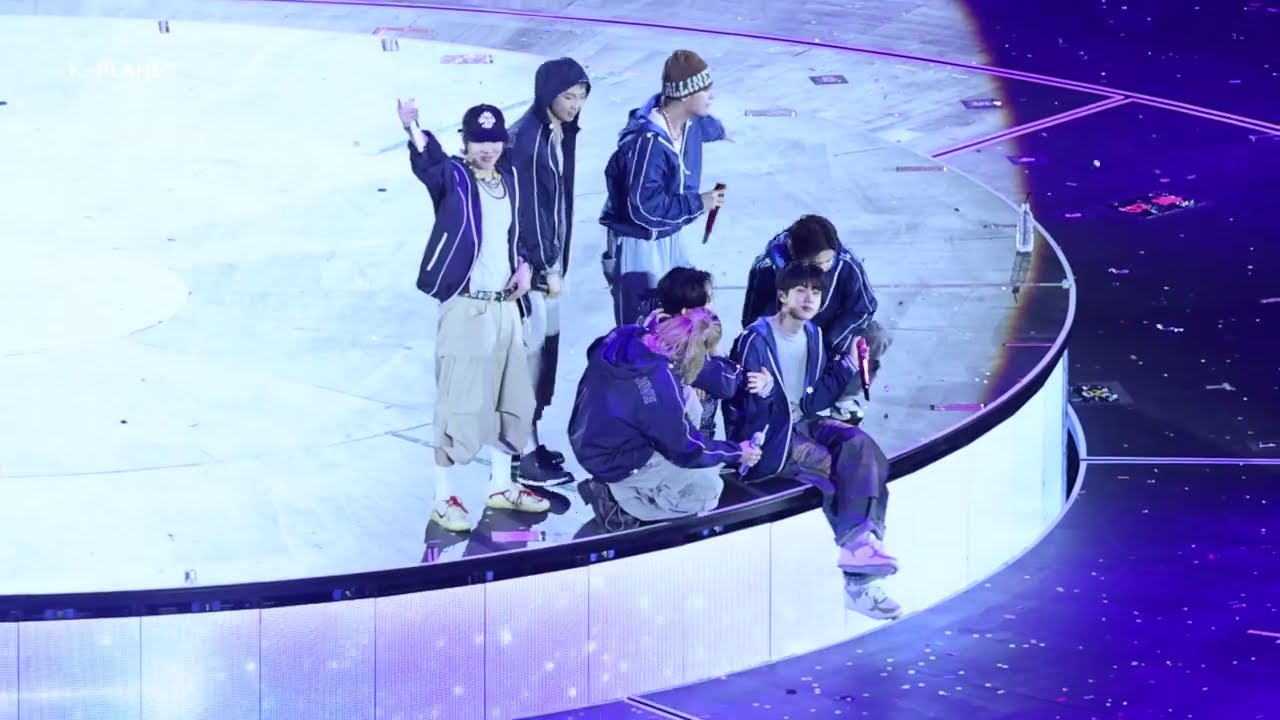
The Busan encore turns the song’s private request into a stadium-sized problem. Seven people are back together, thousands of fans are asking the night not to end, and everybody knows the schedule will still win. BTS keep the performance moving instead of drowning it in farewell drama. That choice makes the request feel more honest.
Overall vibe: fantasy with an expiration time
The production is built around bright, house-leaning synth color instead of a giant dramatic ballad arrangement. Diplo, Pdogg, and NITTI keep it moving, which is almost rude considering the emotional premise. The beat says the night is still alive. The words know it is ending.
That tension keeps “One More Night” from becoming syrup. It is romantic without pretending romance can stop daylight. The song lives in the tiny, irrational space where you know goodbye is coming and ask the universe to misplace the clock anyway.
The hook vibe: not “stay forever.” That would be too easy. It is “give me one more night,” which is smaller, sadder, and somehow more dangerous because it sounds possible.
The hook: repetition doing emotional labor
The central phrase is deliberately simple. BTS do not over-explain the request; they circle it. Repetition turns “one more night” from a casual invitation into a thought somebody cannot stop thinking. The melody keeps the plea light enough to sing along with while the arrangement leaves a little ache underneath it.
This is one of those hooks that can sound pretty in the car and mildly devastating when you read the emotional paperwork. It also fits the group unusually well in 2026. After military service, solo chapters, reunion expectations, and a comeback carrying the weight of an institution, “one more night” can be heard as romance, fandom, memory, or seven people asking for another pocket of time before the machine starts moving again.
Lyrics and meaning: the morning is the villain, sort of
The song opens with the awareness that crying and parting are ahead. From there, the language reaches for fantasy: moonlight, Selene, the protected unreality of night, and the anxiety of whatever morning will require. Selene is the Greek moon goddess, which gives the track a mythic little shimmer without turning it into homework. Night becomes a shelter. Morning becomes consequence.
I do not read the song as denial so much as controlled postponement. The narrator is not claiming the relationship-or this perfect moment-can survive untouched forever. They want one last protected stretch before reality resumes. That is a very adult kind of longing. It is not clean, heroic closure. It is bargaining.
The “video” presentation: official audio, not a fake MV
Important receipt check: the official BANGTANTV upload is an official audio presentation, not a narrative music video. I am not going to invent cinematography that does not exist just to fill a template. The artwork and official upload give the song a visual home, but the storytelling is carried by the sound, album sequencing, and lyric imagery.
That actually suits this track. A glossy plot-heavy video could have locked the fantasy to one couple or one storyline. The official audio leaves enough air for fans to attach the song to their own goodbyes, reunions, enlistment memories, or the simple horror of a perfect night ending because apparently time has rules.
Easter eggs and album placement
The moon file
Selene and moonlight are not decorative sparkles. They make night feel like a separate jurisdiction where ordinary consequences are temporarily suspended. The request is not only for another date. It is for another interval inside that protected world.
The late-album turn
Track 12 comes after “they don’t know ’bout us,” then hands the album to “Please” and “Into the Sun.” That sequence moves from private defiance to bargaining to direct pleading and, finally, daylight. “One More Night” is the hinge.
Who built it-and why the credits matter
Diplo, Pdogg, and NITTI produced the track. The credited writers include RM, SUGA, j-hope, Thomas Pentz, Pdogg, Beau Nox, Richard Mears IV, and Ant Clemons. That mix explains some of the song’s shape: a global pop-house frame, BTS members inside the writing room, and Pdogg supplying the continuity that keeps the track connected to the group instead of sounding like a borrowed producer demo.
The member writing credits matter because the song arrives in an album explicitly framed as a return and a reflection on identity. I am not pretending every line is an autobiographical diary entry, but RM, SUGA, and j-hope participating in the writing gives the central request extra weight. These are three members who have spent years writing about time, separation, ambition, memory, and the cost of moving forward.
What I love
- The restraint. The song does not throw a choir, key change, and emotional emergency siren at the goodbye.
- The hook understands scale. Asking for one night feels more human than promising forever.
- The placement. It prepares the emotional ground for the final stretch of ARIRANG.
- The dual use. It works as a romantic song, but BTS history lets fans hear reunion and impermanence inside it too.
What gets my side-eye
I wanted one more sharp lyrical detail-something tactile and specific enough to make this particular night impossible to confuse with anybody else’s. The moon/fantasy language is pretty, but pretty language can float away if the performance does not pin it down. BTS largely manage that with tone and group history, yet the writing occasionally chooses universality where I wanted one messy fingerprint.
Also, the polished house-pop surface may be too neat for listeners who wanted the late album to crack open completely. I get it. The ache is tucked under the beat instead of sitting in the middle of the floor crying. Personally, I like that choice more than I resent it.
The cultural and interpersonal lens
Night creates temporary permission. Social roles soften, schedules lose authority, and people say what daylight makes awkward. In a culture shaped by long work hours, military duty, group responsibility, and tightly managed public life, one more night can mean one more interval before everybody returns to the role waiting for them.
From a Buddhist lens, the request is impossible and completely human. Impermanence gives the night its value, yet the mind still bargains. The song does not solve that contradiction. It dances inside it.
At the interpersonal level, asking for time is gentler than demanding permanence. The narrator knows morning belongs to both people. Love cannot confiscate tomorrow. It can only ask whether tonight still has room.
The macro story: time is the real celebrity manager
BTS returned to an industry that treats every hour as inventory. Teasers, stages, interviews, travel, metrics, and fan expectations can consume a reunion before the people inside it finish arriving. The song’s fantasy is not only romantic. It imagines time that has not yet been assigned a deliverable.
That is the quiet satire. A global group asks for one more night, and somewhere a calendar is already opening a spreadsheet. Morning is not evil. Morning just has excellent project management.
Seven voices hear the clock differently
RM approaches the extra night like a bargain he knows cannot be enforced. His tone keeps the request self-aware. Jin gives the melody the open ache it needs, while SUGA makes the limited time sound expensive. He rarely lets comfort forget the receipt.
j-hope keeps motion under the sadness. The song is asking for time, not a funeral. Jimin makes closeness feel immediate and breakable. V gives the night its lower temperature, and Jung Kook keeps the emotional center steady enough for the arrangement to breathe. The members do not sing one identical goodbye. They sound like seven people negotiating with the same dawn.
Scarcity makes ordinary time look holy
The song does not ask for a palace, a perfect future or a public promise. It asks for one more night. That scale is why the feeling lands. People often recognize value only when time receives an ending. The last meal before deployment, the final night in an old house, the airport ride after a reunion: ordinary hours become ceremonial because everybody can see the edge.
From my military lens, departures are full of terrible efficiency. Bags get weighed, alarms get set, documents get checked and families try to compress months of feeling into a few hours. Nobody says the perfect thing. People watch television, wash dishes or argue about something small because the body cannot remain inside a grand goodbye all night. “One More Night” understands that intimacy often hides inside ordinary behavior.
A Buddhist reading sees the problem immediately. The speaker wants to extend a moment because the moment cannot stay. Attachment creates the ache, but impermanence creates the value. If the night could last forever, it would stop being this night. The song does not solve that contradiction. It makes the listener sit beside it until morning.
The industry keeps monetizing reunion and absence together
K-pop sells presence through concerts, lives, messages, photos and constant content. It also sells absence through countdowns, hiatus narratives, enlistment clocks and comeback anticipation. Fans are taught to experience time with an artist as both relationship and product schedule. “One More Night” can feel private while arriving inside that machinery.
That does not make the emotion fake. It means sincerity and commerce share the room. BTS can genuinely understand separation while HYBE understands the value of a reunion-era song about limited time. The listener does not have to choose between naïve belief and total cynicism. Both structures exist.
The track earns trust because it avoids promising permanent access. One more night is specific, finite and honest. The members cannot offer forever as a service plan. They can offer one song that acknowledges why people keep asking the clock to slow down.
Final verdict
8.4/10. “One More Night” is not the loudest song on ARIRANG, and it should not be. It is the breath held before “Please” and the last moonlit argument before “Into the Sun.” BTS make postponement sound sweet, self-aware, and just unreasonable enough to press replay.
Keep following the BTS file
BTS group profile · RM · Jin · SUGA · j-hope · Jimin · V · Jung Kook
Receipts and official listening
The canonical live-performance still is stored in the CVM Sekai Media Library with its fan-cam source and local-master record.RaeRae verdict
This exact upload earns the replay because BTS keep seven individual roles inside one shared argument. The companion performance remains useful context, but it no longer competes with the canonical file or turns one React into two reviews.