
BTS Merry Go Round Audio React: Nostalgia Refuses to Move in a Straight Line
Merry Go Round uses circular motion for memory, fame, and the relationships that keep returning with new faces. The official audio is warm enough to comfort and uneasy enough to distrust the ride.
Release file
Released: March 19, 2026
Runtime: 03:50
Artist / channel: BTS / official upload
Exact-file focus: Exact official Merry Go Round audio. The later Goyang fan recording is excluded from the canonical file.
A pretty psychedelic ride about adulthood, fame, pain, caffeine and the deeply inconvenient discovery that the exit button is decorative.
Bottom line: the music floats like a carnival viewed through sleepy purple fog while the words quietly have a breakdown. Kevin Parker brought the Tame Impala shimmer. BTS brought the adult realization that you can grow up, achieve everything, and still circle the same question until your brain files a noise complaint.
“Merry Go Round” follows “SWIM” and opens the album’s more introspective second half. That placement is not an accident. “SWIM” chooses movement through fear; this song admits movement can also be repetition. You can travel the world and still end up facing the same ache from a different hotel room.
What changed every time I replayed it
First intake: Kevin Parker’s psychedelic glow hit before the sadness did. The track floats, sparkles and politely offers you a seat. Then BTS start talking about growing older without arriving anywhere emotionally. That is when the carousel music stops sounding cute. It becomes the soundtrack for adults who achieved the plan and still cannot find the exit.
Second intake: The repetition started earning its keep. “Round and round” is not filler. The phrase acts out the problem. The melody circles because the mind circles. Fame changes the scenery, but it does not automatically change the thought waiting at the next turn. BTS have crossed borders, eras and life stages. The song asks what happens when the same private fear keeps buying a ticket.
Third intake: I paid attention to the space around the voices. The production never crushes them with drums or forces a giant stadium climax. It leaves room for fatigue. That restraint lets small vocal textures matter: a breath, a softened ending, a line that sounds half awake. The music stays beautiful because burnout rarely arrives wearing a villain cape. Sometimes it arrives with good lighting and an excellent synth.
Later replay: The title became less about being trapped and more about choosing when to step off. A merry-go-round is movement designed to return you to the same place. That makes the song a sly companion to the rest of ARIRANG, where movement, home and identity keep arguing over who gets to define progress.
Watch the loop become physical
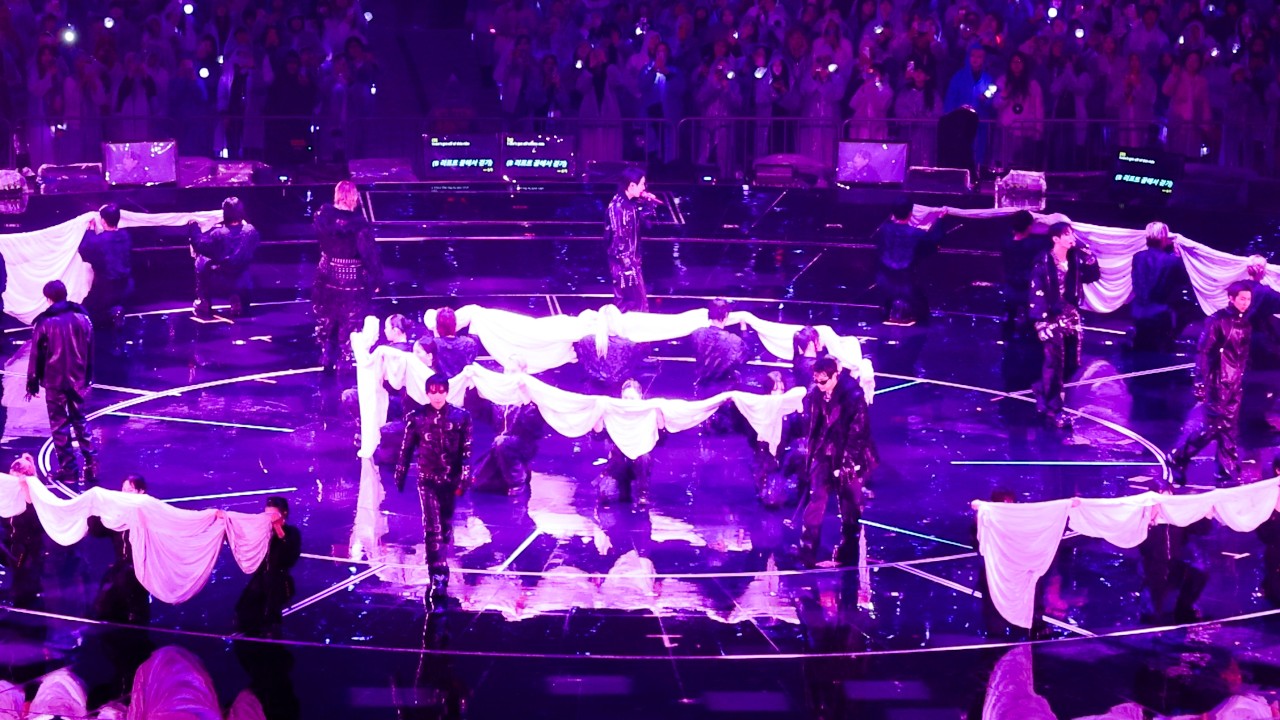
The Goyang stage makes the metaphor visible. Seven members keep moving through the same circular pattern while the crowd gives repetition the force of ritual. The choreography looks controlled, but that control is exactly the trap the song describes. A routine can be beautiful, profitable and exhausting at the same time.
Overall vibe: psychedelic pop wearing funeral eyeliner
The track moves at an unhurried pulse, with hazy synthesizers, rounded bass, guitar color and a slightly woozy sense of gravity. Sam Homaee and Sarah Aarons co-produce with Kevin Parker, whose psychedelic fingerprint is obvious without swallowing the group. The arrangement keeps circling instead of delivering a clean dramatic release. Of course it does. The production is the metaphor.
The vocals are dreamy, but the dream is not peaceful. Layers drift around the beat while the chorus repeats the inability to step off. The prettiness creates distance from the panic, which makes the panic worse. This is anxiety music for people who still have meetings at nine.
The hook vibe: a carousel melody that understands the lights can be beautiful and the ride can still be a trap.
The hook: repetition earns its paycheck
A song about circular motion is allowed to repeat itself. Here, the central phrase returns until it stops sounding like description and starts sounding like proof. The narrator tries, the ride continues, and each pass through the chorus reproduces the problem.
The melody does not climb toward escape. It settles into the loop. That is why the song can feel comforting on a casual listen and miserable when the words register. The body gets a gentle sway. The mind gets trapped at the ticket booth.
Lyrics and meaning: adulthood did not solve the original problem
The Korean verse is the key. The speaker feels grown, but the worries remain. Daily life resembles both a carousel and a hamster wheel; people run through a maze of questions while smiling as if everything is fine. That is not only celebrity commentary. It is painfully ordinary adulthood.
Then BTS scales the metaphor up to their own life. The broken roller coaster is unpredictable and dangerous; the merry-go-round is predictable and impossible to leave. Fame contains both. The schedule changes cities, outfits and audience sizes, but the machinery of performance keeps rotating.
The late images get darker: a bed compared to a coffin, a world powered by caffeine, the mind thinking about not thinking. The childish carousel becomes burnout with painted horses. When the lyric asks a mother to take the rider out, the adult voice briefly reaches backward for the person who once had authority to end the ride.
The title is doing two jobs
The public machine
BTS entered an idol system built on cycles: comeback, promotion, tour, content, rest just long enough to photograph, repeat. Military service interrupted the group calendar but did not magically make the machine disappear.
The private mind
The ride is also rumination. The outro turns thought against itself: trying not to think becomes another thought. A person can leave the stage and carry the carousel home inside their skull.
The official visual file: audio first, video later
The original March release was official audio through BANGTANTV, not a narrative music video. That is the artwork stored locally for this post. I am not replacing missing March cinematography with invented camera notes.
A later monochrome visual expanded the song’s imagery through an isolated, almost cosmic carousel world. Fans immediately began mapping horses, stars, separation and reunion back onto BTS history. The safest reading is the obvious one: seven people can occupy the same machine and still experience the loop alone. The more specific HYYH and constellation theories are fan interpretation unless the director or label confirms them.
The Jin horse question, because fandom has priorities
When a visual places Jin close to carousel-horse imagery, ARMY will create a case file before breakfast. The horse can suggest innocence, duty, performance or being fixed to a beautiful mechanism. It can also be a production choice that looked good in monochrome. I enjoy the symbolic reading; I am not subpoenaing the prop department.
What does matter is that the carousel turns childhood entertainment into adult confinement. A painted horse looks free while traveling nowhere. That is a very efficient image for performers whose work has carried them around the planet.
Who built it, and why the credits matter
Sam Homaee, Sarah Aarons and Kevin Parker produced the song. The writing and composition credits include Homaee, Aarons, Gregory “Aldae” Hein, Parker, RM, SUGA, j-hope, Derrick Milano and Pdogg.
Homaee is credited on synthesizer, drums and guitar. Aarons and Aldae add background vocals, while Parker supplies guitar, bass and synthesizer. RM and Jung Kook also carry background-vocal credits. Pdogg and GHSTLOOP recorded the track; GHSTLOOP handled vocal production, Alex Ghenea mixed it, Jack Normile assisted, Mike Bozzi mastered, and Yang Ga handled immersive mixing and mastering.
The rap-line writing credits matter because the Korean sections contain the song’s sharpest lived detail. I will not assign individual lines without a documented breakdown, but RM, SUGA and j-hope have written about cyclical labor, ambition, exhaustion and the fear of stopping for years. The material belongs beside their history even inside Parker’s psychedelic frame.
The director’s-perspective problem
I looked for a documented director explanation before pretending the visual symbols came with an instruction manual. I found reporting and fan analysis, not a reliable full production commentary. So the article keeps those categories separate. A fan theory can be brilliant without becoming a quote somebody never gave.
That distinction is part of the fun, not a buzzkill. Receipts tell us who made the record and what the lyric says. Fandom gets to argue about horses, stars, HYYH echoes and whether the carousel represents BTS, ARMY, the industry, the mind or all four sharing one deeply cursed season pass.
What I love
- The contradiction. The sound is beautiful enough to make captivity seductive.
- The Korean verse. It moves the song beyond generic fame fatigue into recognizable adult repetition.
- The caffeine line. Finally, representation for my bloodstream.
- The structure. The track circles instead of performing a fake breakthrough.
- The credits. Kevin Parker’s texture and BTS’s emotional history actually meet instead of standing in separate rooms.
What gets my side-eye
The haze can become too tasteful. Pitchfork heard diluted psychedelia; I understand the complaint even though I like the track more. There are moments when the production feels content to signal Kevin Parker instead of forcing the song into stranger territory.
I also wanted one member’s vocal to crack the loop open near the end, something ugly, close and unprocessed enough to make the coffin/caffeine images land bodily. The song tells us somebody is falling apart while the mix keeps every seam professionally ironed.
Seven people ride the same loop from different seats
RM gives the cycle a name. His delivery sounds like somebody mapping the machine while still trapped inside it. Jin brings brightness that makes the darker lyric feel more unsettling. The melody smiles while the thought keeps circling.
SUGA understands repetition as labor. His tone makes the loop feel scheduled, monetized and difficult to escape. j-hope supplies kinetic energy, which is exactly what a merry-go-round needs: movement that looks joyful even when it goes nowhere.
Jimin makes the repetition feel intimate instead of mechanical. V darkens the lower edge, and Jung Kook keeps the melodic center stable while everything around it questions whether stability is comfort or captivity.
A loop can feel safe because it never asks for a destination
The merry-go-round is a perfect adult trap. It offers motion, music, lights and a familiar seat. You can measure progress by how many times the same landmark returns. Nothing forces you to decide where you actually want to go because the ride already has a route.
That is why burnout often hides inside competence. A person keeps completing the task, attending the meeting, releasing the album and answering the message. From outside, the machine looks functional. Inside, the repeated motion may have stopped producing meaning. Success can become evidence that the loop should continue.
From a Buddhist lens, repetition exposes attachment. People keep circling because familiar suffering feels less frightening than uncertain change. The point is not that every routine is a prison. Practice can build mastery and peace. The question is whether the repetition remains chosen.
Fame turns the carousel into public infrastructure
An ordinary person can step away from one exhausting routine without millions of strangers treating the pause as a referendum. BTS cannot change pace quietly. Touring, enlistment, solo work, reunion and rest all become public narratives with financial consequences. The merry-go-round has investors.
The song works because it does not pretend individual strength can solve a structural problem. Better sleep, stronger boundaries and gratitude help, but none of them removes the schedule, the market or the public appetite. The members can negotiate the ride. They cannot behave as if the ride does not exist.
My side-eye remains with the arrangement’s restraint. The final loop should deform. Slow one element, detune one texture or let the chorus return slightly wrong. If the song is about repetition changing the rider, the music should arrive at the same place carrying visible damage.
Final verdict
9.0/10. “Merry Go Round” is one of ARIRANG’s slow-burn standouts: dreamy enough to replay, dark enough to keep unfolding, and honest enough to admit that motion is not always progress. The ride is pretty. The panic is real. Somebody find the emergency stop.
Keep following the BTS file
BTS group profile · RM · Jin · SUGA · j-hope · Jimin · V · Jung Kook
Receipts and official listening
The canonical live-performance still is stored in the CVM Sekai Media Library with its fan-cam source and local-master record.RaeRae verdict
This exact upload earns the replay because BTS keep seven individual roles inside one shared argument. The companion performance remains useful context, but it no longer competes with the canonical file or turns one React into two reviews.