
Shima’onari
He leads survivors out of Ineluki’s Asu’a, rules a hidden people for five centuries, sentences Simon to a beautiful prison, and dies helping turn Sithi memory back into action. None of those choices is morally simple.
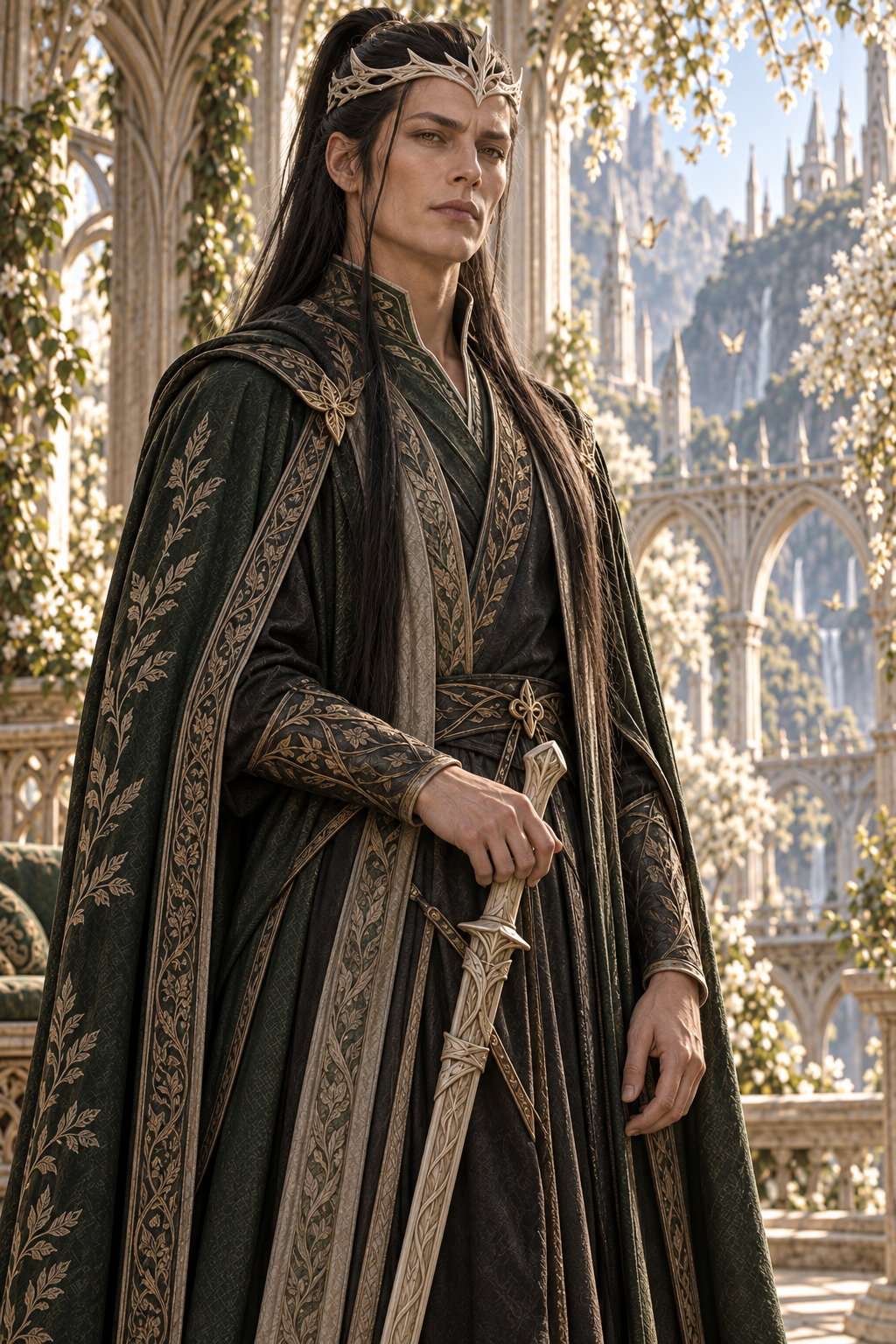
The king whose caution once saved his people and later risks becoming their cage
Shima’onari is Hakatri’s son, Amerasu’s grandson, partner of Likimeya, father of Jiriki and Aditu, and king of the Zida’ya after the fall of Asu’a. He belongs to the generation old enough to remember the Gardenborn city before mortal conquest, yet his defining act is not dying beautifully beside it. He helps Amerasu lead survivors into Aldheorte after Ineluki murders Iyu’unigato and crowns himself.
That history makes caution more than cowardice. Shima’onari has watched a brilliant prince turn desperate resistance into patricide and Unbeing while Rimmersmen burn those left behind. Secrecy, law, retreat, and the hidden city preserve lives for five centuries. The profile’s central question is therefore not why he fears mortal intrusion. It is when a survival system stops responding to the world that justified it.
When Simon arrives in Jao é-Tinukai’i, Shima’onari can honor the White Arrow bond and imprison its bearer in the same judgment. When Amerasu brings new evidence, he must decide whether protection has become dangerous delay. When the attack arrives, he fights Niku’a and takes a mortal wound. His final movement is from guarding survival to spending himself so survival still has a future.
Leaving Asu’a is not surrender; it is refusal to let Ineluki own every survivor
During the siege, Hakatri has already departed west in unending pain. Ineluki becomes heir, poisons witchwood with iron, forges Sorrow, and kills Iyu’unigato when the king orders the weapon destroyed. The prince then crowns himself and continues the defense with the Red Hand.
Shima’onari and Amerasu lead surviving Sithi away. The decision means abandoning a beloved city while Fingil’s armies wait outside and Ineluki turns resistance into personal rule. Those who cannot or will not leave are burned or slaughtered when Asu’a falls.
The exodus becomes the moral foundation of Shima’onari’s later kingship. He knows preserving people may require releasing place, title, and the fantasy of glorious last stands. Jao é-Tinukai’i grows from that refusal. The hidden city is not escapist decoration; it is the material result of survivors choosing continuation over Ineluki’s annihilating definition of loyalty.
But successful emergency structures acquire sacred authority. Five centuries later, the rules that kept mortals out cannot automatically distinguish Simon from Fingil. Shima’onari must judge a new person through a law built from an old army.
History, judgment, war council, and a death that changes the Houses
Book 1: survivor history explains the Sithi who remain
Jarnauga’s history places Shima’onari beside Amerasu during the fall of Asu’a. Hakatri’s son carries the family line away from the uncle who transformed grief into Sorrow. The detail prevents the city’s history from becoming a duel between conqueror and doomed king. Another Sithi future leaves through the forest.
Jiriki’s presence on Simon’s road reveals the result. The prince can offer White Arrow protection, question inherited assumptions, and still feel binding obligation to the House of Year-Dancing. Shima’onari’s survival politics have preserved a community strong enough for younger people to disagree with it.
Book 2: the hidden king receives an impossible guest
Jiriki invokes Simon’s Hikka Staja status to bring him beneath the Summer Gate, violating an ancient tradition. Shima’onari appears with jet-black hair tied high, a carved white-birch crown, angular golden features, narrow eyes, thin mouth, and an ancient air shaped by subtle disappointment.
His judgment is a perfect knot of gratitude and confinement. Sithi honor protects the Arrow-Bearer. The mortal may not be harmed or casually expelled. Yet bringing him into the hidden city violates every law as Shima’onari understands it. Simon may remain, grow old, and die there—but never leave.
The sentence is not presented as cartoon tyranny. Jiriki did gamble with Simon’s freedom. Mortal discovery has historically brought iron and death. Still, safety without consent is imprisonment, even when the prison is the most beautiful place Simon has seen.
Amerasu’s reading of Simon changes the stakes. She understands Ineluki’s design is graver than believed and must persuade Shima’onari and Likimeya before time runs out. The gathered butterflies at the Yásira reflect decisions still unresolved. Then Utuk’ku answers through the Witness network and the physical attack begins.
Shima’onari fights the giant white hound Niku’a and kills it, receiving a mortal wound. Ingen Jegger murders Amerasu. Her death crosses the line withdrawal could not protect. Shima’onari and Likimeya honor her last wish by releasing Simon and begin the first Sithi war councils since Asu’a’s fall.
Books 3 and 4: his absence is carried by a people who finally move
Jiriki reveals his father is dying as armored Houses gather beneath the silver leaves. Amerasu’s assassination and Shima’onari’s sacrifice reunite groups separated for centuries. Their movement is not a magical cavalry reward delivered to mortals. It is the Gardenborn reckoning with the failure of distance.
Likimeya assumes visible command. Jiriki argues for responsibility toward mortals and the Tinukeda’ya. Aditu carries Amerasu’s message and fights. Their differing approaches show Shima’onari did not leave a single doctrinal replacement. He leaves people who must continue governing without the king whose cautious authority organized exile.
The final victory validates neither total withdrawal nor careless intervention. The Sithi lose Amerasu, Shima’onari, Zinjadu, Kuroyi, and others. They also prevent Utuk’ku and Ineluki from turning preserved grievance into Unbeing. Shima’onari’s death belongs to the cost of revision, not proof his earlier caution was foolish.
Hospitality becomes coercion when the guest is never allowed to leave
Simon reaches Jao é-Tinukai’i because Jiriki’s debt and Aditu’s rescue make him exceptional under Sithi custom. Shima’onari respects that status. He does not call for execution or hand Simon to Khendraja’aro’s anger. He gives protection within the city.
The cost destroys the distinction between sanctuary and captivity. Simon’s mortal lifespan makes “stay forever” sound small to beings who experience centuries, but it consumes his entire possible future. Jiriki’s horror confirms this was not the price he intended to impose.
Shima’onari later releases Simon under Amerasu’s last wish. The change is not personal affection magically curing policy. New evidence, direct attack, family death, and the collapse of strategic assumptions force the ruling house to revise. Simon leaves because Sithi authority finally admits the crisis cannot be contained behind the Summer Gate.
The surviving branch is a family of political disagreement
Hakatri is his absent father and the original heir whose dragon wound shapes Ineluki’s fall. Shima’onari inherits leadership through catastrophe rather than ordinary succession.
Amerasu is grandmother, co-leader of the Asu’a exodus, elder, and the person whose final warning breaks the impasse. Her murder makes family loss inseparable from state decision.
Likimeya shares rulership and later leads the visible war. Their partnership survives in the political continuity she carries after his death.
Jiriki challenges inherited withdrawal through friendship with Simon. Shima’onari’s judgment wounds that trust, yet the son’s disagreement also proves the hidden community has not become ideologically frozen.
Aditu becomes messenger, diplomat, healer, and fighter. Like Jiriki, she carries family identity into relationships the old laws could not have anticipated.
He makes “the isolationist elder” historically serious instead of conveniently wrong
Shima’onari’s laws helped a persecuted people survive. That truth prevents easy mockery. The same laws later imprison an ally, slow response, and underestimate the ability of hostile power to breach sanctuary. That truth prevents reverence.
His arc is about institutional time. A rule can be morally intelligible when made and coercive when preserved beyond its evidence. Leaders who remember the founding catastrophe may be least willing to notice when conditions change, because revision can feel like betrayal of everyone the rule once saved.
Shima’onari ultimately revises through action. He fights the weaponized creature that enters his hidden home, releases Simon, and commits the Houses to council. He dies without receiving proof that the new course will succeed. Leadership here is not perfect foresight. It is accepting that yesterday’s survival method cannot become tomorrow’s unquestionable law.
Scope, death, and family-consistent identity art
This profile covers Shima’onari’s verified history and consequences across all four owned Kindle volumes. Direct physical action is concentrated in Jao é-Tinukai’i; earlier and later appearances through history, family, councils, and aftermath remain clearly labeled rather than written as invented scenes.
His approved identity preserves one exceptionally beautiful mature Sitha king with very long jet-black hair tied high, an angular golden-bronze face, narrow dark-amber eyes, thin controlled mouth, powerful lean-tall build, carved white-birch crown, and ancient disappointment. Family resemblance was calibrated against the locked Hakatri, Amerasu, Likimeya, and Jiriki portraits without copying any one relative’s face.
The books specify hair, hairstyle, crown, angular golden features, narrow eyes, thin mouth, and the subtle air of disappointment. Exact face, eye color, build, garment, jewelry, sword, living architecture, butterflies, and light are editorial reconstruction. The same local attachment now governs featured image, visible hero, social image, and all scoped directory cards. Exodus leader, hidden king, judgment, and Niku’a battle milestones must use this exact face; the mortal wound may alter condition but not identity.