
Memory, Sorrow, and Thorn · Canonical Character Profile
Hylissa
Hylissa never walks into the trilogy’s present tense. Elias’s Nabbanai wife and Miriamele’s mother survives as the woman a stray arrow took, Josua could not save, Camaris secretly loved, and Pryrates may have taught a grieving king to reach for through the Veil. Her absence is not backstory wallpaper. It is one of the hidden doors through which the entire catastrophe enters.
At a Glance
The dead queen whose loss keeps governing the living
- Origin
- Nabban; sister of Duchess Nessalanta
- Marriage
- Wife of Elias, before he becomes High King
- Child
- Princess Miriamele, her only confirmed child
- Key relationships
- Elias, Miriamele, Josua, Camaris, Nessalanta, Count Stréawe
- Death
- Killed by a stray arrow during a Meadow Thrithings uprising
- Series status
- Deceased before the main chronology; present through memory and consequence
The Evidence Problem
Everybody remembers Hylissa through what losing her did to them
Hylissa has no direct present-day scene in the four published volumes. Almost everything reaches us through family memory, court report, confession, or later interpretation. That makes attribution essential.
Sangfugol reports that Josua lost his hand trying to defend her and that some people blame her death for ending affection between the brothers. Miriamele remembers journeys with her mother and later gives Simon the family version of the fatal uprising. Elias speaks from grief and rage. Camaris offers a private confession about love he never acted upon. None of these witnesses is neutral.
A responsible profile can map where their accounts agree without pretending it knows Hylissa’s private response. The evidence establishes a Nabbanai noblewoman, wife, mother, traveler, sister, and victim of political violence. It does not give her eye color, hair color, exact age, secret diary, or confirmed romantic choice between men.
Before the Arrow
Nabban, Perdruin, Vinitta—and a childhood Miriamele remembers as movement
Hylissa is Duchess Nessalanta’s sister, connecting Elias’s household to one of Nabban’s most powerful families. Miriamele remembers traveling with her mother to Perdruin, where they visited Nessalanta and Count Stréawe. The island initially feels like a return to childhood because Hylissa once made it familiar.
Another memory places mother and daughter traveling from Nabban toward Vinitta. Seeing the sea-creatures called kilpa nearly breaks Miriamele’s later disguise because a supposed Cellodshire girl should not know them. Hylissa therefore survives in her daughter not only as grief, but as geography, observation, and knowledge.
Those journeys complicate the flattened image of “dead royal wife.” Hylissa moved through Nabbanai and southern political spaces with her child. Miriamele’s later fluency in roads, courts, harbors, and disguise grows partly from a childhood that was not confined to one northern castle.
The Meadow Thrithings
A stray arrow becomes the story everyone uses to explain two brothers
During an uprising in the Meadow Thrithings, Josua escorts or protects Hylissa on the road toward Elias. Raiders attack. Josua loses his hand defending her, and Hylissa dies from a stray arrow.
The “stray” detail matters because the catastrophe lacks a clean villain whom grief can punish. Josua gives part of his body and still fails. Elias loses his wife and has a surviving brother whose wound permanently displays both loyalty and failure. Court memory turns that impossible shape into a simpler story: perhaps Hylissa’s death destroyed the brothers’ affection.
That is reported interpretation, not a confession from either man. Their estrangement has political, temperamental, dynastic, and supernatural dimensions. Hylissa’s death deepens the fracture; it should not be used to erase every choice they make afterward.
Camaris’s Confession
The legendary knight reveals a love story that Hylissa herself never gets to confirm
Camaris later tells of loving Hylissa and believing she loved him. He wishes they had betrayed Elias and fled together. The confession adds a painful secret to the triangle around her death, but it remains Camaris’s testimony.
The distinction is not pedantic. “Camaris believes Hylissa loved him” is supported. “Hylissa planned to leave Elias” is not. The woman at the center receives no direct speech confirming what she wanted. Her profile must not turn a man’s regret into her biography.
Camaris’s account does reveal how thoroughly Hylissa’s loss marks the older generation. The greatest knight in Osten Ard carries not only battle trauma and vanished identity, but an imagined alternate life in which love outran loyalty. Elias carries a different alternate life: the wife who should still be beside him and the son she might have borne.
Mother and Daughter
Miriamele inherits memories, political kinship, and the burden of explaining her father’s grief
Miriamele remembers Hylissa through places before she fully understands the political machinery around the death. Perdruin brings back warmth, then collapses into the journey on which her mother died and Josua was maimed. The past is never a sealed childhood room; every return opens it.
She tells Simon that Elias grieved more deeply than she did. That admission does not diminish a child’s loss. It recognizes that her father’s mourning became the emotional climate in which she grew up. Elias refused to remarry and told John that God had given him one wife and taken her back.
Miriamele eventually interprets the entire crisis through that grief. After hearing Cadrach’s account of Pryrates, Nisses’s book, torture, and Speaking through the Veil, she infers that Pryrates promised Elias contact with Hylissa. She believes grief made her father first Pryrates’s patron, then partner, then slave.
It is Miriamele’s inference, not a witnessed contract. Yet it aligns enough of the evidence that she hopes reminding Elias the catastrophe began in love might still make him stop.
Elias After Hylissa
Love explains the wound; it does not acquit the king
Elias refuses another wife. Later, looking at Simon, he imagines that Hylissa might have borne him a son like the red-haired boy. He says a son was what he needed: someone to raise, trust, and make heir. In the same breath, he treats Miriamele as an insolent failure for refusing the future he designed for her.
The moment exposes how grief curdles into entitlement. Hylissa becomes an imagined source of the obedient male heir history denied him. Miriamele, the actual child Hylissa bore, is punished for being herself rather than the replacement Elias wants.
At the final confrontation, Elias blames Josua for Hylissa, the throne, and Miriamele while attacking with Sorrow. Three distinct losses become one accusation against his brother. That emotional truth is real to Elias; it is not factual absolution. Pryrates may exploit mourning, but Elias repeatedly chooses coercion, murder, and the sword.
Connections
The family tree is also the fault line
Elias
Husband who refuses remarriage, longs for the son they never had, and may accept Pryrates’s promise of contact beyond death.
Miriamele
Daughter whose childhood travels, southern knowledge, and attempt to understand Elias keep Hylissa present.
Josua
Brother-in-law who loses his hand defending her and becomes the target of Elias’s unresolved blame.
Camaris
Legendary knight who confesses love and believes it was returned, without Hylissa’s own testimony surviving to confirm it.
Nessalanta
Sister and Duchess of Nabban, connecting Hylissa and Miriamele to the Sancellan’s dynastic power.
Count Stréawe
Perdruin host associated with Hylissa and Miriamele’s childhood visits—and with Miriamele’s later dangerous return.
Why She Matters
The series makes absence active without giving absence a false voice
Hylissa helps explain why the political crisis feels intimate before it becomes cosmic. A dead wife links Elias’s grief, Josua’s hand, Miriamele’s childhood, Camaris’s regret, Nabban’s dynastic network, and Pryrates’s occult opportunity.
But explanation is not agency. Because Hylissa cannot answer, living characters repeatedly shape her into what they need: lost wife, failed rescue, forbidden beloved, childhood safety, possible voice beyond the Veil, mother of an imaginary son. The most ethical reading notices the pressure without claiming to recover a private woman the text has not directly preserved.
Her profile therefore matters as much for its boundaries as its revelations. A fandom hub can be comprehensive without filling silence with confidence. Here the rabbit hole is not “what Hylissa secretly thought.” It is how many people build futures out of the same irretrievable past.
On the Record
Scope, status, and visual boundaries
This is Hylissa’s one canonical full-spoiler historical profile. She is dead before The Dragonbone Chair begins. Books 1–4 retain scope because her death, Miriamele’s memories, Camaris’s confession, Elias’s motives, and the final confrontation keep her narratively active.
The evidence confirms Nabbanai origin, marriage to Elias, motherhood of Miriamele, sisterhood with Nessalanta, travel to Perdruin and toward Vinitta, and death by stray arrow during a Thrithings uprising. Camaris’s belief that she returned his love and Miriamele’s belief that Pryrates offered Elias contact are explicitly attributed interpretations.
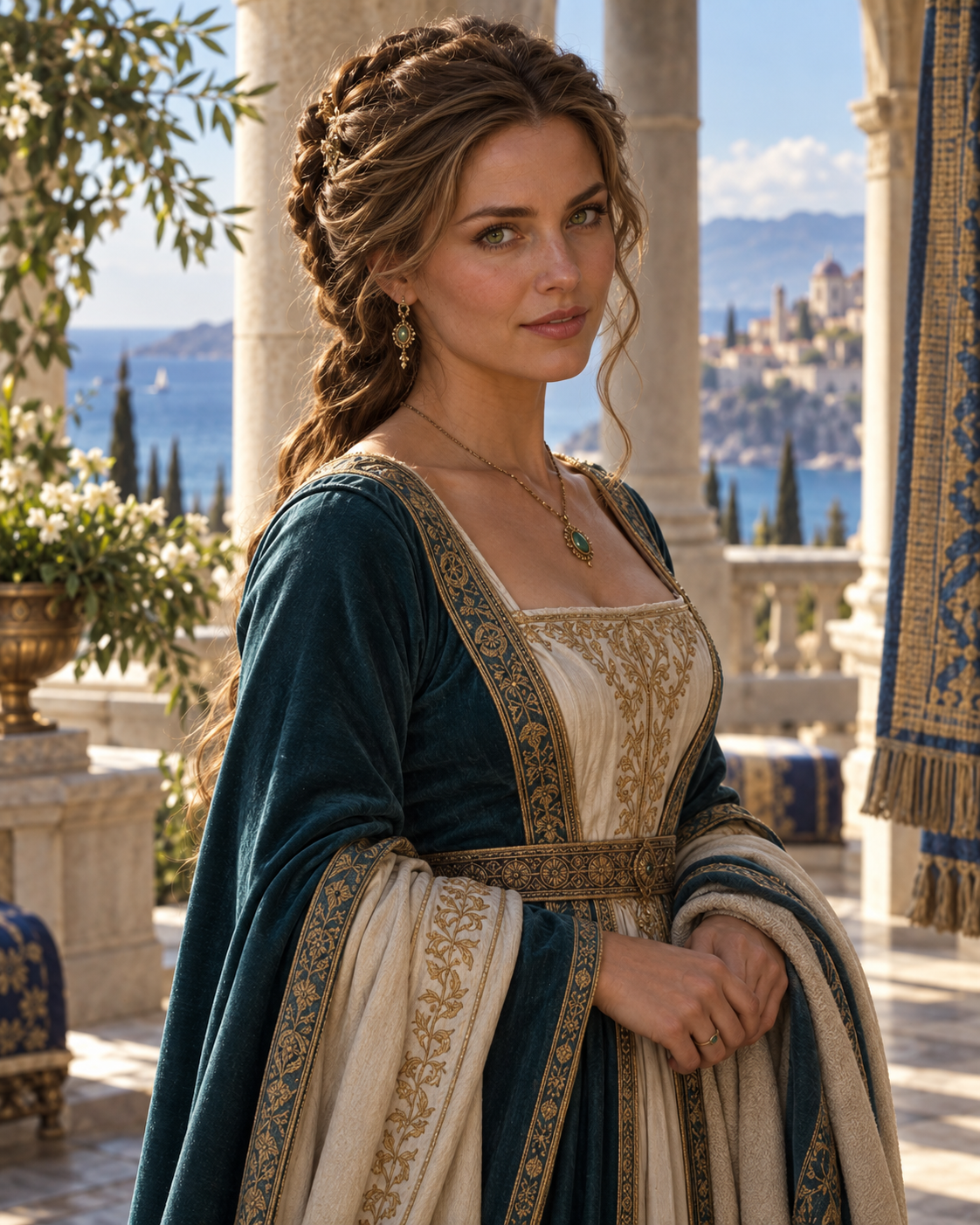
No reliable physical description is recorded in the reading ledger. Her approved dark honey-brown hair, hazel-green eyes, softly olive complexion, apparent age, and Nabbanai court dress are therefore editorial reconstruction, not textual fact. This one identity now governs every family memory, travel scene, death reconstruction, Veil motif, directory card, hero, and social image.