
Father Dinivan
A homely young priest with a dangerous address book turns pastoral care into intelligence work, smuggles a princess through a collapsing Church, and spends his final breath making sure the message keeps moving.
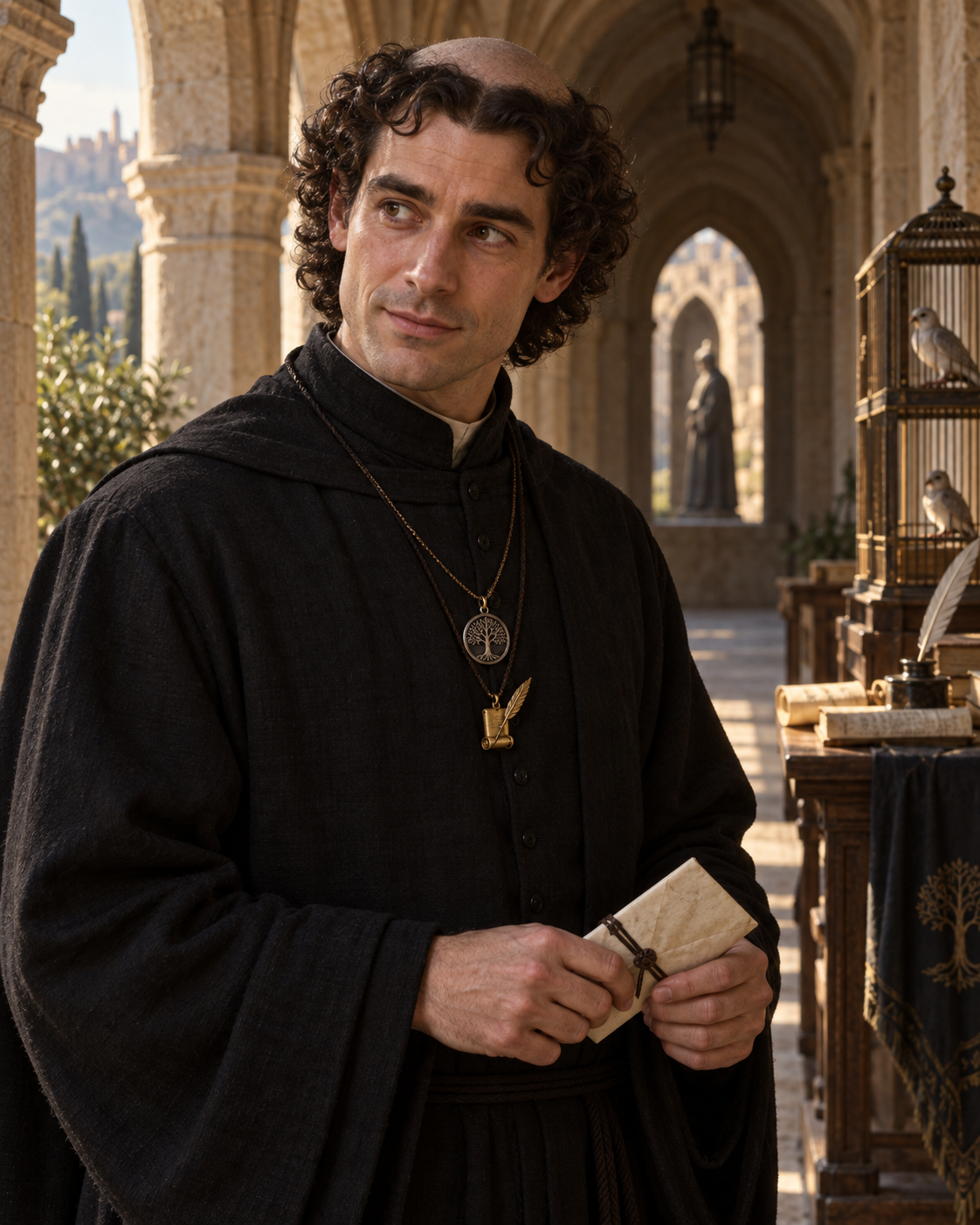
The messenger knows information only matters if somebody survives to receive it
Father Dinivan is Lector Ranessin’s private secretary, a priest of Mother Church, a member of the League of the Scroll, a quiet political operator, and one of the most efficient human links in the resistance network. He does not command an army or carry a Great Sword. He remembers who needs warning, which door remains usable, what name can travel safely, and how to pass a mission onward when he will not live to finish it.
He is young, tonsured, curly-haired around the shaved crown, bushy-browed, homely, intelligent, dressed in plain black, and armed with self-deprecating humor. His care for Ranessin appears through fussing, argument, and a steady hand in a dangerous crowd rather than devotional posing.
Dinivan’s courage is administrative in the best possible sense. He coordinates people, birds, symbols, sanctuaries, aliases, and unfinished duties while institutions around him are being captured. When Pryrates finally destroys his body, Dinivan’s network still outruns the murder.
A short life with consequences in every volume
Book 1: the aide watching the weather change inside the Church
Dinivan arrives at Prester John’s funeral beside Lector Ranessin. He jokes about outpacing the guards while keeping a protective grip on the older man through wind and crowd. Ranessin teases him like a seminary boy; Dinivan privately measures the lector as hard, careful, and respectful enough to deserve loyalty.
In Nabban, Dinivan becomes Eolair’s cautious source. He confirms Leobardis has not submitted to Elias, shares the fear that the conflict runs deeper than ordinary succession, and reveals only what he can safely reveal about Devasalles’s embassy. His political maxim is pure Dinivan: meet swords ready, but receive gifts from the walls while throwing stones. He is not cynical about hospitality. He is experienced about packaging.
Book 2: sanctuary becomes a countdown
Dinivan helps bring Miriamele to Ranessin under the name Malachias and recognizes that something of the former Scrollbearer Padraic may still survive inside Cadrach. He neither excuses Cadrach’s betrayals nor accepts Cadrach’s claim that the responsible man is completely dead. Staying with Miriamele after taking Stréawe’s money counts as evidence that choice remains possible.
Dinivan has already sent warnings to Jarnauga, Binabik, Geloë, and Tiamak. Pryrates answers by arranging crumbs and olive pits into “SCROLL PIG,” proving he knows Dinivan’s secret. The insult also exposes the League’s failure: its members admitted the brilliant young priest, recognized his corruption too late, and expelled him only after he had learned enough to hunt them.
At the Sancellan, Ranessin rejects Pryrates’s ultimatum and excommunicates the priest, Elias, and their knowing followers. Afterward Ranessin admits resistance may change nothing. Dinivan returns his teacher’s own lesson: “There is always hope.” It lands because neither man is pretending hope means safety.
Pryrates attacks, murders Ranessin, crushes Dinivan’s body, and begins the false Fire Dancer story before the dead can be heard. Isgrimnur finds Dinivan still alive. The priest directs him toward Miriamele, Kwanitupul, Pelippa’s Bowl, and Tiamak; warns Josua about false messengers; and gives him the golden scroll-and-quill pendant meant for Tiamak. He dies routing the future.
Books 3 and 4: the dead messenger keeps arriving
Tiamak receives Dinivan’s pendant and the recognition he wanted only after the mentors who might have welcomed him are dead. The gift is both admission and burden. It helps form a new League generation with Binabik and Strangyeard rather than preserving the old organization as a memorial display.
Dinivan’s birds and letters continue shaping decisions. One unsigned message marked with Nabban’s ancient rune for “Friend” tells Josua the Benidrivine house may be vulnerable and to wait for a messenger. The resistance treats it correctly as both possible lifeline and possible trap until evidence arrives.
Pelippa’s Bowl links Isgrimnur to Tiamak and Camaris. The warning about false messengers becomes critical to understanding the enemy’s strategy. Dinivan does not haunt the later books as a ghost. He persists as infrastructure built carefully enough to survive its builder.
Knowledge conservation without the fantasy that scholars are automatically good
The League exists to preserve knowledge threatened by conquest and use it when necessary. Dinivan’s membership ties him to Morgenes, Jarnauga, Tiamak, Geloë’s wider circle, and the damaged man once called Padraic. It also ties him to the League’s greatest institutional mistake: Pryrates.
Dinivan understands that information must travel through imperfect people. Cadrach drinks, steals, lies, and still may carry one necessary act. Tiamak is kept at the edge by drylander prejudice and still becomes essential. Birds die. Notes arrive damaged. Sources must remain protected even from trusted leaders. This is intelligence work stripped of glamorous omniscience.
His pendant matters because it transfers responsibility instead of merely honoring membership. Tiamak does not receive a gold participation ribbon. He receives a network with most of its elders murdered and a problem that may end the world.
“There is always hope” is not the same sentence as “this will be fine”
Dinivan’s faith is practical, chosen, and willing to look directly at institutional danger. He does not claim knowledge he lacks or treat Mother Church’s prestige as evidence that it cannot be captured.
His exchange with Cadrach clarifies the theology. Love and belief require choice rather than compulsion. Cadrach’s challenge—what kind of God allows Fire Dancers and the Storm King—does not receive a cheap miracle. Dinivan answers from inside uncertainty.
The Sancellan confrontation proves the difference between optimism and hope. Ranessin names evil even when naming may not change the outcome. Dinivan preserves the possibility that action matters even when both men are about to die. Hope is the reason to send the bird, hide the princess, pass the pendant, and give Isgrimnur one more address.
The people inside the network
Ranessin is mentor, superior, friend, and the source of the lesson Dinivan gives back at the end. Their affection is visible because they can disagree without converting rank into silence.
Miriamele is not only a princess to protect. Dinivan listens to her anger about men withholding knowledge and redirects her desire to act toward work that matters.
Cadrach / Padraic becomes Dinivan’s test of whether identity can remain morally unfinished. Dinivan refuses both easy forgiveness and total erasure.
Tiamak is the distant scholar Dinivan recognizes as essential. His final pendant turns long-delayed inclusion into immediate responsibility.
Pryrates is the League’s failed judgment made flesh. Their confrontation is scholarship divided by ethics: both value forbidden knowledge, but only one treats other minds and bodies as things that retain rights.
The epic survives because somebody did the clerical work
Dinivan represents the labor grand narratives hide behind prophecy. Somebody trained the bird, encoded the warning, protected the source, remembered the safe house, identified the right recipient, maintained the alias, and carried the pendant. The heroic coalition exists because information repeatedly reaches a person who can do something with it.
He also reveals that institutions are neither automatically sacred nor automatically useless. Mother Church can be occupied, its leaders murdered, and its voice counterfeited. It can also excommunicate a king, shelter a fugitive, preserve conscience, and produce people willing to name evil before witnesses disappear.
Even his humor belongs to the work. Jokes keep rank breathable, let caution arrive without theatrical panic, and remind Ranessin that the younger priest beside him is a person rather than an obedient extension. Warmth does not distract Dinivan from danger. It is one reason his network remains human while Pryrates’s becomes machinery.
His death hurts because it does not close his work. Every later connection exposes another task he expected to help complete. Yet the unfinished network is his victory. Pryrates destroys the messenger and still cannot stop the message.
Scope, status, and identity-art lock
This profile follows Dinivan through all four owned Kindle volumes and their reference material, separating direct action from later consequences carried by letters, objects, and other characters.
One canonical post serves every volume directory. Early-book cards use the status appropriate to that scope rather than spoiling his death before readers deliberately enter complete-series material.
His locked identity preserves the same attractive but text-faithful young priest: monastic shaved crown, remaining curls worn rather long, bushy eyebrows, intelligent face, plain black cassock, quick humor, and protective attentiveness. The funeral, Nabban conversations, Miriamele journey, Sancellan confrontation, and final handoff must all remain this man.