
Memory, Sorrow, and Thorn · Canonical Historical Profile
Fingil the Bloody King
Fingil Redhand is the iron-wielding Rimmersman conqueror who names Rimmersgard, crushes the Hernystiri–Sithi alliance, besieges Asu’a for almost three years, and enters the city after Ineluki burns away his own body. Five centuries later, Fingil’s crown sits on Elias, his sword-history hides inside Bright-Nail, and every new invasion must answer the question: repetition, inheritance, or choice?
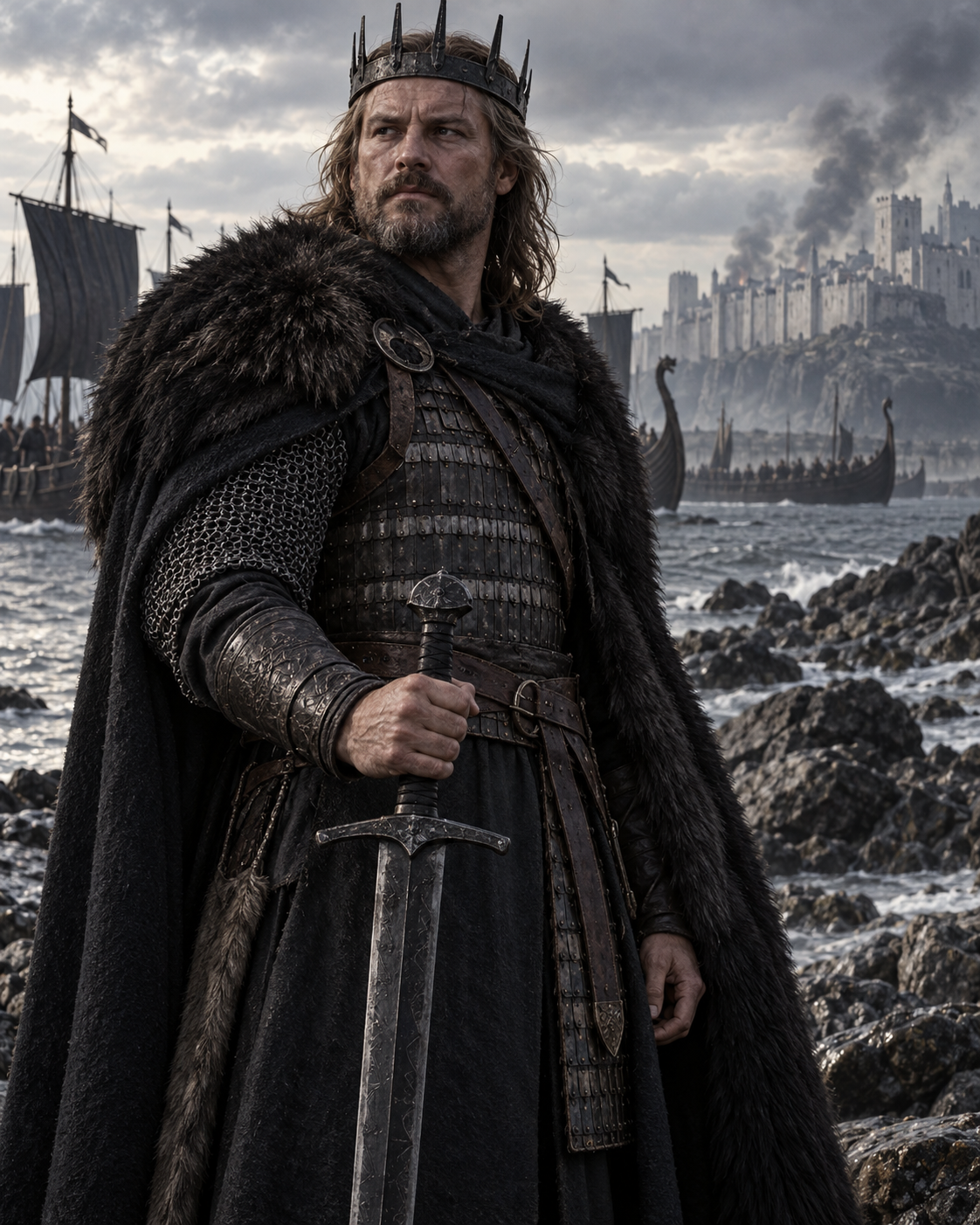
At a Glance
The conqueror whose weapons, crown, and invasion pattern outlive his kingdom
- Names
- Fingil, Fingil Redhand, Fingil the Bloody King
- People
- Rimmersman ship-lord and conqueror
- Realm
- Names the seized northern Frostmarch Rimmersgard
- Major campaigns
- The Knock, Ach Samrath, Utanwash, and the siege of Asu’a
- Relics
- Iron crown, iron ring, and cursed sword Minneyar
- Status
- Dead for centuries; historical and material legacy active throughout the series
The Evidence Problem
Most surviving versions were written by people living inside the conquest
Fingil is historical rather than present-tense. Morgenes teaches the campaigns; Jarnauga restores the Sithi catastrophe; Binabik recounts Saint Hoderund; dwarrow and Tinukeda’ya evidence traces Minneyar; songs preserve the six kings; physical objects carry the crown, ring, and sword forward.
The broad structure is well supported: northern conquest, enslavement, iron warfare against the Sithi, destruction of the Hernystiri alliance, long siege, entry into Asu’a, and atrocities committed by his army. Exact private motives and personal battlefield dialogue are not.
Calling him Bloody King is historical memory, not a substitute for evidence. The evidence is already damning enough without inventing additional speeches or intimate cruelty.
The Frostmarch
Rimmersgard begins as a renamed conquest, not an empty homeland waiting to be claimed
Fingil’s shipmen take the northern Frostmarch and rename the seized territory Rimmersgard. They capture and enslave mortal inhabitants. Cold iron lets them kill Sithi whom the invaders classify as evil creatures.
The naming matters. “Rimmersgard” can sound ancient and inevitable by Simon’s era, but the history remembers an act of possession. A new people arrives, conquers, classifies resistance as monstrous, and makes its own identity the map label.
That origin does not make every later Rimmersman identical to Fingil. Isorn explicitly argues against treating short-lived descendants as their ancestor. The series places inherited structures beside individual moral choice rather than replacing one with the other.
The Knock
Saint Hoderund walks into the space between armies and Fingil answers peace with death
At Ereb Irigú—later Du Knokkegard, the Boneyard, and finally the Knock—Fingil’s forces trap Prince Sinnach’s Hernystiri and Sithi army. Thousands already make the landscape a mass grave.
Hoderund is a Rimmersman convert and Aedonite priest who tries to prevent further slaughter. Fingil rejects the appeal. Hoderund carries the sacred Tree between the armies, calls for peace, and is killed.
Later Church authority declares Hoderund a martyr and establishes the abbey bearing his name. Binabik preserves competing cultural readings: sainthood does not erase the older battlefield or make every group remember the event in the same language.
Ach Samrath · 663
Five days of resistance end when greed finds the unprotected flank
At Ach Samrath, the Summerfield north of Gleniwent, the Sithi and Hernystiri alliance holds Fingil’s host for five days. On the sixth night, Thrithings forces coveting Erkynland and Sithi wealth strike the exposed flank.
The White Stag of Hern is trampled. Chariots break. An in-world count records ten thousand Hernystiri dead, including Prince Sinnach; Sithi losses are grievous and uncounted. The survivors retreat.
Ach Samrath remains a living Hernystiri name for hatred and loss. Morgenes grimaces when young Simon thrills at the grandeur of ten thousand dead. Fingil’s victory is not epic wallpaper to the people who inherit the field.
The Siege of Asu’a
Ineluki holds tens of thousands outside—and destroys himself trying to make conquest impossible
Fingil’s campaign drives the Sithi back toward Asu’a. The capital withstands almost three years of siege. Ineluki, crowned in white witchwood and armed with Sorrow, fights beside five fire-cloaked followers later called the Red Hand.
His magic and sword hold tens of thousands of Fingil’s warriors outside for nearly a year after the wider defense collapses. Then Ineluki climbs Green Angel Tower and performs the final working that burns away his body and those of his companions.
Rimmersmen inside Asu’a burn and scream. The sky flashes white and becomes unnaturally dark. Six piles of ash remain in an otherwise untouched tower, while a dying soldier reports a vast red hand writhing above it.
Fingil’s conquest succeeds physically. Ineluki’s refusal to die completely makes the victory a five-century disaster.
Inside the City
The army wins the walls and proves exactly what the defenders feared
After entering Asu’a, Fingil’s forces commit murder, torture, sexual violence, enslavement, and destruction of irreplaceable Sithi works. These are not collateral shadows around a glorious victory. They define what conquest means for the captured city.
Later mortal rulers rebuild every handspan with prayers and protective spells. Those accumulated workings keep Ineluki and the Red Hand from entering the Hayholt directly, although living servants such as Elias and Pryrates can still act within it.
The protection is another inheritance of Fingil’s victory: the conquerors occupy the city, then spend generations warding it against the hatred their conquest helped create.
Minneyar
The sword Fingil carries into Asu’a begins with a murdered smith and ends disguised as royal memory
Minneyar is forged from the iron keel of King Elvrit’s dragon-boat by secretive Dverning smiths. Elvrit murders the master smith rather than pay him, and the weapon is cursed. Its name means Year of Memory.
The sword passes to Fingil and enters Asu’a with him. It later moves through Hjeldin and Ikferdig. Prester John eventually emerges from Shurakai’s lair carrying it and renames it Bright-Nail.
Fingil’s place in the custody chain matters because the current war’s “Memory” sword is physically made from conquest, broken payment, murder, and inherited rule. It does not become innocent because a later king gives it a shinier name.
Crown and Ring
Elias wears Fingil’s iron while John takes the conqueror’s ring into his grave
Fingil’s iron crown survives into the present. Elias wears it while physically altered, carrying Sorrow and ruling through suspicion, coercion, and supernatural alliance. The visual choice aligns the current king with the old conqueror before anyone finishes debating what that repetition means.
At John’s burial, Noah places Fingil’s iron ring on the dead king’s finger after it was initially held back during preparation. Conquest inheritance enters the grave with the celebrated unifier.
These objects prevent the six kings from remaining statues and rhyme. Fingil’s material authority still touches living and dead rulers.
Repetition Without Blood Guilt
Skali repeats the structure; Isorn refuses the claim that ancestry makes repetition inevitable
When Skali occupies Hernystir, clears forest, builds Rimmersman longhouses, and settles northern families on seized land, Likimeya sees Fingil’s conquest repeating. The resemblance is structural and earned through action.
Isorn argues that short-lived descendants should not be treated as identical to Fingil. He is right. Skali is guilty because he recreates dispossession, not because all Rimmersmen carry inherited moral contamination.
The distinction lets the series use history as diagnosis rather than destiny. Patterns can recur; people can still choose whether to participate.
Connections
The rulers, enemies, victims, and relic-bearers surrounding the Bloody King
Prince Sinnach
Hernystiri ally of the Sithi who resists Fingil and dies at Ach Samrath with ten thousand countrymen.
Saint Hoderund
Rimmersman-born priest killed after Fingil rejects his effort to stop slaughter at the Knock.
Ineluki
Sithi prince whose catastrophic final working denies Fingil an uncomplicated victory and creates the Storm King.
Hjeldin
Fingil’s son and successor, later remembered as the Mad King of the haunted tower.
King Elias
Later ruler who wears Fingil’s crown while Sorrow and Pryrates reshape his kingship.
Minneyar
Cursed iron-keel sword carried into Asu’a, inherited by later kings, and renamed Bright-Nail by John.
Why Fingil Matters
He is the historical conquest the present keeps reenacting, revising, and wearing
Fingil provides the trilogy’s clearest long view of empire. Territory is renamed, people enslaved, enemies classified as monsters, alliances broken, cities violated, and objects converted into proof of legitimate rule.
Yet he is not the sole origin of evil. Elvrit’s betrayal stains Minneyar before Fingil. Ineluki chooses forbidden power. Thrithings attackers choose the flank. Elias and Skali choose later repetitions. History supplies materials and patterns; individuals keep activating them.
The profile therefore belongs across the series, not only in Book 1’s history lesson. Crown, ring, sword, wards, ruined relationships, and invasion memory carry Fingil forward long after the body is under one of the six mounds.
On the Record
Scope correction, status, physical gaps, and responsibility boundaries
This is Fingil’s one canonical full-spoiler historical profile. The prior Book 1-only scope was too narrow. Books 1–4 repeatedly use his conquest, crown, ring, Minneyar custody, Asu’a legacy, protective wards, and comparison to later occupation. He remains dead throughout.
The evidence confirms Rimmersman conquest, Bloody King/Redhand names, Rimmersgard’s seizure and renaming, the Knock, Ach Samrath, Utanwash, Asu’a’s siege, army atrocities, Hjeldin’s parentage, Minneyar, iron crown, and ring. It does not preserve a reliable face, age, coloring, private dialogue, or personal explanation of the campaigns.
The approved attractive but terrifying conqueror portrait is therefore explicitly an editorial reconstruction, not a recovered canonical likeness. That identity now governs portrait, ship, Knock, Summerfield, siege, throne-history, crown, sword, directory, and social images. Visual grandeur must never turn the invaded population into scenery.