
Ingen Jegger
Utuk’ku gives him his name the way another ruler might hand back a knife. The Queen’s Huntsman survives broken legs, ritual remaking, and his own disposability long enough to murder Amerasu—and mistake usefulness for love the entire way.
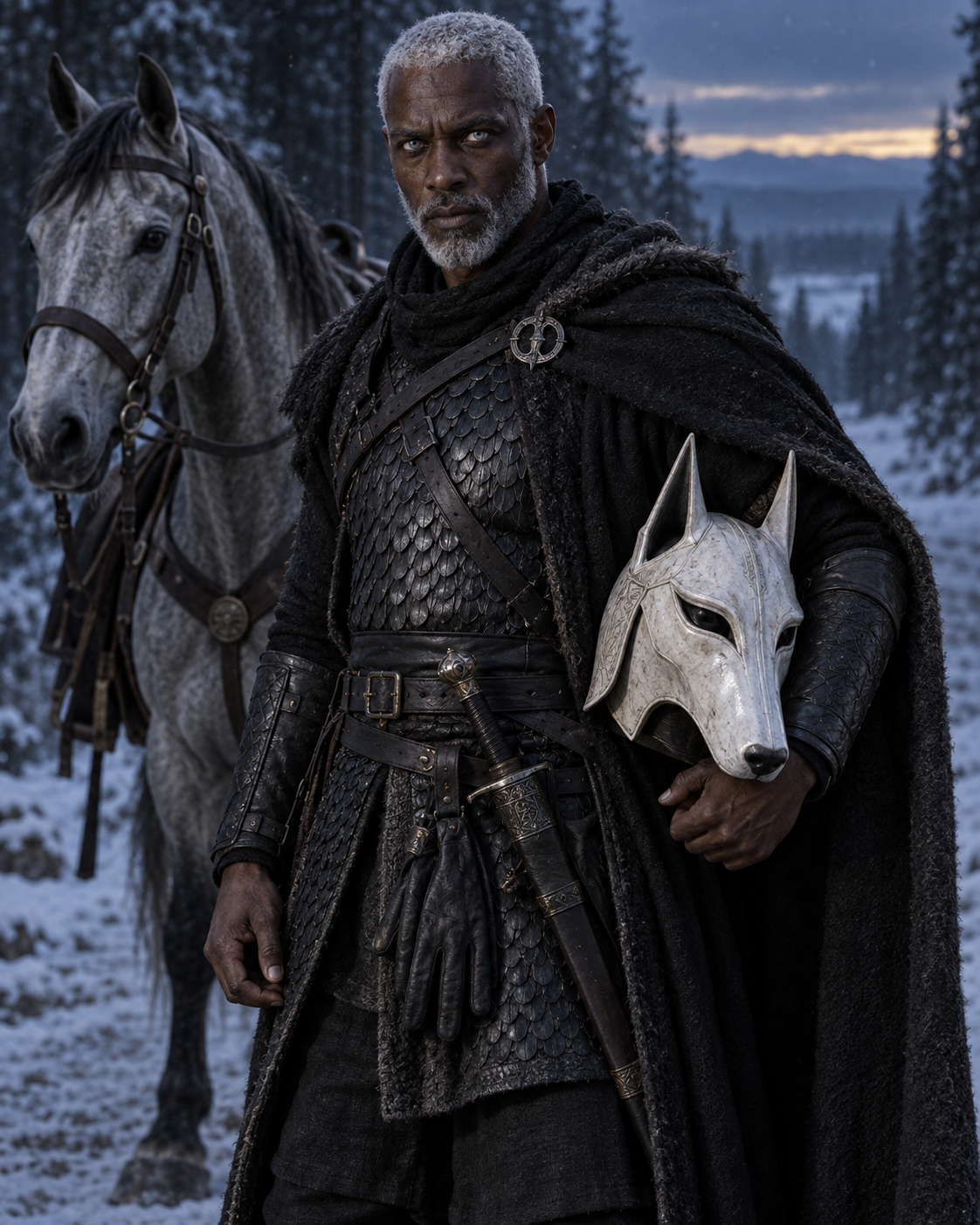
The scariest mortal in the hunt is still a mortal tool
Ingen Jegger is a Black Rimmersman hunter in Utuk’ku’s service, Elias’s supernatural hunt-master, bearer of the white hound helm, master of the altered Stormspike pack, and the mortal assassin who kills Amerasu. He is lean but thickly muscled, hard-faced, almost colorless in hair and eyes, with a close-cropped near-white beard, black armor, a deep cold voice, and speech shaped by the far northern margins near Norn lands.
He carries himself as sacred hunter rather than hired pursuer. The title is not empty. Utuk’ku has hardened, trained, armed, restored, and recommissioned him through practices beyond ordinary mortal survival. He controls terrifying hounds, endures wounds that should kill him, and receives access to the Chamber of the Breathing Harp. Yet the intimacy is counterfeit. To Utuk’ku, he is useful material inside a design. When he dies, she adjusts.
Ingen’s tragedy is not that a secretly gentle man got brainwashed. The original series gives no such laundering. He delights in chase, treats hounds and human hunters as expendable, converts failure into personal grievance, and imagines legendary reward. Manipulation explains the system that shaped his identity; it does not erase the choices through which he enforces it.
From Elias’s escaped children to the one elder Utuk’ku needs silenced
Book 1: the King’s hunt belongs to somebody farther north
Ingen enters the road pursuing Miriamele, Leleth, Simon, and Binabik through Aldheorte. Baron Heahferth carries Elias’s authority and court connections, but the local noble is subordinate to the pale huntmaster. Their argument exposes the chain of command: the children escaped custody, the fugitives are wanted alive, and Ingen—not the baron—is deciding how the pack moves.
The hounds are visibly unnatural: long white bodies, pearl-slot eyes, underslung jaws, carrion breath, Stormspike brands, and royal kennel fittings. Ingen redirects them after wounded Qantaqa when her scent draws danger from Leleth. He treats hounds killed at the canyon as spent assets and keeps the pursuit moving.
At Da’ai Chikiza he anticipates the river route, orders surrender in the King’s name, and uses fire to destroy Geloë’s boat. He curses archers who risk killing quarry intended for capture. Heahferth’s mounted charge ends when the Gate of Stags collapses into the Aelfwent, but Ingen’s deeper pursuit survives the local force’s destruction.
Farther north, he and mortal Huntsmen close on the Thorn expedition. His hound helm marks Utuk’ku’s service. When the confrontation fails, his horse crushes him, breaking both legs and ribs. Niku’a drags him to shelter. Ingen splints himself and chooses revenge. Survival is not moral correction; pain intensifies the identity already built around pursuit.
Book 2: Utuk’ku returns the name only after opening every wound
Gravely injured and initially nameless to himself, Ingen follows a curved seam of stars northwest. He scratches eleven days into his saddle before the horse dies and crawls two more days toward Stormspike. Norns have watched the entire journey. They carry him into Nakkiga rather than rescuing him on the road.
In the blue-lit Well of the Breathing Harp, Utuk’ku searches and tortures his mind. She sees Urmsheim, Thorn, Simon, the Sithi, Igjarjuk’s crushing blow, and the lost helm. Only after rifling every failure does she restore his name: Ingen Jegger. Identity arrives as recommissioning.
She gives him a new white hound helm with scarlet jeweled eyes and tongue, calls him Queen’s Huntsman, and promises quarry unlike any mortal he has hunted. She sends him to sleep and be remade. The ceremony feels like honor because Utuk’ku has made recognition inseparable from utility.
Ingen later rides south with Niku’a, a giant white hound, carrying a translucent carved dagger and declaring death behind them. He uses the hound to summon the last-chase pack and follows Binabik and Sludig toward Sesuad’ra. He imagines reward and legend. The task’s actual purpose is narrower: reach Jao é-Tinukai’i and silence Amerasu before she can reveal Ineluki’s design.
The assassination: success proves he never understood his place
The attack on the Yásira coordinates Red Hand force, white hounds, Norn planning, and mortal penetration. Shima’onari is mortally wounded fighting Niku’a. Jiriki, Aditu, Simon, and the Sithi are pulled into chaos. Ingen reaches Amerasu with the crystal dagger and stabs her, boasting that he has fulfilled his mistress’s command.
Jiriki runs him through with Indreju; Sithi arrows finish him. His victory is strategically significant—Amerasu dies before completing her explanation—but personally empty. Utuk’ku does not love, mourn, or exalt him. Later she assesses him as a useful mortal tool whose loss requires adjustment and pours her purpose into three Norn replacements.
The Queen’s Huntsman achieves the task that supposedly makes him exceptional and is immediately replaced by a more suitable delivery system. That is the final truth of his title.
She controls the reward system all the way down to his own name
Utuk’ku does not merely issue orders. She governs Ingen’s access to identity, survival, equipment, purpose, and imagined greatness. The restored name feels intimate because she has first made him experience its absence. The new helm feels sacred because the old failure was exposed before the replacement was granted.
None of this removes agency. Ingen wants the hunt, accepts its cruelty, and interprets attention as proof of special status. But the relationship explains why failure cannot produce reflection. Every wound becomes a test only the Queen can validate, and every survival returns him deeper into service.
His death reveals the asymmetry without disguise. Utuk’ku has spent more than a thousand sunless days revising a design. Ingen is one strand. When it snaps, she replaces it. He believed himself the Queen’s hunter; she understood him as a method.
The animals are bred, altered, and spent inside the same ownership logic
Ingen calls the white hounds bred for the final chase. Their bodies combine kennel history with Stormspike transformation: royal buckles, Norn brands, blind pearl eyes, sharklike mouths, and voices like chains on slate. They are manufactured terror and living evidence that Elias’s court and northern power are cooperating.
Niku’a is larger, individually named, and bound most closely to Ingen. The hound drags him from Urmsheim and later takes the quarry’s scent. Yet companionship remains subordinate to purpose. Ingen feeds, directs, and depends on Niku’a while participating in a system that created the animal for stolen-child pursuit and disposable violence.
The contrast with Binabik and Qantaqa is deliberate. Both pairs travel and hunt together. One relationship grows through chosen trust and reciprocal care; the other through breeding, remaking, command, and mission. Size and ferocity do not determine monstrosity. Ownership does.
Children become quarry because the system needs their relationships
Miriamele, Leleth, Simon, and Binabik are not random fugitives. Their bodies and bonds carry information, lineage, prophecy, and access. Ingen’s insistence on capture rather than indiscriminate killing reflects strategic need, not mercy.
Qantaqa repeatedly frustrates him because she turns scent into protection. Geloë recognizes him as the greater danger because his hunt extends beyond Elias’s ordinary court politics. Jiriki kills him only after the pursuit enters the hidden Sithi sanctuary and takes Amerasu.
Ingen also personalizes Simon after failure. Pryrates reports the hunt has become a grudge and Elias resents the resources spent on one boy. That grudge makes the larger manipulation easier: Ingen can experience Utuk’ku’s objective as his own unfinished honor.
He is what happens when being chosen means being perfectly usable
Fantasy loves the sacred hunter: special weapon, impossible survival, royal title, singular quarry. Ingen receives the whole package. The books then show the labor hidden inside “chosen.” His body is trained and broken. His mind is searched. His name is withheld and returned. His animal companions are engineered. His ambition is pointed toward somebody else’s design.
The resulting cruelty is still his. He hunts children, spends hounds, burns escape routes, embraces vengeance, and murders Amerasu. Recognizing coercive formation is not a pardon. It is the reason his final boast feels so hollow. He thinks the successful killing proves personhood; Utuk’ku treats it as task completion.
Ingen’s arc also gives the antagonist system a mortal face without making it the mastermind. He is terrifying in the forest because ordinary people meet the blade, hound, and command before they ever glimpse the ancient grievance behind them. Systems become real through people who enjoy enforcing them.
Scope, pronunciation, status, and visual continuity
This profile covers Ingen Jegger’s verified arc across the owned original-series editions, including his Book 1 hunt, Book 2 remaking and assassination, and later explanation of his replaceability. The pronunciation guide specifies a distinct hard-j sound in Ingen Jegger.
The approved identity preserves the text’s attractive but frightening adult Black Rimmersman: lean, thick-muscled, hard dark face, close-cropped near-white beard, very pale eyes, black armor, tall gray horse, and white hound helm. Exact age, facial structure, horse markings, armor detailing, and helm ornament remain editorial reconstruction.
This identity now governs the hero, five scoped directory cards, featured and social images, and every scene depiction. Broken-leg survival, bodily remaking, jeweled replacement helm, crystal dagger, and final Yásira attack must retain this same face, age, and bodily history.