
Memory, Sorrow, and Thorn · Canonical Character Profile
Khendraja’aro
Khendraja’aro is Jiriki’s red-haired uncle: a Sitha elder whose immaculate control cannot hide five centuries of anger over Asu’a. He questions mortals at the hunting lodge, recoils from Thorn and Nakkiga, opposes Simon’s entrance into Jao é-Tinukai’i, then still rides when the Houses of Dawn answer Jiriki’s call. His suspicion is neither decorative prejudice nor the whole of him—it is memory forced to decide whether survival requires cooperation with the descendants of conquerors.
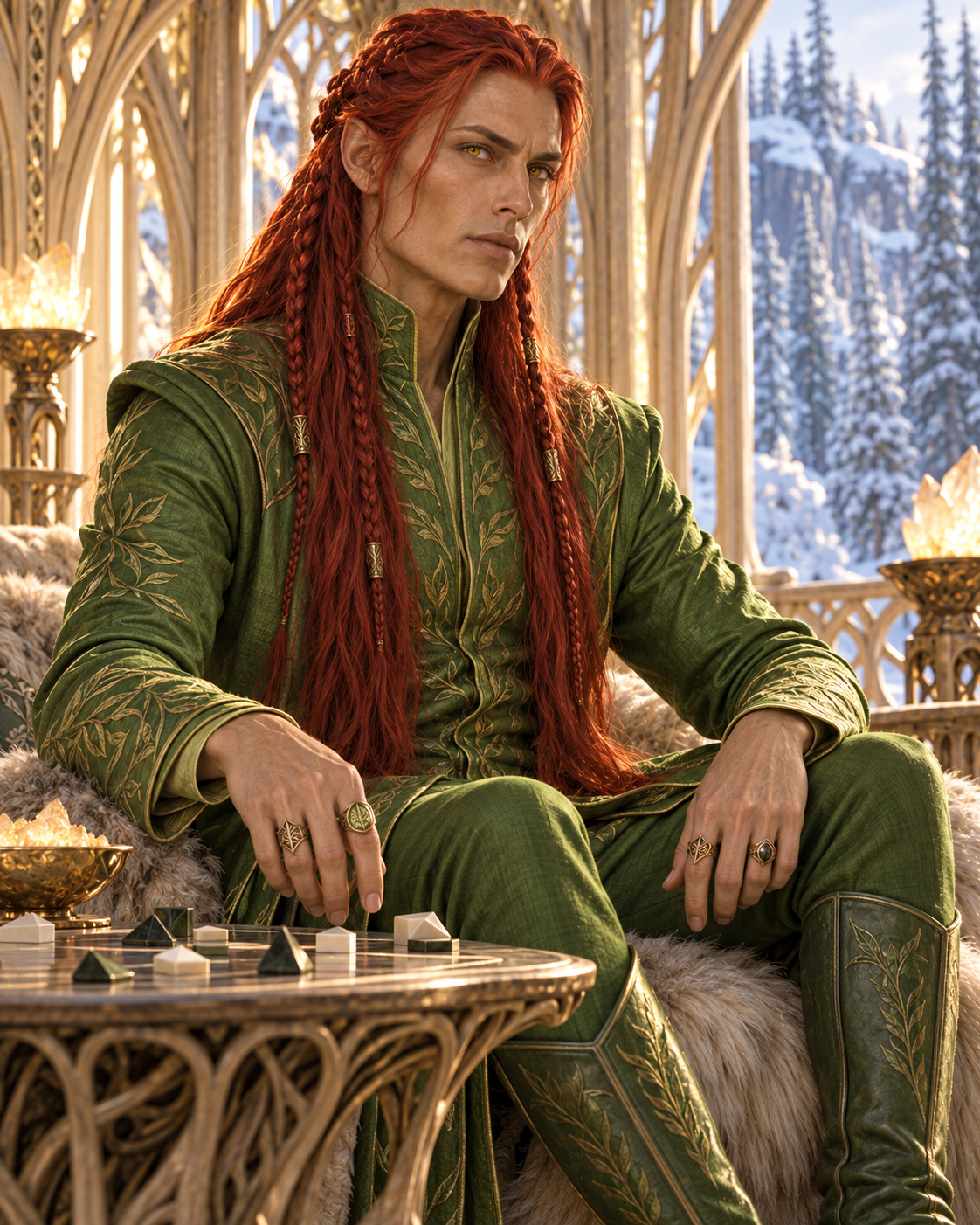
At a Glance
The skeptical uncle who carries Asu’a into every room
- Name
- Khendraja’aro
- People
- Zida’ya, one of the Sithi
- Family
- Jiriki’s uncle
- Appearance
- Angular ageless face, yellow eyes, fiery red braided hair
- Dress
- Bright leaf-green high-collared jacket, matching trousers and boots, rings
- Affiliation
- Houses of Dawn and the Zida’ya councils
- Status
- Alive through the final war
Book 1 · Jao e-Tinukai
He meets the mortals over a strategy game, because Sithi hostility has table manners
Simon first encounters Khendraja’aro in the hidden Sithi hunting lodge beneath the unnatural winter. The lodge glows with mineral lamps, music, water, and fire while armed mortals remain unsure whether they are prisoners, guests, or something painfully between.
Khendraja’aro sits opposite Jiriki at the shent board. His clothing is vivid leaf green from high collar to boots; his fiery red hair is braided; rings catch the light on his hands. Yellow eyes and an angular, ageless face make him visually unmistakable. He is beautiful in the precise, unsettling Sithi register—and visibly closed when distress reaches him.
He questions why the mortals are present. The concern is not irrational: human trespass, iron, settlement, and the destruction of Asu’a sit behind the Rules of Song governing contact. Jiriki’s personal debt to Simon does not automatically erase a history Khendraja’aro survived or inherited at immortal scale.
When Binabik explains Thorn, the Three Swords, Urmsheim, and Ineluki, Khendraja’aro reacts sharply to the black sword and to the “black one below,” Nakkiga. He doubts the account and withdraws during the drinking songs. Jiriki postpones the confrontation rather than pretending hospitality has produced agreement.
The Anger
Five centuries have not made Asu’a abstract enough for polite neutrality
Khendraja’aro’s anger has endured since Asu’a fell. For mortals, five centuries create legend, disputed chronicle, and inherited objects. For the Gardenborn, the catastrophe remains within the emotional reach of people still living.
That difference in time scale explains his severity without automatically justifying every conclusion. He sees human beings through a history in which Fingil’s armies besieged Asu’a, iron killed Sithi, and the captured city suffered murder, torture, enslavement, sexual violence, and destruction. Simon sees himself as one frightened young person who freed Jiriki from a trap. Both perspectives are true at once.
Khendraja’aro therefore functions as resistance to easy reconciliation. One good mortal does not cleanse conquest. One blood debt does not rewrite collective memory. The series makes the alliance work harder than a handshake because characters like him refuse to let historical violence become pretty backstory.
Book 2 · Jao é-Tinukai’i
Simon crosses the oldest boundary and Khendraja’aro’s control becomes more frightening than shouting
When Aditu and Jiriki bring Simon through the Summer Gate into Jao é-Tinukai’i, he becomes the first mortal known to enter the hidden city. Jiriki invokes Simon’s status as Hikka Staja, Arrow-Bearer and blood-debt friend, to break an ancient rule.
Khendraja’aro appears in bright green with braided red hair and an angular face. The sight of Simon produces astonished fury. He argues rapidly with Aditu, then leaves under preternatural control. The closed face matters: this is not a comic uncle losing his temper. It is an immortal court figure containing an emotional and political rupture inside a society where song, rule, and memory are inseparable.
Simon’s entrance has consequences beyond personal dislike. Shima’onari recognizes Jiriki’s debt yet rules that Simon may never leave. The city offers perfect summer and permanent captivity. Khendraja’aro’s objection belongs within that larger conflict: Sithi honor protects the mortal, Sithi law rejects his access, and Sithi trauma fears what knowledge might leave with him.
Aditu and Jiriki both acknowledge that the objection is more serious than ordinary unhappiness. Their sibling teasing survives, but it does not trivialize the elder. Khendraja’aro stands for a constituency the younger prince cannot simply charm out of history.
Book 3 · The Houses of Dawn
He objects, remembers, and still rides through the Gate of Winds
At Sesuad’ra, Josua’s coalition faces Fengbald’s assault while the Sithi alliance remains uncertain. Then Jiriki leads Likimeya, Yizashi, Cheka’iso, Khendraja’aro, and the Zida’ya riders through the Gate of Winds.
The Houses of Dawn ride together for the first time in five centuries. Khendraja’aro is not excluded from the moment because he distrusted mortals. He belongs to the force choosing action. The decision does not imply that he now loves humanity or has revised every judgment; it proves that skepticism and commitment can occupy the same person.
The distinction protects him from becoming a cardboard obstacle. If he merely opposed Simon and vanished, his function would be to make Jiriki look progressive. Riding places him inside the actual burden of alliance: fighting beside short-lived people whose ancestors participated in catastrophe because Utuk’ku and Ineluki threaten both peoples now.
His presence also makes the charge more politically meaningful. These are not only Jiriki’s friends arriving for one boy. Elders, houses, and competing memories cross the gate together. Khendraja’aro brings the dissent with him rather than requiring unity to mean silence.
Book 4 · The Northern Campaign
The immortal army has to admit that memory is not the same thing as current military expertise
Khendraja’aro later sits among named Sithi council figures including Likimeya, Zinjadu, Chekaï’so Amber-Locks, Yizashi Grayspear, and Kuroyi. The council faces a practical truth: the Sithi have not assaulted a fortified enemy since Venyha Do’sae.
Immortality preserves experience, but it does not make every experience current. Eolair and mortal veterans possess siege knowledge the Zida’ya need. The alliance must move beyond mythic status and exchange competence in both directions—exactly the kind of knowledge crossing that the series repeatedly values.
The council is divided. Some question whether the Zida’ya should continue in an age shaped by mortals. Some refuse affection while accepting Utuk’ku as the greater enemy. Khendraja’aro’s long anger belongs naturally in this room, but the ledger does not assign every argument to him. His confirmed presence should not be used to steal Zinjadu’s, Yizashi’s, Likimeya’s, or Kuroyi’s specific positions.
What can be said is stronger than invented dialogue: the uncle who recoiled from human entry remains part of the governing and military body doing the hard work of coalition. His arc is participation without sentimental conversion.
Jiriki’s Uncle
The family relationship turns a civilizational argument into something that must survive dinner
Jiriki is young by Sithi standards, willing to interpret old obligations through present relationships, and personally bound to Simon. Khendraja’aro is his uncle, shent companion, skeptical elder, and political counterweight.
Their first scene at the board implies familiarity rather than formal estrangement. Khendraja’aro can question the hunting party from inside the family circle. Jiriki can postpone a dangerous subject without severing the relationship. This is disagreement housed within continuity.
That family position helps explain why Khendraja’aro matters more than a generic hostile councilor. Jiriki’s choices do not occur against a faceless conservative institution. They disturb people who love him, share his games, remember older losses, and may still ride when his call becomes urgent.
Connections
The prince, family, councils, and memories around the red-haired elder
Jiriki
Nephew, shent companion, and younger prince whose debt to Simon repeatedly crosses boundaries Khendraja’aro protects.
Aditu
Argues with him when Simon enters the hidden city and recognizes that his objection is politically serious.
Simon
The first mortal admitted to Jao é-Tinukai’i, both individual rescuer of Jiriki and descendant of the people Khendraja’aro distrusts.
Likimeya
Sithi queen and war leader beside whom he rides and later serves in council.
The Houses of Dawn
The reunited Sithi force whose ride proves shared action does not require erased disagreement.
Asu’a
The fallen city and five-century wound that gives his suspicion historical weight.
Why Khendraja’aro Matters
He keeps alliance from becoming amnesia with prettier lighting
Khendraja’aro makes the Sithi response to mortals internally credible. A people who survived Asu’a cannot plausibly greet Simon’s innocence as proof that the past no longer matters. His anger keeps the cost visible.
Yet the books do not freeze him at anger. He rides through the Gate of Winds and participates in the later council. Cooperation becomes a choice made with memory intact, not a reward granted after mortals receive instant forgiveness.
This is the character’s deepest contribution: he separates reconciliation from absolution. Jiriki can be right to honor Simon. Khendraja’aro can be right that one boy does not settle history. Both can still fight the Storm King. The alliance becomes stronger on the page because it contains unresolved truth rather than covering it with universal affection.
On the Record
Four-book scope, one face, and strict ownership of every council argument
This is Khendraja’aro’s one canonical full-spoiler profile. Book 1 contains the hunting-lodge questioning and reaction to Thorn and Nakkiga. Book 2 contains his furious response to Simon inside Jao é-Tinukai’i. Book 3 places him among the Houses of Dawn riding through the Gate of Winds. Book 4 names him in the Sithi siege council. The former Book 1-only directory membership hid three quarters of that journey.
The record confirms his family relationship to Jiriki, angular ageless face, yellow eyes, fiery red braided hair, leaf-green clothing, rings, shent play, skepticism, anger reaching back to Asu’a, Houses of Dawn participation, and later council presence. It does not confirm an exact age, romantic history, private account of Asu’a’s fall, or that every anti-mortal council argument belongs to him.
The approved identity preserves one striking, attractive adult Sitha elder across lodge, city, cavalry, and council scenes. Red braids, yellow eyes, angular face, green clothing, rings, and disciplined body language are non-negotiable continuity anchors; exact facial structure, braid pattern, garment embroidery, rings, and shent pieces are editorial reconstruction. Emotional restraint must read as force, not blankness—and never become four unrelated interpretations merely because the volume changes.