
Jiriki
A Sithi prince gives a starving kitchen boy one white arrow and accidentally begins the healthiest political friendship in the trilogy: reciprocal, argumentative, rescue-prone, and never mistaken for ownership.
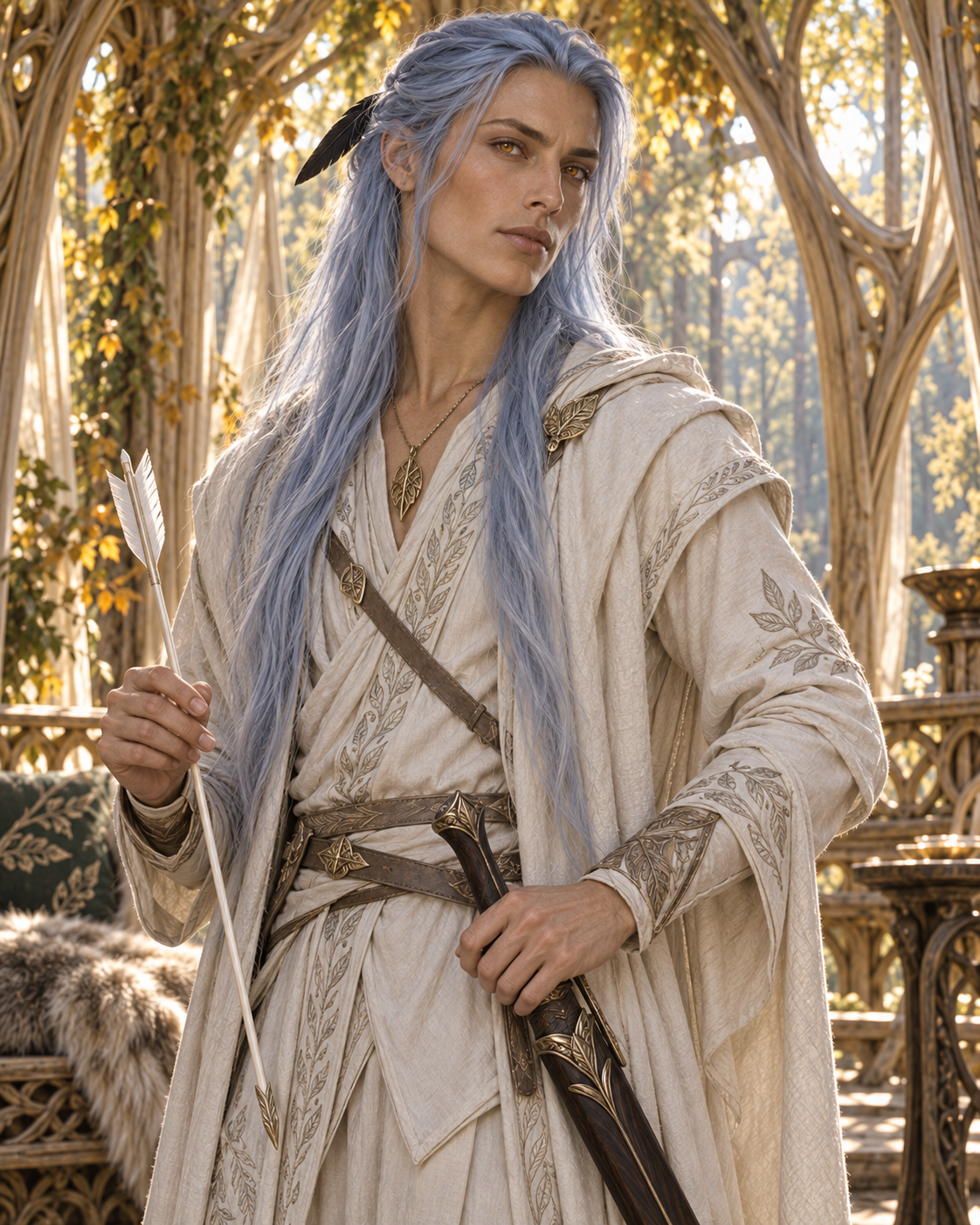
The immortal prince who keeps learning that a debt can become a friendship
Jiriki i-Sa’onserei P’a Shent is a young Sitha of the House of Year-Dancing, son of Likimeya and Shima’onari, brother of Aditu, great-grandson of Amerasu, bearer of the dark witchwood sword Indreju, and Simon’s Hikka Staja—White Arrow friend. “Prince” is the easiest translation and one of the least useful. His place in the reigning family gives him obligation, scrutiny, and inherited law, not the power to order everybody around.
He is beautiful in the distinctly nonhuman way Williams gives the Gardenborn: angular golden face, gold-flecked amber eyes, pale heather-blue hair that later turns white with grief, deliberate movement, and emotional control that mortals often misread as coldness. He can also tease, sulk, mourn, gamble badly with a friend’s freedom, admit the gamble, and make jokes about how often mortals have to rescue him.
Jiriki’s central achievement is not becoming “more human.” It is becoming more accountable within his own culture. He challenges Sithi withdrawal, names the exploitation of the Tinukeda’ya, argues that mortal descendants are not identical to mortal conquerors, and accepts that ancient honor can preserve injustice when nobody living is permitted to revise its meaning.
Four books of owing Simon a life and discovering lives are not arithmetic
Book 1: the trap, the arrow, and the dragon
Simon first finds Jiriki caught in a cotsman’s iron trap while Ingen Jegger’s hunt closes in. Freeing him is not a grand diplomatic act. It is a frightened boy choosing that a strange, beautiful person should not be tortured to death. Jiriki answers with the White Arrow, Staja Ame, a family object made by Vindaomeyo and marked with Words of Making. The pledge places Simon under his protection and makes the rescue legible across Sithi custom.
They meet again in Jiriki’s hunting lodge after Simon’s road has become crowded with Thorn, prophecy, and losses. Jiriki restores the Arrow, recognizes Morgenes’s ring as connected to an older secret, and explains histories without pretending he possesses every answer. He calls wolves’ and mortals’ speech versions of the same declaration: “I am; here I am.” Simon carries that lesson onto Urmsheim, where he faces Igjarjuk by naming himself rather than borrowing a legend.
Jiriki’s companionship does not prevent catastrophe. An’nai dies. Simon is burned by dragon blood. Thorn is recovered at immense cost. Jiriki calls the scarred boy Snowlock, a name that honors survival while leaving open whether the mark is blessing or wound. He remains beside Simon during fever and begins to understand that the debt has outgrown a single rescue.
Book 2: duty stops being an excuse to leave
On Mintahoq, Jiriki cannot command the Qanuc to release Binabik and Sludig. He translates their leaders more accurately as Herder and Huntress, secures Simon time to recover, and insists courage must become lawful advocacy rather than loud foreign demand. When the Summer-Lantern and An’nai’s death call him home, Simon asks what honor means if it lets Binabik die undefended. Jiriki stays for the hearing, accepting that the Book of Year-Dancing may record his choice as disgrace.
Before leaving, he gives Simon a scale mirror descended from Jenjiyana. The gift is a family talisman, possible line of contact, and much more dangerous Witness than either understands. When Simon later calls through it alone, Jiriki rescues his mind and reveals the Sithi Houses gathering after Amerasu’s murder and Shima’onari’s mortal wound.
Jiriki sends Aditu to find Simon and invokes the White Arrow bond to bring him into Jao é-Tinukai’i. That decision saves Simon and places him under a sentence of permanent sanctuary. Jiriki is horrified: he gambled with another person’s life while assuming the price would be survivable. He does not hide behind good intentions. He admits that mortals may be right about the winter while the Sithi are wrong.
Amerasu’s council and murder destroy the possibility of continued withdrawal. Jiriki kills Ingen Jegger with Indreju after the Huntsman stabs his great-grandmother. He recognizes the attack as a coordinated attempt to silence her, refuses Simon’s self-blame, and returns the mirror before Simon leaves carrying Amerasu’s unfinished business.
Book 3: a younger generation drags immortal politics into the present
Jiriki helps lead Houses of Dawn that have not ridden together in five centuries. His hair turns snow-white with mourning. At the Gate of Winds he raises Indreju and brings the Sithi into Josua’s fight—not as a convenient cavalry spell, but as a divided people choosing whether old neutrality can survive Utuk’ku’s war.
He is frank about that division. Yizashi sees mortals as descendants of hunters. Zinjadu doubts the Zida’ya belong in a mortal-shaped age. Likimeya fights to thwart Utuk’ku rather than because she suddenly trusts humanity. Jiriki argues that descendants are not their ancestors and calls Sithi treatment of Ruyan’s Tinukeda’ya a great shame. The admission does not pronounce the harm over; living Sithi still defend servitude, and dwarrow fear remains rational.
At Mezutu’a, Jiriki attempts to use the Shard as a Master Witness and is trapped by Utuk’ku’s intervention. Eolair disobeys his warning against touch and knocks him free, earning the same White Arrow debt Simon carries. Jiriki jokes that mortals rescuing him is becoming a habit. The joke contains a political education: superiority looks very silly when somebody “lesser” keeps saving your life.
He leads the assault at Naglimund, sees Norn cruelty animate long-dead prisoners, and learns that immortal battle songs still spend immortal bodies. Zinjadu dies. The Sithi bleed, grieve, and carry their dead. Jiriki’s knowledge helps identify Naglimund as more than a fortress: the enemy wants to remain because it is a Beyonding site.
Book 4: friendship survives the shattering of its objects
Miriamele breaks Jiriki’s mirror to cut Simon’s bonds. The White Arrow disappears into Binabik’s keeping. Neither loss ends the relationship because the objects were never ownership papers. Simon has already understood that he no longer needs the Arrow to prove himself to Jiriki.
Jiriki reads the Conqueror Star as the signal that the Zida’ya must return to Asu’a. He fights through the final convergence, while the mortal companions enter the tower and discover the sword prophecy’s trap. After Ineluki’s defeat, he and Simon do not pretend the alliance has erased centuries of harm or difference.
Their farewell is a beginning stated honestly. Jiriki says mortal and Sithi relationship must begin afresh, without one side claiming the other. He hopes they will meet again while acknowledging the Houses of Dawn may never gather in one place again. Friendship becomes a bridge because neither man calls the bridge the whole country.
Rescue, argument, rescue, argument—honestly, a very solid friendship model
The White Arrow creates a formal debt, but the story repeatedly lets the friendship exceed it. Simon rescues Jiriki from iron. Jiriki protects Simon, guides him, and names him. Simon’s dragon ordeal creates another rescue. Jiriki sends Aditu. Simon’s mirror call requires intervention. Eolair saves Jiriki from the Shard. By the end, nobody can balance the ledger, which is exactly why relationship replaces transaction.
They disagree without treating disagreement as betrayal. Simon forces Jiriki to examine honor at the Qanuc hearing. Jiriki stops Simon’s loyalty from becoming culturally ignorant shouting. Jiriki’s decision to bring Simon into the hidden city saves him and violates his autonomy through an unanticipated sentence. Naming the mistake protects the friendship better than pretending princes always know best.
Simon also learns identity through Jiriki’s language. “I am; here I am” becomes the ordinary assertion that pulls him back from dragon terror and later from the Graylands. Snowlock never erases Simon. Jiriki’s best gift is not a magical object but permission to understand that several truthful names can coexist.
Love does not make this family politically unanimous
Shima’onari embodies the caution of a king who has watched civilizations collapse. Jiriki respects him and still believes the ruling generation is wrong about the present danger. His father’s mortal wound helps turn old debate into action.
Likimeya is formidable, controlled, and willing to fight the Hikeda’ya without sentimentalizing mortal allies. Jiriki inherits her discipline but presses further toward accountability and renewed relationship.
Aditu is his younger sister, mockingly Rabbit to his Willow-switch. Their teasing establishes affection without making them interchangeable. She becomes diplomat, healer, messenger, and Simon’s rescuer in her own right.
Amerasu gives their line impossible historical weight. Her murder is family grief and strategic assassination. Jiriki’s response begins with violence against Ingen Jegger and matures into carrying forward her demand that memory become action.
He does not apologize for being Sithi; he refuses to make Sithi history innocent
Jiriki can name mortal conquest of Asu’a, iron violence, and persecution without turning every living mortal into the original invader. He can also name Sithi exploitation of the Tinukeda’ya without pretending partial restitution repaired it. That double vision separates accountability from competitive victimhood.
His younger-generation politics remain imperfect and contested. He sometimes assumes his cultural reading is more complete than it is. The mirror and Simon’s imprisonment prove it. Yet he revises when evidence arrives. The trilogy’s false prophecy nearly succeeds because institutions defend flattering interpretation. Jiriki matters because he practices loyalty that can survive correction.
He turns “elf prince” from aesthetic category into an argument about inherited responsibility
Jiriki is gorgeous, immortal, armed with witchwood, and connected to enchanted objects. The profile could stop at fantasy boyfriend inventory. The books keep going. They ask what beauty means beside political retreat, what long memory owes new people, and whether honor is moral when its record rewards abandoning someone.
His answer develops through relationship. Mortals are not abstract Sunset Children after Simon, Eolair, Maegwin, Josua’s coalition, and the dead at Naglimund. The Tinukeda’ya are not creatures after Mezutu’a’s surviving fear. The Norns are not simply monsters when Likimeya mourns killing members of their divided family. Complexity does not paralyze Jiriki. It gives action an honest cost.
By the finale, he has helped make a coalition without declaring reconciliation complete. That may be less cinematic than one eternal alliance beneath a glowing tree. It is also more generous. Friendship can begin again without demanding that history disappear first.
Scope, naming, status, and identity continuity
This profile covers all four owned Kindle volumes and reference back matter. The canonical directory name is Jiriki; expanded Sithi forms remain searchable. His pronunciation is approximately “Jih-REE-kee.” Volume-specific cards must show his status as of that book rather than flattening his changing political and family position into one generic “alive.”
The approved Book 1 portrait preserves his golden angular face, high slanting features, gold-flecked amber eyes, pale heather-blue hair, elegant nonhuman beauty, black crow feather, white garments and jewelry, White Arrow, dark witchwood sword, and visible Amerasu-line resemblance. Minor facial particulars, garment construction, jewelry, and Indreju’s exact ornament remain editorial reconstruction.
The same face now controls hero, featured image, all five character directories, social image, and every milestone scene. Later snow-white mourning hair must be applied to this identity rather than generating a replacement prince.