
Geloë
The valada of Aldheorte does not arrive to solve the quest with witchy hand-waving. She diagnoses, translates, bluffs, bargains, turns into an owl when necessary, and keeps reminding princes that every kind of power sends a bill.
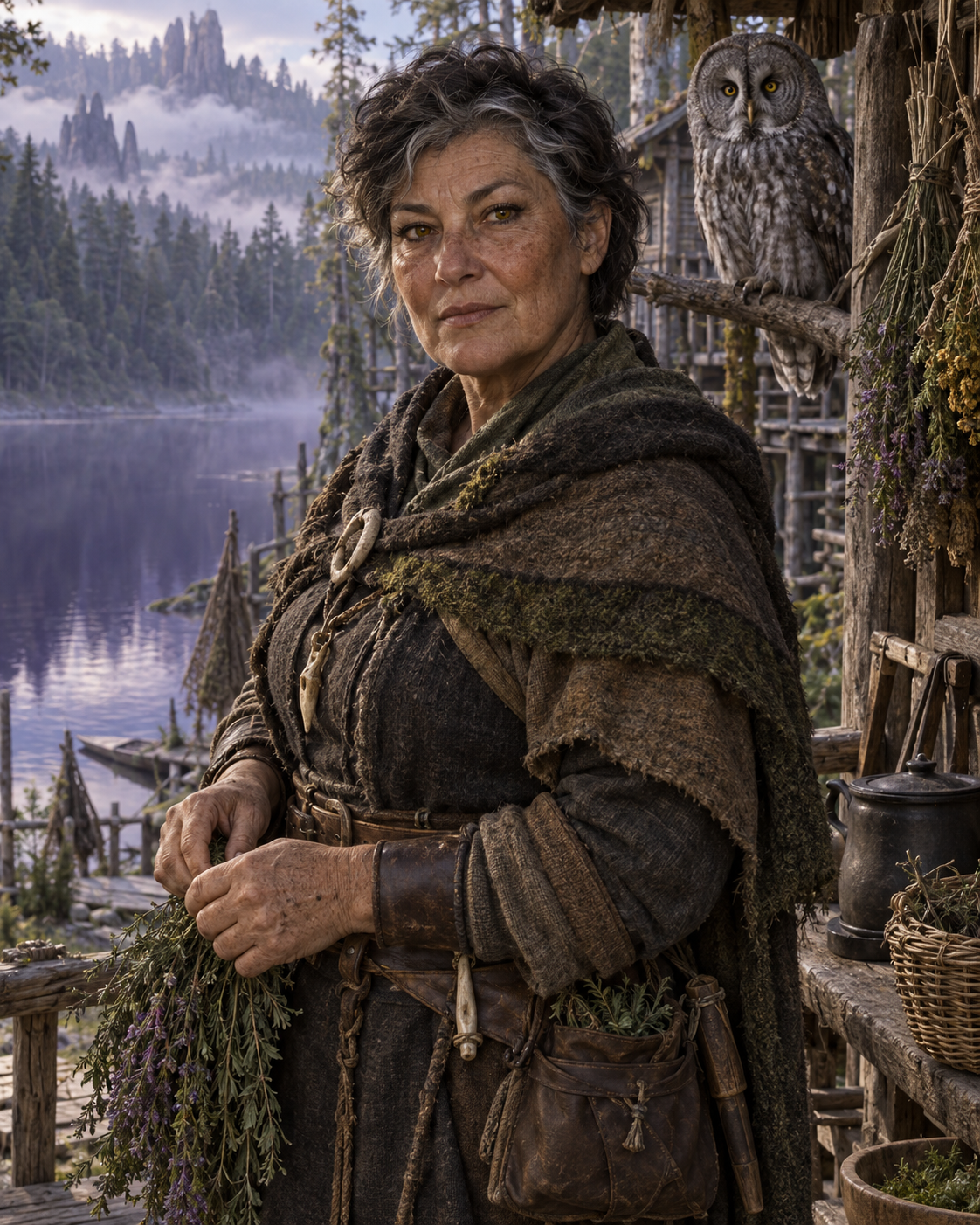
Everybody calls her mysterious because “competent woman with boundaries” apparently felt too direct
Geloë is the valada of Aldheorte: healer, forest wise woman, veteran traveler on the Road of Dreams, political strategist, shape-changer, and one of the few people in Osten Ard who can frighten armed men without pretending fear is the same thing as limitless force. Her home stands over a deep purple lake on stilts that resemble enormous bird legs. Yes, the house moves. No, the moving house is not even the most interesting thing about her.
She enters Simon’s story after Morgenes is dead, Naglimund is threatened, Miriamele is traveling under another name, and the supposed adults have run out of safe roads. Geloë becomes a hinge between worlds that do not trust one another: mortals and Gardenborn, princes and servants, written archives and dream knowledge, Thrithings custom and refugee necessity, formal Scrollbearers and people whose wisdom never received a medallion.
What makes her feel formidable is not omniscience. It is disciplined uncertainty. She distinguishes a bird’s impression from a military count, a dream from guaranteed true-seeing, a warning from a complete plan, and magical capacity from the spectacle desperate people want. When she does not know, she says so. In a series where confident misreading nearly ends the world, that is a superpower.
From the house in the forest to one last warning through a sleeping child
Book 1: the person you seek when every official road has failed
Binabik names Geloë before Simon meets her, directing the fugitives into Aldheorte because the valada must hear about Thorn, the Nornhounds, and the widening supernatural crisis. Her introduction refuses ornamental witch imagery. The house is a working archive. Herbs hang beside books and tools. Geloë looks at Leleth’s bites and knows exactly how dangerous unclean Nornhound flesh makes them.
She already knows Morgenes has died and recognizes his mark on Simon. Rather than certify every strange dream as prophecy, she treats coherence and timing as evidence. She explains the Road of Dreams as a high route where distance behaves differently and hostile travelers may be encountered. Using nightshade, mockfoil, whitewood bark, smoke, and joined hands, she guides Simon and Binabik into their first deliberate crossing.
When Simon becomes trapped by a hostile presence, Geloë returns as a gray owl and drags him out at real cost to herself. The rescue establishes her ethic: power is work performed by a body, not narrative permission to skip consequence. Later, when hunters discover her lake, she attacks a sentry in owl form so the travelers can escape. She keeps Leleth because the badly injured child cannot survive the road to Naglimund. Care changes the party’s shape, and Geloë accepts the burden without turning Leleth into payment for her help.
Book 2: sanctuary is a strategy, not a promise
After Naglimund falls, Geloë reaches Simon through Leleth. The child’s ability focuses her will “like a burning-glass,” allowing Geloë’s face and cadence to emerge through the connection. She reports Josua alive, Miriamele missing from friendly perception, and her own fences breached. Her instruction transforms the title into a destination: seek Sesuad’ra, the Stone of Farewell, as temporary safety.
Geloë later joins Josua’s refugees, redirects them through the dry bed of Re Suri’eni, explains the ancient covenant that makes a boundary meaningful to the Norns, and confirms Strangyeard’s inheritance of the League mark. At Sesuad’ra she proposes a defensible refuge, rallying place, and research center for the Great Swords. She never calls it permanent. This woman reads shelter honestly.
Her strategic work is gloriously unflashy. She invokes Thrithings betrothal law to stop Fikolmij from simply executing Josua, using Vorzheva’s pregnancy to force a legal process the clan leader recognizes. She terrifies him with wind and reputation, then admits most of the confrontation was bluff. When Deornoth wants magic to solve every armed problem, she explains the Art has costs; otherwise rulers would merely hire armies of wizards.
She warns that Helfgrim’s mind hides from itself behind imagined access to powerful people, but permits the council to weigh imperfect intelligence. She gathers bird impressions about troops without promoting avian fear into exact human reconnaissance. During Fengbald’s attack, she helps prepare the frozen-lake trap and keeps the plan from fighters who might be captured. Her wisdom is not a veto stamped “mystical.” It is evidence, risk, and the uncomfortable clock.
Book 3: the coalition’s truth-checker runs toward the poison
At Sesuad’ra, Geloë helps the new Scrollbearer generation contact Tiamak through the Road of Dreams. The dream-city built from books reflects his mind; the invitation turns an isolated Wrannaman scholar into part of the resistance. She also reads the old Sithi-Norn pact, challenges comforting assumptions about Thorn, and insists that time belong on Josua’s war-council list.
Her relationships expose the coalition’s limitations. Vorzheva objects that the male Raad accepts one woman only because men classify Geloë as a special wise woman. Geloë’s presence does not magically make the council representative. During Vorzheva’s threatened pregnancy, she orders rest and wagon travel, then collaborates with Aditu’s Sithi remedies without staging either knowledge system as exotic decoration.
When Aditu smells kei-vishaa in camp, Geloë transforms into an owl and follows her toward danger. The Norn assault is designed around a single target. Geloë is stabbed repeatedly. She refuses the false comfort of healers who know she understands her own body. She asks Aditu to let her return to the forest; her human outline folds into shadow and smoke, and a wounded owl flies into the night. Aditu calls her Ruyan’s Own and later says she has gone away.
Book 4: death does not end her work because Leleth is still on the road
Geloë spends the last of herself through Leleth’s sleeping body. She warns that the Norns are playing a double game, that the camp attack was subtler than a feint, and that Simon’s dream of the false messenger must be remembered. She asks that her forest be respected and promises to try to send Leleth back.
Her absence becomes painfully practical. Tiamak and Strangyeard mourn the scholar and friend while admitting fear. Aditu recognizes Geloë as the person most likely to retrieve Leleth from the Road of Dreams. Binabik has to tell Simon her death and stop him from converting grief into another fantasy that his presence could have prevented every loss.
The finale confirms the value of her warning. The heroes’ interpretation of the Three Swords is the false message hiding in plain sight. Geloë does not live to watch the correction, but her habits—test appearances, distrust easy answers, distinguish evidence from desire—are among the tools that let the survivors recognize the trap.
The child is not a spooky telephone, and Geloë never treats her like one
Leleth’s abilities make distant contact possible, but the relationship begins with bodily care: cleaning wounds, judging infection, providing shelter, and keeping a gravely injured child off a road that would kill her. Geloë describes Leleth as a focusing lens because accuracy matters. She does not confuse access with ownership.
That distinction becomes essential after the Norn attack. Leleth lies unreachable while Geloë uses their bond to deliver a final warning and tries to return the child to herself. The image is supernatural, but its ethics remain intimate. Geloë’s last unfinished responsibility is not a sword, king, or prophecy. It is getting a child home.
Owl-shape, dream travel, healing, weather—and the radical habit of naming limits
Geloë can travel or fight in the form of a great gray owl, move with unusual secrecy, work healing knowledge, call wind strongly enough to terrify an audience, interpret birds, enter the Road of Dreams, and help focus contact across distance. Her house’s movement connects her to older, stranger powers than court scholarship can classify.
She cannot conjure armies, guarantee prophecy, heal every wound, see through every barrier, or use the Art without cost. She cannot reach Miriamele when a wall forms around the princess. She cannot certify every Road vision. She cannot save Einskaldir or herself merely because others need her. Those limits do not diminish her. They separate expertise from wish fulfillment.
She builds bridges without pretending everybody already agrees
Morgenes is an old ally whose mark she recognizes and whose death reaches her before ordinary news. Their shared seriousness about knowledge places her adjacent to the League without making formal membership the source of her authority.
Simon and Binabik arrive as fugitives carrying incomplete truths. She teaches them without turning either into a chosen pet. Simon needs rescue on the Dream Road; Binabik needs a peer who can challenge his interpretations.
Josua and Vorzheva reveal the political use of her expertise. Josua listens, though his councils remain male spaces. Vorzheva correctly refuses to let Geloë’s exceptional admission stand in for women’s voices generally. Geloë then uses knowledge of Vorzheva’s culture and condition to protect rather than domesticate her.
Aditu becomes collaborator, witness, and the person trusted to hear Geloë’s last request. Their shared healing and immediate response to poison avoid the tired contest between “ancient magic woman” and “forest witch.” Competence recognizes competence.
Tiamak and Strangyeard inherit a research emergency shaped by her work. Their friendship after her death proves that the best continuation of a wise person is not imitation. It is a network strong enough to admit fear and keep investigating.
She is what magic looks like when spectacle stops being the point
Geloë could have been the fantasy wise woman who appears, says a riddle, and exits before anybody asks for logistics. Instead, she thinks about infection, travel speed, legal custom, troop movement, winter shelter, pregnancy, information quality, psychic risk, and who will care for the child while adults pursue destiny.
Her famous power is transformation. Her deeper power is refusing transformation of uncertainty into authority. She does not know everything, and she will not make her listeners feel safer by lying. That makes her indispensable to a series about false messengers, manipulated interpretations, and old grief disguised as fate.
Her ending hurts because the coalition loses both a beloved person and a method. Yet the method survives wherever someone checks the evidence, names the cost, listens across cultures, protects the vulnerable without possessing them, and understands that keeping people alive is not lesser work than defeating a king.
Scope, status, and the portrait we did not prettify
This profile covers all four owned Kindle volumes and their reference material. The owned-edition pronunciation guide accepts both “Juh-LO-ee” and “Juh-LOY.” Her final state is described as gone rather than clinically overexplained: the text gives repeated stab wounds, her own recognition that healing will not save her, transformation into a wounded owl, Aditu’s description, and post-event mourning.
The approved identity preserves the book’s actual woman: compact height, broad sun-browned face, short dark hair threaded with gray, age lines, heavy-lidded yellow eyes with large black pupils, wide callused freckled hands, rough practical clothes, and gray-owl continuity. Attractive does not mean sanding away age, work, or the face Tad Williams wrote.
The same locked identity controls the post hero, featured image, all five directory views, social image, and every later scene depiction. Unspecified facial particulars and clothing construction remain documented reconstruction rather than textual fact.