
Qantaqa
She is not Binabik’s furry transportation system. Qantaqa chooses, warns, searches, fights, mourns, slows her stride for sick humans, and repeatedly proves the wolf understands companionship better than half the crowned people in Osten Ard.
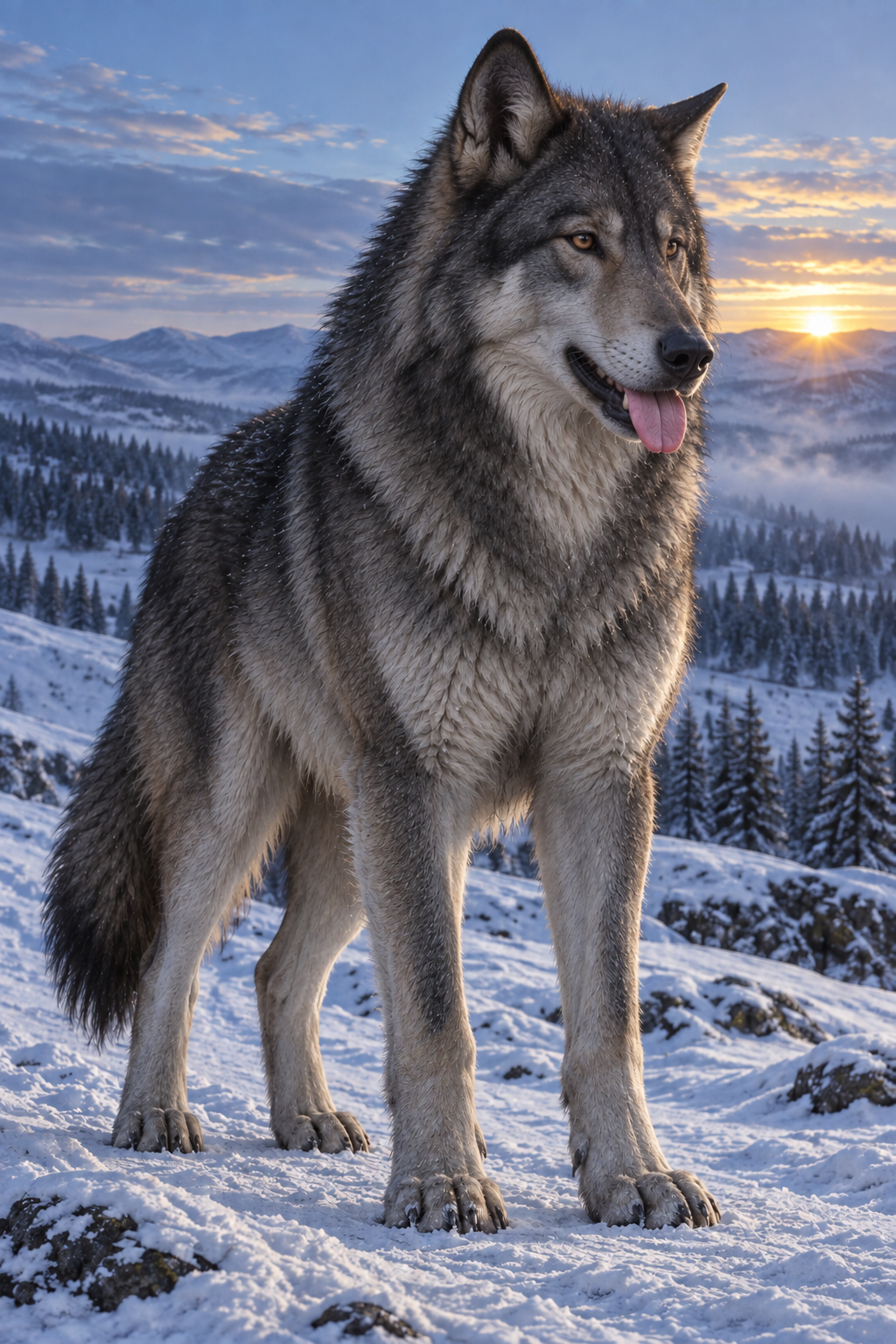
An immense gray wolf, an unusually patient friend, and absolutely nobody’s pet
Qantaqa is a massive female wolf raised by Binabik after he found her as a white-furred orphaned pup near Mintahoq. Qanuc and wolves have lived beside one another for thousands of years, but their partnership is personal rather than a standard cultural practice. Binabik’s teacher doubted the choice. Qantaqa and Binabik built something neither obedience training nor species mythology adequately names.
Binabik calls the relationship a bond of honor. He values her cleverness and friendship above the obedience of an ordinary ram mount. Qantaqa carries him because she chooses the partnership, not because the story has quietly classified a thinking animal as equipment. That distinction governs every scene: she can refuse, fear, grieve, improvise, extend trust to Simon, and act toward goals not reduced to the rider on her back.
She is physically formidable—large enough to carry Binabik or an injured person, strong enough to kill hounds and Norns, swift enough to pull a supernatural pack away from children—but the books make attention her defining intelligence. She reads scent, terrain, danger, exhaustion, and attachment. When humans are lost in titles or arguments, Qantaqa usually knows which person needs finding.
Four books of saving people who still occasionally call her a beast
Book 1: Qantaqa expands the road from two companions to three
Binabik summons her after rescuing Simon. Qantaqa arrives with such joy that she bowls the Qanuc down, immediately puncturing Simon’s expectation of a frightening controlled animal. She provides warmth while the sick boy sleeps, keeps watch, and joins the westward journey through the Knock and Aldheorte.
Her senses find survivors at Saint Hoderund’s and detect danger before human sight. During the Bukken attack she carries Binabik into the swarm and helps open the route that saves Simon. At Aldheorte’s edge, she hears the white hounds closing. At the canyon she crosses an unstable fallen tree with Simon, kills a remaining attacker after he knocks it off balance, and continues despite a wounded leg.
The next choice is enormous. When Simon’s insistence leads them to Miriamele and Leleth, Binabik sends injured Qantaqa away from the children to draw the new pack toward her stronger scent and carry warning to Geloë. She survives the chase and reaches the hidden lake. That is not passive animal loyalty. It is the most dangerous assignment in the scene, performed without the reassurance of a shared human language.
At Naglimund, stable workers throw her into a muddy slaughter pit because they see a devil-beast. Simon climbs down, improvises a step, and helps haul her out. Qantaqa accepts his touch and reunites with Binabik. Sangfugol names Simon Companion of Wolves because the trust is visibly earned.
Book 2: she leads Simon to the person both refuse to abandon
On Mintahoq, Binabik is imprisoned and emotionally preparing for death. Qantaqa waits for the recovering Simon, shortens her stride when he cannot keep up, checks him after he falls, and leads him to the prisoners’ pit. She seeks comfort from him while making clear that Binabik’s captivity is also her loss.
Once the judgment is reversed, she returns to the expedition. She helps defend the party against Hunën, ravens, Bukken, cultists, and Norn pursuit. Skodi’s abbey terrifies her so deeply that she cannot follow tracks into it; the narrative treats fear as information and limit, not betrayal. When Simon disappears, Binabik and Sludig search with her until storm erases the trail.
The party eventually must carry Thorn toward Sesuad’ra. Qantaqa joins the raft through flooded ruins, survives another Hunën pursuit, and reaches the Stone with Binabik and Sludig. Her road has moved from one rescue promise to a community under siege.
Book 3: “Find Simon” is a complete mission
When Simon and Miriamele leave secretly for the Hayholt, Binabik follows with Qantaqa. Isgrimnur’s farewell corrects some of his own prejudice toward Qanuc; Binabik sends the wolf ahead with the simple instruction to find Simon. The mission depends on scent, memory, and relationship rather than map or rank.
Qantaqa helps break the Fire Dancer ambush, kills Maefwaru’s allies, locates horses, and carries the fugitives through ground saturated with enemy patrols and supernatural pressure. She is not immune to the Storm King’s influence, but her immediate priorities remain astonishingly clear: the person, the route, the threat.
Book 4: the bond survives the end of the quest
As the journeys converge on Asu’a, Qantaqa continues beside Binabik through pursuit, rescue, and war. The swords, kings, prophecies, and towers take the foreground, but the partnership never becomes disposable once its early plot function is complete.
After the tower falls, Binabik returns toward Yiqanuc, Sisqi, and a life larger than the quest. Qantaqa’s survival matters because the story does not require loyal animals to die merely to certify that the ending was sad enough. She remains part of the future he chooses.
Friendship first, riding arrangement second
Binabik finds a motherless pup and ignores the old assumption that wolves and Qanuc should remain respectfully separate. He teaches Qantaqa to carry him, but training does not define the relationship. He speaks to her, reads her fear, trusts her independent action, and refuses Simon’s suggestion that another wolf could simply replace her.
Qantaqa’s grief during his imprisonment makes reciprocity visible. She is not waiting for an owner to resume issuing commands. She seeks him, recruits Simon, and mourns beside the pit. Later, Binabik’s decision to pursue Simon with her rests on shared attachment. “Find Simon” works because the goal already belongs to both.
Trust accumulates in cold camps, bad footing, and one extremely insulting pit
Simon begins with uncertainty around the immense wolf. Illness makes him dependent on her warmth and pace before pride can interfere. He watches her choose care, learns her bond cannot be reduced to animal obedience, and eventually contributes his own body to her rescue.
The slaughter-pit sequence completes the first movement of their relationship. Simon does not perform dominance. He enters danger, gives her a foothold, helps distribute her weight, and trusts her not to panic. Qantaqa answers with accepted touch and later leads him through Mintahoq. Their bond becomes practical knowledge of what the other will try to do.
Intelligence does not require turning her into a furry human
Qantaqa communicates through movement, scent, pace, sound, attention, and refusal. The narration does not give her jokey interior monologues or make every action secretly human. Her animal capacities remain the basis of agency.
That matters politically. Rimmersmen and castle workers often use “beast” to end moral consideration. Binabik sometimes translates her motives, but the repeated behavioral evidence lets Simon and readers recognize personhood without demanding speech. She belongs in the character directory because the story treats her choices as relationships with consequences, not because fandom needed an adorable companion slot.
The saga’s cleanest answer to possession is companionship
The Storm King’s world turns bodies into vehicles: Elias carries Ineluki, the Red Hand animates corpses, prophecy moves sword-bearers, rulers draft subjects, and frightened institutions treat children and animals as tools. Qantaqa carries people too, but the moral structure is opposite. Consent, trust, care, and reciprocal obligation make transport part of relationship rather than possession.
Her scenes also correct epic scale. A continent may be freezing, yet the immediate decision is whether to slow for the feverish boy, draw hounds from an injured child, find the prisoner, or enter the fight beside a friend. Qantaqa cannot solve prophecy. She repeatedly preserves the people capable of questioning it.
And yes, she is cool as hell. The point is not to apologize for loving the enormous wolf. The point is to love the actual character: intelligent, frightening, affectionate, independent, vulnerable, and never interchangeable with the next gray animal generated for visual convenience.
Scope, status, and animal-identity continuity
This profile covers Qantaqa across all four owned Kindle volumes and their reference material. Her relationship is described using the text’s own distinction between friendship and mastery. She remains a wolf; intelligence and agency do not make her a magical shape-changing human.
Her approved healthy-adult identity is an anatomically believable immense female northern wolf with a heavy storm-gray coat, charcoal crown and mantle, silver-gray muzzle and chest, warm amber-brown eyes, long muzzle, huge head and girth, long legs, large paws, low-carried tail, and a subtly outward-tipped right ear. The novels establish her sex, scale, heavy gray fur, huge head and girth, long pink tongue, and white puppy coat; the exact mask, eye color, ear set, coat map, proportions, White Waste location, and dawn light are editorial reconstruction.
The same local attachment governs featured image, visible hero, social image, and all five directory views. Puppy flashbacks must transform this same facial identity into a white-furred orphan; later road and battle scenes may add the canon foreleg wound, ragged paws, exhaustion, or limp without drifting into a dog breed, fantasy monster, oversized husky, or generic dire wolf.