
Memory, Sorrow, and Thorn · Canonical Character Profile
Jarnauga
Ninety years old, white-bearded to the belt, serpent-marked, and cursed with the problem of seeing danger before powerful men find it politically convenient: Jarnauga leaves an emptied Moon Door to warn Naglimund, restores the causal history of the Storm King, and spends his last blood buying Father Strangyeard enough time to carry the record onward.
At a Glance
The warning-bearer who refuses to make uncertainty sound prettier than it is
- Home
- Tungoldyr, called Moon Door, near Stormspike
- Age
- About ninety
- Affiliation
- League of the Scroll
- Work
- Northern watcher, historian, messenger, Minneyar researcher
- Gift
- Extraordinary distant sight and dream sensitivity
- End status
- Dead; mortally wounded at Naglimund and stays behind to seal the final gate
The Visual Receipt
Old, spare, bright-eyed, and absolutely not a generic snowy wizard
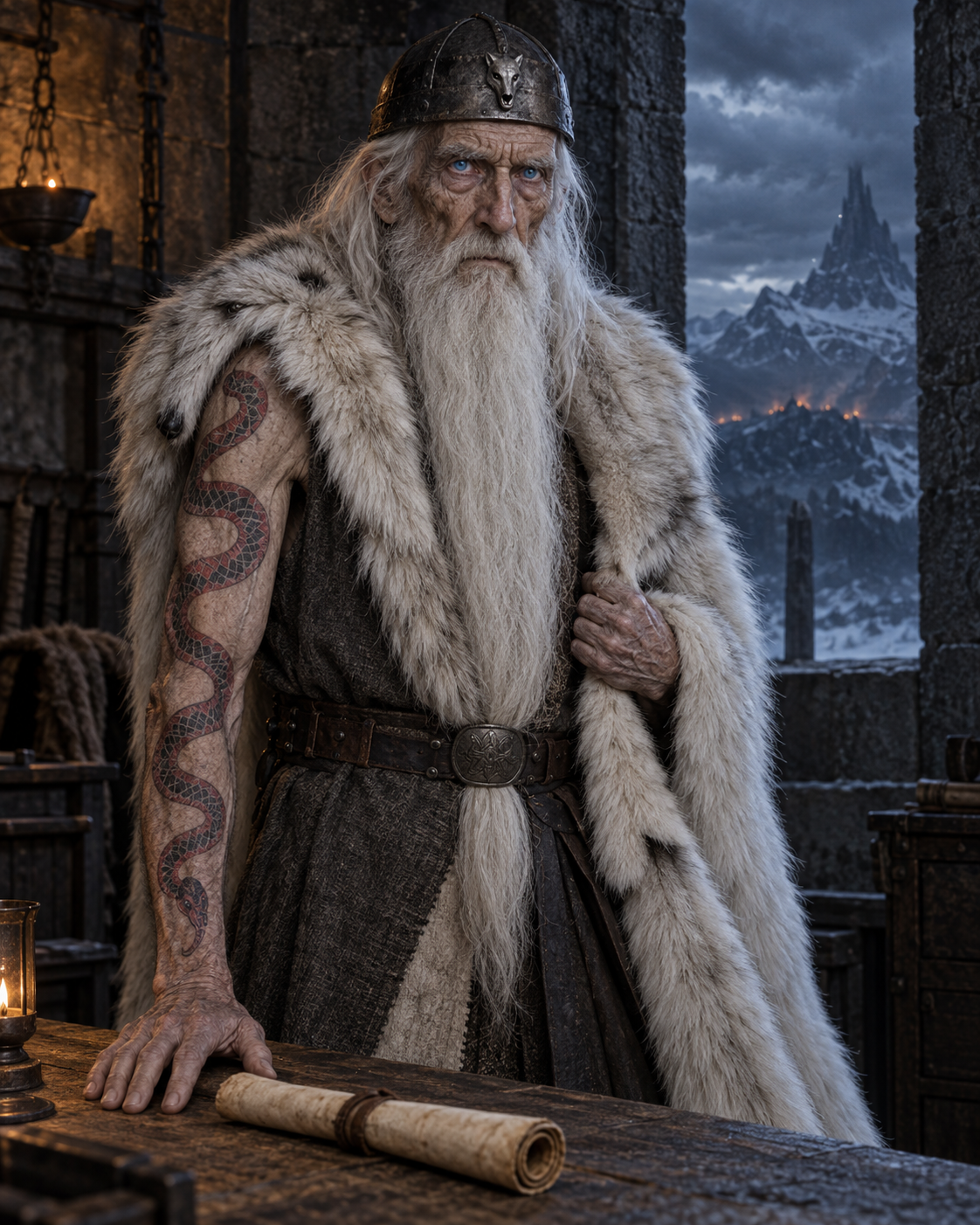
Jarnauga has white hair and a white beard so long it reaches his belt and can be tucked into it. His body is impossibly spare and weathered by the far north, but his cobalt-blue eyes remain luminous. He wears white wolfskin and an iron cap marked by a toothless wolf skull. A vivid red-and-black serpent tattoo spirals along his right arm; during the bird-message ritual, the image appears to move.
The approved portrait honors age rather than treating it as an aesthetic defect to erase. Attractive here means magnetic: sharp presence, startling eyes, formidable history, and a body that has endured ninety winters. The serpent work, wolfskin, northern materials, and lived-in face distinguish him from stock fantasy wizardry.
One stable face now connects Tungoldyr, council testimony, archive work, distant sight, Naglimund’s destruction, death, and every later memorial card. Exact facial structure, skin tone, garment weave, cap construction, and serpent pattern inside the recorded red-black form remain editorial reconstruction.
Book 1 · The Dragonbone Chair
Stormspike is burning, the White Foxes are awake, and the south would prefer a normal political argument
Jarnauga remains at Moon Door after unnatural winter empties Tungoldyr. Families die or flee; Stormspike’s lights intensify; hostile music travels across the mountains. He is the last resident to remain, watching evidence accumulate where dismissal has a human body count.
He sends Morgenes a runic warning by bird: smoke has risen for nine days, fires have burned eight nights, the White Foxes wake, children are troubled, and someone is knocking at dangerous doors. Pryrates appears immediately after the message and speaks of captured birds and extracted secrets. Warning itself has become exposure.
Jarnauga eventually leaves in wolf pelts with messenger birds, the recurring dream of a black book and three swords, thunder behind him, and riders approaching. He guides Isgrimnur’s party from the Vestvennby road to Naglimund and identifies himself as a Tungoldyr man and Scrollbearer.
The council wants to debate Elias, Josua, mediation, taxes, and rebellion. Jarnauga does not deny those conflicts. He says they are the visible glove around a larger hand. Midsummer approaches while Hunën move south, Bukken attack armed companies, Stormspike burns all night, and black winter advances. Calling him superstitious will not warm the ground.
From the Ashes of Asu’a
He restores the story’s causal order before naming its enemy
Josua asks for a name. Jarnauga refuses to deliver “the Storm King” as an isolated villain reveal. He begins with Asu’a, mortal conquest, the battles at the Knock and Ach Samrath, the Sithi’s losses, Ineluki’s making of Sorrow, the Red Hand, Eahlstan Fiskerne’s later discoveries, and the League founded to preserve what victory buried.
The sequence matters. Old wounds explain present motives without licensing fresh ethnic hatred. Jarnauga explicitly resists using ancient betrayal to simplify the mixed people sitting in the Raed. History should identify mechanisms and responsibility, not hand the living a decorative excuse to hate whoever resembles the dead.
When he names Sorrow, Simon’s blocked Stoning Night memory breaks open. Jarnauga corrects the boy’s identification: the figure he saw was not Ineluki himself but one of the Red Hand. Their bodies burned, yet some remnant survived through Sorrow and the final working as dreams, shades, or living wills.
Jarnauga marks the limits of knowledge. The League’s years of observation support the conclusion that Ineluki’s influence has awakened among the Norns and the Red Hand returned with him. Jarnauga cannot claim complete access to the Storm King’s mind or plan. He infers revenge because hatred preserved Ineluki in the void. The page must preserve that inference as inference.
The League of the Scroll
Knowledge survives because custody passes before certainty arrives
Jarnauga’s father Trestolt belonged to the network with Morgenes, Ookekuq, Padraic, Xorastra, Dinivan, and others. The League’s traditional number, recruitment history, and disastrous proximity to Pryrates make it a human institution rather than a flawless secret order.
Jarnauga gives Father Strangyeard the glittering League pendant. Geloë later confirms what it means. Membership is not a reward badge; it transfers access, duty, danger, and the responsibility to continue when another keeper dies.
During Naglimund’s siege, Jarnauga remains in the archive with Strangyeard to research Minneyar while the Thorn company travels north. He senses that Morgenes concealed a crucial clue in the ending of Prester John’s Shurakai account but cannot initially reach it. Extraordinary sight does not cancel interpretive blindness.
Naglimund
He sees the attack coming and still cannot make warning equal prevention
Jarnauga’s distant sight detects Leobardis’s approaching Nabbanai force, but he sees movement rather than motive. Deornoth witnesses the murder that follows; Aspitis carries another part of the event. The division reinforces his epistemic discipline: sight is evidence, not omniscience.
As Naglimund’s destruction begins, Jarnauga dreams of a violent rupture at Urmsheim—Simon calling out in fear and anger—while immediate disaster closes around the castle. He and Josua walk under unnatural storm clouds. The black winter he announced is no longer a contested interpretation.
Jarnauga is mortally wounded during the harrowing. Strangyeard gathers survivors toward the hidden passage. At the final gate, the old Scrollbearer stays behind to close and jam it, handing the pendant and burden onward. His last useful act is not explaining one more secret. It is creating physical time for the next keeper to escape.
Books 2–4 · The Record After Him
Berry liquor, a badge, a manuscript, and people frightened enough to keep working together
Jarnauga remains active through what others carry. Strangyeard’s League badge makes him a target and gives him standing when Josua needs a Scrollbearer to perform the Thrithings wedding. The old man’s teaching shapes the continuing search for Minneyar and the Three Great Swords.
Tiamak and Strangyeard later share Jarnauga’s berry liquor while mourning Geloë. They admit they are afraid and form a small pact not to let either scholar disappear alone. The drink is not a quirky prop. It turns inheritance into companionship at the point solitary expertise has become lethal.
Morgenes’s manuscript, Ookekuq’s scrolls, Jarnauga’s lessons, and witness accounts still fail to provide a simple instruction manual for the swords. That failure honors his method. Preserved knowledge narrows possibilities and prevents amnesia; it does not owe the living a convenient answer.
Connections
The warning network and the people who inherit it
Morgenes
Fellow Scrollbearer and recipient of the Stormspike bird warning; their separate evidence chains converge around the swords and Ineluki.
Father Strangyeard
Archive partner, pendant heir, Minneyar researcher, and survivor for whom Jarnauga seals the gate.
Josua
The prince who permits Jarnauga to speak, asks for the enemy’s name, and later admits the Norns destroyed hope that the warning was mistaken.
Simon
His buried memory confirms parts of Jarnauga’s history while requiring correction about the Red Hand figure.
Binabik
Recognizes Jarnauga through Ookekuq and helps translate northern evidence into terms the council can evaluate.
Tiamak
Later Scrollbearer-level investigator who inherits Jarnauga’s teaching, liquor, fear, and commitment to collaborative knowledge.
Why He Matters
He knows the difference between evidence, inference, and the story frightened people want certainty to become
Jarnauga’s authority comes partly from extraordinary perception, but his credibility comes from restraint. He distinguishes what the League observed from what he concludes. He corrects Simon without humiliating him. He refuses to flatten five centuries into a villain’s name before restoring the causal chain.
That practice makes him the opposite of prophecy culture at its worst. He does not promise the swords will solve the crisis or that history guarantees justice. He preserves enough truth for other people to make less blind choices.
Seeing Is Not Knowing
His gift becomes trustworthy because he refuses to pretend it reads motives
Jarnauga can perceive distant movements, storms, fires, and ruptures that others cannot. He still needs witnesses, manuscripts, cultural memory, and debate. Leobardis’s approaching army does not tell him who will betray whom. A dream of Simon’s danger does not deliver an operational rescue plan.
The distinction protects every later explainer built from his testimony. Supernatural perception is a source with scope and limits, not permission for the website to state every interpretation as fact.
On the Record
Scope, status, and evidence boundaries
This is Jarnauga’s one canonical full-spoiler profile. His direct life and death occur in Book 1; Books 2–4 carry his badge, teaching, liquor, historical account, research, and institutional legacy. Those later memberships represent explicit continuing relevance, not survival.
The approved visual record preserves white hair, belt-length white beard, luminous cobalt eyes, extremely spare weathered frame, white wolfskin, iron cap with toothless wolf skull, and a red-black serpent tattoo on the right arm. Unsupported facial, textile, metalwork, and exact tattoo details remain editorial reconstruction.
Every card, hero, warning ritual, archive, death, and legacy illustration must preserve this face and body. The serpent’s apparent movement is a witnessed magical effect; the page does not invent a complete mechanism for it.