
Memory, Sorrow, and Thorn · Canonical Character Profile
Father Strangyeard
Naglimund’s anxious one-eyed archivist inherits a dead scholar’s manuscript, a doomed league, a sword mystery, and eventually the responsibility to decide what the new kingdom will remember. Strangyeard is frightened often, embarrassed beautifully, and brave in the deeply inconvenient way of a man who keeps bringing the books into places books have no business surviving.
At a Glance
The quiet man holding the loudest evidence
- Calling
- Aedonite priest, Naglimund archivist, historian, and later Scrollbearer
- Primary role
- Keeper of Morgenes’s manuscript, Three Swords investigator, witness recorder, confessor, and memorial builder
- Core fear
- Blindness and darkness—not because he fears death most, but because they would end his life among books
- Closest scholarly partner
- Tiamak, with whom he renews the League of the Scroll
- Defining gift
- Making fragments answer one another without pretending uncertainty has disappeared
- End-of-series status
- Alive; building an archive, memorial, and place of learning where Green Angel Tower stood
The Visual Receipt
One blue eye, one black patch, and absolutely no warrior silhouette
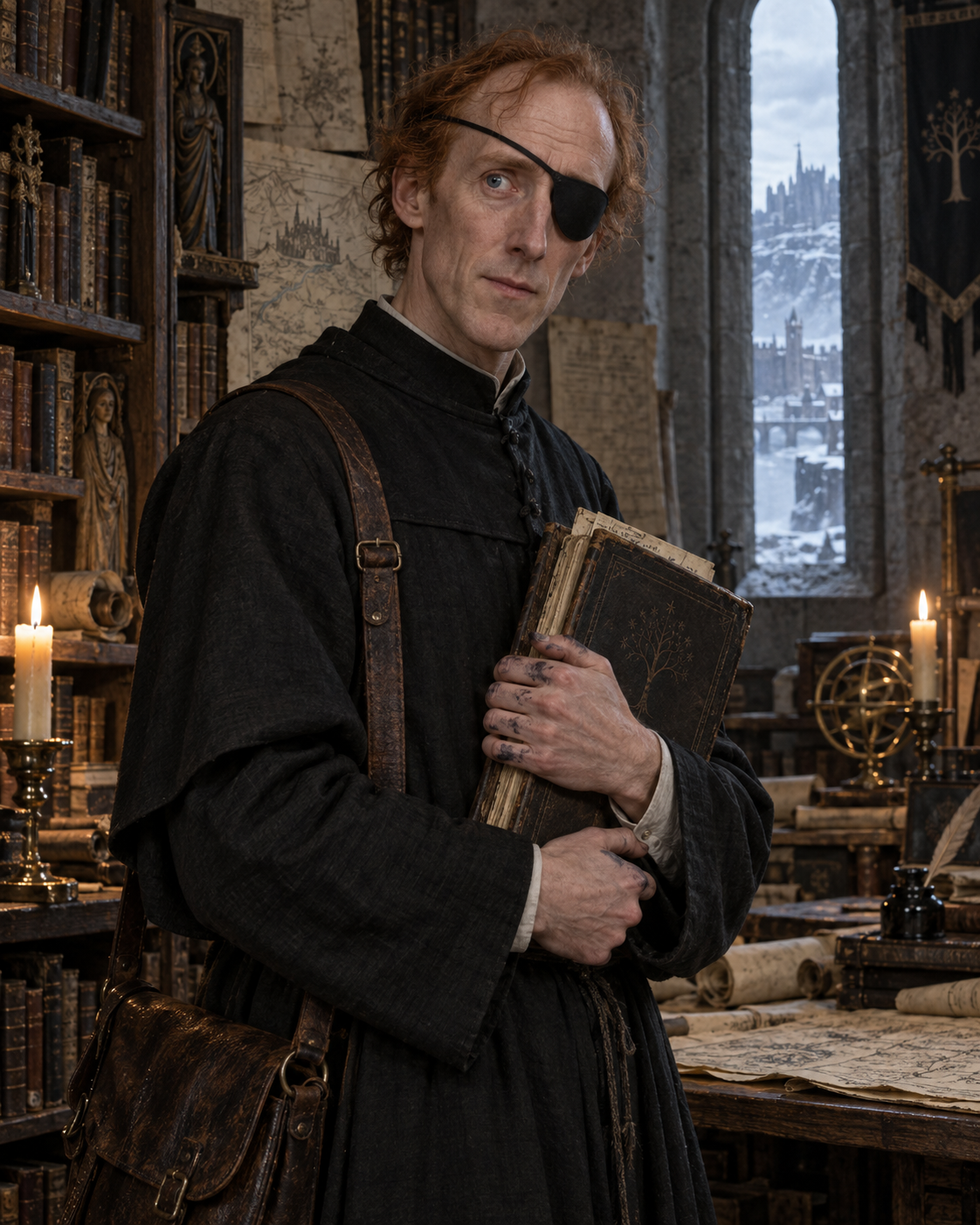
Strangyeard is slight, pale, and long-chinned, with sparse copper-red hair. One visible eye is blue; a black patch covers the other. He wears the gray or black cassock of a priest and carries nervousness openly rather than polishing it into mysterious-sage composure. His body does not advertise battlefield usefulness. That is the point. The story repeatedly places civilization’s continuity in the hands of a man soldiers might overlook.
Canonical art should make him appealing through intelligence, gentleness, and specificity—not inflate him into a broad-shouldered action cleric. His milestones move from sparse Naglimund room to ragged forest flight, New Gadrinsett study, winter campaign, and the rebuilt Hayholt. The eyepatch, blue eye, narrow build, copper hair, and recognizably anxious warmth must remain locked across all of them.
The Complete Journey
The archive escapes the castle and becomes a person
Book 1 · The Dragonbone Chair
He gives Simon a room and Morgenes’s work a future
Strangyeard welcomes Simon to Naglimund with nervous kindness, self-effacing humor, and his own sparse room. He identifies the giant killed during Simon’s rescue as a Hunën and treats its crude clothing and reddish-stone belt as evidence rather than permission for the crowd’s devil stories. His habit is established immediately: look closely enough that inherited categories stop doing all the thinking.
When he asks to examine Morgenes’s unfinished manuscript, his gratitude is not acquisitive. Simon has trusted him to read and preserve serious work. Strangyeard joins Jarnauga in the search for Minneyar, using John’s history, monastery records, Colmund’s testimony, and the strange spear-to-sword contradiction. Scholarship becomes suspense because the siege keeps crossing the walls while the answer remains buried inside language.
Naglimund falls before the research can become safe. Strangyeard carries Morgenes’s manuscript and Jarnauga’s League badge into flight. He identifies himself as a possible Norn target because knowledge is now materially attached to his body. When Norns seize him on watch, Deornoth attacks barehanded to save him. The archivist who feared he would be useless has become important enough for the enemy to hunt and loved enough for a knight to imagine reading aloud to him if sight fails.
Book 2 · Stone of Farewell
The accidental Scrollbearer becomes part of the resistance’s working memory
In the survivors’ camp, Strangyeard performs priestly labor that war epics often leave offscreen: care, burial signs, washing, shriving, improvised clothing, and ceremonies conducted without ideal tools. He knights Simon beside Josua, losing the prayer and catching the sword in his sleeve just before the moment becomes solemn enough to change the boy’s public identity. The comedy does not puncture meaning. It makes meaning human-sized.
Eolair brings portable copies of the dwarrow maps, and Strangyeard praises their exquisite ancient scholarship before learning two exhausted Hernystiri scribes made them. His mortification lasts only until the information takes over. Then Minneyar becomes Bright-Nail: Josua’s burial memory, John’s secrecy, Morgenes’s account, and dwarrow craft history rearrange into one solution.
Binabik initiates Strangyeard and Tiamak into a renewed League. The oath is not a promotion into certainty. It transfers unfinished responsibility from dead mentors to frightened survivors. Strangyeard’s theology follows the same ethic: good deeds cannot purchase God’s favor; right must be done because it is right. In a story crowded with prophecies and bargains, he refuses virtue as transaction.
Book 3 · To Green Angel Tower, Part I
Two frightened scholars decide neither will carry the answer alone
Strangyeard and Tiamak become the remaining Scrollbearer-level investigators after Geloë’s death and Binabik’s departure. They test sword materials, Words of Making, contradictory histories, witness accounts, and the possibility that confusion itself is part of Ineluki’s design. Their great strength is evidentiary humility: the failure to produce a coherent answer is not permission to invent one.
He also becomes keeper of knowledge that should not become public simply because powerful people want it. Camaris agrees to confess his hidden Jao é-Tinukai’i history under the Door of Ransomer. Strangyeard emerges shaken and discloses only what the agreed scope permits: the event does not bear on the current war. Scholarship and confession share an ethical boundary. Access is not ownership.
When Tiamak decides someone who knows the texts must enter the Hayholt’s depths, Strangyeard insists on joining despite age, poor vision, and fear of enclosed darkness. They drink Jarnauga’s berry liquor, mourn Geloë, and admit they are afraid. The pact is the League at its best: not seven grand men announcing destiny, but two friends refusing to make the other expendable.
Book 4 · To Green Angel Tower, Part II
He recognizes the trap, then builds the institution that can remember it
Strangyeard’s work moves between records and battlefield perception. He and Tiamak audit ignored people, places, and incidents because the sword facts still do not explain Pryrates’s plan. At Swertclif, half-blind in snow, Strangyeard understands the defenders’ silence before the generals do. The Norns know the underground routes and have allowed the army to bring the apparent Camaris inside so they can isolate and destroy the hope attached to him.
The insight does not make him a warrior. It proves observation can alter survival even when the observer cannot swing the decisive sword. By the ending, Tiamak has completed his healer’s book and Strangyeard has begun a different answer to catastrophe. Where Green Angel Tower stood, he builds a memorial, archive, and place of learning so knowledge will not vanish into another private order or sealed room.
At the restored Great Table, he belongs not as court decoration but as part of the new realm’s constitutional memory. John’s kingdom hid Bright-Nail in a grave and let history become rumor. Strangyeard’s postwar labor proposes another model: preserve the dead, teach the living, and make evidence available before the next crisis requires a frightened archivist to flee through the forest with civilization under his robe.
The People Around Him
Trust turns documents into a community
Simon
Simon gives him Morgenes’s manuscript; Strangyeard gives Simon shelter, history, ceremony, and a model of courage that does not depend on looking fearless.
Jarnauga
The old Scrollbearer makes him a fellow investigator and leaves him both badge and burden. Their Minneyar work proves knowledge survives through collaboration, not mystical inheritance.
Tiamak
Tiamak becomes colleague, oath-brother, drinking companion, and friend. Their partnership makes scholarship reciprocal: each challenges the other, and neither is allowed to become the sole expendable expert.
Deornoth
Deornoth promises to read to him if blindness comes, then attacks a Norn barehanded when Strangyeard is seized. The relationship imagines a future for damaged people before survival is guaranteed.
Camaris
Camaris entrusts him with a truth the prince cannot ethically extract by force. Strangyeard proves that knowing a secret can create a duty not to repeat it.
Morgenes and Geloë
Their deaths leave tools rather than instructions complete enough to obey. Strangyeard honors them by continuing the questions, not by treating every fragment as infallible scripture.
Why He Works
Knowledge without the usual wizard costume
Strangyeard works because intelligence never cures his fear. He remains anxious, physically slight, visually imperfect, and capable of comic embarrassment. Courage is the repeated decision to keep doing the work with fear still present: read while stones cross the wall, carry the manuscript, take the oath, hear the confession, enter the dark, speak when the trap becomes visible.
He also corrects the fantasy archive’s usual politics. Documents do not merely contain lore for heroes. They belong to institutions, servants, scribes, witnesses, damaged books, and readers who must decide what can ethically be disclosed. His memorial at Green Angel Tower makes remembering a public responsibility rather than a secret society’s private advantage.
On the Record
Scope, spoilers, and one carefully preserved face
This is Father Strangyeard’s one canonical profile across all four owned Kindle volumes and their completed reading receipts. It is intentionally full-spoiler. Franchise and volume directories must filter this post by explicit appearance metadata and display scope-aware status rather than create duplicate biographies.
His locked identity preserves one attractive, slight, pale, long-chinned, sparse-copper-haired face with one blue eye and one black eyepatch across archivist, fugitive, Scrollbearer, campaign scholar, and memorial-builder milestones. Fear, weather, and age can move across the face; its anxious gentleness remains.