
Memory, Sorrow, and Thorn · Canonical Character Profile
Cadrach-ec-Crannhyr
A charming friar, a gifted natural philosopher, a practiced thief, and the series’ most exhausting argument against confusing self-hatred with accountability. Cadrach keeps failing people, keeps understanding exactly what the failures cost, and finally uses everything he knows to hold open a road he cannot take himself.
At a Glance
The facts, before he tries to drink around them
- Birth name
- Padraic or Padreic ec-Crannhyr; Cadrach insists that man is dead
- Known as
- Brother Cadrach; a self-described friar whose claimed order changes when convenient
- Primary role
- Fallen Scrollbearer, natural philosopher, reluctant guide, betrayer, rescuer, and witness to Pryrates’s design
- Core skills
- Languages, old texts, mechanisms, performance, theft, survival, and a dangerous remnant of the Art
- Defining relationship
- Miriamele—the person he repeatedly endangers, repeatedly saves, and cannot persuade to accept shame as a complete answer
- End-of-series status
- Dead; remains inside Green Angel Tower after revealing the invisible stair
The Visual Receipt
A face built for laughter with something darker living underneath
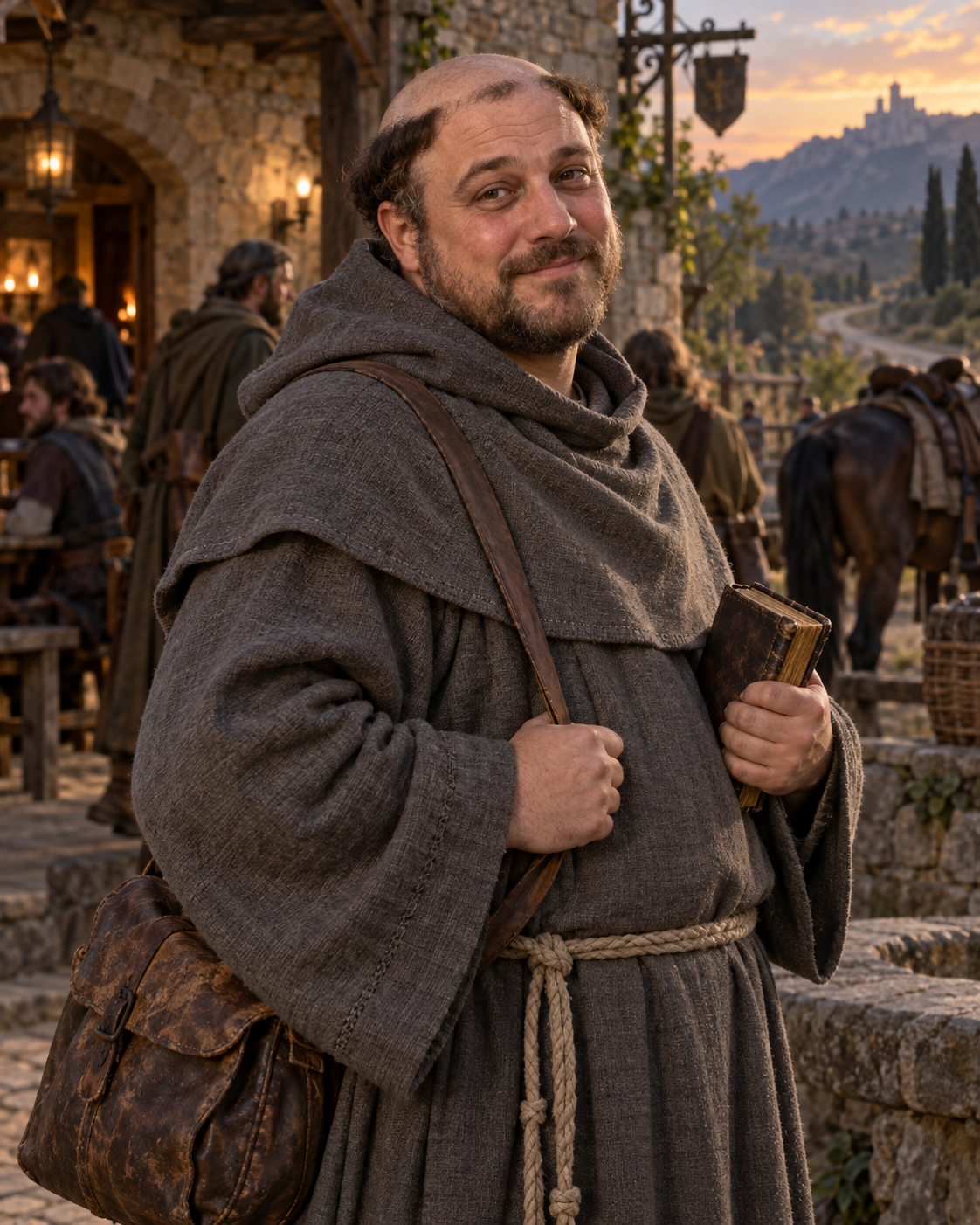
Simon first sees a plump mendicant friar in a gray robe and tonsure: weather-hardened pink face, heavy-lidded eyes, rough boots, and the easy smile of a man who can make strangers feel as though the joke already includes them. The important visual detail is not ugliness. It is contradiction. His eyes have practiced amusement in them, but Simon catches a deeper shadow; when Cadrach smiles sadly, the eyes finally match the mouth. He should look appealing enough that trust feels natural and worn enough that escape has become a bodily habit.
The canonical art cannot turn him into a greasy comic drunk or a generic sinister monk. He is educated, charismatic, observant, and once belonged among brilliant people. Later milestones should show the cost of chains, seasickness, hunger, torn hands, alcohol, and sustained fear without changing his identity. The same face must carry the market performer, Miriamele’s gray-robed escort, Pryrates’s terrified former pupil, and the exhausted man beneath Green Angel Tower who finally stops trying to rename himself out of responsibility.
The Complete Journey
He keeps choosing survival until he discovers a choice worth dying for
Book 1 · The Dragonbone Chair
The friendly friar who keeps leaving somebody else with the bill
Cadrach enters through comedy sharpened into warning. In Erchester he rescues Simon from soldiers, buys him hot chestnuts, offers a theology of invisible puppet-masters, and watches the crowd with more care than his relaxed manner suggests. He introduces himself as a Vilderivan friar traveling with Gwythinn. After he leaves, Simon’s purse is gone. The theft is not witnessed, but the pattern becomes harder to romanticize when they meet again at Flett.
There Cadrach claims a different order, supplies food, ale, and wonderful stories, then produces an empty purse and abandons Simon to the angry innkeeper. Simon escapes only after Erkynguard appear. Cadrach can create warmth; he can also convert another person’s need into cover for his own survival. The series refuses to pretend those facts cancel each other in either direction.
His road becomes inseparable from Miriamele’s after Vorzheva hires him to escort the disguised princess. He knows routes, scripture, languages, and how to disappear. He also takes Vorzheva’s gold, sells information to Count Stréawe, and accepts another purse for delivering Miriamele into a chain of arrangements she never chose. At Innishcrich, the dying Arthpreas recognizes him as Padreic. At Nabban, Dinivan does too. The charming rogue identity begins cracking around a former life Cadrach has declared dead without convincing anyone who knew it.
Book 2 · Stone of Farewell
Padreic returns every time somebody needs the knowledge Cadrach is hiding
Dinivan names him a former student of natural philosophy with a gift for pulleys, levers, and mechanisms. Cadrach answers that Padreic is dead and some crimes cannot be forgiven. It sounds honest, but it also performs a convenient burial: if the responsible man no longer exists, the surviving man can keep moving without making repair. Miriamele will not let him have that escape.
When Pryrates comes to the Sancellan, Cadrach knows excommunication will bring immediate murder. He begs Miriamele to flee, knocks her unconscious when she refuses to leave Dinivan, carries her out, and uses a word of the Art to dissolve Pryrates’s invisible barrier. He saves her life by removing her choice. Both things remain true. Aboard the Eadne Cloud, his warning about Aspitis is accurate; his record makes trusting it nearly impossible. He tries to escape, gambles away his passage, and returns in chains.
His confession finally gives the dread a shape. Born Padraic in ancient Crannhyr to a hard coppersmith after his mother’s death, he found kinship in the Tethain Library. Morgenes brought him into the League of the Scroll. Cadrach helped recommend the brilliant young Pryrates, then slid through disillusionment, forbidden study, and deliberate alcoholic oblivion. Pryrates tortured and used him. Cadrach surrendered knowledge, pages of Du Svardenvyrd, and access he understood was dangerous.
During the shipboard revolt, Cadrach turns his chain against a kilpa and gives Miriamele the oar she uses to break Aspitis’s face. He rows until his hands split. Later, in Kwanitupul, he returns under pursuit to smash the only spare boat, buying the fugitives time. In the Wran he cannot enter the ghant nest because underground terror overwhelms him. Isgrimnur calls it cowardice; Miriamele leaves him a role he can perform. Cadrach builds a palm-oil fire-thrower, burns his own hand, and saves the entire rescue party. Trust works because it is specific, not innocent.
Book 3 · To Green Angel Tower, Part I
Being called a friend frightens him more than being called a thief
Cadrach can identify a Sithi Witness, explain Stones and Scales, and frame the Art as understanding the world the way a builder understands ramps and leverage. He also secretly searches for Tiamak’s parchment, repeating the furtive behavior that has made every explanation sound like another trick. Miriamele tells him that a hated child grows into a man who teaches others to hate him; he admits enough of his childhood to show she has struck the truth. When she calls him her friend, he softens—and then retreats.
After Camaris defeats Aspitis, Cadrach takes a horse and leaves a note. He says he cannot face Josua, does not belong among good people, and cannot help anyone. The flight proves one of his ugliest habits: shame becomes a prophecy he works very hard to fulfill. Miriamele later realizes his interest in Tiamak’s page was not simple theft and understands that the lost leaf of Du Svardenvyrd connects directly to the catastrophe. Cadrach’s absence is no longer just emotional damage. It is missing evidence.
Book 4 · To Green Angel Tower, Part II
He follows the princess home and finally tells the whole truth
Cadrach follows Miriamele from Sesuad’ra through Stanshire and Falshire into Saint Sutrin’s and the tunnels below the Hayholt. He frees Binabik, forces the dwarrows’ hidden door ahead of pursuing Norns, and collapses at the threshold with the warning that they are behind him. Rescue does not erase betrayal; it creates the chance for a reckoning that is finally specific.
Pressed by Miriamele, Cadrach admits Pryrates tortured him into spying on the Scrollbearers. He identified Bright-Nail as Minneyar, located it in John’s barrow, and gave Pryrates the three-sword theory in exchange for survival. The most terrifying revelation is that Pryrates already knew and deliberately allowed the sword to remain buried. He wants all three blades brought to Green Angel Tower. Cadrach’s cowardice did not accidentally derail the prophecy; it helped place the heroes inside the enemy’s machinery.
When Pryrates calls him Padraiec, Cadrach tries poison and fails. He still joins Miriamele and Binabik in the final climb. As the tower breaks, he remembers the riddle of stars shining at midday and recognizes solid steps hidden across open air. Too weak to cross, he directs the others onto the impossible road and stays behind. His last declaration—he is not the man he was—does not mean the guilty man magically died years ago. It means the living man makes a different final choice while owning the road that brought him there.
The People Around Him
Everybody he disappoints, and the few who keep demanding more
Miriamele
She is victim, judge, protector, friend, and the person least willing to confuse mercy with absolution. She throws him into a bay, shades his face from the sun, trusts him with the boat, and keeps asking for the truth after shame says the conversation should end.
Pryrates
Pryrates turns scholarship, torture, terror, and Cadrach’s instinct for survival into a leash. Calling him Padraiec is an attempt to reactivate ownership. Cadrach’s final choice rejects that ownership without pretending it never shaped him.
Morgenes and Dinivan
They remember the gifted man before the collapse. Their belief is not sentimental acquittal; it is evidence that Cadrach possessed loyalties and capacities he cannot erase simply by announcing their death.
Simon
Simon meets the most entertaining version of Cadrach and pays for the privilege twice. Their brief encounters establish the series-wide rule: charisma is a real gift, and gifts do not become goodness merely because we enjoyed receiving them.
Isgrimnur
The duke judges fear from the outside and initially gets Cadrach wrong. His later declaration that Cadrach is a good man matters precisely because it follows a concrete act, not a charming speech.
Tiamak
Tiamak’s page awakens the scholar Cadrach keeps burying. Suspicion makes his secret search look like theft; the eventual provenance proves his knowledge was essential even when his conduct deserved scrutiny.
Why He Works
Redemption with the receipt still attached
Cadrach works because the story never makes suffering a coupon redeemable against harm. Pryrates tortured him. His childhood taught him self-hatred. Alcohol became anesthesia. None of that makes Simon’s lost purse reappear, restores Miriamele’s choices, revives Dinivan, or removes the swords from Pryrates’s design. Explanation enlarges accountability; it does not replace it.
He is also funny, useful, tender, infuriating, and capable of courage that fits his actual fear. The ghant rescue is the miniature of his whole arc. He cannot go underground, and public contempt cannot force him through the entrance. Given one trusted role outside, he uses knowledge, improvisation, and his own burned hand to bring everyone home. At Green Angel Tower, the same structure becomes final: the man who opened a forbidden door for Pryrates is the man who finds an impossible road for Miriamele and Binabik.
On the Record
Scope, spoilers, and the identity still waiting for a face
This is Cadrach-ec-Crannhyr’s one canonical profile across all four owned Kindle volumes and their completed reading receipts. It is intentionally full-spoiler. Franchise and volume directories must filter this post by appearance and display scope-aware status rather than create duplicate biographies.
His locked identity preserves the text’s plump, weather-pink, heavy-lidded, frequently smiling friar while keeping him attractive, intelligent, and recognizably marked by the sorrow beneath the performance. This face now governs every later road, captive, and tower milestone so suffering can change him without replacing him.