
Memory, Sorrow, and Thorn · Canonical Character Profile
Isorn
Isorn escapes captivity with youth already pulled from his face, then refuses to let pain make him ornamental. He commands beside Josua, recruits displaced Rimmersmen through remembered grief, becomes Eolair’s steady friend, impersonates Camaris in the final siege, and dies inside the trap meant to destroy everybody’s hope.
At a Glance
The northern heir who earns loyalty by remembering the dead as people
- Family
- Son of Isgrimnur and Gutrun; husband; brother within a larger northern family
- Position
- Heir of Elvritshalla, Rimmersman commander, Josua supporter
- Physical mark
- Broad and stocky with blue eyes; captivity leaves him drawn and leg-wounded
- Core bond
- Friendship and campaign partnership with Count Eolair
- Final mission
- Impersonates Camaris during the Hayholt assault
- End status
- Dead; found among the soldiers killed near Pryrates during the final breach
The Visual Receipt
His father’s build and eyes, with captivity written across a younger face
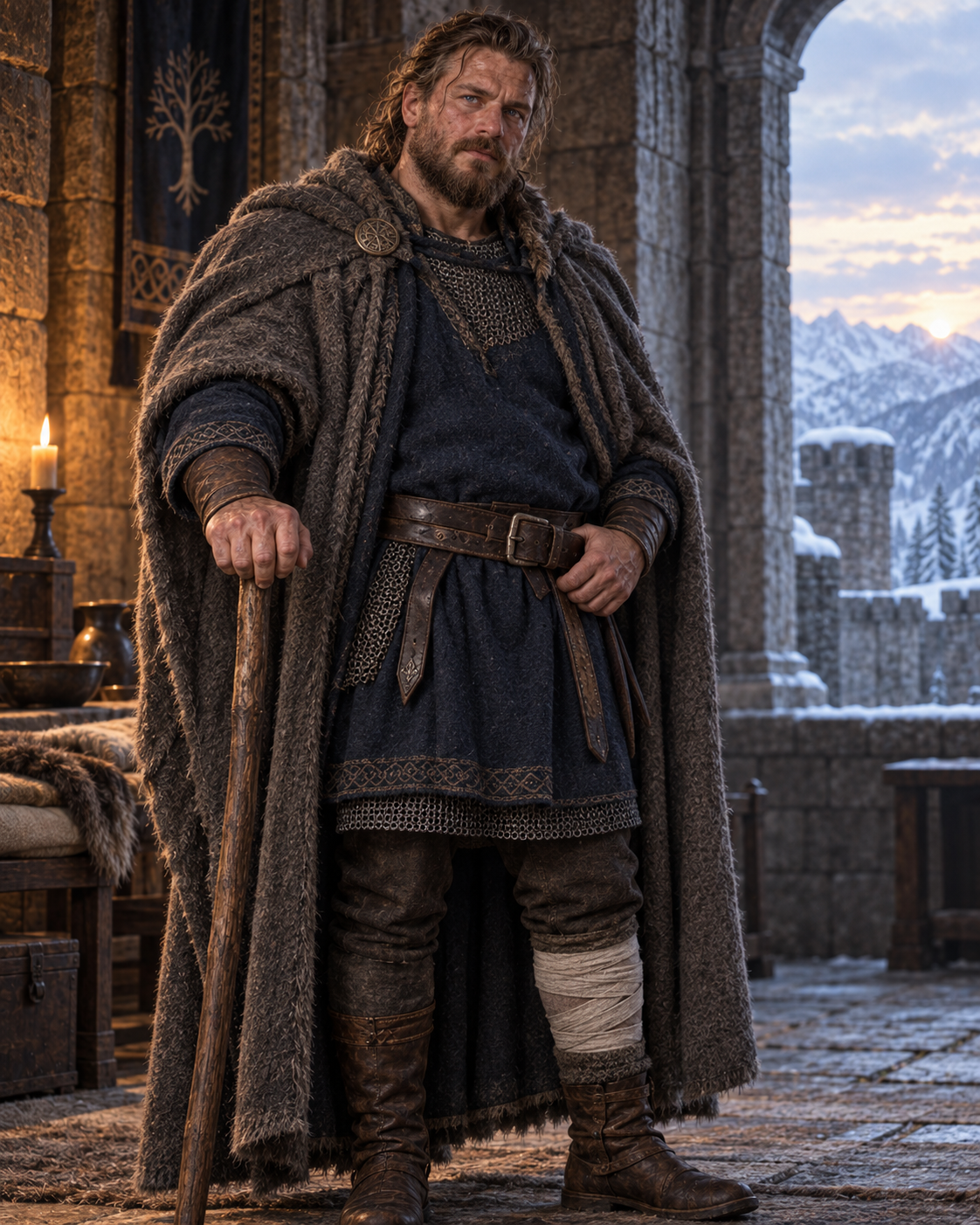
Isorn inherits Isgrimnur’s blue eyes and broad, stocky body. When he reaches Naglimund after captivity, his face is drawn and shadowed, as though youth has been drained from it. Bandages and a persistent leg injury record torture and escape without turning pain into decorative grit.
The approved identity is an attractive adult Rimmersman whose strength remains believable through injury. The face before capture, the exhausted escapee, recovering commander, road recruiter, Sithi-allied warrior, black-armored Camaris decoy, and final dead must all remain recognizably one man. Trauma changes posture, weight, expression, and movement; it does not recast the actor.
The ledger does not securely establish hair color, exact age, or every wound. Ash-brown hair, short beard, apparent age, scar placement, clothing colors, and walking staff are therefore editorial reconstruction rather than textual fact.
Book 1 · The Dragonbone Chair
Held as leverage, returned as a commander
Isorn first enters through Isgrimnur’s fear. Elias declares the duke a traitor, transfers Elvritshalla to Skali Sharp-nose, and permits Isorn to be held as pressure against his father. Bindesekk carries warning and instructions north, only to be murdered with the identifying arrow broken.
Isorn eventually escapes the people connected to Stormspike who tortured Elvritshalla’s prisoners. He reaches Naglimund wounded, leading others rather than arriving as passive evidence of what happened. In the sickroom, Isgrimnur and Gutrun reunite around their grown son. The scene lets family care outrank ceremony: Gutrun does not rise for Josua, and the prince understands why.
Even while bandaged and favoring his leg, Isorn returns to military responsibility. He rides beside Josua at Bullback Hill, distrusts the green-tent parley, and helps arrange protection when the prince will not be stopped. After Leobardis is murdered, Isorn joins the objections and organizes defense rather than treating injury as an excuse for silence.
At Naglimund’s fall, he survives Bukken bites and knife wounds as the company escapes into Aldheorte. The wounds accumulate; “alive” is not the same as unharmed.
Book 2 · Stone of Farewell
Survival makes his loyalty more practical, not less fierce
Only a handful remain with Josua after Naglimund: Isorn, Gutrun, Deornoth, Einskaldir, Strangyeard, Towser, Sangfugol, Vorzheva, and the prince. Bodies are buried, one companion cannot be recovered, and Sangfugol carries Norn iron in his leg. Isorn’s presence helps keep “the resistance” from becoming an abstract banner detached from exhausted people.
Captivity among the Thrithings produces one of his darkest statements. If the duel becomes an execution, the survivors plan to seize guards. Isorn says he would kill Gutrun himself rather than let her be taken. The line is not macho decoration. Torture has taught him what capture can mean, and the proposed protection is itself horrifying.
He also keeps puncturing Josua’s grand despair. When the prince claims to rule only grass, ruins, and empty land, Isorn and Deornoth point out that people already wait for him. Their argument burns Ielda’s breakfast cakes, and Isorn crowns him “definitely not the King of Cakes.” Humor becomes a way to keep political responsibility human-sized.
Einskaldir’s death adds another debt. Isorn names Skali, Elias, and their allies within the blood feud, carrying northern justice and grief into the next stage of the war.
Book 3 · To Green Angel Tower: Part I
He recruits with truth, not inherited entitlement
Josua sends Isorn and Eolair with a mounted band to find displaced Rimmersmen, assist Hernystir where possible, or return with fighters. Weeks of circling Erchester, the Hayholt, and Thistleborg turn partnership into friendship. Eolair values Isorn’s openhearted courage and uncomplicated loyalty.
At a hidden woodsmen’s hall, Ule Frekkeson rejects Isorn’s claim as a possible trick and insists the outlaws are free men. Isorn does not answer with “obey me because my father is duke.” He argues that hiding without homes or families is not freedom and offers land reclaimed from Skali.
The political promise alone does not win the room. Ule asks about his father. Isorn tells him plainly that Frekke died at Naglimund and remembers the man’s kindness. Ule’s anger breaks into an embrace; Isorn cries with him. Shared grief recruits more convincingly than feudal language because it proves the dead are not headcount.
Travel with the Sithi further tests him. Isorn argues that short-lived descendants should not be treated as identical to Fingil. Likimeya answers with Skali’s repetition of conquest. The exchange holds individual moral difference against recurring historical structures without pretending either side has the whole argument.
When Norn orange dust makes allies look like monsters, Eolair and the Hernystiri turn on one another until snow washes the poison away. Isorn helps use clean snow to restore everyone they can reach. Later, he becomes Eolair’s version of Isgrimnur: lifting him from war trauma, needling him toward endurance, and refusing to let worry become isolation.
Book 4 · To Green Angel Tower: Part II
The Camaris decoy walks into the trap built for hope
At Naglimund’s liberation, Isorn charges a Hunën and survives a blow that does not land squarely. Eolair finds him apparently dead, then discovers consciousness and learns he followed Maegwin through the battle before being struck. Their later farewell sends Eolair west toward rebuilding while Isorn returns to the Hayholt campaign.
When Josua and Camaris disappear into the secret mission, Isgrimnur creates visible substitutes. Baron Brindalles plays Josua. Isorn wears black-painted steel and impersonates Camaris, the legendary knight whose apparent presence is meant to hold enemy attention.
The first gate seems to break. Isorn leads mounted knights and infantry through the opening; a second barrier rises behind them. Norns compress the force inside an enclosure designed to destroy the hope attached to “Camaris.” Isgrimnur recognizes that his son cannot be abandoned and enters the trap.
Josua later finds Pryrates among Isorn, Brindalles, and other dead soldiers. Isorn’s final role is not merely impersonation. He knowingly makes his body carry a symbol large enough to redirect the enemy, then dies where that symbol was expected to stand.
Afterward, Isgrimnur and Gutrun mourn him at his grave while speaking of their surviving children and grandchildren. Victory names him. It does not replace him.
Connections
The family, friendship, and command relationships that make him more than an heir
Isgrimnur
Father, political predecessor, and fellow commander. Their resemblance is physical; their shared stubborn loyalty becomes ethical inheritance.
Gutrun
Mother, refugee leader, and the person he fears seeing captured. She survives to mourn him without his story replacing hers.
Eolair
Campaign partner and intimate friend. Isorn shares grief, recruits beside him, restores him during poison chaos, and steadies his war trauma.
Josua
Prince and chosen leader. Isorn challenges his despair, serves his resistance, and becomes the Camaris decoy protecting the hidden mission.
Ule Frekkeson
Distrustful exile won by honest news of Frekke’s death and proof that Isorn remembers the dead personally.
Maegwin
Isorn follows her through the Naglimund battle and survives long enough to redirect Eolair toward her path.
Why He Matters
He inherits a title but earns the part people follow
Isorn could have remained a dynastic extension of Isgrimnur. Instead the books give him a distinct leadership language: direct truth, remembered kindness, open tears, teasing humor, and willingness to take practical risk. He does not hide the dead behind recruitment copy.
His relationship with Eolair also gives male friendship room beyond command hierarchy. They observe each other under fear, poison, grief, beauty, and exhaustion. Isorn becomes steady without becoming emotionally blank.
The Camaris disguise completes his arc with brutal clarity. The man once held as leverage turns himself into strategic leverage by choice. That agency does not make the loss painless or automatically glorious. It shows how far he has moved from being somebody else’s hostage.
Captivity Is Not Backstory Wallpaper
The wounds change his choices long after the cell disappears
His drawn face and damaged leg make the escape visible, but the deeper afterlife appears in his terror of recapture and protective extremity toward Gutrun. The story does not provide a modern diagnostic label. It provides behavior shaped by what captivity taught him.
Isorn continues commanding, laughing, grieving, and building relationships. Survival neither cures the harm nor confines him to it. Both truths remain active.
On the Record
Scope, status, and evidence limits
This is Isorn’s one canonical full-spoiler profile across all four published volumes. He is alive through Books 1–3, dies during the final Hayholt assault in Book 4, and receives an explicit memorial afterward.
The visual record confirms blue eyes like Isgrimnur’s, a broad stocky build, a drawn shadowed face after captivity, bandages, and a persistently injured leg. Hair color and exact age are not firmly established; the approved ash-brown hair, short beard, age, scars, clothing colors, and staff are editorial reconstruction.
The approved recovery portrait now governs every card, hero, family scene, campaign image, Camaris-decoy scene, death image, and memorial. Status displayed in earlier book directories remains alive so the scoped journey stays truthful even within this full-spoiler ecosystem.