
Memory, Sorrow, and Thorn · Canonical Character Profile
Fengbald
Earl Fengbald begins as the loud young favorite Miriamele refuses to marry and ends beneath black lake water, still insisting death cannot possibly apply to him. Between those points he burns Falshire, hunts the king’s enemies, learns enough caution to disrupt a clever defense, and turns a father’s love into the route of his own destruction.
At a Glance
The court peacock who becomes a capable butcher
- Title
- Earl of Falshire
- Allegiance
- King Elias and the Hayholt regime
- Political use
- Elias’s proposed husband for Princess Miriamele
- Military role
- Commander of Erkynguard, knights, and hired Thrithings forces
- Heraldry
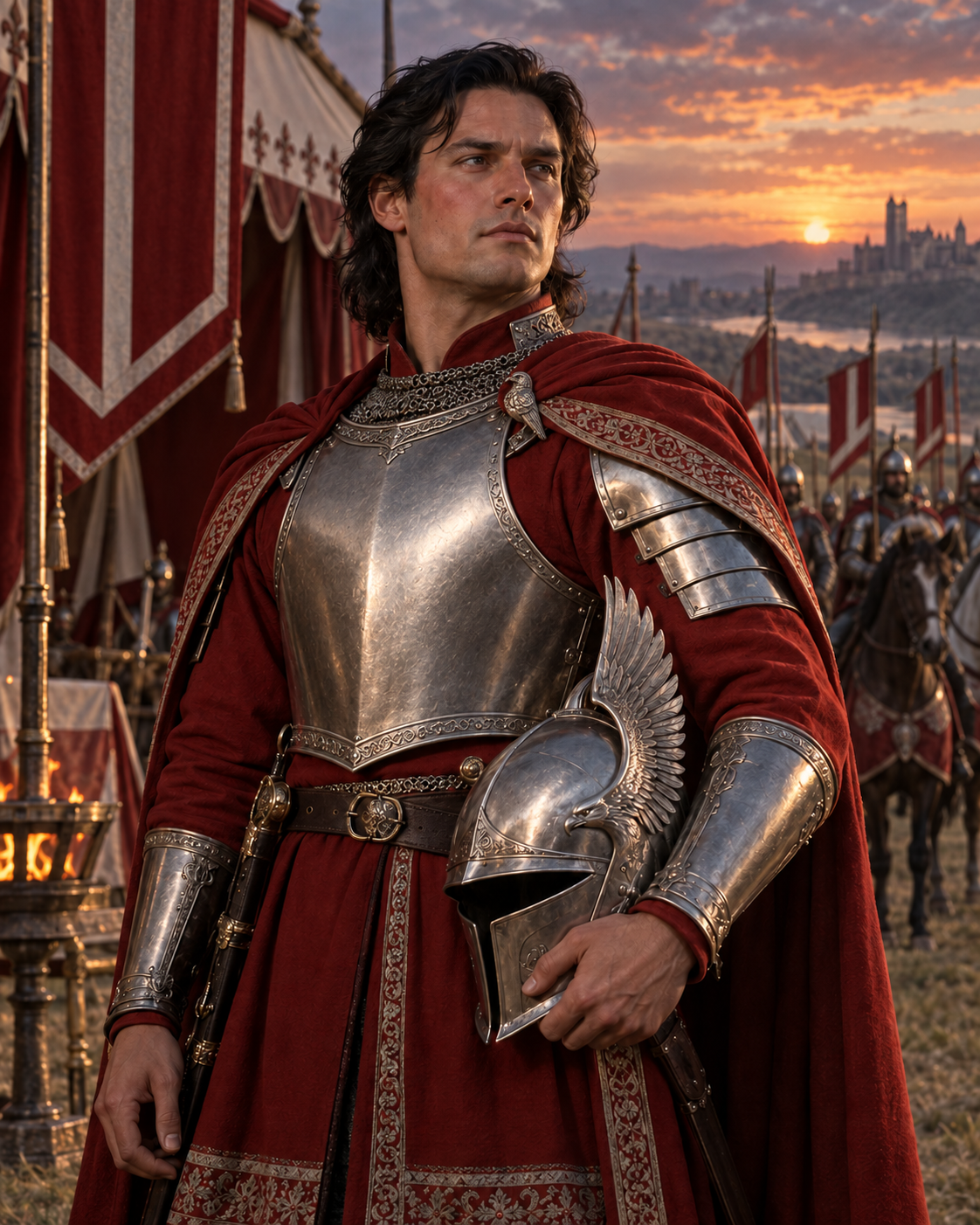
- Scarlet and silver; a falcon or eagle motif and wing-crested casque
- End status
- Dead; drowned when Helfgrim’s trap collapses the lake ice
The Visual Receipt
Black hair, red face, silver wings—and an ego dressed for a parade
Fengbald is introduced among Elias’s favored young lords as red-faced and black-haired. During the coronation revel he wears his dark hair loose, becomes disheveled and half-undressed as the drinking continues, and waves a dagger beneath the red comet while proclaiming the death of John’s age. Later military appearances replace drunken disorder with calculated spectacle: armor, a red tunic stitched with a silver bird, and a silver casque crowned by wings.
That contrast belongs in his identity. Fengbald should not look like a generic mud-streaked marauder. He is a court favorite who believes rank, clothes, weapons, and performance all confirm his importance. The attractive fantasy treatment can make him handsome and physically credible without polishing away the flushed volatility and entitlement that organize his presence.
His canonical art remains ungenerated. When approved, one adult identity must carry across the feast, the Falshire campaign, the pursuit through the Thrithings, Sesuad’ra, and the lake battle. Scene images may change clothing, condition, and expression; they may not quietly replace his face.
Book 1 · The Dragonbone Chair
A marriage candidate, a royal favorite, and the smoke on Simon’s horizon
The Hayholt court
He mistakes proximity to a new king for proof that the new age belongs to him
At Elias’s table Fengbald sits among the young men rewarded by the incoming reign. He wrist-wrestles Guthwulf between drawn daggers, drinks until his clothes and composure loosen, and calls the company outside when the red comet cuts the sky. His toast declares King John’s age dead and Elias’s age begun. It is court theater with a blade in its hand: loud loyalty, public omen-making, and the confidence of a man who assumes history has arrived to promote him.
Elias also selects him as Miriamele’s prospective husband. The king frames the match through dynastic fear—he has no son, needs an heir, and wants a grandson who can stabilize the succession. Miriamele’s answer is refusal. She finds Fengbald older, dull, threatening, and politically irrelevant beside the real emergency: Pryrates is changing her father. Fengbald reacts to her resistance as damage to a promise made between men, not as the decision of the woman expected to marry him.
His everyday cruelty makes the political arrangement uglier. When Jael spills wash water and he slips, he threatens the frightened chambermaid, tears a tapestry, and strikes Rachel even after she takes responsibility. No battlefield fog excuses this. A puddle and an elderly servant are enough to expose what he does when someone lower in the hierarchy inconveniences him.
Falshire
The campaign Simon admires returns with six hundred bodies hidden beneath a victory song
Fengbald leads several hundred Erkynguard and a dozen knights into his own earldom when wool merchants resist the crown’s plan to seize livestock for Erchester’s displaced population. The drought makes the original problem real: people need food, and rural producers cannot survive if armed authority strips away the animals sustaining the wool economy. Fengbald’s answer turns extraction into massacre.
Morgenes reports that the force burns the wool district, kills women and children alongside resisters, scalds guild leaders in heated sheep-dipping vats, and leaves roughly six hundred royal subjects dead. The soldiers march home singing. The novel places this account directly against Simon’s fascination with banners and armor. Fengbald is not merely a bad personality attached to a necessary campaign; he is the receipt proving how easily state need becomes atrocity when vanity and force face no restraint.
After Morgenes’s escape and death, Fengbald also hunts the red-haired apprentice who survived. He fails to catch Simon, but the search keeps him active as one of the regime’s practical hands. Elias and Pryrates supply the terror at the center; men like Fengbald make that terror mobile.
Book 2 · Stone of Farewell
The favorite becomes the rider closing every road behind the resistance
Fengbald continues serving Elias as commander and pursuer. His scarlet-and-silver falcon banner warns Josua’s party that royal force is almost upon them while the prince and Vorzheva complete their hurried wedding among the Thrithings-folk. He does not arrive as an isolated villain hunting one hero. His movement shows the regime pressing borders, clans, refugees, and rival law into its war.
Fikolmij attempts to help him without the consent of the clan chiefs. Hotvig and other dissenters invoke Free Thrithings law, delay or turn Fengbald away, then leave with families and fighters to follow Josua. The encounter matters because royal authority cannot simply announce itself as universal. Fengbald carries Elias’s command, but the steppe has obligations and political structures of its own.
Falshire travels with him even when he leaves it behind. Refugee settlements grow across the route, and families name ruined crops, devil-dealing, and the burning of the wool district as forces that drove them out. His violence is no longer one terrible report from Morgenes. It has become geography: displaced people, thinned markets, frightened roads, and a domain whose wealth has been converted into warning.
Book 3 · To Green Angel Tower: Part I
At Sesuad’ra, his caution nearly saves him—and his cruelty guarantees that it will not
By the assault on New Gadrinsett, Fengbald is dangerous precisely because he is not as foolish as his enemies hope. Josua’s defense layers Deornoth’s mounted feint, Freosel’s limited arrows, Hotvig’s ice-shod cavalry, and Simon’s Qanuc flank. The plan depends on drawing enough attackers onto the frozen lake. Fengbald commits cautiously, advances steel-shod sledges that spread sand across the ice, and sends disciplined Erkynguard rather than reckless mercenaries into the vulnerable lead.
The adaptation forces Josua to spring an imperfect trap. Fengbald’s forces cross terrain meant to defeat them, and the defenders survive only by adjusting in turn. That competence matters. If every cruel man were also stupid, resistance would be comforting arithmetic. Fengbald can plan, observe, and learn; he simply directs those abilities toward domination.
He also employs deception. Simon charges the crimson cloak and silver-winged armor he believes marks the commander, only to defeat a toothless gray-haired decoy. The real Fengbald has taken a hidden Sithi route toward the defenders’ rear. His absence from the obvious place is not cowardice dressed as mystery; it is a tactical maneuver that nearly converts the battle.
The hidden route comes from Helfgrim under coercion. Fengbald holds the former mayor’s two daughters and threatens them until their father provides the track. Then he interprets the man’s surrender as treachery, forcing the victim to carry the moral blame for the cruelty being used against him. He plans to keep all three hostages close while attacking from behind.
Helfgrim answers with a trap inside the answer. He guides Fengbald and his guard onto prepared lake ice while Freosel and a handful of survivors strike it with heavy mallets. Helfgrim and his daughters remain on the collapsing surface rather than allow themselves to be carried away. They fall into the black water, and Fengbald follows, screaming that he cannot die. Binabik later confirms the real commander’s death.
The ending is not tidy justice. Helfgrim and his daughters pay with their lives, the defenders lose many people, and Falshire does not refill because its earl drowns. But the shape is exact: Fengbald treats love as a lever, assumes coerced obedience proves his mastery, and never imagines that the route extracted from a captive might lead somewhere chosen by the captive.
Book 4 · To Green Angel Tower: Part II
Dead men still occupy roads, economies, and frightened memories
Fengbald does not need to return bodily for the final volume to carry him. The completed story looks back on his defeat as a major turn in Josua’s resistance, while travel through Falshire shows what victory could not repair. The once-rich wool-and-hide city beneath his former castle is subdued, economically hollowed, and wary of strangers. Simon and Miriamele enter a place still organized by the violence committed in the earl’s name.
That is why his profile belongs to all four scoped views even though his living chronology ends earlier. Volume membership records relevance, appearance, testimony, aftermath, and explicit recall; it does not falsely declare that every character walks onstage alive in every physical book. The Book 4 card must label him deceased and frame the scope as aftermath rather than manufacture a new adventure.
Connections
The people he treats as rewards, tools, rivals, and disposable bodies
Miriamele
Elias proposes the marriage as succession policy. Miriamele refuses, and Fengbald treats her resistance as a threat to his promised advancement rather than her right to choose.
King Elias
Elias gives him status, military command, and coercive reach. Fengbald supplies the regime with enthusiastic violence that can be blamed on a subordinate while serving royal aims.
Guthwulf
They share the favored table and dagger contest, but Guthwulf’s later collapse develops a conscience and terror that Fengbald never displays.
Simon
Simon first admires the spectacle of his campaign, later identifies him as a bully, disobeys orders to attack his camp, and fights the decoy wearing his armor.
Josua
Fengbald hunts the outlaw prince and leads the assault on Sesuad’ra. Josua names him a tool of a greater evil without pretending the tool is harmless.
Helfgrim and his daughters
Fengbald weaponizes their family bond. They turn coerced knowledge into the lake trap that kills captor and captives together.
Why He Matters
He is what happens when ordinary entitlement receives an army
Fengbald has no ancient immortality, cursed sword, or supernatural revelation. His appetite is painfully human: public importance, a politically valuable wife, obedience from servants, and victory that can be sung about on the ride home. Elias’s corrupted kingship enlarges those appetites until they burn cities.
That ordinariness makes him essential. Pryrates may be colder and the Storm King’s design far larger, but governance reaches civilians through commanders willing to turn a requisition into collective punishment. Fengbald makes evil administrative, fashionable, and loud enough for a feast.
He also punctures the comforting equation between moral failure and incompetence. At Sesuad’ra he reads the danger, uses sand sledges, commits disciplined soldiers carefully, and places a decoy in his heraldry while taking a secret route. He loses because the defenders adapt and because the captive he despises possesses agency he cannot imagine—not because the plot suddenly makes him incapable.
The Marriage Threat
Miriamele’s refusal is not a romantic subplot obstacle; it is political judgment
The proposed match exposes how Elias converts paternal love into dynastic possession. He tells Miriamele that he needs Fengbald because the crown lacks a male heir and ambitious men surround him. Meremund and the sea become bargaining chips offered if she agrees to produce the next generation of stability.
Miriamele refuses to let the conversation shrink around the suitor’s feelings. Fengbald interests her less than the transformation of her father under Pryrates. Her answer recognizes that marrying one favored earl cannot repair a court whose king treats dissent, bodies, and allegiance as property.
Fengbald’s own behavior validates the refusal without becoming its prerequisite. She does not owe readers a courtroom case proving he is cruel enough to reject. Still, the ledger supplies the case: threats against a chambermaid, violence against Rachel, contempt for civilians, and panic that Elias may withdraw a promise made over her life.
Falshire’s Afterlife
The strongest indictment is not his death scene—it is the city that remains damaged afterward
Fantasy villains often disappear when the sword lands or the water closes. Fengbald’s domain refuses that convenience. The attack on the wool district destroys people and the economic systems around them. Refugees carry the event into other territories, and the later city is quiet, suspicious, and depleted beneath the castle that once represented his authority.
The books therefore separate revenge from repair. Helfgrim can avenge Falshire and kill the man responsible, but vengeance cannot restore six hundred lives, rebuild trust, replace livestock, or make displaced families unremember what royal banners brought. The profile must hold both truths at once: Fengbald’s death is narratively earned, and it is nowhere near sufficient.
On the Record
Scope, status, and evidence boundaries
This is Fengbald’s single canonical full-spoiler profile for the complete four-volume published edition. The franchise and each relevant book directory point here; no duplicate volume biographies should exist.
Status is scoped by volume. He is alive through Books 1 and 2, dies in the lake battle recorded in Book 3, and remains deceased in Book 4, where his campaign and defeat persist through recap and Falshire’s aftermath. Directory labels must not replace that timeline with a vague global field.
The approved identity preserves the recorded young adult courtier, red face, loose black hair, scarlet-and-silver bird heraldry, and wing-crested casque. Exact age, facial structure, eye color, armor construction, and heraldic bird design remain editorial reconstruction. The same image now serves the hero, featured image, five scoped directories, and social metadata.
Primary evidence comes from the completed owned-edition reading ledger. Reported events remain attributed where the narrative reaches them through Morgenes or other witnesses; interpretation is marked as editorial analysis rather than disguised as quotation or omniscient fact.