
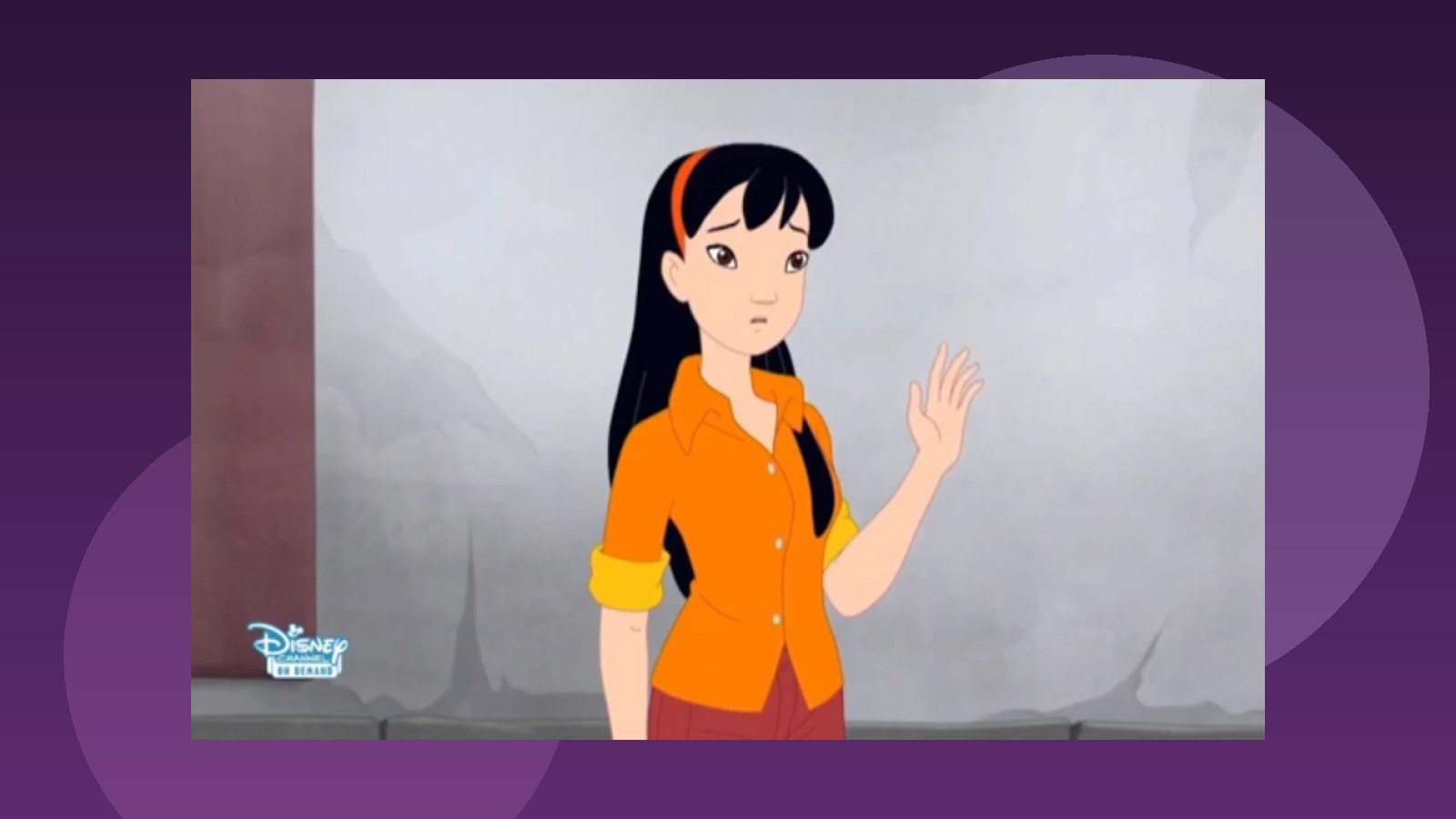
STITCH & AI CHARACTER PROFILE · OLDER SISTER · CAREGIVER
Wang Jiejie Character Profile: Loving Ai Was Never the Same as Defending Her
Jiejie loves her sister from the beginning. Her arc begins when love finally becomes something she is willing to defend in front of the person making the decision.
Profile record
Full name: Wang Jiejie
Name note: Jiejie means older sister in Mandarin
Species: Human
Home: Huangshan mountains, Anhui, China
Family: Ai Ling, younger sister; Daiyu, aunt; Bao, cousin; unnamed deceased parents
Work: Mr. Ding’s tea shop
Relationship: Qian Dahu
English voice: Laura Post
Appears in: All 13 episodes of Stitch & Ai
Who Jiejie is
Wang Jiejie is Ai Ling’s older sister, caregiver, and closest remaining immediate family after the deaths of their parents. The name used for her in the series is itself a relationship word. Jiejie means older sister in Mandarin, so the character is introduced through responsibility before the story tells us much about private ambition. She works at Mr. Ding’s tea shop, maintains the mountain household, dates Qian Dahu, and spends much of the season absorbing consequences created by people with louder plans.
That structure makes her easy to flatten into “the Nani counterpart.” The resemblance is deliberate. Both young women care for a spirited younger sister after parental loss. Both face an outside threat of separation. Both must balance work, household survival, and a child whose pain often emerges as disruptive behavior. The differences matter more than the franchise shorthand. Nani actively fights a social-services deadline. Jiejie initially accepts Daiyu’s claim that moving Ai to the city may be helpful, even while the separation clearly devastates her.
Her profile therefore begins with a failure. Jiejie loves Ai and does not defend Ai strongly enough when the decision is most immediate. That is not evidence that the love is false. It is evidence that private devotion can collapse under family hierarchy, money, fear, and an adult who enters the house speaking as if the conclusion has already been reached.
Caregiving after the parents are gone
The series gives little factual history about the Wang parents or the exact arrangement that left Jiejie responsible for Ai. The absence creates questions the story should have answered. How old was Jiejie when responsibility shifted? What legal or family authority does Daiyu possess? Who controls the home? How stable is the tea-shop income? Those details would clarify why Jiejie feels unable to refuse her aunt in “Hello – Goodbye.”
Even without the missing paperwork, the emotional load is visible. Jiejie has to keep the household moving while Ai grieves, attends school, practices drums, argues with rivals, and resists relocation. Caregiving often looks passive from the outside because the labor prevents emergencies rather than producing a dramatic victory. Meals, work schedules, explanations, repairs, and emotional monitoring form the background of every alien adventure.
The show could have protected Jiejie from becoming household infrastructure by giving her a goal unrelated to Ai. Her tea work, relationship with Dahu, friendships, and thoughts about the city deserve independent attention. A caregiver remains a person whose future cannot be reduced to whether the child stays safe. The profile keeps that missing interior life visible instead of inventing certainty.
Why she freezes when Daiyu arrives
Daiyu arrives with social confidence and a prepared plan. She presents the city as education, culture, cleanliness, and upward movement. Jiejie’s mountain household is treated as inadequate before anyone evaluates what Ai actually needs. Family hierarchy adds pressure. Refusing an older relative with money and institutional confidence is more complicated than announcing that love will win.
Jiejie initially tells Ai that Daiyu is trying to help. The statement is emotionally devastating because it translates control into care at the exact moment Ai needs her sister to recognize the threat. Jiejie looks distressed when Daiyu says she will prevent visits after the move, yet distress does not stop the plan. Ai reads that inaction correctly. Being sad about a separation is not the same as opposing it.
The scene earns attention because caregivers can participate in harm while believing they lack alternatives. Jiejie is neither the architect nor an innocent observer. Her arc begins when she accepts that keeping peace with Daiyu cannot be the highest household priority. Ai’s anger forces the distinction into the room.
Teacher’s Pet shows advocacy arriving too late
In “Teacher’s Pet,” Jiejie attempts to persuade Daiyu that Ai receives a good education and has a real life in the mountains. The argument is important because she finally names the existing life as valuable. The timing is terrible. They enter a classroom immediately after chaos involving Stitch and the possessed teacher, and the visible wreckage appears to confirm every concern Daiyu brought with her.
The failure is not proof that Jiejie’s case was wrong. It shows how institutions and authority figures often evaluate families through one disastrous moment. Ai’s home, school, skills, and relationships are compressed into the mess visible during an inspection. Nobody with power waits for context. The series turns that dynamic into comedy, but the pressure resembles the original film’s social-services scenes closely enough to hurt.
Stitch ultimately tricks Daiyu by impersonating Ai during the departure. The escape buys time and does not resolve who has decision-making authority. Jiejie benefits from the trick without becoming its author. Her profile has to distinguish survival from advocacy. The child and alien solve an immediate removal while the adult caregiver is still learning to challenge the premise.
The Scroll is the point where Jiejie finds her public voice
“The Scroll” gives Jiejie two moments of direct confrontation. She finds Jumba and Pleakley restrained in the house while Ai is missing and demands that they bring her sister back. Later, when Jumba intends to take Stitch away, she argues that Stitch restored Ai’s happiness and gave the child a sense of life after grief. The second intervention is especially important because Jiejie places emotional evidence against scientific ownership.
Her argument does not claim Stitch is harmless. Jiejie has seen enough chaos to know better. She claims the relationship matters and that taking him without regard for Ai would repeat the same adult habit currently threatening the household. Jumba created Stitch. Daiyu is Ai’s aunt. Neither relationship gives automatic moral authority to remove somebody from the place and person they chose.
Jiejie becomes persuasive because she finally speaks before the separation. The scene marks growth without erasing the first episode. A character arc should not retroactively make the starting failure noble. She becomes stronger because Ai’s accusation was true and because another threatened bond gives her a chance to act differently.
Gaslighting Daiyu is funny and ethically ugly
Jiejie later participates in the scheme that makes Daiyu think she is experiencing delusions. Stitch hides with Ai, an impossible transformation is staged, and Daiyu is carried onto a train by a doctor while the household remains behind. The sequence is played as victory. It is also manipulation of somebody’s perception and credibility, which should not become harmless because the target was controlling.
The family has limited legitimate power, and the plan prevents an immediate forced relocation. That context explains the choice. It does not turn the method into a healthy communication model. A richer series would allow consequences. Daiyu could discover the deception, distrust every later claim, or use the incident as evidence that Jiejie cannot provide stable care. Short-form comedy closes the door before those costs enter.
Jiejie’s participation shows how far she has moved from passivity and how desperately the family lacks a fair process. She is willing to deceive an older relative to keep Ai home. The action defends the right outcome through a tactic that reproduces another form of control. Keeping both judgments visible makes her more interesting than a suddenly fearless sister who can do no wrong.
Jiejie and Dahu need a life beyond supporting Ai
Qian Dahu is Jiejie’s boyfriend and Ai’s drum instructor. The arrangement ties romantic life, community activity, and caregiving into one network. Dahu already knows Ai as a student, which gives his relationship with Jiejie consequences beyond dating. He is entering a family where the younger sister’s safety and stability shape every adult decision.
The series offers affectionate moments, including the pair holding hands in costume during “Nuo Opera,” but does not give the relationship enough conflict or independent aspiration. How does Dahu understand Daiyu’s plan? Would he stay in Huangshan if Jiejie moved? Does Jiejie imagine marriage, work elsewhere, or a future at the tea shop? The absence leaves her adult life suspended around Ai’s needs.
Caregiver representation becomes shallow when sacrifice is the only proof of love. Jiejie deserves pleasure, ambition, frustration, and choices that Ai cannot approve or reject. Dahu could have helped the show explore those dimensions. Instead, he often functions as kind support. Kindness matters. A full profile also records the story space that remains unused.
Nuo Opera lets her participate in community repair
In “Nuo Opera,” Jiejie tries to stop Daiyu’s aggressive cleaning and later appears in costume with Dahu. The episode places the family inside a local performance tradition rather than treating the village as an empty set. Jiejie’s practical relationship to the event matters because culture is sustained by people preparing, performing, attending, financing, cleaning, and repairing.
Daiyu’s pledge to fund replacement sets and costumes creates a rare moment when her resources serve the community Ai values. Jiejie occupies the middle of that shift. She understands Daiyu well enough to push against the germ panic and understands the mountain community well enough to recognize what the damaged production needs. The episode hints that family disagreement does not require one side to possess every useful quality.
The performance also offers Jiejie a visible role beyond domestic labor. Costuming, public participation, and the quiet intimacy with Dahu show a young woman who belongs to the social fabric of Huangshan. Removing Ai to the city would affect Jiejie too, even if the aunt technically leaves the older sister in place. A household can be broken without moving every person.
Jiejie and Stitch negotiate another dependent in the house
Stitch enters a home already stretched by grief, work, and family conflict. Ai invites him before Jiejie has meaningful information. The new arrival eats, destroys, hides, attracts aliens, and provides the emotional connection that helps Ai feel alive again. Jiejie has to hold all of those truths. Treating Stitch as a miracle would ignore labor. Treating him as a burden would ignore what the relationship gives her sister.
Her decision to argue with Jumba reveals that she accepts Stitch as part of Ai’s support system and, increasingly, part of the household. She does not have the original film’s adoption scene or a clear legal framework. Her belonging is built through repeated accommodation. The family makes room, protects secrets, responds to danger, and eventually treats his removal as a family crisis.
Stitch also changes the power balance with Daiyu. His disguises and abilities allow Ai to resist in ways Jiejie cannot. That help is liberating and destabilizing. A caregiver should not need an alien capable of impersonation to keep a child from being removed. The absurdity exposes how little legitimate authority Jiejie has been allowed.
Voice performance record
Laura Post voices Jiejie in the documented English production. The same performer is also credited for Daiyu in available English records, which makes the contrast a useful acting challenge. Jiejie needs warmth, hesitation, and growing resolve. Daiyu needs control, status, irritation, and the rare moment when concern becomes constructive. Performance choices have to separate two related women who occupy opposite positions in Ai’s custody conflict.
Jiejie’s strongest vocal scenes are not the loudest. Distress under polite language in “Hello – Goodbye” shows how much she is swallowing. The demand for Ai’s return in “The Scroll” lands because the earlier restraint finally breaks. Her argument to Jumba needs emotional specificity rather than generic heroism. She is talking about the sister she watched retreat into grief and the alien who reopened a door.
A verified Mandarin performer credit has not been established from the production records available for this profile. The absence is stated instead of filled with an unsourced name. The page will be updated when a licensed credit source or original broadcast documentation provides the role. More text is never a substitute for an accurate record.
What Jiejie’s arc says about love and advocacy
Jiejie begins as a caregiver who loves Ai privately and cannot challenge authority publicly. She grows into somebody willing to demand action, argue with a scientist, deceive an aunt, and defend the bond keeping her sister emotionally connected. The progression is uneven because the season is short. The direction is clear.
Her story makes a useful distinction between feeling and protection. Love can motivate advocacy, but love does not automatically produce the courage, resources, or language required to oppose a powerful relative. Jiejie has to learn that keeping family peace can become participation in a harmful plan. Ai’s anger helps force the lesson.
The profile should end with what remains unanswered. Jiejie’s own ambitions are thin. Her legal authority is vague. Her grief receives little space. Her relationship with Dahu remains pleasant and underwritten. A second season could have made her more than the older sister who finally spoke. The first season gives enough evidence to say that speaking changed the family anyway.
Keep exploring
Return to the Stitch & Ai hub, read Ai Ling’s full profile, or read the complete series review.
Love does not make a secret harmless
Jiejie can believe she is protecting Ai and still damage trust by withholding information about relocation, danger, or family plans. Adults often call secrecy temporary because they know when the reveal is coming. The child experiences a world that suddenly changes without warning. The harm is not only the decision. It is discovering that ordinary conversations were happening inside a reality other people had already replaced.
Repair requires more than saying the secret came from love. Jiejie needs to explain what she feared, who participated, which options were considered, and why Ai was excluded. She also needs to hear what the exclusion cost without turning the conversation into a trial of her intentions. Love matters most when it can survive an honest record of what love handled badly.
Older-sister care is not automatically parental authority
Jiejie occupies a difficult space between sibling and caregiver. She may perform adult labor, carry family expectations, and feel responsible for keeping Ai safe while lacking full power over the household. That pressure can make control feel like competence. If she cannot change the plan, managing Ai’s reaction may become the only task she believes she can succeed at.
The profile should separate responsibility from authority. Jiejie deserves support for the labor she carries, and Ai deserves clarity about which decisions Jiejie can actually make. Pretending the older sister controls everything invites resentment in both directions. A healthier family names who has power, who has duties, and where a sibling can advocate without becoming the substitute parent everybody blames.
Practical advice can become emotional dismissal
Jiejie often reaches for the next task because tasks are solvable. Pack this, attend that, consider the opportunity, stop making the conversation harder. Ai is asking what happens to her identity, relationships, and home. A checklist cannot answer that fear. Practical help becomes care only after the emotional problem has been acknowledged as real.
That does not mean every feeling decides the outcome. Jiejie can validate grief and still discuss money, education, safety, or work. The order matters. When adults begin with logistics, children hear that attachment is an inconvenience delaying the sensible plan. When adults begin by listening, logistics become tools for protecting what matters rather than weapons used to prove the child is irrational.
Stitch makes the family argument impossible to contain
An alien turns private tension into public emergency, but he does not create the original fracture. Stitch gives Ai an ally, exposes secrets, attracts danger, and makes leaving or staying materially different. Jiejie may resent the disruption because every new crisis seems to confirm that Ai cannot be trusted with freedom. The same evidence can show that the family withheld too much for safe cooperation to be possible.
Jiejie’s growth depends on distinguishing Stitch’s chaos from Ai’s underlying claim. She can set boundaries around dangerous investigations while reopening the relocation conversation honestly. If every problem becomes proof that the original adult plan was correct, no child behavior could ever count as evidence. Authority would always interpret resistance as the reason resistance should be ignored.
A sister can apologize without surrendering dignity
Jiejie should not have to collapse into self-blame before Ai’s hurt becomes valid. An apology can be specific: I knew this fact, I kept it from you, I expected compliance, and I understand why that changed how safe you felt with me. Specificity protects both people because it identifies the behavior rather than declaring one sister good and the other bad.
Ai also owes repair for choices that endangered others. Mutual accountability is not a trade where one apology cancels another. Each person owns her action separately. The relationship becomes stronger when neither sister has to win the entire moral argument before care can resume. Family trust is rebuilt through accurate receipts, changed behavior, and promises small enough to keep.
Jiejie needs a future outside crisis management
If every scene gives Jiejie another problem to contain, the character becomes a function rather than a young woman. She needs friends, work or study ambitions, privacy, humor, mistakes unrelated to Ai, and relationships where she is not automatically the responsible one. Those details explain what relocation or staying might cost her too.
Giving Jiejie an independent future also changes the family conversation. She may support a move because it protects an opportunity of her own, or resist it because she knows how much care work will follow her. Either position becomes more honest when the story names her stake. Self-interest is not betrayal. Hiding self-interest behind claims about what is best for Ai is the problem.
Cultural authority should not rest on one older sister
The branch sometimes needs Jiejie to explain family expectations, local customs, or social rules to Ai and the audience at once. That can flatten her into a cultural guide whose every statement sounds universal. A real community contains disagreement across age, class, region, and household. Jiejie should know some things, question others, and be corrected without losing credibility.
Specific sources make the writing stronger. Let elders name local stories, teachers explain institutional rules, tourism workers discuss economic pressure, and children reveal how those structures feel in practice. Jiejie then becomes one situated voice rather than the person responsible for making all of China legible to an imported franchise mascot.
Profile verdict
Wang Jiejie matters because she stands where care, limited authority, sibling history, and adult expectation collide. She can love Ai fiercely and still participate in the secrecy that makes the younger girl feel transferable. The character becomes substantial when the story allows both truths to remain visible.
Her best future includes an honest apology, clearer family roles, support for the labor she carries, and an independent life that does not depend on managing Ai. Let her advocate, disagree, fail, rest, and tell the truth before the emergency. Then sisterhood becomes a relationship between two people rather than a hierarchy disguised as affection.
Conflict with Ai should not erase their ordinary sisterhood
The relocation argument is important, but it cannot be the only evidence that Jiejie and Ai know one another. Sisters have private jokes, repeated annoyances, remembered meals, borrowed objects, old alliances, and tiny rituals nobody else notices. Those ordinary details explain why betrayal hurts and why repair remains worth attempting. Without them, the relationship becomes a debate staged by two positions rather than a family history.
Future episodes should let them cooperate when no adult plan or alien threat forces the issue. Jiejie can ask Ai for advice, admit embarrassment, or need comfort. Ai can notice her sister’s exhaustion and help without becoming responsible for fixing it. Reciprocity gives the bond room to breathe and prevents care from flowing only downward.
The family needs a process for the next disagreement
One apology cannot prevent another secret plan if the household keeps the same decision structure. Jiejie and Ai need predictable meetings, clear deadlines, named decision-makers, and a way to record unresolved objections. That may sound formal for a family, but informality already allowed the person with less power to learn the truth last.
A process does not eliminate conflict. It stops every conflict from becoming a referendum on love. Jiejie can support a difficult choice without proving she does not care, and Ai can object without proving she is impossible. The rules carry some of the pressure so neither sister has to win through silence, volume, or crisis.
Jiejie should be allowed to change her mind publicly
Older siblings and young caregivers are often trapped by the need to look certain. Reversing a position can feel like admitting they were never qualified to help. Jiejie needs permission to say that new evidence changed her view or that Ai understood a consequence she missed. That admission models judgment rather than weakness.
Public revision also repairs authority. Ai learns that speaking can matter before disaster forces attention. Jiejie learns that maintaining credibility does not require defending a harmful plan forever. A family becomes safer when changing course is treated as responsible behavior instead of humiliation.
The next family decision must preserve that receipt, because trust cannot survive another plan that becomes final before the person moving is heard.