
Choose without a guarantee.
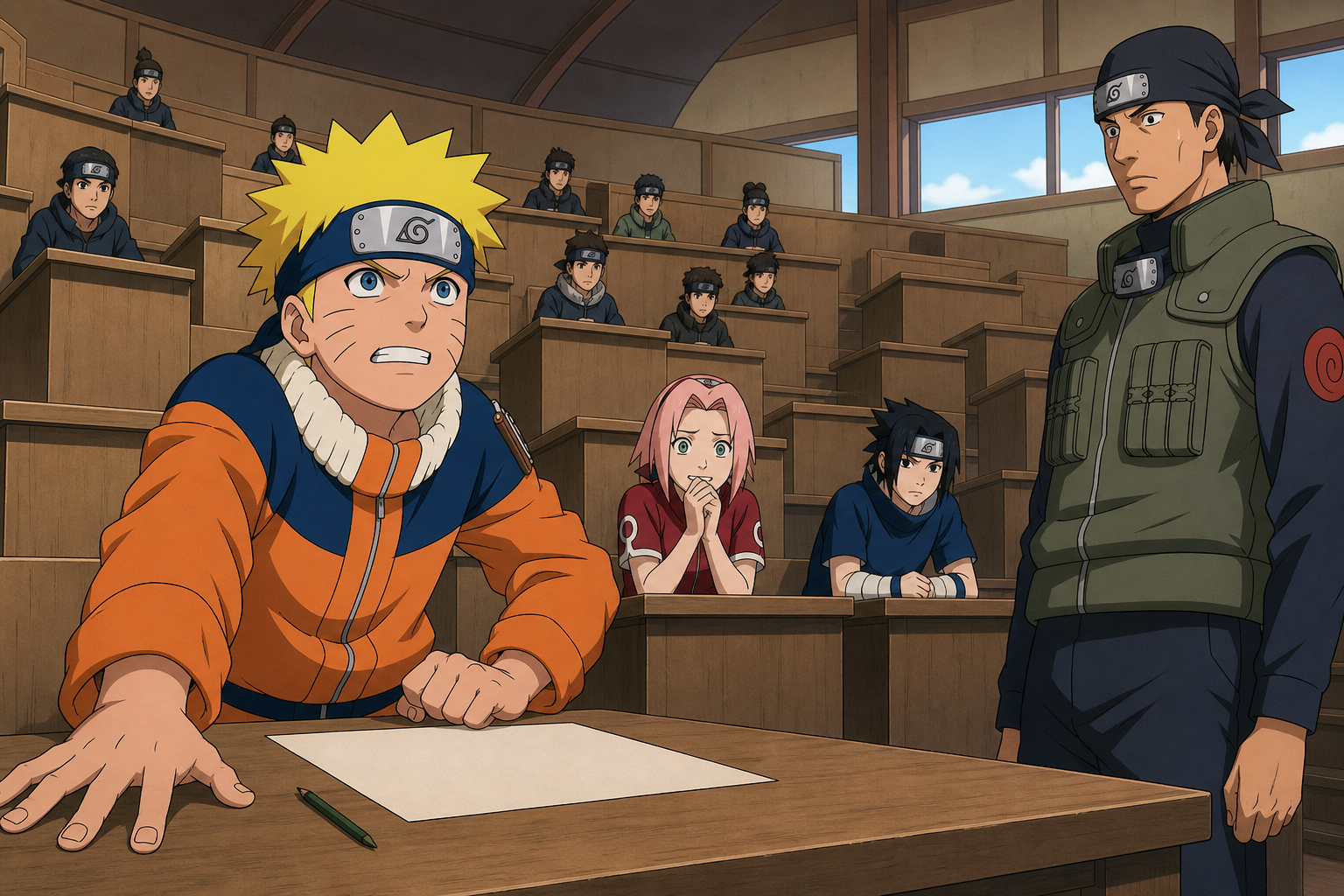
“The Tenth Question: All or Nothing!” reveals that Naruto’s empty paper was never the deepest problem. The real exam asks whether fear can make a person abandon a future before failure has actually arrived.
Ibiki turns uncertainty into the real final question
The tenth question works because Ibiki makes the candidates imagine consequences larger than the room can verify. Attempt it and fail, he says, and a genin may lose the chance to become chūnin forever. Withdraw and the whole team leaves. The threat converts uncertainty into a test of identity.
No written answer can solve that pressure. Candidates must decide whether fear of a permanent verdict controls the future before they have evidence that the verdict is real. The test measures who can act when intelligence is incomplete and the cost sounds irreversible.
Sakura’s raised hand almost becomes an act of protection
Sakura watches Naruto struggle and considers withdrawing for him. She understands how fiercely he wants the Hokage title and fears that pride will make him accept a consequence that could destroy the dream. Her hand begins to rise because care is trying to prevent harm.
The choice is compassionate and paternalistic at once. Naruto has not asked her to decide what risk his future can bear. Teamwork means sharing consequences, but it cannot mean quietly replacing a teammate’s agency whenever fear becomes intense.
Naruto’s raised hand changes meaning before it comes down
For one terrible second, the room assumes Naruto is surrendering. Instead, he plants his hand and refuses Ibiki’s premise. He does not know the hidden answer, possess a cheating technique, or understand the proctor’s psychology. He knows that a threat cannot be allowed to define the limit of his dream.
The speech is loud, imperfect, and powerful because Naruto gives the entire room another possible response. Courage becomes socially contagious. Candidates who were ready to withdraw hear somebody name fear without obeying it.
Passing without answering exposes the exam’s true design
Ibiki passes everyone who remains because endurance under uncertainty was the final answer. The reveal is satisfying, but it also confirms how completely authority manipulated children through a fabricated lifelong punishment.
A shinobi may need to act when capture, death, or mission failure are possible. That professional reality does not make every instructional method morally clean. The exam teaches resolve by exploiting trust in the proctor’s power.
Naruto succeeds through character rather than hidden knowledge
He finishes with a blank page, which should be a complete academic failure. Instead, the exact trait that frustrated teachers becomes useful: Naruto does not accept a verdict merely because an authority delivers it confidently.
That stubbornness has costs. It can make him reckless, resistant to instruction, and difficult to protect. Here, it also prevents fear from collapsing the room. A flaw and a strength can be the same habit under different conditions.
Ibiki’s scars make interrogation history visible
The marks on Ibiki’s head reveal professional violence carried into the examination room. He knows how uncertainty, pain, and threatened consequence pressure a person because his body records that knowledge. The test is not an abstract puzzle designed by a teacher detached from its stakes.
That history gives him authority and raises another question. Survivors can teach what kept them alive, but survival knowledge can reproduce the conditions that wounded them. Expertise does not automatically make the method gentle.
Team success depends on a decision none of them can make alone
If one candidate withdraws, three people leave. If one candidate stays, three people share the risk. The team rule prevents individual bravery from remaining purely personal. Naruto’s refusal commits Sakura and Sasuke as surely as Sakura’s possible withdrawal would have committed him.
The episode treats Naruto’s decision as inspiring because it is, but the shared stakes remain. Leadership is not only the ability to make others brave. It is responsibility for the people your bravery brings with you.
Anko enters by destroying Ibiki’s atmosphere
Ibiki controls the room through stillness, threat, and psychological pressure. Anko crashes through that tone with volume and movement. Her entrance announces that the next stage will replace imagined danger with a physical environment capable of killing candidates.
The contrast is funny, but it also keeps the institution from feeling coherent or safe. Different proctors bring different appetites for risk. Children who passed one adult’s manipulation are immediately handed to another adult excited by attrition.
The first exam rewards the ability to disobey the surface
Every stage asks candidates to discover what authority really wants. The written test says do not cheat while rewarding covert collection. The tenth question presents withdrawal as rational while rewarding refusal. Success depends on treating instructions as evidence rather than truth.
That skill suits espionage. It can also teach children that no adult statement deserves uncomplicated trust. A village built around hidden objectives should not be surprised when its shinobi learn to suspect the people training them.
RaeRae’s final take
Episode 25 belongs to Naruto because his most inconvenient quality saves the room. He cannot solve the paper, outsmart the surveillance, or prove he understands Ibiki’s trap. He can refuse to let a frightening adult write the ending of his dream.
Sakura’s almost-withdrawal matters too. She is trying to protect him, and the moment exposes how care can cross into deciding for someone. Sasuke stays quiet because he trusts the direction Naruto chooses, even if he would never announce that trust with the same volume.
The tenth question is clever, cruel, and perfectly suited to the shinobi institution. Naruto passes by rejecting its claim to permanence. The blank page remains blank. The child sitting behind it is the answer.
Naruto’s courage changes the room, but courage should not erase consent. Sakura and Sasuke remain because they accept the same risk, not because Naruto owns their futures. The scene works when his declaration gives others language for their own decision. It would be less heroic if inspiration became another authority telling frightened children what they must endure.
That shared ownership is what turns one child’s refusal into teamwork rather than spectacle.
They stay together because each one chooses to remain.
That choice is the answer Ibiki could never place on paper.
Episode file
Episode
Naruto Episode 25
Official English title
“The Tenth Question: All or Nothing!”
Arc
Chūnin Exams · first stage conclusion
Core question
Who are you when authority threatens to make one uncertain choice define the rest of your life?
Spoilers: complete-series connections appear where they deepen the examination’s meaning.
The feeling you remember
Naruto raises his hand, and everyone who loves him briefly thinks he is giving up.
The gesture is tiny. That is why it hurts.
Sakura has spent the exam worrying that Naruto’s blank answers will destroy Team 7’s chance. When his arm moves, she prepares to sacrifice her own attempt before he can condemn himself permanently.
Then Naruto Uzumaki slams the hand down and refuses the future Ibiki Morino has described.
The room changes because Naruto has made fear audible and survived hearing himself answer it.
The first nine questions were espionage
Ibiki explains the hidden structure of the written portion. The difficult questions created a need for information, and planted candidates supplied accurate answers worth stealing.
The proctors were evaluating whether teams could gather intelligence without exposing the operation. Being caught repeatedly demonstrated not moral dishonesty but operational incompetence.
This is a classic Naruto reversal: what appears to be an academic weakness becomes a mission problem. The village does not primarily need chūnin who can solve every equation alone. The village needs leaders who recognize missing intelligence, acquire it and protect the team from the consequences of careless collection.
Sakura’s legitimate answers remain impressive. Sasuke’s recognition of the hidden rule remains sharp. But the examination’s institutional purpose lies in what happens around the paper.
The tenth question is a weapon made of time
Ibiki introduces a choice before presenting the final question. A candidate can withdraw and preserve the possibility of returning another year, while the entire team fails now. Accept the question and answer incorrectly, however, and Ibiki threatens permanent exclusion from future Chūnin Exams.
The threat moves consequence out of the room and across the candidate’s entire imagined life.
A wrong answer no longer means one bad day. The answer means a frozen rank, a ruined ambition and responsibility for teammates who trusted the choice.
Ibiki does not need the rule to be true. He needs candidates to believe authority possesses the power to make it true.
Interrogation works through that gap. A subject rarely knows everything the interrogator can do. Fear fills the missing information with the worst future available.
Why people leave
Candidates begin withdrawing. Their choices are not proof of cowardice in some simple moral sense.
They are calculating under coercion. One uncertain answer appears capable of destroying every later opportunity, while withdrawal preserves a route back. Protecting the future can look rational.
The cruelty lies in the team structure. One person’s risk tolerance governs three careers. A cautious candidate can save herself from permanent loss by forcing two teammates into immediate failure.
Ibiki wants to know who can accept uncertainty when a mission offers no guarantee. Yet the exam also selects for people willing to gamble communal futures under authority’s threat.
Naruto passes the intended virtue. The scene still permits us to question the institution that manufactures the terror.
Sakura is ready to lose for Naruto
Sakura knows Naruto cannot answer an elite academic question. She also knows becoming Hokage is the organizing dream of his life.
When his permanent eligibility appears threatened, she considers withdrawing for the team. This would end her own attempt and Sasuke’s, but it would prevent Naruto from accepting the supposedly irreversible risk.
The thought is one of Sakura’s quiet early transformations. She is no longer evaluating Naruto only as an embarrassing classmate or romantic obstacle. His future has become emotionally real to her.
She does not trust his knowledge. She does trust that his dream deserves protection.
That distinction is love in an unfinished form: understanding another person badly in several ways while still becoming unwilling to watch the world crush what matters to them.
Naruto’s answer
Naruto raises his hand, then declares that even if he remains a genin forever, he will become Hokage anyway.
Logically, the sentence contradicts the village hierarchy. Hokage is not a private mood; it is an institutional office. A permanent genin cannot simply announce himself through the ranks.
Existentially, the contradiction is the point. Ibiki has tried to make authority’s predicted future more real than Naruto’s chosen self. Naruto refuses.
He cannot guarantee success. He can guarantee that fear will not make the decision in advance.
This is not optimism as probability. Naruto does not say the risk is small or that he secretly knows the answer. He says uncertainty does not possess the right to author him.
Courage spreads sideways
Naruto’s declaration stabilizes the remaining room. Candidates who were wavering hear someone name the threat and remain seated.
His greatest early power is often social rather than supernatural. He makes a choice visible enough for other people to borrow its shape.
Courage spreads because fear was already collective. Everyone has been privately imagining the same ruined future. Naruto turns private dread into shared defiance.
This pattern will define his relationships across the series. He rarely hands another person a complete solution. He demonstrates that a supposedly finished identity can be refused.
The failed student becomes the room’s emotional leader before receiving any formal promotion.
Ibiki passes everyone who stayed
Ibiki reveals that the decision itself was the tenth question. Candidates who remained have passed the first stage.
He removes his bandanna and exposes the scars covering his head, evidence of interrogation and the cost of protecting information.
The explanation grounds his test in mission reality. A chūnin may lead people into danger with incomplete intelligence. Retreat may sometimes be correct, but paralysis cannot be the only response to uncertainty.
Ibiki respects Naruto’s declaration because it meets the exact condition he created: commitment without informational comfort.
Still, his scars complicate the triumph. The village celebrates people who withstand breaking. Whether the village cares for them afterward remains far less clear.
Is the lesson actually “never quit”?
The episode’s emotional slogan can be flattened into reckless persistence. That is not a sufficient operational lesson.
Real leadership sometimes requires withdrawal, surrender or revision to keep people alive. Naruto himself will later learn that endurance without strategy can endanger the very comrades courage is supposed to protect.
Ibiki’s exam tests whether candidates can act when certainty is unavailable, not whether every retreat is immoral. The candidates who leave fail this constructed test because they allow an unverified threat to decide their entire course.
The distinction matters: courage is not refusing all exits. Courage is evaluating an exit without letting fear impersonate fact.
The exam measures a story candidates tell themselves
Ibiki cannot see the future he threatens. Neither can the candidates. The decision depends on which imagined story becomes emotionally authoritative.
One story says a wrong answer will close the road forever, so withdrawal is the only responsible choice. Naruto’s story says the road remains his even if every current rule claims otherwise.
Neither candidate possesses certainty. The difference is authorship. Naruto recognizes, instinctively rather than academically, that a prediction enforced through fear is still a prediction.
This is why his declaration affects strangers. He does not provide new evidence about the rule. He changes the narrative weight assigned to it.
Anko crashes through the conclusion
Anko Mitarashi arrives with a banner, theatrical aggression and immediate disappointment that too many candidates remain.
Her entrance releases the room’s pressure through comedy while introducing a new form of danger.
Ibiki is containment: desks, rules, watchers and silence. Anko is movement: flying cloth, blades, appetite and a lethal forest waiting beyond the classroom.
The contrast functions like a relay between examination stages. The children have proven they can sit inside psychological pressure. Now they will be scattered into an environment where other teams, hunger, deception and death move freely.
Anko looks entertaining because the alternative is to confront how casually an adult announces that candidates may die.
From paper to forest
The second stage relocates the exam from a room where authority watches everything to a forest where candidates cannot assume authority will intervene.
Stage one
Acquire information while surveillance is visible and rules are deliberately misleading.
Stage two
Protect information and bodies while surveillance recedes and rival teams become direct threats.
Stage one failure
Detection, misreading the hidden objective or surrendering to the threatened future.
Stage two failure
Losing a scroll, losing the team or failing to reach the tower alive.
The progression reveals what Konoha believes leadership requires: intelligence, resolve, field adaptation and survival inside uncertainty.
Easter eggs and future echoes
Naruto leads without rank
His emotional effect on the room anticipates a career in which people follow him before institutions formally recognize him.
Ibiki’s scars
The body records what classified missions hide. Naruto’s world repeatedly places political history inside damaged people.
Sakura’s protective thought
Her concern for Naruto’s dream anticipates bonds that become more important than the performance of indifference.
The invented permanent rule
Authority manufactures inevitability; Naruto’s defining instinct is to test whether the supposedly inevitable can be refused.
Anko’s entrance
Her comedy conceals the fact that Orochimaru’s former student is about to proctor the environment he will infiltrate.
Too many passing teams
The crowded field guarantees further filtering, showing that promotion is partly controlled scarcity rather than competence alone.
What the hidden village is telling us
A Hidden Village needs people willing to act without guarantees because hidden information defines its wars.
But the village also produces uncertainty intentionally. Ibiki lies about the consequence. The exam’s authority creates fear, then rewards candidates for overcoming the fear it manufactured.
This is how institutions can claim ownership over resilience. They construct the ordeal and then treat survival as proof that the ordeal was necessary.
Naruto’s response exceeds that logic. He does not simply become the shinobi Ibiki wants. He grounds the decision in a self the rank system cannot fully control.
“I will become Hokage” is absurd under the threatened rule, which makes it philosophically potent. Naruto insists that institutional classification, including genin, failure and ineligible, cannot exhaust identity.
The episode’s deepest hope is not that the village tests well. The deeper hope is that a child can pass through the test without allowing the village to become the sole author of his future.
RaeRae reaction: this ridiculous child saves the room
I know exactly what Naruto’s raised hand means, and Sakura’s panic still gets me. For one second, everybody thinks the loudest dream in the room is about to disappear under a technicality.
Then he plants that hand and essentially tells Ibiki, “Your fake permanent rule is not more permanent than me.” Naruto’s choice is irrational, magnificent and completely true to the child he has always been.
I also love Ibiki here. The reveal works because he is not secretly soft. He is a professional who recognizes that Naruto has answered the question with his whole identity.
And then Anko launches herself into the episode like HR hired a knife. The tonal shift is hilarious until you remember she is introducing a forest where children can legally kill one another for scrolls.
Episode verdict: 9.4/10. A classroom speech becomes one of the clearest early statements of Naruto’s philosophy: no predicted failure gets to live your life before you do.
Where Episode 25 leaves us
Team 7 passes despite Naruto submitting no conventional answers. The first examination has measured more than knowledge and less than wisdom.
Anko now leads the surviving candidates toward Training Ground 44. The next test will make its threat physical, distribute teams across hostile terrain and place Heaven and Earth in their hands as objects worth attacking for.