
Naruto · Complete Character Profile
Anko Mitarashi
Anko survives the teacher who treated chosen attention as ownership, then turns danger into a career instead of letting Orochimaru own the rest of her life. She is appetite, theater, field competence, rage and recovery in one loud woman.
The bottom line
Anko survives a teacher who tried to turn mentorship into ownership. Her curse mark records what Orochimaru did, but it does not get to become her whole personality. She performs danger, eats what she likes, laughs loudly and keeps working because survival is not supposed to look permanently tasteful for an audience. That does not mean Konoha repaired the damage. It means Anko built a life while the village benefited from a survivor it never fully centered.
Anko Mitarashi at a glance
| Full name | Anko Mitarashi |
|---|---|
| Japanese name | みたらしアンコ |
| Birthday | October 24 |
| Age | 24 in Part I; 28 in Part II |
| Height | 167 cm |
| Weight | 45.8 kg in the Part I record |
| Blood type | A |
| Village | Konohagakure |
| Rank | Tokubetsu jōnin, or special jōnin |
| Registration | 011226 |
| Academy graduation | Age 10 |
| Chūnin promotion | Age 12 |
| Former teacher | Orochimaru |
| Specialty | Tracking, infiltration, reconnaissance and snake techniques |
| Manga debut | Chapter 44 |
| Anime debut | Episode 21; her full Forest of Death proctor entrance follows |
| Japanese performer | Takako Honda |
| Status | Alive; Academy instructor in the New Era |
Appearance and visual identity
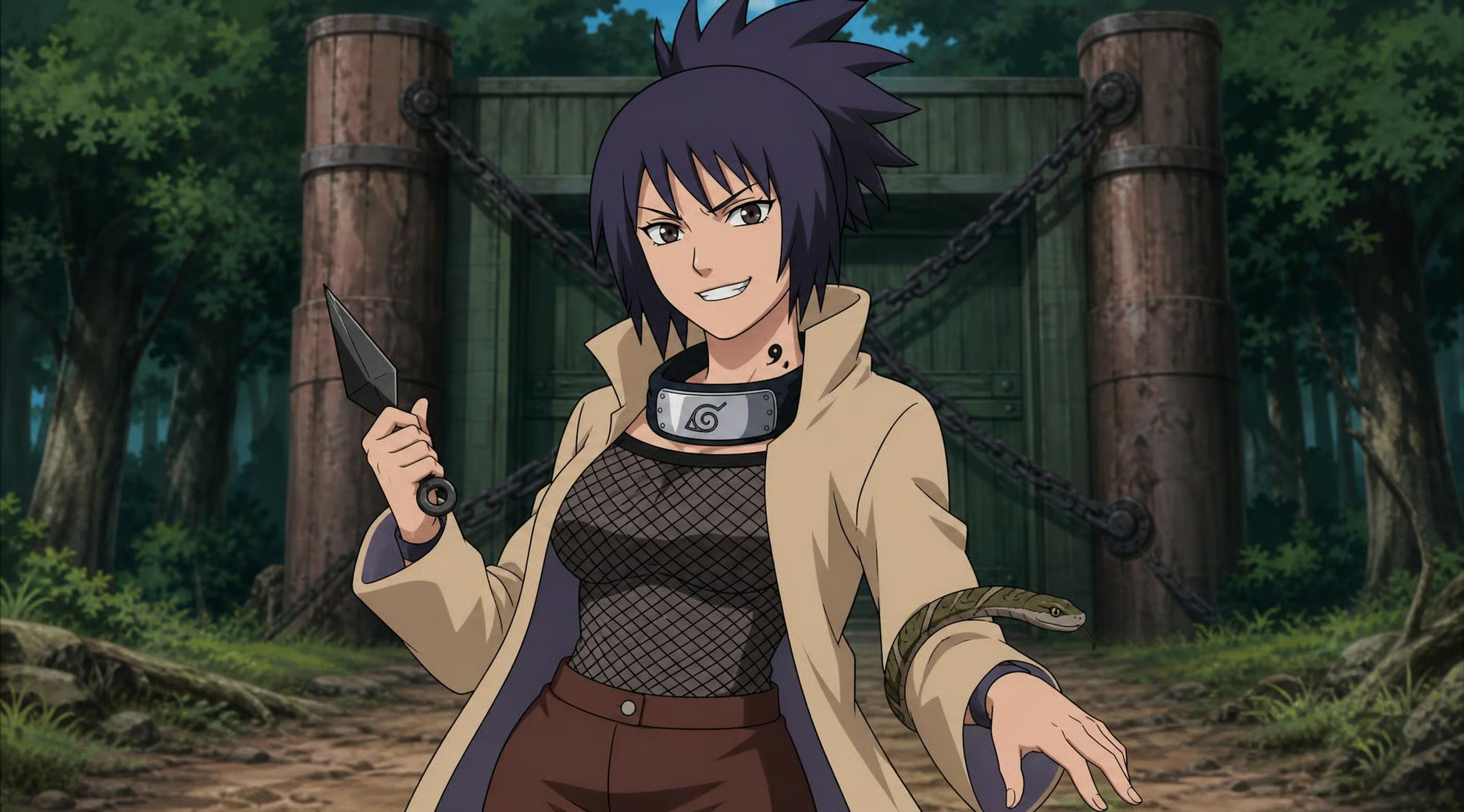
Anko’s original design is immediately recognizable: short spiky violet-black hair, a tan overcoat, mesh armor, dark skirt, orange leg warmers, open-toe sandals and a small necklace.
The Cursed Seal of Heaven sits at the base of her neck. Unlike a decorative tattoo, the mark is an imposed mechanism tied to Orochimaru’s chakra and experiments.
Her clothing mixes exposure and protection in a way early Naruto often uses for adult kunoichi. The mesh has generated decades of shallow commentary, but the stronger visual story lies in movement. Anko’s coat, hair and aggressive gestures make her seem impossible to contain.
She carries herself as though entering a room should feel like an ambush.
Name, food and the right to appetite
“Anko” can evoke sweet red-bean paste, while “Mitarashi” is associated with the glaze and style of dango she famously enjoys. Her love of sweets is built into the wordplay surrounding her identity.
Food functions as comedy, but it also gives Anko a body that wants things for itself. Orochimaru treated bodies as sites for modification, replacement and utility. Anko eats because pleasure is not productive and does not require his permission.
Later portrayals of her body have often attracted cruel fandom commentary. A serious profile rejects the idea that a woman’s worth, competence or narrative legitimacy depends on preserving the silhouette she had as a young adult.
Appetite is not moral failure. Survival does not owe anyone perpetual thinness.
Orochimaru’s student
Anko trained under Orochimaru when he still operated within Konoha. This placed her close to exceptional knowledge and exceptional danger.
The teacher-student bond in Naruto can be chosen family, professional apprenticeship and ideological inheritance at once. Orochimaru corrupts all three. He identifies potential, offers intimacy through secret knowledge and then treats the student’s body as experimental territory.
Anko receives snake-based techniques and the Cursed Seal of Heaven. The mark demonstrates survival. She lives through a process many subjects do not, but survival is not consent.
Her later hostility toward Orochimaru is therefore not simple village loyalty. It is the response of a former student confronting the adult who made mentorship inseparable from violation.
What canon establishes and what adaptation expands
The manga establishes Anko as Orochimaru’s former student, bearer of his cursed seal and Chūnin Exam proctor who recognizes his return.
The anime expands portions of her childhood training, memories and abandonment. Those scenes can illuminate how she experienced the relationship, but they should be labeled as adaptation material rather than silently merged into a single undifferentiated record.
Some expanded material emphasizes memory suppression and the false belief that Orochimaru rejected her because she lacked value. The emotional idea fits his methods: an abuser makes the victim interpret exploitation as personal failure.
Responsible fandom depth keeps the version boundary visible while still asking what each version reveals.
Episode 25: crashing into the exam
Anko’s first major entrance arrives after Ibiki Morino completes the written stage. She bursts through a banner with theatrical aggression and immediately judges the remaining group as too large.
The comedy works because she is the opposite of Ibiki’s controlled dread. He builds pressure through silence and delayed consequence; Anko throws herself into the room like consequence has kicked down the door.
Her role is not merely tonal. The second examination moves candidates from monitored desks into a lethal environment. The proctor’s personality previews the stage.
Anko makes danger charismatic, which is exactly why the Forest of Death can initially feel like an adventure instead of an institutional scandal.
The Forest of Death
Anko explains the scroll-based survival test and warns the candidates that death is possible. Teams must obtain both Heaven and Earth scrolls and reach the central tower.
The stage tests resource protection, pursuit, deception, environmental survival and willingness to confront other teams. Unlike the written exam’s simulated intelligence operation, the forest contains real predation.
Anko’s comfort with the environment reflects her tracking specialization and her own training history. She knows how quickly a landscape becomes a weapon.
Yet her bravado should not hide the moral structure: adults authorize children to enter a space where killing competitors is an accepted possibility. Anko did not create the shinobi system, but she becomes one of its vivid gatekeepers.
Recognizing Orochimaru
When Anko discovers signs of Orochimaru’s presence, the examiner becomes a former victim and student confronting a personal threat.
Her cursed seal reacts. The body recognizes him before the institution has fully processed the intrusion.
Anko pursues Orochimaru and uses the Twin Snakes Mutual Death technique, apparently willing to kill herself if that is the price of stopping him. He escapes through deception and overwhelms her.
The scene shows courage and the danger of unresolved responsibility. Anko treats Orochimaru as a debt located inside her own body, as though surviving him made her uniquely responsible for ending him.
That logic mirrors many survivors’ burden: if they understand the threat better than anyone else, failure to stop it can feel like complicity. It is not.
The Cursed Seal of Heaven
Anko’s mark is one of Orochimaru’s powerful cursed seals. It can produce pain and react to his chakra, binding her present body to a past violation.
The seal also becomes a narrative bridge to Sasuke’s experience. When Orochimaru marks him, Anko immediately understands the danger in a way most adults cannot.
Her perspective proves that a cursed seal is not merely a cool power amplifier. It is coercive access. Orochimaru places part of his influence inside another person and makes the body an argument for continued relationship.
Anko’s long survival with the mark demonstrates resistance, but the story gives limited space to her interior recovery. Her file must not confuse insufficient narrative attention with an uncomplicated life.
Abilities and field craft
Snake techniques
Anko uses techniques inherited from Orochimaru’s training, including snakes launched from her sleeves for restraint or attack.
Tracking
As a special jōnin, her elite specialty includes following dangerous targets and reading evidence in hostile environments.
Infiltration sense
She recognizes when the Forest of Death’s expected danger has been penetrated by a threat outside the exam’s rules.
Mutual-death technique
Twin Snakes Mutual Death reveals extreme resolve and a willingness to make her own body the final containment measure.
Cursed-seal endurance
She survives and functions despite the seal’s pain and connection to Orochimaru.
Instruction
Her later Academy work shows a life that moves from dangerous testing toward teaching the next generation.
Relationship atlas
| Person | Relationship | What it reveals |
|---|---|---|
| Orochimaru | Former teacher and abuser | Knowledge, attention and experimentation become tools of ownership. |
| Ibiki Morino | Fellow proctor | Their contrasting styles prepare candidates for different forms of institutional danger. |
| Sasuke Uchiha | Fellow cursed-seal bearer | His marking turns Anko’s private history into urgent professional knowledge. |
| Naruto Uzumaki | Exam candidate and later ally | He belongs to the generation tested by systems built from the adults’ unresolved wars. |
| Konoha | Home and employer | The village gives Anko purpose and authority but failed to prevent Orochimaru’s access to students. |
Plain names become links when their complete CVM Sekai profiles are published.
Fourth Shinobi World War
Anko participates in the investigation surrounding Kabuto and Orochimaru’s remaining networks. She is captured, and Kabuto uses the chakra connected to her cursed seal to strengthen his access to Orochimaru’s power.
Once again, her body becomes infrastructure for a man extending Orochimaru’s legacy.
Later, Sasuke uses the cursed seal on Anko as part of the process that restores Orochimaru. The scene advances the plot, but from Anko’s perspective it repeats the central violation: unconscious, her body and mark are used as a resource.
This repetition is one reason her story feels under-served. The narrative recognizes her unique connection to Orochimaru whenever that connection is mechanically useful, then rarely grants equal space to her response.
After the war
In the later era, Anko works as an Academy instructor. She remains expressive, food-loving and recognizable while occupying a less lethal professional environment.
The transition matters. A person trained through dangerous intimacy and employed in deadly examinations ends up teaching children before they become field shinobi.
That does not automatically resolve her past, but it changes what she can do with experience. She can identify manipulation, danger and performative bravado in students because she has lived all three.
Her later body is sometimes treated as a punchline. The stronger interpretation sees continuity: Anko survives, eats, works and exists beyond the narrow visual desirability often demanded of women in action fandom.
Personality
Theatrical
Anko controls attention through entrances, threats and humor, making performance part of command.
Impulsive
She can move toward danger before institutional support or emotional distance catches up.
Perceptive
Her tracking skill and Orochimaru history make her sensitive to threats others cannot yet name.
Protective
Her pursuit of Orochimaru is partly an attempt to prevent candidates and village from suffering what she knows he can do.
Pleasure-seeking
Food and comedy remain visible sources of enjoyment rather than traits that need moral correction.
Self-sacrificing
Her willingness to use a mutual-death technique reveals courage and a dangerous belief that her body should settle Orochimaru’s debt.
Original Japanese performance
Takako Honda gives Anko a sharp, exuberant force that can pivot quickly into recognition, fear and anger when Orochimaru enters the story.
The performance prevents her theatricality from becoming empty comedy. Anko sounds like someone who enjoys making candidates nervous and someone whose own nervous system remembers a far more dangerous examiner.
Only the original Japanese performance is covered here under this project’s cast policy.
Common misconceptions
“The curse mark proves Orochimaru trusted her.”
The mark reflects experimentation and imposed access, not a healthy teacher’s confidence.
“Anko is only the sexy exam proctor.”
She is a special jōnin, tracker, cursed-seal survivor, former disciple and later instructor whose history carries major institutional implications.
“Her anime childhood is all manga canon.”
The adaptation expands memories and training details beyond the manga’s presentation; version boundaries should remain explicit.
“Her appetite is a character flaw.”
Enjoying food is not evidence of laziness, moral weakness or lost competence.
“She failed because Orochimaru survived.”
Stopping an abusive former teacher is not a survivor’s solitary responsibility.
“The seal is just unused power.”
Its most important meaning is coercive connection. Treating it only as a missed battle upgrade repeats Orochimaru’s logic of utility.
What Anko is really telling us
Anko’s story asks who owns the knowledge transferred through mentorship.
A teacher should enlarge a student’s agency. Orochimaru transfers techniques while narrowing agency, making advancement dependent on proximity to him and placing his influence directly inside bodies.
Anko survives by refusing the identity his abandonment implies. She becomes a Leaf officer, an examiner and eventually an instructor. None of those roles erase the seal, but they prove the seal does not contain the whole person.
Existentially, her theatrical personality is an act of authorship. She decides how a room encounters her. The coat, kunai, appetite and jokes say: you will not meet me first as the child he marked.
The tragedy is that the narrative repeatedly returns to her body when Orochimaru’s power needs a mechanism. The responsibility of a deep fandom profile is to return instead to her perspective.
Anko is not important because Orochimaru selected her. Orochimaru is important to her story because she had to build a self after his selection became a wound.
Orochimaru’s chosen attention is grooming before it becomes experimentation
Anko’s history with Orochimaru matters because he does not begin as a stranger attacking from the dark. He is her teacher, a celebrated Konoha shinobi, and an adult with authority over what counts as talent. Being selected by him can feel like proof that she is exceptional.
That power gap changes every later claim about consent. A young student cannot meet a legendary mentor as an equal partner in forbidden experimentation. Orochimaru controls information, praise, training, access, and the meaning attached to survival. The Cursed Seal of Heaven is not a gift made ethical because Anko lives through it.
The franchise often gives Orochimaru charisma, comedy, scientific curiosity, and later domestic absurdity. None of those tones erase what he does to students and test subjects. Anko’s body remains an early receipt. His research depends on people whose pain becomes data.
Anko’s loudness can therefore be read as reclaimed authorship. Orochimaru once controlled the secret story written on her neck. Adult Anko introduces herself, sets the danger level, chooses the joke, and decides when other people should be afraid.
The Cursed Seal of Heaven: mechanics, survival, and the lie of ownership
The seal sits at the base of Anko’s neck and responds to Orochimaru’s chakra. The mark connects her to his experiments long after the teacher-student relationship collapses. Pain, suppression, and activation make the body carry history even when the survivor wants distance.
Anko’s survival does not prove the experiment was acceptable. Survival is an outcome. Consent is a condition that must exist before the act. Naruto repeatedly confuses exceptional endurance with permission because shinobi institutions praise anybody who lives long enough to remain useful.
The seal also becomes an archive. During the war, Sasuke and Jūgo use the residual connection in Anko’s mark as part of restoring Orochimaru. Her unconscious body becomes a route through which the former teacher returns. The scene is plot-efficient and ethically ugly. The victim’s body still stores access for the man who marked it.
Orochimaru’s return from the seal does not make Anko secretly responsible for him. A door installed by an abuser does not become the survivor’s choice because somebody else later opens it.
Forest of Death professionalism under the entrance theatrics
Anko’s entrance to the second Chūnin Exam stage is deliberately excessive. She crashes the room, brandishes danger, and treats the Forest of Death like an attraction whose legal department has already resigned. The comedy makes her memorable, but the job underneath is serious.
The forest tests survival, information control, team judgment, and willingness to continue under threat. Anko explains the rules, issues the Heaven and Earth scroll objective, and makes candidates acknowledge the risk. The exam still places children in lethal conditions, so professional administration cannot make the institution innocent.
Her reaction to discovered bodies and Orochimaru’s signature changes the tone. Anko recognizes the method, pursues the intruder, and understands the personal danger. She is not merely a colorful proctor waiting for the kids to finish. She becomes one of the first adults to grasp that the exam has been penetrated by a threat tied to Konoha’s own buried history.
The forest therefore functions twice. For genin, the location is an exam arena. For Anko, the location becomes a return to the teacher who turned training into predation.
The suicide technique shows courage and the damage in her threat model
Anko attempts the Twin Snakes Mutual Death technique when confronting Orochimaru. The method is designed around killing the user and target together. Even before the reveal that she has caught a substitute, the choice tells us how she assesses the encounter: stopping him may require her own life.
The move proves nerve, knowledge, and terrible conditioning. A former student facing an abusive mentor can imagine self-destruction as the only remaining form of control. The series frames sacrifice as heroic so often that fandom can miss the despair inside the calculation.
Orochimaru counters through deception and demonstrates the gap between them. Anko’s familiarity is real, but familiarity does not equal mastery over the person who built the trap. Her special jōnin competence remains intact without inventing an elite power tier she never occupies.
Her survival after the failed attempt is narratively important. Anko does not receive meaning only through dying against Orochimaru. She has to keep living in the same village, carrying the seal and building a career that is not organized entirely around him.
War capture: the survivor becomes laboratory infrastructure again
During the Fourth Shinobi World War, Anko tracks Kabuto and is defeated and captured. Kabuto exploits the Orochimaru-linked chakra in her seal to support his techniques. The story returns Anko to the exact ethical danger her adult career resists: another researcher converts her body into a resource.
That repetition should not be mistaken for proof that she learned nothing. Competence cannot guarantee immunity from systems and enemies operating at a larger scale. Survivors are not responsible for becoming impossible to victimize twice.
The sequence also connects Orochimaru’s legacy to Kabuto. Kabuto does not merely copy snake imagery. He inherits a method of treating bodies, identities, and dead people as available material. Anko’s captivity makes that inheritance physical.
When Sasuke’s group later uses the seal to restore Orochimaru, Anko remains unconscious. The plot centers what Orochimaru can provide for the war, while Anko’s bodily autonomy receives little room. A complete profile has to restore that missing point of view even when canon does not pause to do the labor.
After the war: teaching children without becoming Orochimaru
In the New Era, Anko works at the Academy. The career choice creates a sharp structural answer to her past. She also becomes a teacher, but she does not reproduce Orochimaru’s secret laboratory model.
Healthy teaching cannot be measured only by friendliness. The distinction is accountability. Orochimaru isolates gifted students, withholds the real stakes, and treats their bodies as projects. Anko works inside a public institution with colleagues, rules, visible students, and responsibilities that can be named.
The Academy still belongs to the shinobi system, and the Boruto era does not abolish every problem attached to training children for dangerous work. Anko’s presence nevertheless matters. A former experimental subject occupies authority without requiring possession of the student.
Her adult role also denies the idea that trauma survivors must spend every later scene performing the same wound. Anko can teach, eat, joke, complain, and appear in ordinary school life without proving that Orochimaru no longer mattered.
Adult Anko, appetite, and the fandom’s body-policing problem
Boruto-era Anko has a fuller body than her younger design. The franchise uses sweets and appetite as recurring comedy, and fandom often responds by turning an accomplished adult survivor into a single fat joke. That reading is lazy.
Body change across decades is not character failure. Anko remains a former special jōnin, an Academy educator, and a woman who survives war, experimentation, capture, and institutional neglect. None of those facts disappear because her silhouette changes.
The younger design already invites objectifying commentary through mesh clothing and exposed legs. The older design receives a different form of policing. Fans sexualize the young body, mock the older body, then pretend the reaction is neutral character criticism. The common rule is that a woman’s design must remain available for approval.
Anko’s appetite can carry cultural and personal texture without becoming diagnosis. Dango appears in her name associations and characterization, but sweets do not explain an entire adult body. CVM Sekai is not going to conduct medical analysis through snack jokes.
The more useful question asks what the sequel chooses to preserve. Anko remains loud, food-loving, connected to the Academy, and unwilling to shrink herself for somebody else’s comfort. That continuity deserves more attention than the waistband.
Teacher duty, Buddhist nonattachment, and the ownership argument
A Confucian teacher-student framework makes Orochimaru’s betrayal especially severe. The teacher owes knowledge, correction, protection, and moral example because the student enters the relationship at a structural disadvantage. Orochimaru takes the loyalty attached to that role and converts it into experimental access.
Anko’s later teaching can be read as repair at the level of practice. She cannot undo the mark or reclaim the childhood relationship. She can occupy authority without turning a student into property.
A Buddhist lens separates memory from ownership. Anko carries the past, but the past does not possess every future action. Her appetite, theatrics, and ordinary adult work resist the idea that purity requires becoming untouched again.
The curse mark makes attachment literal. Orochimaru leaves part of his power and access inside bodies. Liberation therefore requires more than walking away geographically. The body, institution, and plot can all reopen the connection.
Anko’s story never receives the giant cathartic resolution its premise deserves. That incompleteness is part of the critique. Naruto remembers spectacular redemption more easily than the long administrative lives of people harmed by the redeemed man.
Media and canon boundaries
The manga controls Anko’s Chūnin Exam introduction, Forest of Death work, recognition of Orochimaru, curse-mark history, war capture, and the use of her seal during Orochimaru’s return. The anime expands childhood, training, memory, missions, relationships, and later appearances. Expansion can be valuable without becoming retroactive manga fact.
Boruto-era Academy material depends heavily on anime continuity and sequel presentation. The profile labels the medium when discussing specific school events or comedy beats.
Films, OVAs, games, and promotional material often use Anko as part of the wider Konoha roster or preserve her snake techniques and exam identity. Representative appearances belong in a media shelf. Move lists created for games do not automatically become manga technique proof.
Takako Honda is Anko’s original Japanese performer. Credit can be stated. Scene-specific claims about vocal register, breath, rhythm, or comic timing require a directly heard Japanese performance and should not be invented from casting data.
What Konoha owes Anko and never fully pays
Orochimaru is not a random criminal who appears from outside the village. He grows inside Konoha’s prestige system, studies under Hiruzen, gains authority, and conducts work that depends on institutional blind spots. Anko survives the product of that environment.
The village suppresses her curse mark and keeps her functional, but functionality is not the same as repair. A military institution can praise a survivor’s usefulness while avoiding the question of who protected the adult who caused the damage, who failed to notice, and who later decided the former victim was ready to return to dangerous field work.
Hiruzen’s sorrow over Orochimaru is real. His hesitation and attachment still have consequences for people with less power. Anko’s body sits downstream from a leader’s inability to stop a beloved student early enough.
Konoha later accepts Orochimaru’s assistance and tolerates his continued existence under surveillance because his knowledge becomes strategically useful. That decision may be pragmatic. Pragmatism does not erase the moral debt owed to Anko, Yamato, Sasuke, and unnamed subjects.
A complete profile cannot invent private therapy, compensation, or reconciliation scenes to make the institution look kinder. The absence of visible repair is itself part of the record.
Orochimaru’s later usefulness does not close Anko’s case
Naruto often allows dangerous people to become allies when the crisis changes. Orochimaru contributes during the war and later appears within a monitored, strangely domestic sequel arrangement. Fans can enjoy the tonal absurdity while keeping the accountability ledger open.
Redemption is not the same as usefulness. Usefulness asks whether somebody can help solve the present emergency. Redemption asks what the person admits, repairs, surrenders, and changes in relation to those harmed.
Anko does not owe Orochimaru forgiveness because the plot needs his research. She also does not need a revenge scene to prove that the harm mattered. Her career, appetite, jokes, and survival belong to her rather than functioning as evidence for his rehabilitation.
The franchise rarely gives Anko control over the conversation about Orochimaru’s return. That narrative imbalance helps explain why fandom arguments become so strange. Viewers receive many later scenes with the offender and relatively little interior follow-up with an early survivor.
CVM Sekai keeps both truths visible: Orochimaru becomes useful to people fighting larger threats, and the series never fully settles what justice would look like for the people whose bodies made his knowledge possible.
Where to continue
Sources and canon boundary
Manga chronology controls this profile. Anime staging, databook material, novels, films, games, and later franchise appearances are labeled instead of being blended into one false continuity.
Primary franchise references: Naruto Official and VIZ Media Naruto. CVM Sekai’s conclusions about Orochimaru, the Cursed Seal, the Forest of Death, war captivity, body politics, survival, and Anko’s New Era life are editorial analysis, not invented creator quotations.