
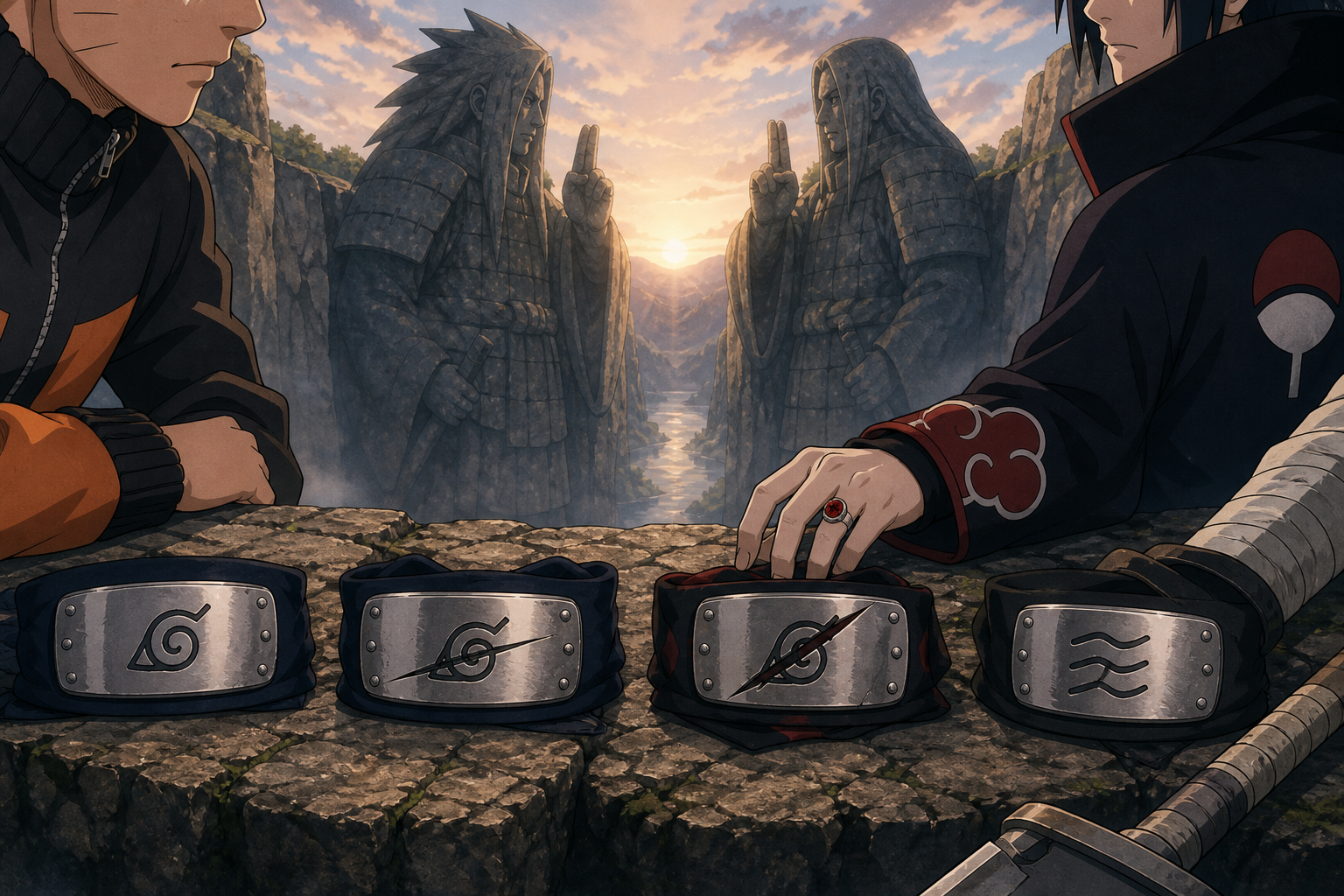
Village Symbols & Forehead Protectors
A metal plate and strip of cloth can certify graduation, identify an army, protect an eye, memorialize a teammate, announce defection, or carry a village name after its government has failed you. Naruto’s forehead protectors are tiny uniforms with enormous political lives.
The one-sentence truth
A forehead protector identifies village affiliation, but where it is worn and whether the symbol is intact, hidden, replaced, borrowed, or slashed turns standard equipment into personal argument.
Hitai-ate
The Japanese term literally means forehead guard, though characters wear it on the forehead, arm, waist, neck, head covering, or elsewhere.
Village symbol
An engraved emblem identifies the hidden village that trained or claims the shinobi. It is closer to military insignia than a family crest.
Scratched symbol
A deliberate slash commonly declares rejection among Akatsuki members. It is not an automatic mark placed on every missing-nin.
Allied symbol
During the Fourth Shinobi World War, a plate bearing 忍, shinobi, temporarily places shared professional identity above village emblems.
The object is credential, uniform, lightweight armor, propaganda, keepsake, and costume design doing five jobs without needing a speech bubble. Its metal plate standardizes allegiance. Its cloth and placement leave enough room for the wearer to remain visually specific.
That tension is the point. A village wants the plate to say, “This shinobi is ours.” A person may hear, “Iruka believed in me,” “Konoha failed my family,” “Mist made me,” or “I left, but the place did not leave me.” Symbols are efficient because they compress meaning. They become dangerous when institutions pretend the compressed version is the only one.
What does a forehead protector certify?
Academy graduates receive forehead protectors as visible proof that they have become genin. The object marks entry into professional village service, not mastery of every ninja skill.
Iruka gives Naruto Uzumaki his own protector after Naruto defeats Mizuki and demonstrates the Shadow Clone Technique. The gift matters because certification and recognition arrive together. Naruto is not merely passed by an institution; he is acknowledged by the teacher whose opinion has become emotionally essential.
The protector therefore carries two authorities. Its emblem belongs to Konoha. Its history belongs to Naruto and Iruka. Public insignia becomes private inheritance.
The Hidden Leaf spiral
Konoha’s symbol resembles a stylized leaf with a spiral and pointed stem. It identifies Konohagakure, the Village Hidden in the Leaves, not the entire Land of Fire.
The distinction matters. The village is a military settlement governed by a Hokage; the country around it has a daimyō and civilian political structure. Wearing Konoha’s mark signals village allegiance inside that broader state.
The spiral visually harmonizes with Naruto and Uzumaki motifs, but it should not be confused with the Uzumaki clan crest. Konoha’s engraved leaf and the red spiral commonly worn on village uniforms are related identity designs, not the same emblem.
The red spiral preserves the historic Konoha-Uzushiogakure alliance after the Uzumaki homeland is destroyed. That memory becomes especially uncomfortable on Naruto’s clothing because he grows up with the surname and symbol but little education about the people behind them. Institutions are very good at retaining logos after losing responsibility for descendants.
The leaf also supports Will of Fire ideology: one village imagined as family, generations feeding the future, leaders protecting children. At its best, the emblem calls adults toward reciprocal care. At its worst, it asks children to sacrifice for a family that did not protect them equally.
For the political structure behind the plate, use the Hidden Villages guide.
The major village symbols
| Village | Country | Symbol’s visual idea | Associated identity |
|---|---|---|---|
| Konohagakure · Hidden Leaf | Land of Fire | Stylized leaf and spiral | Will of Fire, clan federation and Hokage leadership |
| Sunagakure · Hidden Sand | Land of Wind | Hourglass-like sand form | Desert scarcity, puppetry and Kazekage authority |
| Kirigakure · Hidden Mist | Land of Water | Four diagonal mist lines | Island military power and the legacy of the Bloody Mist |
| Kumogakure · Hidden Cloud | Land of Lightning | Cloud formation | Mountain defense, military strength and Raikage rule |
| Iwagakure · Hidden Stone | Land of Earth | Two stylized rock shapes | Fortification, endurance and Tsuchikage leadership |
| Amegakure · Hidden Rain | Land of Rain | Four vertical rain lines | Small-country suffering, industrial landscape and contested rule |
| Otogakure · Hidden Sound | Land of Sound | Musical note | Orochimaru’s experimental state and recruited outsiders |
Why does everyone wear it differently?
Forehead
Naruto and many conventional shinobi use the plate as its name suggests. It clearly presents affiliation and offers limited physical protection.
Eye covering
Kakashi angles his protector over the transplanted Sharingan, combining uniform, concealment and chakra management.
Hair or head covering
Sakura initially uses hers as a hairband. Shikamaru later incorporates the plate into an upper-arm band, while some shinobi mount it on caps or cloth hoods.
Neck, waist or arm
Hinata wears hers around her neck; Rock Lee uses a belt position. The emblem remains readable even when personal style rejects the literal forehead.
Uniform does not erase individuality
The plates standardize allegiance without standardizing the entire body. Cloth colors vary. Placement responds to technique, comfort, disability, clan clothing and personality.
This flexibility is useful military design: the emblem remains visible while the wearer adapts it to equipment. It is also character design. Naruto’s prominent plate matches his desire to be recognized. Kakashi’s plate hides as much as it declares. Sakura’s early styling places institutional adulthood inside adolescent self-presentation.
A tiny shared object lets the series create a coherent army without dressing every character identically.
What does the slash mean?
Akatsuki members commonly wear the plate of their former village with a horizontal gouge through its symbol. The old affiliation is not removed; it is displayed as something deliberately severed.
Itachi Uchiha retains Konoha’s leaf beneath the slash. Kisame Hoshigaki carries Mist. Deidara carries Stone. The scratched plate turns departure into portable accusation.
Not every missing-nin wears one. Zabuza Momochi continues wearing an intact Mist symbol despite rebellion and exile. Orochimaru often displays Sound affiliation after leaving Konoha. Sasuke does not adopt a slashed Konoha plate as his permanent identity.
The slash is therefore political performance, especially associated with Akatsuki, rather than an automatic administrative category.
Naruto and Sasuke: one plate, two promises
At the Valley of the End, Sasuke scratches Naruto’s forehead protector during combat. The moment answers Naruto’s earlier claim that Sasuke cannot even scratch his forehead. It proves equality while their relationship breaks.
Sasuke does not take Naruto’s life to gain Mangekyō Sharingan by Itachi’s prescribed path. He leaves through his own decision, yet the damaged protector records Naruto’s inability to stop him. The object becomes a receipt for both boys: Sasuke reached him; Naruto could not reach Sasuke.
Naruto keeps the scarred plate. He does not replace it with a clean symbol and pretend the failed rescue never happened. The village emblem now carries a relationship Konoha cannot own or fully understand.
Much later, Naruto returns Sasuke’s old protector. The object survives defection, war, revolution, and reconciliation. It no longer simply means “Konoha owns you.” In Naruto’s hands, it means a bond and an unfinished invitation to belong without erasing grievance.
Sasuke’s return also remains complicated. Wearing Konoha affiliation after learning the truth about the Uchiha cannot mean returning to innocent faith. It means choosing a future relationship with the village while judgment stays awake. Reconciliation without memory would only polish the metal.
Zabuza’s intact Mist symbol
Zabuza attempts a coup against the Mizukage, becomes a missing-nin, and works as a mercenary, yet his protector still bears Kirigakure’s intact emblem.
The image resists a simple loyalty chart. Mist trained him through lethal graduation practices and produced the Seven Ninja Swordsmen. He rejects its ruler without becoming culturally originless.
The intact plate does not prove secret loyalty. Zabuza uses Mist techniques, carries a Mist sword, employs Mist-trained subordinates, and reproduces the village’s tool ideology in his relationship with Haku. His body and labor remain institutional history even after the payroll ends.
That continuity is not absolution. Zabuza chooses exploitation and murder as a mercenary. It explains why leaving a state does not instantly remove the state’s training from a person’s reflexes.
A person can oppose a government while carrying the skills, damage, reputation, and comradeship of the place that formed them. The intact symbol reads less like obedience than unresolved homeland.
Allied Shinobi Forces: replacing the village with the profession
During the Fourth Shinobi World War, shinobi from the Five Great Nations and the samurai alliance use a shared protector marked 忍, shinobi. The emblem suppresses rival village identities long enough for collective survival.
The gesture is idealistic and strategic. Soldiers who recently viewed one another as enemies need an immediately legible common uniform. Shinobi becomes a coalition identity broad enough to cross military borders.
The plate also asks people to trust former enemies before institutions have finished processing history. Gaara’s speech and battlefield relationships give that trust emotional force. Shared danger accelerates solidarity, but emergency unity is not the same as justice.
The symbol does not retroactively repair exploited jinchūriki, destroyed small countries, stolen bloodlines, or generations of war. Shared insignia creates a present commitment. Memory still has to survive the costume change.
When Naruto distributes Kurama’s chakra across the alliance, the visual project becomes material. Separate uniforms receive one protective network. The old villages remain, but survival depends on power moving through relationship rather than being hoarded behind emblems.
Can the plate actually protect the forehead?
The metal can deflect or reduce minor physical impact, and characters sometimes use it directly in combat. Its narrative function is far greater than its armor value.
A small plate cannot make the head safe from the techniques used in high-level battles. Calling it a “protector” reflects the object’s material origin and shape, while the story treats it primarily as credential and symbol.
Like many uniforms, it protects socially by helping allies identify one another,and endangers socially by announcing who the wearer serves.
Symbols, propaganda and the right to belong
Village emblems compress institutions into simple images. Konoha’s leaf can mean Iruka’s recognition, Will of Fire, the Uchiha massacre, a mission contract, a childhood home, or leadership that failed Naruto. The plate cannot control which meaning the wearer experiences.
That ambiguity makes symbols useful to states. A clean emblem invites emotional loyalty while hiding internal disagreement. Scratching it makes disagreement visible but can reduce a complex defector to enemy status.
Confucian political thought helps explain why the family metaphor is powerful. A good authority should earn loyalty through reciprocal care. The symbol asks the wearer to serve; the institution must answer by protecting the people under it. When duty runs only upward, the emblem becomes branding.
A Buddhist lens adds the danger of attachment. Belonging is not the problem. Clinging to a pure image of the village can make criticism feel like betrayal and suffering feel necessary for continuity. Naruto’s healthiest loyalty is not blind. He loves Konoha enough to demand it become worthy of the child it once rejected.
The series repeatedly asks whether belonging requires obedience. Its best answer is relational: a village becomes worthy of its symbol when it protects actual people, including those who criticize what the symbol concealed.
Common confusions
Does every missing-nin scratch the symbol?
No. The practice is strongly associated with Akatsuki. Missing-nin appearance and allegiance vary.
Is the red spiral on Konoha uniforms the Leaf symbol?
No. The familiar red spiral reflects the village’s bond with the Uzumaki clan; the engraved leaf is Konoha’s primary village mark.
Must it be worn on the forehead?
No. The Japanese name describes the object, but characters adapt placement widely.
Does receiving one make someone chūnin?
No. Academy graduation normally marks genin status. Promotion is a separate process involving judgment and responsibility.
What the forehead protector is really telling us
The forehead sits beside the face, the part by which a person is recognized. Placing a state emblem there makes affiliation part of visible identity. Naruto’s world does not let soldiers pretend violence is purely private.
Characters move, cover, scratch, exchange, lose, and preserve the plate. They edit the relationship between face and institution. Material culture becomes language for choices dialogue cannot hold.
The object can be tender without becoming innocent. Iruka’s protector gives Naruto recognition. The same metal certifies a child for missions. Kakashi uses his plate to manage a transplanted eye and carry Obito’s memory. Akatsuki turns plates into dissenting uniforms. One prop collects the whole political mess.
The protector’s deepest meaning is contested authorship. The village engraves the first mark. The wearer decides what history accumulates around it.
That is why the plate remains powerful after the cloth tears and the politics change. It does not prove allegiance. It proves a relationship happened, and somebody is still deciding what that relationship means.
The forehead protector is identification, uniform, and argument
A metal plate marked with a village symbol tells allies, clients, rivals, and civilians where a shinobi was trained and whose authority stands behind the mission. It functions like visible institutional identification, but characters wear it as something more personal. The protector can represent graduation, recognition, chosen belonging, inherited duty, or a promise to somebody who finally treated the wearer as real.
Naruto’s first protector matters because Iruka gives it to him after acknowledging both his skill and his personhood. The object is not valuable because the metal is rare. It carries the moment an adult stops treating Naruto as a problem and names him a shinobi worth protecting. Later headband gestures keep drawing power from that beginning.
Placement changes style, not official allegiance
Forehead protectors appear on foreheads, arms, necks, waists, bandannas, and other customized placements. The variation helps silhouettes and character design, but it does not automatically create a new rank or status. Sakura’s later headband placement, Shikamaru’s arm, and other styling choices remain readable because the engraved plate carries the institutional mark.
That visual flexibility is part of why the design became iconic. The symbol can remain legible while the wearer makes it personal. Uniformity identifies the system. Placement gives the character room to negotiate how that system sits on the body.
A scratched symbol is a declaration, not a magic legal form
Akatsuki members wear protectors scored across their former village emblems. The slash announces rupture and contempt for prior allegiance. It does not single-handedly create missing-nin status, and not every person who leaves a village must perform the same gesture. Legal pursuit depends on defection, secrets, danger, and village policy, not on whether somebody remembered to scratch a costume piece.
The distinction matters because symbols communicate stories that institutions may contest. A missing-nin may see departure as liberation, revenge, survival, or ideological refusal. The village may classify the same act as betrayal and theft of state knowledge. The crossed emblem shows the conflict. It does not settle which account is morally complete.
Village symbols compress complicated histories
Konoha’s leaf evokes a home built through the alliance of clans, yet the village also contains the Uchiha massacre, Root, jinchūriki isolation, and generations of child soldiers. Suna’s hourglass-like mark can stand for collective identity while its leadership weaponizes Gaara. Kiri’s emblem travels with shinobi shaped by the Bloody Mist period. A symbol can be beloved without being innocent.
That is why allegiance deserves more than easy cynicism or blind celebration. Characters defend villages because people, graves, streets, teachers, food, language, and memory live there. They challenge those villages because institutions can harm the same people they claim to protect. The symbol holds both truths on one small plate.
Removing a protector can expose vulnerability
Characters sometimes remove, lose, exchange, or return protectors during transitions in identity. The absence can mark exile, disguise, rejection, grief, capture, or a temporary separation between the person and their official role. Context matters. A bare forehead does not automatically mean freedom, just as wearing the plate does not prove wholehearted loyalty.
Sasuke’s relationship to Konoha cannot be summarized by whether he wears its mark in a given scene. His body carries Uchiha history, village training, Kakashi’s teaching, Orochimaru’s intervention, and his own decisions. Clothing gives us a signal. The narrative record gives us the argument.
Symbols become meaningful through recognition
A protector can be issued administratively, but its emotional force comes from relationships. Iruka tying Naruto’s headband, rivals touching or striking the plate, teammates recognizing an emblem at a distance, and defectors scoring out their origins all turn the object into social language. Somebody sees the mark and understands a claim.
That claim may be “I belong here,” “I earned this,” “I reject you,” “I am operating under this authority,” or “I still carry the place I left.” The same object changes because the person and the witness change.
RaeRae’s bottom line
Read the village symbol as identification first, then follow what the character does with it. Do not invent legal rules from costume placement. Do not treat a scratched plate as a complete biography. And do not confuse love for home with approval of every institution using the same emblem.
The forehead protector works because Naruto understands something real: belonging is never only paperwork. It is recognition, responsibility, memory, and choice made visible. The plate can announce a village. The person wearing it decides what that announcement will cost. Sometimes the bravest use of the symbol is defending the community it represents. Sometimes it is refusing the institution behind it. Naruto needs room for both choices, because loyalty without conscience is only obedience wearing sentimental armor.
Source shelf and visual boundary
Academy graduation, Team 7, missing-nin, Akatsuki, Valley of the End, and Allied Shinobi Forces details use the core manga/anime record and official Naruto retrospectives. The official Iruka retrospective supports Naruto’s graduation and recognition. The official war retrospective supports alliance context. Interpretation and judgment are original to CVM Sekai.
Symbol shapes, cloth colors, and placement can vary across animation, manga color art, games, and merchandise. This guide distinguishes durable story meaning from design variation and does not claim that every scratch, costume change, or placement has a canon explanation.