
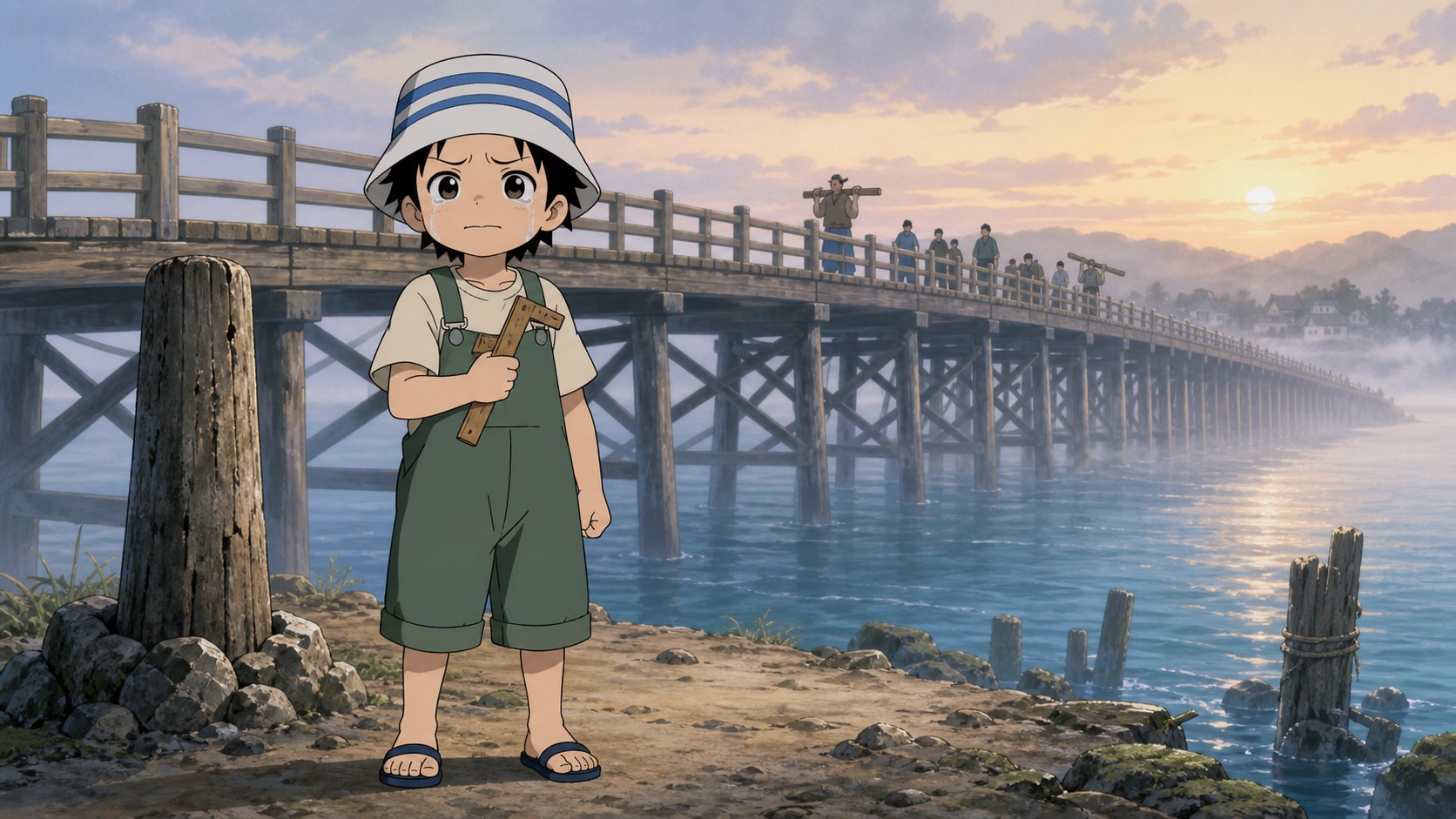
Inari
A grieving child mistakes despair for intelligence because hope once got the man he loved killed. Inari’s story is not about Naruto teaching a coward to be brave. The story follows a traumatized boy discovering that cynicism can describe a prison without opening its door.
The one-sentence truth
Inari survives by insisting resistance is childish, then proves courage begins not when fear disappears but when love makes submission more unbearable than danger.
Bottom line: Inari is the Land of Waves argument in child form
Inari matters because Gatō did not only take money from the Land of Waves. Gatō trained an entire country to confuse surrender with common sense, then left a grieving child to repeat the lesson at dinner. Inari sounds rude when Team 7 meets him, but the attitude comes from evidence. He watched the bravest man in his life get tortured and executed in public. Adults lowered their heads. Gatō kept control. Hope looked less like courage and more like a reliable way to get somebody killed.
That makes Inari one of the first characters who forces Naruto’s big mouth to prove something. Naruto cannot win the argument by yelling that heroes never quit. The boy has heard brave speeches before. Naruto has to train while exhausted, return to danger, protect people who are not from Konoha, and keep moving after the mission turns into a nightmare far above a genin pay grade. Inari changes because Naruto supplies receipts.
I also think fans flatten Inari because the Land of Waves arc sits so early in the franchise. Everybody remembers Zabuza, Haku, the giant sword, the ice mirrors, and Kakashi looking illegally cool with the Sharingan. Inari gets filed under crying child who learned courage. That summary removes the occupation, the grief, the family, the economics, and the fact that a civilian child helps turn a ninja victory into a public uprising. Nada, babes. The child is carrying half the arc’s political argument.
Before Team 7: Gatō already lives inside Inari’s head
The Land of Waves is poor because Gatō controls shipping and imports. Geography gives the businessman leverage. The country depends on routes across the water, so one man with capital, hired killers, and control over transport can choke the local economy without sitting on a throne. Gatō does not need villagers to love him. He needs workers to believe resistance costs more than submission.
Tazuna’s bridge threatens that arrangement in plain material terms. A permanent connection to the mainland can change trade, travel, food access, labor, and prices. The bridge also lets residents organize around something Gatō does not own. Tazuna is building infrastructure, but Gatō correctly reads the construction project as rebellion. That detail matters because Naruto’s first major mission outside Konoha is not random bodyguard work. Team 7 walks into a fight over who gets to control movement and survival.
Inari has absorbed the occupation at the family level. His foster father Kaiza once stood up for the country, and Gatō made the punishment public on purpose. A private murder removes one opponent. A public execution teaches every witness what courage supposedly buys. Inari repeats Gatō’s message after Gatō’s men leave the room because terror works best when frightened people start doing the enforcement themselves.
Calling Inari a coward misses the design. A coward avoids danger because fear wins in the moment. Inari has built a whole theory around avoiding hope. The theory protects him from trusting another hero and losing another father. Cynicism becomes grief wearing glasses and pretending to be smarter than everybody else.
Kaiza gave Inari a father, then Gatō weaponized the loss
Kaiza first earns Inari’s trust by saving him from drowning. The rescue could have remained one dramatic memory, but Kaiza stays. He joins the household, loves Tsunami, and becomes the father Inari chooses. Kaiza teaches him that people must defend whatever they hold precious with their own hands. The lesson gives Inari an idea of adulthood built around care, work, and public responsibility.
Kaiza also becomes a community hero. When disaster threatens the village, he organizes people rather than waiting for a stronger outsider. That history explains why Gatō targets more than Kaiza’s body. Gatō attacks the meaning of Kaiza. The execution tells every witness that bravery leads to humiliation, pain, and an abandoned family.
Inari receives two lessons from the same man. Kaiza’s life says love requires action. Kaiza’s death appears to say action gives power a target. The child cannot reconcile those facts, so he treats the death as the final verdict and buries the life underneath. Naruto does not replace Kaiza. Naruto gives Inari new evidence that Gatō does not deserve the final word on what Kaiza meant.
The father-son relationship also complicates the Great Naruto Bridge name. Naruto deserves the honor. He helps save Tazuna, reaches Zabuza, and cracks open Inari’s fatalism. Kaiza still died for the principle the bridge makes physical. Tazuna and local workers perform the labor. Inari helps the villagers recover the nerve to stand together. One name sits on the bridge, but several people built the meaning.
Naruto and Inari are two children arguing over what pain gets to decide
Naruto grew up under public rejection. Konoha adults looked at him and saw the Nine-Tails before they saw a child. Naruto answers that treatment by becoming louder, more visible, and almost aggressively hopeful. Inari answers public trauma by shrinking the range of futures he allows himself to imagine. One child demands acknowledgment. The other child decides acknowledgment, heroes, and promises are scams.
The boys irritate each other because each recognizes a dangerous possibility. Inari sees another loud man offering hope and expects another body. Naruto sees a child using pain as proof that trying is stupid. Naruto has spent his whole life fighting that conclusion. Of course the conversation gets ugly. Neither child owns a customer-service voice.
Naruto’s anger does not automatically make every word wise. He can be insensitive. The writing gives his argument weight through behavior rather than politeness. Naruto trains until his body drops. He returns to a mission whose danger level was hidden from Team 7. He faces fear after freezing during the Demon Brothers attack. He watches Sasuke fall while protecting him, loses control, regains enough moral clarity to hear Haku, and still keeps asking what kind of shinobi he wants to become.
Inari watches belief operate as a practice. Naruto does not wake up fearless. Naruto moves while scared, embarrassed, exhausted, or grieving. That example reaches Inari because Kaiza taught the same principle before Gatō turned the lesson into a warning.
The mirror also foreshadows later Naruto conflicts. Neji calls destiny fixed. Gaara treats violence as proof of existence. Nagato turns unbearable loss into a political theory about pain. Sasuke tries to make isolation into control. Inari is the small early version of a recurring franchise question: when suffering explains somebody, does suffering also get to command the rest of that person’s life?
The hostage crisis exposes the lie behind passive survival
Gatō’s men come to Tazuna’s home and seize Tsunami. The scene corners Inari with the weakness in his own argument. Submission has not kept his mother safe. Staying quiet has only allowed violent men to choose the time, place, and target.
Inari is a civilian child. He has no chakra training, no clan technique, and no believable path to defeating armed adults. The story does not secretly make him a prodigy because courage finally loaded. His victory begins before physical success. Inari moves toward Tsunami while expecting to lose because abandoning her would make survival unbearable.
Naruto’s shadow clone provides the power required to finish the rescue. Fans sometimes let the clone swallow Inari’s choice, but Naruto can save the boy’s body only after Inari rejects Gatō’s rule inside his own head. The child acts before rescue becomes likely.
That choice recovers Kaiza without copying his death. Inari uses his hands to defend somebody precious, but the story does not demand a second martyr. Courage does not have to look like winning a fair fight. Sometimes courage looks like refusing the moral terms an abuser wrote for the room.
Inari turns private courage into collective action
After the rescue, Inari runs through the country and asks the villagers to stand together. That action matters more than a private change of heart. A child feeling better gives the audience relief. A child changing how courage moves through an occupied community changes the ending.
The villagers do not arrive at the bridge with shinobi skill. Nobody in that crowd is about to out-ninja Kakashi. Their numbers change the cost of intimidation. Gatō’s hired men depend on isolated targets and the belief that everybody else will stay home. Once the residents appear as a public group, the mercenaries face witnesses, resistance, and a population capable of remembering who ran.
Inari becomes the messenger between three forms of resistance. Kaiza gave the country an earlier example. Naruto brings outside force and a refusal to accept Gatō’s story. Inari makes the lesson local again. Without that step, Team 7 could defeat enemies, collect a moral, and leave while the population remained trained to wait for the next Gatō.
The scene also refuses the idea that only combatants shape history. Tazuna builds. Tsunami protects. Inari organizes. The villagers show up. Team 7 creates an opening, but civilians decide whether the opening becomes a different life.
The Great Naruto Bridge is economic warfare with railings
The bridge gets discussed as a symbol of hope because the symbolism works, but the concrete does real work too. Gatō controls maritime trade. A land route weakens the monopoly. Residents gain another way to move goods, find work, reach markets, and stay connected to the mainland. Hope has lumber, engineering, payroll, and a supply chain.
I love that the Land of Waves arc refuses to keep liberation inside a speech. Zabuza can kill Gatō. Team 7 can survive the battle. Neither outcome guarantees a functioning country. Tazuna and the workers still have to finish the bridge. The population still has to use the connection. Recovery requires people whose names will never appear on a jutsu card.
The bridge also becomes Naruto’s first giant piece of public branding, which is honestly funny. The boy leaves Konoha desperate for acknowledgment and comes home with international infrastructure named after him. Still, the name should not erase Kaiza. The structure carries Kaiza’s first stand, Tazuna’s labor, Inari’s organizing, Team 7’s protection, and the villagers’ return to public life.
Structurally, the bridge previews Naruto’s long-term role. He keeps entering systems built around inherited isolation and forcing a connection that everybody else calls impossible. The first major monument to that habit literally connects an island country to a wider world. Kishimoto was not being subtle, and subtlety was not required.
Tsunami, Tazuna, and the family adults tend to flatten
Tsunami spends much of the arc carrying consequences created by men with more power. She loses Kaiza, raises Inari under the government that killed him, hosts shinobi whose mission has placed the home in danger, and becomes a hostage. None of those facts make her passive. Tsunami protects her son inside a situation designed to punish open resistance.
Tazuna resists through construction and deception. He lies about the mission because the Land of Waves cannot afford the rank of protection the job actually requires. The lie endangers Team 7, and Kakashi has every right to be furious. The lie also exposes a weakness in the shinobi economy. A poor country under private occupation receives protection according to available cash, even when the occupier created the poverty that makes honest payment impossible.
That class issue rarely survives the cute “Team 7’s first real mission” summary. Konoha sells military labor through a ranked system. Tazuna manipulates that system because correct pricing would leave his country undefended. Team 7 then discovers that a low-ranked assignment can hide political violence the paperwork never captured.
Inari grows between several models of care. Tsunami survives and protects. Tazuna risks construction. Kaiza confronts power directly. Naruto refuses emotional surrender. Inari’s later work as a carpenter suggests that he does not choose one model and discard the others. He builds, helps, remembers, and acts without becoming a ninja.
Duty, family, reciprocity, and why the Japanese context adds weight
A Japanese audience does not need a lecture to recognize the pressure around family role, public shame, obligation, and social harmony. Kaiza becomes Inari’s father through demonstrated care rather than blood alone. That chosen role carries duties. Gatō’s public execution attacks Kaiza’s body, his reputation as a protector, and the community’s willingness to honor the same obligation.
A Confucian lens helps explain the tension without turning Naruto into a philosophy textbook. Families and communities depend on people fulfilling roles, but hierarchy becomes rotten when powerful people demand obedience while abandoning reciprocal duty. Gatō expects submission and offers no protection, fairness, or moral leadership in return. Gatō’s authority rests on money and nothing worthy underneath.
Reciprocity becomes clearer in Part II. Konoha once sends shinobi to protect Tazuna and the bridge. Inari and Tazuna later help rebuild Konoha after Pain’s assault. The Land of Waves does not remain a grateful poor country frozen in Team 7’s origin story. Skilled workers return value when the former protector needs help.
A Buddhist lens also sharpens Inari’s grief. Attachment does not mean loving Kaiza was a mistake. The problem comes when Inari clings to one interpretation of the loss and lets that interpretation control every future choice. Releasing Gatō’s verdict does not release Kaiza. Inari keeps the love and stops treating despair as loyalty.
Shizuka Ishikawa has to make cynicism sound borrowed
Shizuka Ishikawa performs Inari in the original Japanese cast. The role needs more control than “sad child cries.” Inari tries to sound older, sharper, and more realistic than the shinobi at the table. The performance still lets panic and grief leak through, so the audience hears a child repeating a conclusion that never made him safe.
The crying matters. Naruto stories sometimes get mocked for tears, but emotional visibility is part of the franchise’s argument about strength. Inari does not become brave after the voice stops shaking. He acts while fear remains audible. That choice keeps the hostage scene from turning into a cheap personality transplant.
Direction and editing also pair Inari’s domestic grief with the bridge battle. The arc moves between elite shinobi violence and civilians deciding whether to appear. That crosscutting prevents the audience from treating Zabuza and Haku as the only story that counts. The adults with giant weapons dominate the frames, but a child running door to door helps decide what the victory means.
CVM Sekai documents the original Japanese performance only. No English-dub material belongs in this file. Ishikawa’s name should link when her dedicated profile exists. Until then, an honest unlinked credit beats a fake destination.
The carpenter return pays off the character without handing him a Rasengan
Part II shows an older Inari working as a carpenter. After Pain destroys Konoha, he and Tazuna arrive to help with reconstruction. The choice is almost aggressively correct. A child shaped by the destruction of public hope grows into somebody who builds what communities need to continue.
Naruto: Shippuden Episode 180, “Inari’s Courage Put to the Test,” expands the reunion and uses reconstruction as a frame for looking back at his change. The episode contains anime-original expansion, so every added beat should not be passed off as a manga scene. The larger return fits the established connection between the Land of Waves family and Konoha’s rebuilding.
The profession rejects a common shōnen shortcut. Growth does not require chakra, a secret bloodline, or a glow-up fight. Inari becomes useful through civilian skill. He can repair homes, support infrastructure, and return help to the village that once helped his country. That is character development with a union card.
Later Boruto-era material does not give Inari a major ongoing plot. Movies and OVAs do not add a meaningful separate character arc that deserves inflation. A complete profile should say that plainly. Screen-time scarcity does not erase a finished function, and a database should not invent adulthood because fans want every empty year filled.
Canon boundary, adaptation differences, and facts fans keep blending
The central Land of Waves story belongs to the original manga and its television adaptation. Kaiza’s death, Inari’s fatalism, the threat to Tsunami, the villagers’ arrival, and the completed bridge form part of the core arc. Anime pacing, acting, music, and added connective moments shape how viewers experience those events, but the transformation does not come from filler.
The Shippuden reconstruction material requires a label. Episode 180 expands Inari’s return through television continuity and retrospective scenes. Fan databases often stack manga, anime, novels, games, and promotional material into one smooth timeline. CVM Sekai separates formats whenever the difference changes what a reader should believe.
Inari has no shinobi rank, named jutsu library, or secret combat career in established canon. Games can turn civilians into playable units because games need mechanics. A button prompt does not enroll the boy in ninja school.
Age information also circulates with inconsistencies between story dialogue, databook references, and fan summaries. The honest description is simple: Inari is a young child during the Land of Waves mission and an older youth by the reconstruction period. A suspiciously precise number does not become better reporting merely because a wiki infobox found room for the number.
The name Inari matches a major Shintō kami associated with rice, agriculture, prosperity, industry, and foxes. Kishimoto does not stop the story to confirm one official symbolic code for the boy. The association remains interesting beside a character tied to recovery, labor, scarcity, and construction, but CVM Sekai treats that link as interpretation rather than creator-confirmed intent.
Common Inari takes that leave half the story on the floor
“Naruto bullied him into bravery.”
Naruto speaks harshly. The boy changes because Naruto’s words arrive with behavior, and because the hostage crisis proves quiet submission cannot guarantee safety. Kaiza’s memory and Inari’s own decision remain central.
“Inari is useless because he cannot fight.”
He moves to protect Tsunami, mobilizes the villagers, and later contributes skilled reconstruction labor. The arc deliberately gives political consequence to a person who cannot win a ninja battle.
“Naruto saved the country by himself.”
Team 7 provides force and protection. Kaiza provides precedent. Tazuna and the workers build. Inari organizes. The villagers end their isolation. The ending needs every layer.
“The bridge should only have been named after Kaiza.”
The complaint understands Kaiza’s importance, but the either-or framing creates another erasure. Naruto becomes the immediate catalyst, while Kaiza, Tazuna, Inari, Team 7, and the population all live inside the finished structure’s meaning.
“The carpenter return is random nostalgia.”
Construction completes his arc better than a combat upgrade could. Inari turns inherited courage into durable work and returns aid when Konoha needs rebuilding.
Essential viewing
- Episode 11: Kaiza and the wound beneath Inari’s cynicism.
- Episodes 12–18: Naruto’s example presses against fatalism.
- Episode 19: Inari brings the villagers to the bridge.
- Shippuden Episode 180: anime-original reconstruction and reciprocal aid.
Courage still matters after the crowd arrives
Inari’s run through the village is satisfying because it does not pretend fear disappears. He has already watched Gatō punish public resistance by killing Kaiza where everybody can see. Asking those same neighbors to gather at the bridge means asking them to risk becoming the next lesson. Inari speaks anyway.
The villagers’ arrival does not turn him into a miniature general or erase the adults’ responsibility. It shows how one frightened child can interrupt the silence that lets a threat look unanimous. Naruto gives Inari an example, but Inari performs the local work Naruto cannot do. He knows the people, the history, and the exact shame Gatō has used to keep households separated.
That is the real shift in his arc. At first, Inari uses realism as armor: heroes die, resistance fails, and anyone who hopes is childish. By the bridge, he understands that despair can be factually informed and still serve the person causing the harm. Courage is not believing loss became impossible. It is refusing to let the possibility of loss make every decision in advance.
Source shelf and canon boundary
This profile synthesizes the completed Land of Waves story, the official anniversary retrospective, official Volume 4 synopsis, official Episode 11 listing, and official reconstruction episode listing. Later Konoha reconstruction material is anime continuity and is labeled accordingly. Japanese performance: Shizuka Ishikawa. English dub credits are intentionally omitted.