
Haku
Haku did not need a reason to die. He needed adults who gave him reasons to live.
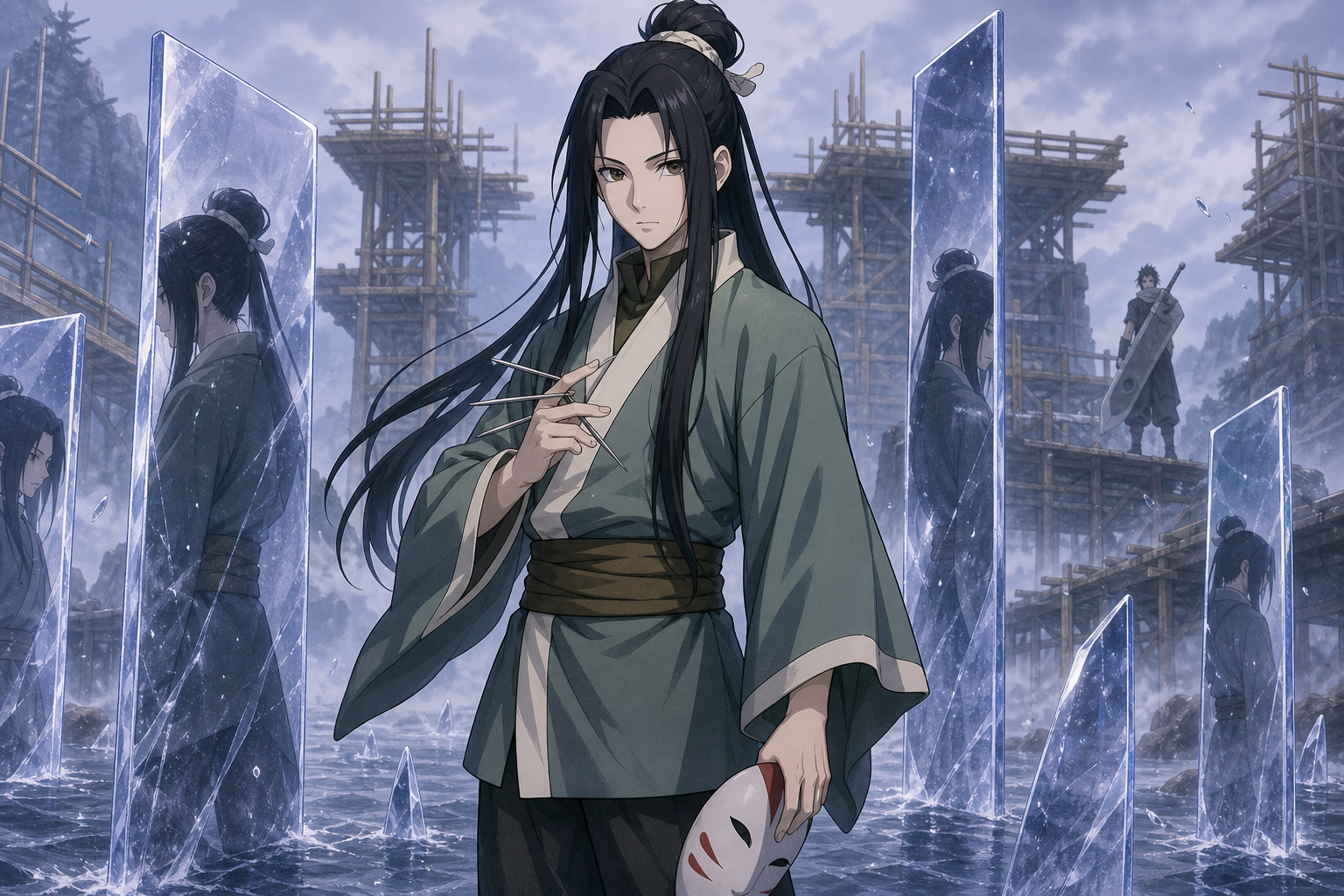
Haku is one of the earliest characters in Naruto to say that protecting someone precious can make a person strong. The line sounds warm enough for a motivational poster until the bridge shows what Haku believes protection requires. He is fifteen. He has survived the murder of his mother, killed his father and the attacking group in self-defense, lived without a home, and attached his entire worth to one adult who offered him shelter on the condition that he become useful.
That is the bottom line. Haku’s devotion to Zabuza is real. His skill, judgment, restraint, loyalty, anger, and final choice are real. The power imbalance is also real. Zabuza meets a bereaved child with nowhere safe to go and gives that child a purpose shaped like a weapon. Calling the bond fake erases Haku’s feelings. Calling the bond perfectly wholesome erases the conditions that trained him to treat death as proof of love.
Haku is not tragic because he was too pure for the ninja world. He is tragic because every system around him taught the same lesson in a different accent: blood makes you dangerous, usefulness makes you welcome, and your body earns belonging by protecting somebody else. Naruto rejects that lesson because he meets Haku before the doctrine can start sounding normal.
Databook record: fast, intelligent, precise, and not built for brute force
The first databook describes Haku as kind, sincere, and dedicated. His eight-category stat line gives ninjutsu 3.5, taijutsu 1, genjutsu 1, intelligence 4, strength 1.5, speed 4, stamina 2, and hand seals 4, for a total of 21 out of 40.
That shape fits the page better than one loud “power level.” Haku wins through speed, planning, seals, bloodline technique, anatomy, and precision. Raw strength, direct taijutsu, stamina, and genjutsu sit lower. He can dominate newly graduated genin inside a field designed around his abilities, yet sustained combat, developing Sharingan perception, emotional hesitation, and a surge of Nine-Tails chakra expose limits.
The stats also explain why fandom arguments about Haku often go sideways. One side treats his defeat as proof that he was weak. Another repeats the largest speed claim available and promotes him into a secret god. Haku is more interesting in the middle. He is a gifted fifteen-year-old specialist whose kindness changes how he uses lethal tools.
Haku means white, not whatever purity speech fandom wants to paste onto him
Haku’s name uses the single character 白, meaning white. The association suits snow, ice, the pale hunter mask, and the visual cleanliness of his techniques. White can suggest absence, mourning, death, purity, or a blank surface depending on context. No one interpretation should march in wearing a fake citation crown.
The name works most clearly as visual design. Haku stands against Zabuza’s black clothing and heavy bandages. His mask is white. His ice reflects rather than absorbs. His gentleness appears inside a violent job. The contrast does not make him morally untouched. Haku deceives Kakashi, attacks children, supports an assassination contract, and chooses Zabuza over his own survival. White is a palette, not an innocence certificate.
Haku is a boy, and androgyny does not cancel that
Haku is a fifteen-year-old boy. The manga identifies him as male, the databook identifies him as male, and Haku tells Naruto that he is male after Naruto assumes otherwise. Use he/him.
Haku also has an intentionally androgynous presentation. He has a slender frame, long black hair, large brown eyes, delicate facial features, and clothing that many viewers read as feminine. Naruto blurts out that Haku is prettier than Sakura. The moment unsettles Naruto’s visual assumptions, but Haku does not become a joke because Naruto guessed wrong.
Fandom can discuss gender expression, queer resonance, translation choices, and the freedom Haku’s design gives viewers who rarely see soft-looking boys treated seriously. Those readings belong in the interpretation shelf. Claims that Haku is “secretly a girl” overwrite his own words. Trap language turns a child’s face into a sexualized gotcha and can stay outside with the rest of the garbage.
Haku’s softness is not proof of womanhood. His violence is not proof of manhood. The design allows gentleness, technical skill, beauty, grief, and male identity to occupy the same body without asking anybody’s permission.
Appearance and design chronology: the mask is a job, not his whole identity
Haku is a slender fifteen-year-old boy with pale skin, large dark-brown eyes, and long black hair. In his shinobi look, a white holder gathers the hair into a high bun while two long strands frame his face. Metal cuffs finish the loose strands. That silhouette matters because the bun, framing locks, mask, and green outer layer identify him faster than generic ice effects ever could.
His combat clothing layers a green haori with white trim over the pinstriped Kirigakure outfit that ends around the knees. A brown fringed sash wraps twice around his waist. Light-brown sandals and matching blue-green nail color finish the design. A dark Kirigakure forehead protector sits beneath the hunter-nin disguise. Haku is a boy wearing an elegant, practical shinobi outfit. The design does not invite readers to age him up or sexualize him.
Outside combat, the forest meeting uses a civilian look. Haku wears his hair loose and appears in a long sleeveless pink kimono with pale edging, plum-colored swirl decoration, a white obi, sandals, and a dark neckband. Naruto reads the clothing, hair, and face through his own assumptions. The scene then lets Haku correct him without embarrassment.
Childhood clothing changes with circumstance. Family-era and early Zabuza-era material uses short kimono-like clothing. Homeless Haku wears an oversized torn shirt and damaged knee-length pants, visually reducing the distance between persecution and Zabuza’s offer.
The white hunter-nin mask has narrow curved eye openings, a red wave-like mouth marking, and the Kirigakure symbol near the top. Haku wears the mask over the forehead protector during the rescue deception and covert combat. The mask performs professional authority and hides the gentle face Naruto met. Haku is not secretly a hunter mask with a child stored underneath. The disguise is a tool he uses.
Demonic Mirroring Ice Crystals extends the same design logic. Multiple reflections reproduce Haku’s masked figure, obscure the original body, and turn visibility into control. The mirrors make a person who already ties identity to usefulness appear as interchangeable combat images. That symbolic reading grows from the visible technique; the manga never pauses to hand readers a mirror-theory worksheet.
Edo Tensei changes the eyes and body rather than aging him. Reanimated Haku retains the fifteen-year-old silhouette and familiar clothing while the sclera turn black and the skin carries the reanimation state. Death does not make him older. War simply places the same child-shaped body back on duty.
The Yuki bloodline survived war, then entered the family home
Haku descends from the Yuki clan, whose members carry Ice Release. In the Land of Water, bloodline abilities became feared after shinobi conflict used them as military assets. People associated kekkei genkai with war, destruction, and the return of violence.
Haku’s mother hid her heritage and built a family with a man who did not know. For a time, Haku remembers warmth. Then he innocently manipulates water and reveals the same ability. His father responds to inherited power as if a child has confessed to being a weapon pointed at the household.
He kills Haku’s mother. He attacks Haku with other men. Haku’s Ice Release erupts in lethal self-defense, killing his father and the group. The child survives the people who were supposed to protect him and learns that being seen can destroy a home.
That chronology cannot be cleaned into a tasteful “tragic backstory.” Haku watches inherited fear turn into intimate violence. The state-level history of bloodline warfare enters the kitchen. Public prejudice gives a father permission to imagine murder as protection. A child then uses the feared power to survive, which lets everyone who already feared the bloodline pretend their fear was correct.
The cycle is vicious because Haku’s self-defense becomes evidence against him in his own mind. He does not leave believing that his father failed. He leaves believing that his existence causes harm.
Homelessness makes “I need you” sound like salvation
After the killings, Haku lives without a home or stable protector. He is young, isolated, hungry for purpose, and convinced that nobody needs him. Zabuza finds him in that condition.
Zabuza does not offer unconditional safety. He recognizes Ice Release and names Haku’s usefulness. The adult missing-nin needs talent for a future built around violence and ambition. The homeless child needs belonging. Their arrangement begins where those needs meet, but the power is not equal.
Zabuza controls training, shelter, direction, work, and the definition of success. Haku receives skills, food, proximity, identity, and one person whose plans include him. That arrangement can feel like rescue to Haku while remaining recruitment to the reader.
This distinction matters because vulnerable people do not need to be physically chained before dependence becomes coercive. Haku chooses Zabuza. He also chooses from a world that has already removed his parents, home, social safety, and belief in independent worth. Choice survives. Freedom is narrow.
Haku has agency inside exploitation
Haku is not a puppet with no mind. He studies opponents, gathers medicine, treats Zabuza, designs deception, decides where senbon land, protects Naruto from unnecessary death, threatens people who disrespect Zabuza, and changes course when he senses danger. He can disobey the simplest version of an order while remaining loyal to the larger relationship.
Agency explains why the bond matters. Exploitation explains why Haku’s agency keeps curving toward self-erasure. He does not merely follow Zabuza because a villain commands him. Haku has built a moral system around being useful to the person who gave him a place.
Zabuza’s care is also more than fake manipulation. He trusts Haku with his body after battle. He relies on Haku’s judgment and power. He reacts when Haku is insulted. He grieves. None of that turns the recruitment ethical. Love can grow inside a harmful structure without making the structure harmless.
That is the uncomfortable adult answer. Their relationship does not fit into “abuser who never cared” or “father who saved a child.” Zabuza saved Haku from one form of abandonment and trained him into another form of disappearance.
The hunter-nin mask is a disguise, not proof of rank
Haku enters the first Zabuza battle wearing a white hunter-nin mask and claiming authority from Kirigakure. Hunter-nin track missing-nin because a deserter’s body can reveal village secrets, techniques, medicine, and intelligence. Disposal matters as much as pursuit.
Haku uses senbon and anatomical knowledge to strike Zabuza at points that imitate death without killing him. The intervention stops Kakashi before the fight becomes fatal. Haku then removes the body.
Kakashi later recognizes the procedural problem. A hunter-nin protecting village secrets would normally destroy or examine the corpse rather than carry an intact body away like precious luggage. The mask makes the first lie plausible. The body makes the lie collapse.
The scene proves Haku understands anatomy, hunter procedure, timing, deception, and Kakashi’s battlefield attention. The scene does not prove Haku held an official hunter-nin appointment. Wearing the uniform during a con is not the same as receiving the job.
Senbon, anatomy, herbs, and the choice to control damage
Senbon fit Haku because they reward precision. A needle cannot compete with Kubikiribōchō for visual intimidation. Haku does not need intimidation. He needs the right angle, point, depth, and target.
His medical knowledge is practical rather than formally titled. He understands vital points, can create a false-death state, tends Zabuza’s recovery, and gathers useful plants. “Medical ninja” would imply a classification the checked record does not provide. Anatomical and medicinal skill says enough.
Precision also gives Haku moral room. During the mirror battle, he repeatedly avoids immediate fatal hits even while maintaining the contract. Sasuke appears dead but survives because Haku’s needles miss true killing points. Restraint does not make the attack safe. Naruto and Sasuke are still children trapped inside a lethal technique. Restraint shows that Haku remains a decision-maker inside the role he calls a tool.
Haku’s kindness is not passivity. Anime-expanded recovery material shows him injuring Gatō’s arm and turning Zōri and Waraji’s drawn swords against them when they threaten Zabuza. That confrontation is not part of the same core manga sequence used for the bridge chronology, so the adaptation label stays attached. Soft speech and fine features do not make Haku incapable of anger. He chooses when harm feels necessary, which makes every nonfatal strike more meaningful.
One-handed seals are not decorative genius points
Haku performs seals with one hand, a rare skill that surprises observers. The ability matters because combat usually requires both hands for conventional sequences. One-handed formation lets Haku keep weapons ready, maintain balance, or perform technique during movement.
The feat supports his hand-seal and intelligence scores. Haku does not simply inherit Ice Release and press the pretty mirror button. He learns control difficult enough to impress experienced shinobi.
Technical talent still has cost. Complex techniques consume chakra. Speed inside the mirrors cannot continue forever. Haku’s body remains fifteen years old, and the bridge battle forces him to sustain a large field while monitoring two opponents and suppressing lethal intent.
Water, Wind, and the complete Ice Release shelf
Ice Release is Haku’s inherited kekkei genkai and combines Water and Wind Release. The combination creates ice rather than simply freezing water through temperature alone. Haku can also use water-based technique directly, as Thousand Flying Water Needles demonstrates.
The manga technique shelf includes Demonic Mirroring Ice Crystals, Thousand Flying Water Needles of Death, and the war-era defensive Hyōton: Hyōgan Dōmu (氷遁・氷岩堂無). English reference translations vary, including “Ice Rock Dome of Magnificent Nothingness” and game-localized “Glacial Dome,” so the Japanese name and chapter evidence are safer than pretending one fan/reference rendering is the universal official title. In chapter 520, Haku rapidly creates a transparent dome that protects against an explosive-tag assault. Naruto: Shippūden episode 265 adapts the defense. The dome broadens his record beyond speed and needles: Haku can use Ice Release to shield others as well as surround opponents.
The original anime expands Ice Release imagery during Haku’s childhood self-defense, showing large ice spikes around the attackers. That television staging belongs to the adaptation rather than an extra manga technique entry. Game move lists remain outside the biography because playable balance is not manga evidence.
Across the verified shelf, the mechanics stay consistent: senbon and anatomy provide precision, one-handed seals support speed and control, Water and Wind create Ice Release, mirrors control angles, and the dome protects at short range. Limits remain chakra, stamina, perception counters, emotional restraint, and opponents whose power breaks the field.
Thousand Flying Water Needles of Death
Haku uses water around the target and one-handed seals to form many needles that attack from multiple directions. The technique restricts escape and turns environment into ammunition.
The name promises certain death more confidently than the scene delivers. Sasuke responds, protects Naruto, and survives. That gap does not mean the technique is fraudulent. Names in Naruto sell intimidation. Outcomes still depend on user intent, opponent response, speed, terrain, and power.
Haku’s use shows control more than destruction. He can create a surrounding threat while selecting how much damage lands. A weaker user might throw water. Haku creates a geometry problem with consequences.
Demonic Mirroring Ice Crystals
Demonic Mirroring Ice Crystals creates a formation of reflective ice mirrors around the targets. Haku enters a mirror and travels between surfaces at extraordinary speed, launching senbon from changing angles. Every reflection becomes a possible attack point.
The technique controls perception. Naruto and Sasuke cannot tell which image contains the moving body, where the next volley begins, or how to reach the user. Mirrors turn Haku’s androgynous face into repetition while hiding the person behind a combat system.
Sasuke’s developing Sharingan begins to follow the movement. Haku’s speed remains dangerous, but perception reduces surprise. Chakra use and accumulated fatigue slow the formation. Haku’s reluctance to kill creates further openings. When Naruto releases Nine-Tails chakra after believing Sasuke has died, the power surge overwhelms the mirrors and Haku.
Calling that result proof of weakness ignores the actual fight. Haku has sustained the technique, controlled damage, fought an awakening Sharingan, and faced a tailed-beast chakra eruption. Calling Haku unbeatable ignores the same evidence from the other direction. The technique is elite, specialized, costly, and countered under extreme conditions.
Some summaries use language that sounds like literal light-speed travel. Without the exact source and translation, physics cosplay can take a nap. Haku moves faster than the boys can initially perceive. The fight gives us enough.
The forest conversation is Haku speaking and warning at the same time
Naruto meets Haku in the forest without recognizing the masked opponent. Haku gathers plants while Naruto recovers from training. The scene lets two lonely children talk outside the roles adults assigned them.
Haku asks about someone precious and explains that people become truly strong when protecting such a person. Naruto thinks about his own bonds and goals. Haku then identifies himself as male after Naruto’s assumption.
The conversation is gentle, but the story places a blade inside the lesson. Haku’s precious person gives him strength and supplies the reason he accepts death. Protection can build courage. Protection can also become a moral trap when one person’s survival consumes another person’s identity.
Naruto hears the first half before the battle. The bridge forces him to confront the second.
Sasuke: restraint, recognition, and the body that shields Naruto
Sasuke becomes Haku’s most direct tactical opponent inside the mirrors. He watches patterns, awakens stronger Sharingan perception, protects Naruto, and begins predicting attacks. Haku recognizes the danger and adjusts.
The exchange complicates the claim that Haku lacks killing ability. Haku could target more lethal points, but his behavior and later explanation show restraint. When Sasuke shields Naruto and collapses, Naruto believes Sasuke has died. Sasuke survives.
Both boys use their bodies to protect someone important. Sasuke does so before he can explain why. Haku sees that act while living inside a doctrine that treats the same choice as his highest purpose. The mirror battle is not only technique versus technique. Two young people demonstrate protective attachment under different adults and different futures.
Sasuke has Kakashi, Team 7, and a path beyond the bridge, even with all his own trauma. Haku has organized every path around Zabuza. Similar courage produces different consequences because support systems matter.
Naruto: the child who refuses Haku’s definition of worth
Nine-Tails chakra lets Naruto break the mirror field and overpower Haku. Rage gives Naruto strength, but the decisive moral moment comes after the power display. Haku removes the mask, explains his failure, and asks Naruto to kill him because he believes he can no longer serve Zabuza.
Naruto cannot accept the request. He has spent his own childhood being treated as dangerous and unwanted. The difference is that Naruto still wants recognition as Naruto. Haku has learned to want recognition as a useful extension of Zabuza.
Haku’s request horrifies Naruto because Naruto sees the destination of the tool doctrine. A person who fails one assigned function believes no self remains worth protecting.
Before Naruto acts, Haku senses Kakashi’s attack against Zabuza and leaves. That decision is Haku’s. The relationship has trained the range of choices, but Haku still reads the field and chooses the shield.
Kakashi and the repeated wound
Haku deceives Kakashi after the first Zabuza fight, then dies intercepting Kakashi’s Lightning Blade during the bridge rematch. The attack is intended for Zabuza. Haku moves into the path.
The scene echoes Kakashi’s earlier trauma with Rin, who also moves into his thrust. Haku does not know that history. The structure belongs to Kakashi and the audience. Another young person turns Kakashi’s technique into an accidental killing instrument while protecting someone through bodily sacrifice.
Kakashi responds professionally because the battle continues. Later reflection gives the event weight. His judgment during the war recognizes that Zabuza and Haku mattered to Naruto’s development and displayed a bond through their deaths and tears.
The war forces Kakashi to face the composition again. A reanimated Haku shields a reanimated Zabuza. Repetition does not romanticize fate. Repetition shows a military system reusing trauma because the bodies remain tactically useful.
Sakura and the care work outside the mirrors
Sakura does not fight Haku directly inside the ice formation. She guards Tazuna, maintains the mission objective, and later checks Sasuke’s body. Those roles are easy to erase when fandom reduces every scene to who landed the flashiest hit.
Haku and Sakura both perform care under danger, but their teams assign care differently. Sakura protects the client because Kakashi gives her a mission role. Haku tends Zabuza because his entire belonging depends on service. Sakura’s position has problems, including young soldiers on a deadly mission, but Team 7 still gives her relationships beyond a single function.
That contrast belongs in the profile because Haku’s tragedy is not “caring too much.” The tragedy is a life where care, labor, identity, and debt collapse into one person.
Zabuza: attachment does not erase control
Haku protects Zabuza, treats him, manages deception, fights for his ambition, and dies for him. Zabuza trains Haku, relies on him, protects the partnership, calls him a tool, and denies the emotional obligation created by Haku’s devotion.
During the bridge fight, Haku’s body intercepts Kakashi. Zabuza continues attacking through the corpse. That action is brutal enough to stop every clean foster-family rewrite. Haku’s usefulness remains active even after death.
Naruto names what Zabuza refuses to admit. Haku cried, lived, fought, and died for him. Zabuza’s tears prove attachment, but tears arrive after Haku can no longer receive care, freedom, apology, or a different future.
The final charge against Gatō acknowledges Haku’s personhood. The request to lie beside Haku records the bond. Neither action returns Haku’s childhood. Calling the moment redemption would let Zabuza’s feeling consume Haku’s consequence one more time.
The stronger reading holds both truths. Zabuza loved Haku. Zabuza also built a relationship where Haku believed death was the best service he could provide.
Haku’s death is not a pretty snow globe
Haku chooses to shield Zabuza. The choice shows speed, awareness, courage, loyalty, and agency. The choice also shows how completely Haku has tied existence to usefulness.
Martyr language can make the scene feel spiritually clean. The body is not clean. Kakashi’s hand passes through Haku’s chest in the manga’s graphic staging. Zabuza uses the body as an opening. In manga chapter 32, Gatō kicks Haku’s face and corpse in revenge for the earlier arm injury. The original television sequence omits that exact kick, while Shippūden episode 265 later inserts the action into an inconsistent flashback. Naruto watches adults treat a fifteen-year-old as equipment while arguing about whether equipment can be loved.
The original anime gives the aftermath its own visual and musical presentation, but this profile does not invent shot, snow, or timing criticism without direct scene observation. Adaptation style can ask viewers to grieve without asking them to endorse the structure that killed him.
Haku does not die because devotion is naturally fatal. He dies because every available idea of belonging has narrowed toward service. That consequence is the point Naruto carries forward.
Reanimation turns the metaphor into paperwork
Kabuto reanimates Haku with Zabuza and other shinobi valued for bloodline abilities. Haku’s body returns because Ice Release remains useful to someone managing a war.
Before control fully tightens, reanimated shinobi can show awareness, warn opponents, or react to the situation. Agency then shrinks. Haku fights beside Zabuza and repeats the protective interception against Kakashi.
The second shield is more horrifying than the first. In life, Haku chose within dependency. In reanimation, an external controller uses the bond, body, and reflex as military material. Death cannot end the labor contract because Edo Tensei does not recognize consent.
Kakashi’s division eventually seals Haku and Zabuza. Sealing stops their tactical use. The scene does not give Haku a new life, independent dream, or chance to renegotiate the bond. War borrows the old tragedy and returns the bodies to silence.
Confucian reciprocity: loyalty creates duty upward too
A Confucian lens can clarify the moral failure without declaring obedience automatically virtuous. Hierarchy carries reciprocal duty. A subordinate owes service within a legitimate relationship, but a superior also owes care, moral conduct, protection, and recognition.
Haku gives more than service. He gives identity, skill, bodily safety, and life. Zabuza accepts all of that while speaking as if naming Haku a tool cancels obligation. The hierarchy becomes morally crooked because duty travels down and sacrifice travels up.
Zabuza’s final tears acknowledge the debt. Acknowledgment matters, but late recognition cannot complete reciprocity after the subordinate has died. The bridge makes failed duty visible through timing.
This lens does not turn Haku into an ideal retainer. Haku is a child subordinate shaped by trauma. Loyalty deserves respect only when the relationship respects the loyal person.
Buddhist attachment: selflessness can still erase the self
Haku believes meaning comes from serving someone precious. Care for another can loosen selfish obsession. Haku’s version goes further. He allows no independent self to remain outside usefulness.
That is attachment wearing selfless clothing. Haku clings to one condition for worth: Zabuza needs me. When he believes he has failed, he asks Naruto for death. Suffering grows because identity has only one support.
The lesson is not that Haku should have cared less. The lesson is that compassion without boundaries can feed the structure causing harm. A child cannot build a healthy self by disappearing into another person’s ambition.
No spiritual lens should blame Haku for trauma. He creates meaning from the options available. The adults and institutions around him are responsible for making those options cruel.
Labor: bloodline capital, care work, and a body paid in advance
Haku’s Ice Release is inherited power and labor value. War makes bloodlines feared because villages convert them into military advantage. Zabuza converts the same ability into mercenary advantage. Gatō purchases the result through contract.
Haku performs combat labor, medical care, intelligence work, disguise, tracking, and emotional support. He receives shelter, training, belonging, and purpose rather than an equal contract. The arrangement resembles family to Haku and workforce management to everyone benefiting from his skill.
Care work becomes invisible because Haku does the work gently. He gathers plants, monitors Zabuza, preserves his body, and keeps the mission functioning. The giant sword gets the poster. The child with needles keeps the swordsman alive.
Gatō then betrays the contractors once they become expensive and vulnerable. Zabuza finally rejects that hierarchy after Haku dies. The refusal comes late because exploitation often becomes obvious to people only when the same logic reaches someone they love.
Mayumi Asano and the honest performance boundary
Mayumi Asano performs Haku in the original Japanese anime. Her credit is verified. I am not inventing pitch, breath, timing, or gender-performance analysis without the heard Japanese scenes; a cast list is better than fake criticism.
The relevant contexts are Haku’s forest conversation with Naruto, the hunter-nin deception, the mirror battle, the request for death, the shield, and the war return. Those scenes explain where Asano’s performance belongs. Detailed criticism requires lawful observation of the Japanese track.
The performer’s gender does not determine Haku’s gender. Voice casting often crosses age and gender lines, especially for young anime characters. Haku remains a boy because the character record and his own statement establish that identity.
Manga, anime, novel, OVA, games, and attraction boundary
Haku’s core manga story appears in Land of Waves and the Fourth Shinobi World War reanimation. The original anime adapts the early material with expanded motion, color, music, voice, and some added Ice Release imagery. Naruto: Shippūden adapts the war return.
Naruto: Innocent Heart, Demonic Blood retells early material in novel form rather than adding a secret independent campaign. Hidden Leaf Village Grand Sports Festival! includes Haku as a comic OVA cameo outside the central chronology.
Haku appears as a playable character in the early Clash of Ninja and Ultimate Ninja lines, Rise of a Ninja, The Broken Bond, Ultimate Ninja Storm Generations, and later Storm entries. Storm Generations includes the Haku and Zabuza tale through narrated cutscenes. Game move sets and original matchups remain licensed adaptation rather than manga capability proof.
The checked record does not establish a substantive feature-film storyline. In 2026, the official Naruto site promoted the Shinobi-Zato attraction story “Haku & Zabuza Arc: Chasing Fading Shadows.” That attraction-original narrative is official franchise material and separate from manga canon.
Fandom arguments that miss Haku
“Haku was secretly a girl.”
Haku identifies himself as male, and the official character record agrees. Androgynous beauty is not a hidden production error.
“Haku chose Zabuza, so no exploitation happened.”
Choice exists inside context. Haku chooses after family violence, homelessness, isolation, adult recruitment, and dependence narrow the field.
“Zabuza saved Haku.”
Zabuza gave Haku shelter, training, purpose, and attachment. He also trained a child to understand worth as usefulness. Rescue and exploitation share the same doorway.
“Haku was too gentle to be strong.”
Gentleness affects target choice. Speed, seals, anatomy, Ice Release, deception, and tactical intelligence remain dangerous.
“Nine-Tails Naruto proved Haku was weak.”
Haku had sustained a costly technique, limited lethal damage, faced an awakening Sharingan, and then received an abnormal tailed-beast chakra surge. Defeat is evidence. Context is also evidence.
“His death is beautiful loyalty.”
The scene is moving because a fifteen-year-old believes bodily sacrifice is the final proof of belonging. Beauty in direction cannot make that belief healthy.
“Haku and Zabuza were romantic.”
Canon supports intense attachment, dependence, partnership, and unequal power. Turning an adult recruiter and child subordinate into a romance sexualizes a relationship the story does not present that way.
Why Haku still matters
Haku gives Naruto its first complete argument about tools. Zabuza says shinobi use people. Kakashi admits every village carries some version of that ideal. Haku demonstrates how the doctrine feels from inside a child who has accepted the assignment.
Naruto does not defeat the idea merely by breaking the mirrors. He defeats the idea by refusing Haku’s request for death and carrying the question into his own ninja way. Strength cannot require surrendering personhood. Protection cannot make the protected person’s ambition the only life available.
Haku also matters because kindness does not save him automatically. He avoids killing when possible, gathers medicine, speaks gently, and loves deeply. Systems can exploit kind people precisely because kind people are willing to give more.
The profile cannot rescue Haku with nicer words. Haku dies. Zabuza understands too late. Reanimation uses the body again. Consequence remains.
What the story can preserve is the truth Zabuza denied. Haku was never a tool with a beautiful face. He was a boy with power, judgment, humor, anger, restraint, trauma, devotion, and possibilities the bridge never allowed him to explore.
That is why “someone precious makes you strong” needs a second sentence. Someone precious should also make room for you to remain a person.
Sources and canon boundary
Manga chronology controls this profile. Anime staging, databook material, games, and reanimation-era appearances are labeled instead of being blended into one false continuity.
Primary franchise references: Naruto Official and VIZ Media Naruto. CVM Sekai’s conclusions about Haku’s agency, gender discourse, exploitation, Ice Release, and bond with Zabuza are editorial analysis, not invented creator quotations.