
Naruto Character Encyclopedia · Complete Canon Profile
Kakashi Hatake
Kakashi survives by turning grief into rules, lateness, borrowed power, and teaching. The tragedy is how often children inherit the bill before he learns to speak plainly.
01
Bottom line
Kakashi Hatake teaches children that comrades matter more than rules because Konoha first taught his father the opposite lesson and buried him under the shame.
02
Bottom line
Kakashi is one of Naruto’s best teachers in principle and one of its most uneven mentors in practice.
He understands teamwork because isolation has cost him nearly everyone. He understands a child’s dangerous fixation because grief once turned him into a rule-obsessed prodigy and later into an ANBU operative who barely seemed attached to living. He gives Team 7 the moral sentence that organizes the franchise: people who abandon comrades are worse than people who break rules.
Then Konoha asks him to guide three damaged children while keeping the village’s worst secrets sealed.
Kakashi teaches survival, coordination and tactical judgment. He gives Sasuke the most individualized combat instruction. Sakura eventually needs Tsunade to build a profession. Naruto eventually needs Jiraiya to build a path. Kakashi loves all three, but love does not create equal mentorship.
RaeRae’s bottom line is that Kakashi turns grief into public competence. He also turns grief into delay, secrecy and private ritual. His calm is not freedom from pain. His calm is pain placed on a schedule between missions.
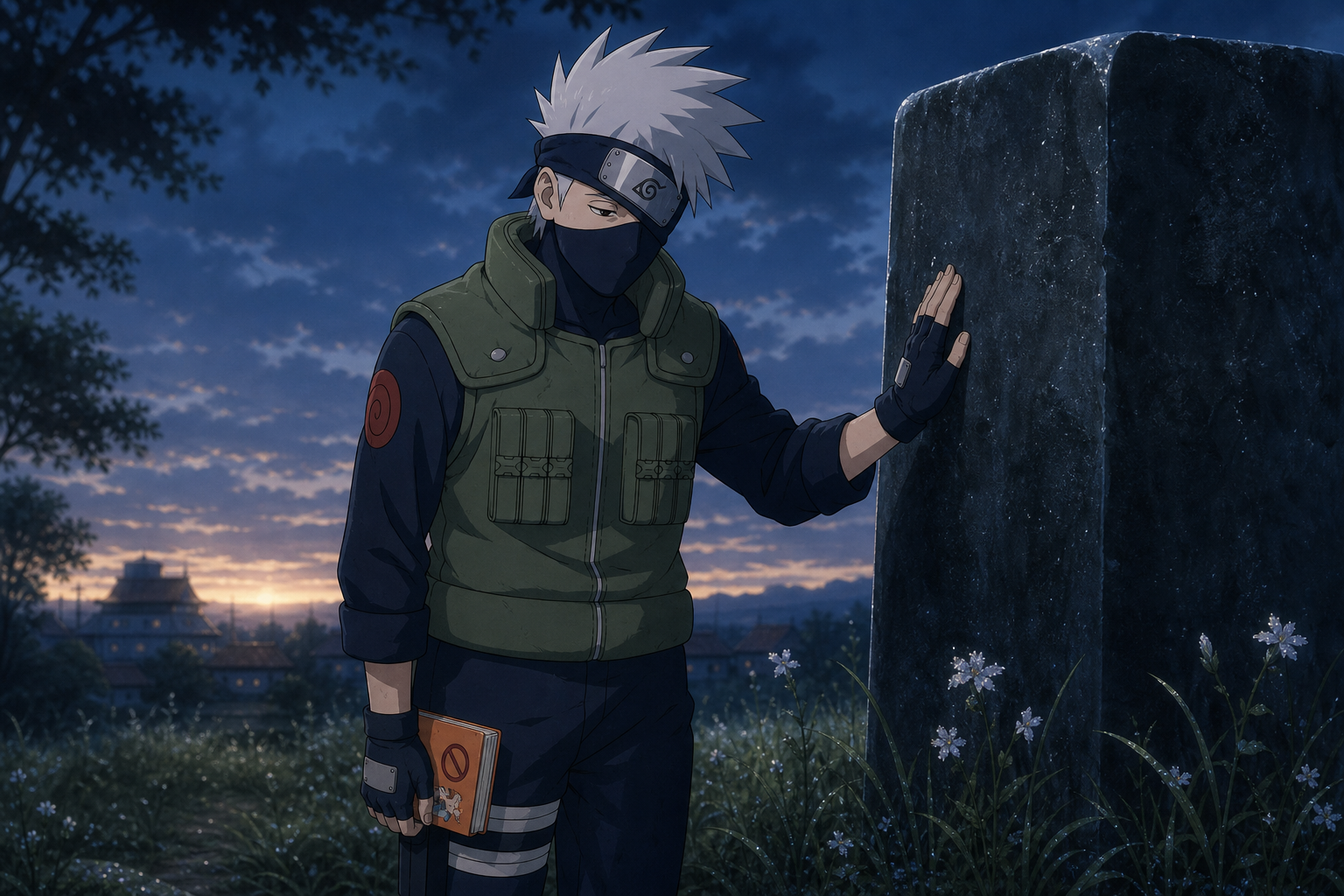
The mask makes him look unreadable. The story keeps proving the opposite. Kakashi’s whole life is visible in what he teaches, where he arrives late and which names he cannot stop visiting on the memorial stone.
03
Fast facts and canon boundaries
- Japanese name: はたけカカシ.
- Birthday: September 15.
- Blood type: O.
- Father: Sakumo Hatake, the White Fang of Konoha.
- Mother: deceased and unnamed in the principal canon.
- Academy graduation: age five.
- Chūnin promotion: age six.
- Jōnin promotion: during the Third Great Ninja War while still a child.
- Registration number: 009720.
- Team history: Team Minato, ANBU units, Team 7, Allied Shinobi Forces Third Company and later village administration.
- Major titles: Kakashi of the Sharingan, Copy Ninja and Sixth Hokage.
- Original Japanese anime performer: Kazuhiko Inoue.
Guidebook records place adult Kakashi at about 181 centimeters and 67.5 kilograms, with age moving from 26 to 27 in Part I and 29 to 31 through Part II. Later eras follow the publication timeline rather than pretending one number covers decades.
The main manga is the biographical spine. Kakashi Gaiden supplies the childhood war tragedy. The anime expands Academy, ANBU and mission material. Novels add Hokage-era governance and postwar missions. Films, OVAs and games require their own continuity labels.
Later flashbacks create timeline pressure around Academy ages, war chronology and peers. This profile reports the licensed record and names contradictions instead of inventing a perfect calendar.
04
Design chronology: one eye, one mask and too much private history
Kakashi’s adult silhouette is immediate: spiky silver hair, lower-face mask, tilted Konoha forehead protector covering the left eye and green flak jacket.
The covered eye is practical. Kakashi is not an Uchiha, so the transplanted Sharingan consumes chakra even when he is not actively fighting. The forehead protector becomes an eyelid the body did not receive.
The vertical scar across the left eye records Kannabi Bridge. Obito’s Sharingan beneath it records gift, debt and bodily inheritance. Kakashi’s right eye remains his natural gray eye.
The mask is never given one grand tragic explanation in the central canon. The series uses the hidden face for comedy, mystique and fan obsession. A complete profile should resist turning a running gag into a diagnosis.
His orange book is from Jiraiya’s adult Make-Out series. Reading it during tests or conversations performs boredom and keeps other people from knowing how closely he is watching. The habit is comic and mildly inappropriate around students. It also gives Kakashi a private pleasure not organized around death.
Child Kakashi wears practical war clothing and initially lacks the scar and transplanted eye. ANBU designs add mask and darker institutional anonymity. Hokage clothing places public authority over the same guarded person. Retirement-era clothing becomes lighter and less militarized.
The face changes less than the role. That is part of the character’s tension. Kakashi can become Hokage while still looking like the man standing at a grave.
05
Sakumo, public shame and suicide
Sakumo Hatake is a renowned Konoha shinobi whose reputation once eclipsed even the Sannin.
During a mission, he chooses to save his comrades rather than complete the objective. The decision causes serious consequences for the Land of Fire. Villagers and even the saved comrades condemn him.
Sakumo dies by suicide.
The story often frames the event through the moral that comrades matter more than rules. That moral cannot erase the death.
Konoha celebrates sacrifice until a mission fails. Then the institution isolates one person, turns shame into public discipline and leaves his child with the body and the lesson.
Young Kakashi responds by worshiping rules.
This is not proof that he did not love his father. Rule absolutism is how the child tries to prevent the same collapse. If Sakumo died because he chose people over mission, Kakashi will choose mission so completely that no one can accuse him of the same weakness.
The village later repeats Sakumo’s moral as Kakashi’s heroic teaching without fully accounting for what it did to Sakumo.
That is institutional laundering.
06
Child prodigy and rule absolutism
Kakashi moves through the Academy and rank system at extraordinary speed.
Talent gives him authority before emotional maturity can catch up. He becomes chūnin at six and jōnin while other children are still learning how to operate inside a squad.
The promotions are evidence of skill and evidence of a war economy willing to turn children into officers.
Young Kakashi is sharp, disciplined and impatient with Obito. He treats lateness and emotional detours as failures. Mission logic feels safe because rules do not abandon him in the unpredictable way people do.
Minato recognizes the talent and the rigidity. Rin provides care and social mediation. Obito challenges the value system directly.
The tragedy is that Obito must nearly die before Kakashi accepts the lesson.
07
Guy rivalry gives him a different kind of strength
Might Guy offers Kakashi something rare: a relationship not built primarily from guilt.
Guy declares rivalry with overwhelming sincerity. Kakashi responds with apparent boredom, then keeps participating for years. Their contests range from combat to races and nonsense.
Sakumo notices Guy’s training early and warns Kakashi that the boy may become stronger.
The prediction matters. Kakashi’s genius is publicly obvious. Guy builds mastery through repetition, physical cost and a style many classmates initially dismiss.
Their adult friendship rejects one narrow version of masculinity. Guy is loud, emotional and physically affectionate. Kakashi is quiet, masked and evasive. Neither has to become the other for respect to last.
During the war, Kakashi witnesses Guy open the Eighth Gate against Madara. The rival becomes the person Kakashi once underestimated and Sakumo told him to remember.
08
Team Minato and Kannabi Bridge
Team Minato consists of Kakashi, Obito and Rin under Minato Namikaze.
At Kannabi Bridge, Kakashi leads a mission intended to disrupt enemy supply lines. Rin is captured. Kakashi initially prioritizes the mission. Obito refuses to abandon her.
Obito repeats the comrade-over-rule ethic that Konoha punished in Sakumo.
Kakashi changes course.
During the rescue, an enemy attack blinds Kakashi’s left eye. Obito awakens the Sharingan and helps coordinate the fight. Falling rock then crushes half of Obito’s body while he saves Kakashi.
Believing he will die, Obito gives Kakashi his left Sharingan as a jōnin-promotion gift and asks him to protect Rin.
Rin performs the transplant in a battlefield cave.
The eye is gift, organ, military tool and unfinished promise at the same time.
Kakashi leaves with a new ability and another dead friend attached to his body.
09
The Sharingan is borrowed power with a permanent bill
Kakashi becomes famous for copying techniques and reading opponents with the Sharingan.
The eye never becomes genetically his.
An Uchiha can deactivate the dōjutsu. Kakashi cannot. Covering it reduces constant use, but major battles drain chakra and can leave him hospitalized.
That cost prevents the familiar fan argument that borrowed power makes him a fraud. Kakashi does not steal Obito’s eye. Obito chooses the gift while Rin performs the transplant. Kakashi then trains for years to use an organ his body cannot regulate naturally.
The eye also complicates identity. Other villages know `Kakashi of the Sharingan` better than Kakashi without it. When he loses the eye after the war, the famous title becomes history rather than current anatomy.
His later competence proves that the Sharingan expanded the toolkit. The eye did not create the analyst, teacher or leader.
10
Rin is a teammate, not a prize between boys
Rin Nohara is a medic-in-training, teammate and emotional center within Team Minato.
She cares for Kakashi and recognizes Obito’s feelings. Fandom and even parts of the plot often position her as the person both boys orbit.
Her death deserves more precision.
Hidden Mist forces make Rin the jinchūriki of the Three-Tails as part of a plan involving Konoha. Rin understands the danger and chooses to move into Kakashi’s Lightning Blade during battle rather than risk the beast being released in the village.
Kakashi does not decide to execute her.
Rin still dies through his arm.
The difference matters for intent. The bodily consequence remains.
Obito arrives to witness the strike and collapses into despair. Madara has engineered circumstances around the event. Kakashi survives with memory, blood and the belief that he broke Obito’s final request.
Rin should not be reduced to the reason Obito becomes evil or Kakashi becomes sad. She makes a choice under coercive conditions created by adults and villages using a girl as a weapon.
11
Minato’s death and ANBU service
Minato and Kushina die during the Nine-Tails attack while Naruto is an infant.
Kakashi loses his teacher after already losing his father, Obito and Rin.
The anime substantially expands his ANBU period. That material shows Hiruzen and Minato attempting to direct his skill, Danzō’s darker structures, Yamato’s history and Kakashi’s movement through assassination work.
The manga provides less operational detail. Medium labels matter.
Institutionally, ANBU makes grim sense. Konoha has a highly trained young man skilled at suppressing emotion and following orders. The village uses him in a branch designed around secrecy.
Psychologically, the placement is terrible care.
Kakashi survives loss by becoming more useful to the system that keeps producing loss.
Leaving ANBU and teaching genin returns him to daylight. Team 7 does not cure him. The students give the accumulated lessons somewhere to go.
12
Naruto grows beside adults who know his father
Kakashi teaches Minato’s son without beginning the relationship through that identity.
Naruto enters Team 7 as the village troublemaker and jinchūriki, not as the publicly honored child of the Fourth Hokage. Kakashi knows the parentage. Hiruzen knows. Jiraiya knows. Several adults carry pieces of Naruto’s family history while the child begs strangers to recognize him.
The secrecy has security logic. Minato made enemies. The Nine-Tails attack remains politically dangerous. Logic does not eliminate the interpersonal consequence.
Naruto grows up without the ordinary sentence `your father loved you` from people who served beside that father.
Kakashi protects him on missions and teaches him chakra practice. He does not become a daily surrogate parent. Iruka reaches Naruto first at the point of social recognition. Jiraiya later supplies individualized training and a complicated family-like bond.
This is another place where fandom inflates a teacher title into work the page does not show.
Kakashi cares about Naruto. Care is not identical to presence.
During the war, the direction changes. Naruto becomes the moral leader who pulls Kakashi out of paralysis over Obito. Kakashi stops treating mentorship as one-way transmission. The student now carries Minato and Obito’s values forward in a form the teacher can follow.
Kakashi’s later Hokage term prepares the office for Naruto. That administrative stewardship may be the most concrete long-term care he offers Minato’s son.
13
The memorial stone and lateness are not the same joke
Kakashi is famously late.
He offers absurd excuses involving lost cats, old women and wrong turns. Obito was also late because he stopped to help people. The behavior becomes one small way Kakashi carries his friend.
Kakashi also spends time at Konoha’s memorial stone.
The two patterns overlap without being identical. Helping a stranger is living Obito’s ethic. Standing at the stone is maintaining a private bond with the dead. Making students wait can still be inconsiderate even when grief explains the delay.
The comedy works because Kakashi controls the room once he arrives. Students cannot punish the authority figure for wasted time. The audience laughs because the habit is safe inside routine.
War reveals the cost beneath it. Kakashi has spent years speaking to Obito as a dead hero while the living Obito helps create catastrophe.
Memory can preserve values and preserve errors.
A healthier memorial practice would let Kakashi honor the dead without allowing every current relationship to receive whatever time remains afterward. Team 7 slowly pushes him toward that balance.
14
The Make-Out books give him a life that is not a funeral
Jiraiya’s adult romance novels are Kakashi’s favorite reading.
The books are a running gag, a tactical distraction during the second bell test and a rare sign that Kakashi has private taste unrelated to combat.
Their presence around minors deserves mild side-eye. He is not reading excerpts aloud, but the teacher bringing erotic romance into training is not an ideal professional boundary.
The habit also complicates the `emotionless Kakashi` image. He likes melodrama, anticipation and romance enough to follow a series. The mask does not mean the man lacks appetite or curiosity.
Naruto and Sakura exploit the reading habit by threatening to spoil the ending. Kakashi closes his eyes and covers his ears, disabling his own visual advantages. The former students win through knowledge of the person rather than brute force against the legend.
That is character-based teamwork.
The books should not become evidence that every later relationship is secretly romantic. Kakashi’s canon does not require a spouse to prove he healed. Friendship, teaching, reading, travel and public service are adult life too.
15
Failed genin teams and the bell test
Kakashi fails previous genin teams before accepting Naruto, Sasuke and Sakura.
The bell test appears to reward individual skill. Two bells for three students create competition and scarcity. Kakashi watches whether the children will accept that framing.
Naruto charges alone. Sasuke hides and attacks tactically. Sakura becomes trapped in a genjutsu tied to Sasuke.
They fail.
Kakashi then forbids feeding Naruto while leaving the others with food. Sasuke and Sakura break the instruction.
That is the answer.
Kakashi quotes the ethic created through Sakumo and Obito: rules matter, but abandoning comrades is worse.
The test is manipulative. It also reveals the structure of shinobi work better than a simple duel. Missions create pressure to treat teammates as obstacles or resources. Kakashi wants students who will refuse that reduction.
16
Land of Waves: the teacher can still need rescue
The Tazuna escort reveals the mission was misclassified.
Kakashi chooses to continue after the Demon Brothers attack and the truth begins surfacing. That decision protects Tazuna and exposes inexperienced genin to Zabuza Momochi and Haku.
The profile must keep both sides visible. Compassion matters. Command risk matters.
Kakashi confronts Zabuza with the Sharingan, copies Water Release and reads movement. Zabuza traps him in Water Prison. Naruto and Sasuke develop the plan that frees their teacher.
The great Copy Ninja needs his students.
Kakashi later teaches tree-climbing chakra control. Sakura succeeds first because precision is already her strength. Naruto and Sasuke turn practice into rivalry.
During the final bridge battle, Kakashi fights Zabuza while the students face Haku. Haku dies protecting Zabuza from Kakashi’s Lightning Blade. The mission ends with Kakashi and Team 7 witnessing how the shinobi system calls people tools until attachment makes the lie impossible to maintain.
17
Chūnin Exams and the question of readiness
Kakashi recommends all three students for the Chūnin Exams.
Iruka objects because they are recent graduates. Kakashi asserts command authority and argues from mission experience.
The recommendation gives them opportunity and sends them into an exam where Orochimaru marks Sasuke, the Forest of Death nearly kills the team and foreign invasion overtakes the finals.
Readiness in this world is never a clean educational standard. The exams are military display, promotion system, diplomacy and proxy competition.
Kakashi trains Sasuke individually for the Gaara match. He teaches Chidori and pushes speed development. The choice fits the immediate opponent and Sasuke’s Sharingan.
Naruto receives Ebisu and later Jiraiya. Sakura receives no equivalent individualized combat apprenticeship from Kakashi.
That asymmetry is one reason `Kakashi taught Team 7` needs more detail than a fact box.
18
Chidori transfers brilliance and danger
Kakashi developed Chidori as a young shinobi.
The high-speed thrust creates tunnel vision without perception capable of handling counterattacks. Obito’s Sharingan solves that problem for Kakashi. Sasuke’s Sharingan makes him a viable student.
Teaching Chidori gives Sasuke a powerful answer to Gaara’s defense.
It also gives an increasingly isolated child a killing technique while Orochimaru’s curse mark and revenge fixation are already active.
Technique transfer is not moral corruption. Sasuke remains responsible for later choices. A teacher must still consider what the student is becoming while the skill grows.
Kakashi recognizes the danger after Sasuke uses Chidori against Naruto at the hospital rooftop. His lecture warns that revenge leaves emptiness.
The warning is true and insufficient.
Kakashi understands grief. He does not know the state truth behind the massacre. Konoha asks him to treat the symptom while senior leadership protects the cause.
19
Itachi proves the Sharingan does not make Kakashi Uchiha
When Itachi returns to Konoha, Kakashi meets a level of ocular power his copied reputation cannot answer.
Itachi catches him in Tsukuyomi and subjects him to an extended experience of torture inside compressed time. Kakashi survives but is left incapacitated until Tsunade returns and treats him.
The defeat establishes a clean limit. Kakashi knows the Sharingan and has used it for years. He does not possess Uchiha physiology, Itachi’s Mangekyō mastery or automatic protection from a superior genjutsu.
The scene also adds another layer to his later handling of Sasuke. Kakashi has personally experienced a fraction of the technique Itachi repeatedly uses to shape his brother through terror. He understands the danger. He still lacks the political truth that would explain why Itachi is operating through a manufactured villain identity.
Knowledge comes in pieces while Sasuke moves faster than the adults gathering them.
20
Sasuke’s defection exposes the limit of mentorship
Kakashi finds Naruto and Sasuke after the hospital rooftop clash and stops their attacks from colliding.
He ties Sasuke to a tree and argues against revenge. The conversation comes from lived experience. Kakashi has lost almost every member of his first family and team. He knows vengeance will not restore them.
Sasuke is also a massacre survivor recently tortured by the perpetrator.
The lecture asks him to release revenge without offering truth, justice or specialized care. Kakashi cannot reveal information he does not have, but the institutional gap remains.
When Sasuke leaves, Kakashi joins the pursuit too late to prevent the Final Valley battle. His famous lateness stops being cute when the student disappears into Orochimaru’s control.
Kakashi did not cause the defection. Orochimaru, Itachi, the massacre, curse mark, Sound Four and Sasuke’s choices all matter.
He still failed to keep the student.
A mature teacher profile can admit that without turning mentorship into total ownership of another person’s decisions.
21
Kazekage Rescue and the cost of Kamui
Part II opens with Kakashi testing Naruto and Sakura again. This time the students use knowledge of his reading habit and work together to seize the bells.
The joke confirms growth. Kakashi is no longer demonstrating teamwork to children who cannot cooperate. The former students can now manipulate their teacher’s attention as a unit.
During the Kazekage Rescue mission, Kakashi confronts an Itachi projection and later pursues Deidara.
His Mangekyō Sharingan ability, Kamui, warps targets into another dimension. Early use requires concentration, aim and enormous chakra. Kakashi struggles to control the effect against a moving Deidara and collapses after repeated use.
Kamui is not instant invincibility at introduction. The technique grows through practice, desperation and later resonance with Obito’s corresponding eye.
Kakashi’s recovery leaves Yamato leading the next Team Kakashi mission. Even elite power can remove the commander from the field.
22
Team Asuma and the ethics of revenge
Asuma’s death sends Shikamaru, Ino and Chōji toward Hidan and Kakuzu.
Kakashi volunteers to support them.
The mission forces him into another revenge story. He does not simply forbid action. He joins, provides adult combat capacity and works inside Shikamaru’s plan.
That response is different from the rooftop lecture to Sasuke.
The circumstances differ. Team Asuma has village authorization, intelligence, support and a plan aimed at active Akatsuki threats. Sasuke is being recruited by Orochimaru into isolation. The comparison still shows Kakashi learning that grief cannot be managed through one speech.
Against Kakuzu, Kakashi destroys one heart with Lightning Blade, analyzes multiple chakra natures and protects the younger team through a prolonged fight. Naruto’s new Wind Release attack becomes the final major answer.
The teacher lets the student take the opening without pretending the previous generation did nothing.
23
Pain, death and the conversation Sakumo never received alive
Kakashi confronts the Deva and Asura Paths during Pain’s invasion.
He analyzes the attraction and repulsion interval, coordinates with Chōza and Chōji and tries to transmit intelligence after the plan fails.
With chakra nearly gone, he uses Kamui again to protect Chōji and ensure the information reaches Tsunade.
Kakashi dies.
In the space between life and the afterlife, he meets Sakumo at a fire. Father and son finally speak.
Kakashi tells Sakumo he is proud of him.
The scene offers personal release. It does not acquit the village that made reconciliation possible only after both men had died or nearly died.
Nagato later restores those killed in the assault, returning Kakashi to life. Sakumo can move on after receiving his son’s forgiveness.
Kakashi returns with grief changed rather than erased.
24
The Five Kage Summit turns teacher into possible executioner
Sasuke’s attack on the summit and Akatsuki association move him into international criminal status.
Kakashi confronts Sakura after her failed attempt to handle Sasuke alone and then faces his former student.
He accepts responsibility as teacher and prepares to kill Sasuke.
The choice is not proof that he stopped caring. Sasuke has attacked leaders, endangered Karin, threatened Konoha and rejected appeals. Kakashi is now responsible for people Sasuke may harm.
The scene also shows the system’s familiar solution: kill the damaged operative after the institution has hidden the machinery that shaped him.
Naruto arrives and refuses the simple ending.
Kakashi’s role is neither soft parent nor clean executioner. He stands in the failure between them.
25
War command and the Seven Swordsmen
Kakashi commands the Allied Shinobi Forces Third Company.
The assignment recognizes leadership beyond Team 7. He coordinates shinobi from multiple villages against reanimated fighters, including Zabuza and Haku.
The reunion is cruel. Zabuza and Haku already died after exposing the human feeling beneath the tool ideology. Kabuto returns their bodies to forced combat.
Kakashi’s anger targets the desecration and the use of sacrificed people as reusable weapons.
He defeats and helps seal enemies while leading a mixed force. The famous claim about copied techniques functions as morale and threat, not a promise that the manga will display a literal catalog of one thousand moves.
War-era Kakashi balances command, close combat, analysis and repeated Kamui use. His stamina has improved. Limits do not vanish.
27
The Kamui-space duel is memory turned into choreography
Kakashi and Obito fight inside the Kamui dimension.
The manga intercuts adult violence with childhood sparring. Every strike has an earlier version before war, masks and graves.
They make the spar sign and attempt to kill each other.
Kakashi drives a kunai through Obito. Obito escapes and uses the wound within a larger plan connected to Madara’s control over his body.
The duel cannot be reduced to `Kakashi won` or `Obito allowed it` without losing the emotional and tactical layers. Kakashi fights seriously. Obito has his own purpose. Both men are acting through a relationship that never stopped shaping their movements.
Kakashi later prepares to finish defeated Obito. Minato stops him. Naruto’s method of reaching Obito creates another possibility.
Reconciliation does not erase the dead. It changes what the survivors choose next.
28
Kaguya and the temporary return of both eyes
Obito dies protecting Kakashi and Naruto from Kaguya.
Through a temporary chakra connection after death, he grants Kakashi access to both Mangekyō Sharingan.
Kakashi manifests Susanoo, uses Kamui-enhanced attacks and takes command of former Team 7’s final plan.
The power is spectacular and temporary.
It does not belong in Kakashi’s ordinary battle ceiling. The condition depends on Obito’s chakra and expires after the encounter.
The scene completes the gift cycle. Obito once gives one eye because Kakashi has lost his own. At the end, he lends both eyes so Kakashi can protect the students and world he feared he could no longer reach.
Kakashi’s final plan creates openings for Naruto, Sasuke and Sakura to seal Kaguya. Leadership, not possession of the strongest permanent body, is his lasting contribution.
29
Sixth Hokage: administration after apocalypse
Kakashi becomes the Sixth Hokage after the war.
Obito wanted the office as a child and asks Kakashi to take it. Kakashi holds the position until Naruto is ready to succeed him.
The job is not a victory sash.
Konoha needs reconstruction, diplomacy, demobilization, legal decisions and a transition from world war into a technological peace. Kakashi participates in Sasuke’s pardon and manages relationships with former enemy villages.
Kakashi Hiden and other Blank Period material expand the administration and missions around this era. Those events need novel labels even when they fit the broader canon.
His leadership style relies on delegation, experience and the ability to read competing interests. He is less publicly inspirational than Naruto and less politically entrenched than Hiruzen.
The masked former ANBU becomes the official face of the village.
That irony should not be wasted.
30
A pardon is policy, not proof of innocence
Kakashi uses Hokage authority in the postwar handling of Sasuke.
Sasuke helped seal Kaguya and end Infinite Tsukuyomi. He also attacked the Five Kage Summit, Killer Bee’s team, Karin and former allies before attempting a revolution built around killing Naruto and controlling the tailed beasts.
The village’s own hands are dirty. Danzō manipulated the Uchiha crisis, stole Sharingan and operated Root. Hiruzen failed to prevent the massacre. Itachi was turned into a child instrument and public criminal. Senior leaders protected the false history Sasuke inherited.
Kakashi’s judgment therefore operates inside two ledgers.
Pardon can recognize wartime service, future risk, political stability and the possibility of repair. Pardon cannot transform harm into innocence.
Kakashi is personally involved as former teacher. That creates insight and conflict. He knows Sasuke’s capacity for change. He also has a stake in seeing Team 7 restored.
A mature government needs procedures stronger than one good man’s discretion.
The series uses the decision as closure more than as a legal study. The profile should name the gap. Shinobi villages grant enormous authority to Kage while hiding classified violence. Kakashi may exercise that authority humanely. The structure still needs accountability.
His later administration helps stabilize peace, but peace built on unexamined secrets can reproduce the same wound in another generation.
31
The Sixth Hokage inherits modernization and demobilization
Kakashi’s term sits between world war and Naruto’s more technologically visible era.
The village rebuilds infrastructure, expands transport and communications, deepens alliances and moves toward a civilian economy less visibly dominated by immediate conflict. Those changes are collective. A Hokage does not personally invent every train, building or treaty.
Leadership means making systems possible.
Demobilization is especially difficult in a society where military labor begins in childhood. Thousands of shinobi trained for war return to villages that need ordinary administration, border security, reconstruction and diplomacy.
Former enemies must share intelligence without assuming betrayal. Orphans, disabled veterans and bereaved families need support. The tailed beasts have changed political status. Scientific tools are beginning to alter who can access power.
Kakashi’s experience suits the transition. He knows covert institutions, field command, international enemies and the cost of treating people as tools.
Experience does not guarantee reform. Former insiders can preserve the systems they understand because alternatives feel dangerous.
The strongest reading of Kakashi’s term is therefore custodial. He keeps the peace open long enough for Naruto’s generation to inherit something other than immediate war.
That is less glamorous than defeating Kaguya and more difficult to measure.
32
Retirement and the New Era
Kakashi steps down when Naruto becomes Seventh Hokage.
Retirement does not mean disappearance. He advises, observes younger generations, travels with Guy and remains part of Konoha’s institutional memory.
Losing the Sharingan removes Kamui and the constant chakra burden. Later material presents a veteran still capable of high-level technique and tactical work.
The New Era also gives him something rare: time not immediately owned by war command.
His friendship with Guy becomes especially important after Guy’s Eighth Gate injuries. Their travel and comedy are not meaningless epilogues. Two men whose bodies were built for war attempt ordinary companionship after survival.
Current sequel appearances must remain proportional to the published record. Kakashi’s historical importance does not justify inventing a secret role in every new crisis.
33
Complete ability and limit shelf
Kakashi is a tactical generalist with exceptional perception, speed, stealth and chakra control.
His natural affinity is Lightning Release. Chidori and Lightning Blade concentrate lightning chakra for a high-speed thrust. The Sharingan originally compensates for the attack’s tunnel vision. He later develops or uses lightning variants across eras and media, but game-only names require labels.
The transplanted Sharingan reads movement, supports genjutsu perception and helps copy techniques. Kakashi cannot deactivate the eye, which creates continuing chakra drain.
Kamui warps targets or parts of targets into a linked dimension. Early use is slow, inaccurate and exhausting. Later use becomes faster and more precise. The connection between Kakashi’s long-range eye and Obito’s corresponding eye creates unique interactions.
Kakashi uses Water Release in the Land of Waves, Earth Release defenses and tracking techniques, clones, standard Fire Release examples and other elemental applications. The famous copied catalog should be represented through demonstrated techniques rather than padded with every adaptation move.
Ninken summons, including Pakkun, provide scent tracking, restraint and communication. Kakashi’s own sense of smell and field reading support pursuit.
He is skilled with kunai, wire, traps, hand-to-hand combat and sword use in appropriate eras. Analysis is often the decisive ability. He identifies timing, tests conditions and converts enemy mechanics into a team plan.
His limits change by period: child rigidity, transplanted-eye drain, ordinary chakra supply, Mangekyō exhaustion, trauma-triggered hesitation and the need to protect weaker allies while fighting.
Temporary double Mangekyō and Susanoo are a one-battle borrowed condition. Postwar Kakashi loses Sharingan and Kamui. Experience, chakra no longer spent maintaining the eye and continued technique development keep him formidable without preserving an expired god-tier loadout.
35
Relationship and accountability atlas
Sakumo Hatake
Sakumo’s suicide turns Kakashi toward rules. Kakashi’s later pride releases his father personally. Konoha’s public shame remains an institutional crime the reunion cannot erase.
Obito Uchiha
Obito gives Kakashi an eye and an ethic. He later commits mass violence while carrying the same unresolved past. Manipulation explains vulnerability. It does not absolve choices. Reconciliation restores friendship, not the dead.
Rin Nohara
Rin treats Kakashi, transplants the eye and chooses death under weaponized coercion. Kakashi carries responsibility without having chosen her execution. Her personhood must remain larger than the boys’ grief.
Minato Namikaze
Minato is teacher, commander and lost adult anchor. Kakashi later teaches Minato’s son without initially knowing how to speak about the family truth openly.
Might Guy
Guy is rival, friend and living proof that talent has multiple forms. Their bond survives without either man demanding emotional sameness.
Naruto Uzumaki
Kakashi teaches teamwork, chakra practice and tactical thinking. Jiraiya provides Naruto’s deeper individual apprenticeship. During the war, Kakashi follows Naruto’s moral lead and later holds the Hokage office until Naruto can inherit it.
Sasuke Uchiha
Kakashi gives Sasuke Chidori and focused training, recognizes revenge and fails to address its institutional roots. Later he prepares to kill Sasuke, supports the pardon and witnesses return. Care and failure coexist.
Sakura Haruno
Kakashi protects and trusts Sakura but provides less individualized technical instruction. Tsunade builds her professional path. Kakashi later relies on Sakura as an adult medic and final Team 7 member rather than the child watching from behind.
Yamato
Yamato shares ANBU history and later leads the reconstituted Team Kakashi. He is not a temporary Kakashi substitute without identity. His Wood Release and control role answer specific risks Kakashi cannot handle while recovering.
Pakkun and the ninken
The ninken are professional partners rather than cute accessories. Tracking, restraint and communication repeatedly extend Kakashi’s reach.
36
Kazuhiko Inoue and the original Japanese performance
Kazuhiko Inoue is Kakashi’s principal original Japanese anime performer.
The credit is verified through official Naruto and Shippuden cast pages.
A lawful scene-by-scene audio review was not available for this production pass, so the profile will not invent claims about breath, pitch or timing.
The performance contexts worth close study are specific: bored bell-test delivery that hides observation, Zabuza-era command, the rooftop revenge lecture, Sakumo reunion, Obito recognition, Kamui-space resolve and the shift from jōnin leader to Hokage.
That future analysis should use heard scenes. `Inoue perfectly captures Kakashi` is applause, not criticism.
37
Manga, anime, novels, films, OVAs and games
The manga supplies Kakashi’s main chronology, Team 7 leadership, Kakashi Gaiden, Pain death, war, Obito and Hokage succession.
The anime expands childhood, ANBU service, missions, teaching and comedy. Some expansions deepen emotional continuity. They remain anime material when the manga does not supply the same event.
Kakashi Hiden and other licensed novels expand Sixth Hokage transition and postwar governance. Novel facts need book labels.
Films place Kakashi in alternate or supplementary mission structures. The Last sits within the Blank Period bridge. Road to Ninja uses an alternate-world premise. Earlier films do not silently enter the core manga timeline.
OVAs often emphasize comedy, contests or supplementary missions. Games turn his copied reputation into broad playable move sets and alternate battles. Those mechanics are not a databook.
38
Confucian duty and the failure of one-way loyalty
Kakashi’s life begins inside a conflict between role duty and relational duty.
Sakumo fulfills duty to comrades and violates mission duty. The village answers with shame rather than reciprocal care.
Young Kakashi reacts by making hierarchy absolute. Obito teaches that a role loses moral legitimacy when obedience requires abandoning people.
Adult Kakashi passes the lesson to Team 7.
The Confucian lens becomes useful when duty is reciprocal. Students owe cooperation. Teachers owe instruction and protection. Shinobi owe the village service. The village owes truth, care and humane judgment to the shinobi it deploys.
Konoha repeatedly demands the first half and fails the second.
39
Buddhist grief and attachment to the memorial stone
Kakashi visits the memorial stone so often that lateness becomes part of his public identity.
The ritual honors the dead and keeps him attached to a conversation that cannot change.
Buddhist readings of attachment do not require forgetting. The question is whether memory guides compassionate action or traps the living inside repeated suffering.
Kakashi’s best teaching transforms memory into care for current comrades. His worst hesitation occurs when the past overwhelms the person standing before him.
Obito argues for abandoning reality in favor of a world where loss never happened. Kakashi ultimately chooses grief inside reality.
That choice is less comforting and more humane.
40
Masculinity behind the mask
Kakashi rarely explains pain directly.
He reads, jokes, arrives late and performs composure. The mask becomes an easy symbol for emotional concealment without needing a literal tragic origin.
Guy offers the counter-model: loud feeling, declared friendship and visible effort.
The series does not force one style to defeat the other. Kakashi learns to say he loves Team 7 during the final battle. The sentence lands because open affection has been rare.
Calm can be competence. Calm can also make students guess what the adult refuses to discuss.
41
Teaching is labor, not a title attached to cool adults
Kakashi is remembered as `Kakashi-sensei` because the title carries affection, not because every teaching need is met.
Real instructional work includes assessment, planning, repetition, feedback, protection and adapting to different students. Kakashi performs some of that brilliantly. The bell test diagnoses a social problem. Tree climbing gives the whole team a foundational exercise. Sasuke’s Chidori training is individualized and technically exact. Naruto’s elemental transformation later benefits from Kakashi’s clone-based training insight and Yamato’s safety support.
The gaps remain.
Sakura’s control is recognized before a dedicated professional path is arranged. Naruto’s jinchūriki needs and family history remain divided among adults. Sasuke’s trauma exceeds a combat instructor’s tools, yet no coordinated care system appears.
One jōnin cannot be teacher, therapist, parent, intelligence officer and political truth commission.
That defense of Kakashi becomes an indictment of Konoha.
The village puts three children under one field commander and calls the structure education. When the children need specialized teaching, they depend on personal networks and chance encounters with Sannin.
Kakashi’s success comes from giving Team 7 a moral foundation strong enough to seek help beyond him. His limitation shows why a good mentor cannot substitute for a good institution.
42
Fandom court
`Kakashi is useless without the Sharingan`
False. The eye expands perception, copying and Kamui. Kakashi remains an elite tactician, elemental user, tracker, leader and later Hokage after losing it.
`Kakashi naturally owns every copied technique forever`
Too broad. The story gives a reputation and representative use, not a complete thousand-jutsu inventory. Chakra nature, memory, condition and medium matter.
`He was a perfect teacher`
False. The teamwork foundation is excellent. Individual mentorship is unequal. Sasuke receives focused combat training while Naruto and Sakura find deeper apprenticeships elsewhere.
`He failed Sasuke, so everything Sasuke did is his fault`
False. Kakashi’s limitations matter. So do Itachi, Orochimaru, Danzō, Konoha secrecy, the curse mark and Sasuke’s choices.
`Obito gave Kakashi power, so Kakashi stole Uchiha glory`
False. Obito intentionally gives the eye. Rin performs the transplant. Kakashi pays a lifelong bodily cost and repeatedly credits the friend behind the gift.
`Double Mangekyō Kakashi is his standard power level`
False. The condition is temporary and dependent on Obito’s posthumous chakra.
`Rin died because Kakashi chose to kill her`
False. Rin moves into the attack under a coercive jinchūriki plot. Kakashi’s arm causes the death. Intent and consequence must remain distinct.
43
Consequence ledger
Sakumo’s public shame produces Kakashi’s rule obsession.
Obito’s apparent death changes the rule ethic and gives Kakashi the Sharingan.
Rin’s death produces guilt and helps Madara break Obito.
ANBU turns grief into useful secrecy rather than care.
The bell test gives Team 7 a moral foundation.
Uneven mentorship leaves students seeking other teachers.
Kamui saves missions and repeatedly drains Kakashi to incapacity.
Pain kills him after he spends the final chakra protecting intelligence and Chōji.
Sakumo’s reunion releases personal shame.
Obito’s return forces Kakashi to distinguish the boy’s memory from the adult’s violence.
The temporary final gift helps Team 7 seal Kaguya and then expires.
The Hokage office turns a survivor of secret operations into the administrator of peace.
44
Final verdict
Kakashi Hatake survives by becoming useful.
Useful child. Useful soldier. Useful ANBU. Useful teacher. Useful commander. Useful Hokage.
The danger is that usefulness can look like healing while grief remains untouched underneath.
Team 7 changes the equation.
Kakashi does not save every student from every wound. He arrives late. He teaches unevenly. He serves institutions whose secrets harm the children he loves.
He also gives them a rule strong enough to challenge the whole shinobi world.
People come before mission.
The sentence begins with Sakumo’s death, passes through Obito’s gift and becomes Naruto’s way of leading.
Kakashi’s greatest copied technique was never elemental.
He copied a moral choice the village had punished, kept it alive and finally helped place it above the office that once failed his father.
Sources and canon boundary
Editorial record: Manga chronology controls. Anime expansions, novels, films, OVAs and games are labeled instead of blended into canon.
Primary franchise references: Naruto Official and VIZ Media Naruto.