
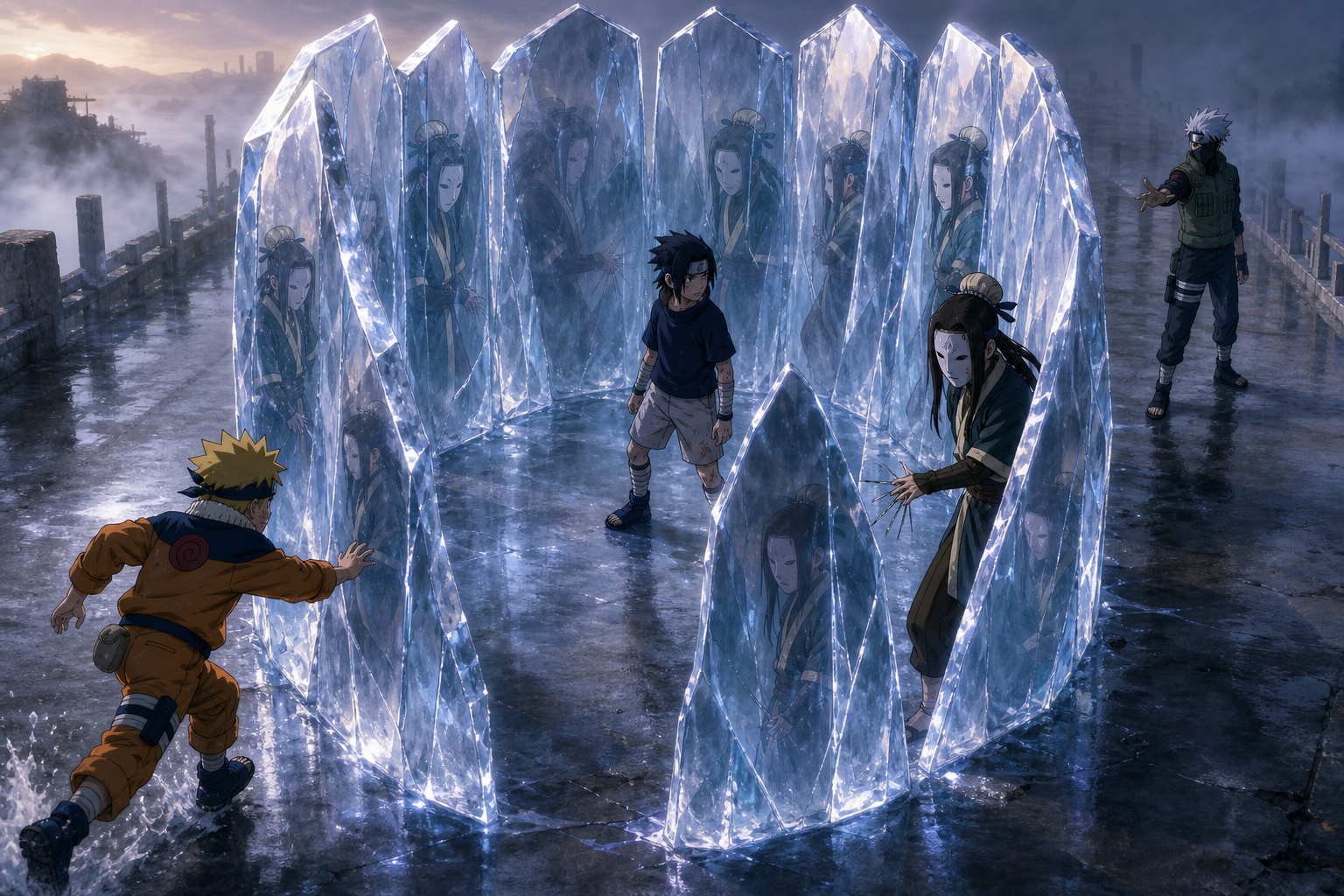
Haku’s Secret Jutsu: Crystal Ice Mirrors
Sasuke enters a chamber where every reflection can attack, Naruto rushes inside instead of breaking it from without, and Haku reveals a bloodline power born from the very inheritance that once made home unsafe.
Naruto’s instinct is emotionally faithful and tactically disastrous: he cannot tolerate Sasuke suffering alone, so he joins the trap that Sasuke needs him to break.
The Bridge Holds Two Battles
Mist covers the unfinished bridge as Zabuza and Haku divide the defenders. Kakashi confronts the missing-nin he already defeated once. Sasuke engages the masked child whose speed and precision unsettled Naruto after the river battle.
Sakura remains near Tazuna, the mission’s protected center. The battlefield creates parallel structures: adult against adult, child against child, and protector around client.
This division is not accidental. Zabuza understands that Kakashi’s attention is Team 7’s greatest shield. Haku provides a threat capable of occupying the genin while Zabuza controls the jonin.
The bridge built to connect a country becomes a machine for separation.
Sasuke Tests the Training
Sasuke moves differently after the forest exercise. Chakra control does not announce itself through a new costume or giant technique. The change appears through cleaner acceleration, steadier contact, and more efficient movement.
He meets Haku’s attacks with alertness that surprises both opponents. Zabuza notices. Haku notices. Sasuke’s improvement becomes legible to enemies before he receives praise from allies.
The scene validates training as transformation without making the result absolute. Sasuke is better. Haku remains beyond him.
Growth changes the terms of struggle. Growth does not promise immediate superiority.
Haku’s Gentle Precision Becomes Combat
The hands that gathered herbs now release senbon. The contrast is not a contradiction. Haku’s knowledge of bodies allows both care and incapacitation.
Haku aims with extraordinary precision, striking points that reduce movement while avoiding immediate death. The restraint can look merciful, but it also demonstrates control over another person’s body.
Haku’s gentleness survives inside combat as selective harm. That does not make the violence harmless. Selective harm makes the character morally coherent in a more painful way.
Water Becomes Ice
Haku combines water and wind natures through an inherited bloodline ability, producing Ice Release. The element is more than frozen water. Ice Release represents a power unavailable through ordinary instruction or imitation.
Kakashi’s Sharingan can copy hand signs and techniques it perceives, but bloodline limits establish boundaries around copying. Some abilities are embedded in lineage and physiology.
The distinction expands the series’ power system and its politics. Inherited capacity can create privilege, fear, strategic value, and persecution.
Haku’s extraordinary technique cannot be separated from the history that made possessing it dangerous.
The Crystal Ice Mirrors Rise
Tall ice mirrors form around Sasuke, enclosing him in a luminous oval chamber. Haku enters one surface, and the mask appears in every mirror.
The visual effect turns one person into an environment. Sasuke is no longer facing an opponent standing at a readable location. He is facing reflected possibility.
The mirrors destroy ordinary spatial confidence. Every direction contains Haku. Every attack risks choosing an image after the physical body has already moved elsewhere.
Haku’s earlier mask reduced a person to a role. The ice mirrors multiply that effect. Sasuke sees function repeated until individuality becomes impossible to locate.
Speed That Looks Like Omnipresence
Haku moves between mirrors so quickly that the transition appears instantaneous. Senbon arrive from shifting angles before Sasuke can identify which reflection became physical.
To the trapped observer, extraordinary speed becomes omnipresence. The difference between “everywhere” and “too fast to locate” disappears at the level of experience.
Sasuke’s task is therefore perceptual before it is offensive. He must discover a pattern inside motion his eyes cannot yet organize.
The chamber turns combat into a crisis of knowledge. He cannot strike what he cannot distinguish.
Sasuke Alone Inside the Reflections
Sasuke has spent years constructing self-sufficiency around loss. The ice chamber gives that isolation physical form. He stands alone at the center while versions of another person surround him.
His solitude is no longer chosen emotional distance. The mirrors impose tactical vulnerability.
The scene begins forcing a transformation in Sasuke’s relationship to Team 7. Survival may require access to someone outside his control and outside the mirrors.
For a child who trusts competence more than attachment, dependence is its own kind of threat.
Naruto Arrives With Perfectly Wrong Timing
Naruto reaches the bridge late after training exhaustion and enters with characteristic theatrical confidence. The entrance promises rescue because Naruto has learned to associate arrival with the chance to prove himself.
Kakashi immediately recognizes the strategic problem. Sasuke is trapped inside a technique whose structure could be attacked from the outside. Naruto is positioned where he might disrupt the mirrors or force Haku to divide attention across interior and exterior.
Naruto enters the chamber.
The choice removes the outside advantage and gives Haku both boys in one controlled space. Sasuke’s frustration is justified.
Why Naruto Jumps In
Tactically, the decision is foolish. Emotionally, it follows the entire series.
Naruto has spent his life outside circles of belonging. When he sees Sasuke enclosed and attacked alone, remaining outside feels like abandonment. He does not yet know how to distinguish joining someone from helping them.
His model of solidarity is physical proximity. Iruka stepped between him and the shuriken. Sasuke and Sakura sat beside him and shared food. To care is to enter the danger.
Strategy will have to teach Naruto that protection sometimes requires distance, patience, and an action the suffering person cannot immediately feel as companionship.
Shared Values, Opposing Positions
Naruto does not yet know the masked opponent is the forest stranger. The audience does. Haku is fighting according to the philosophy shared at dawn: become strong for someone precious.
Naruto enters to protect Sasuke. Haku attacks to protect Zabuza. The same relational ethic produces opposed violence.
This is why the conflict cannot be solved by proving one child cares and the other does not. Both care. The question is what loyalty permits and whether devotion can survive critical judgment of the person it serves.
Bloodline Power as a Family Secret
Ice Release is inherited, which means Haku’s body carries family history whether Haku chooses it or not. Power becomes identity before the child has authored its meaning.
In the shinobi world, bloodline abilities are resources and threats. Villages desire them. Enemies fear them. Families conceal them. Ordinary people may associate them with war and catastrophe.
Haku’s mirrors are beautiful because the inheritance has been refined through skill. They are terrifying because beauty does not protect the bearer from the social meaning attached to blood.
The Mirror as a Symbol of Assigned Identity
A mirror appears to show the self, but Haku’s mirrors show repeated masks. The technique replaces interior personhood with an externally legible combat identity.
Haku learned that usefulness to Zabuza could provide belonging. Inside the mirrors, usefulness is perfect. The body becomes nearly unreachable, motion becomes service, and the mask appears everywhere.
The cost is that the unmasked child from the forest disappears.
Naruto’s later challenge will be to insist that the person beneath the function remains real even when Haku has organized life around denying that distinction.
Sasuke Begins Reading the Impossible
Although Haku dominates the chamber, Sasuke does not surrender to the appearance of omnipresence. He watches, absorbs impacts, and begins searching for the transition between reflections.
This response echoes Kakashi’s Sharingan. Perception can turn apparent magic back into movement. If Haku travels, then travel has timing.
Sasuke’s eyes have not yet completed the transformation the audience expects, but the pressure is drawing dormant inheritance toward visibility.
The chamber designed to exploit his limits may become the environment that awakens another way of seeing.
Sakura and the Discipline of Staying Outside
Sakura remains with Tazuna while Naruto rushes toward the dramatic center. Her position receives less spectacle, but it preserves the mission.
The contrast exposes a recurring bias in action stories: movement looks heroic, while restraint looks passive. Yet if every member abandoned the client, Zabuza and Haku would win through distraction.
Sakura’s discipline is not enough to resolve the battle. Her discipline is necessary for the battle to remain worth resolving.
Kakashi Cannot Solve Every Layer
Kakashi understands the mirrors and Naruto’s mistake, but Zabuza prevents him from intervening freely. The adult can see the students’ danger without being able to remove it.
The bridge continues the Water Prison lesson in a different form. Protection is limited by simultaneous responsibility.
Kakashi must trust that the training, teamwork, and judgment developed so far can operate without his direct rescue.
Character Pulse Check
Naruto
He arrives ready to help and converts an outside advantage into shared confinement. His loyalty is genuine; his strategy has not caught up with it.
Sasuke
Training improves his movement and perception, but the mirrors isolate him inside an opponent’s bloodline domain. He begins searching rather than panicking.
Haku
Haku’s gentle precision becomes a nearly perfect combat system. The inherited ice is both extraordinary agency and evidence of a dangerous history.
Sakura
She remains with Tazuna and protects the mission’s center while the boys enter the spectacle. Restraint is her tactical contribution.
Kakashi
He understands the trap and its bloodline nature but cannot freely disengage from Zabuza to rescue the genin.
Zabuza
He trusts Haku to contain both boys while he occupies Kakashi, revealing the strategic value he assigns the child.
Easter Eggs and Rewatch Echoes
Kakashi cannot simply copy Ice Release
The mirrors establish bloodline limits as a boundary around the Copy Ninja’s otherwise expansive ability.
Naruto’s entrance mirrors his loneliness
He enters the closed space because being outside another person’s suffering resembles the exclusion that shaped him.
Sasuke’s eyes are being trained by danger
The need to distinguish Haku’s true movement becomes pressure on the Uchiha inheritance Kakashi revealed only episodes earlier.
One mask, many images
The mirrors multiply Haku’s assigned function rather than Haku’s personhood, foreshadowing the arc’s argument about tools and humans.
The Hidden Village and Inherited Bodies
Bloodline limits make the body a political resource. A child can be valued, feared, hunted, or owned because of traits received before consent.
The village system organizes clan abilities as strategic assets. Haku’s history shows what happens outside stable protection: inheritance can turn family into danger.
Naruto already lives a related reality. The Nine-Tails sealed inside him produced fear before he could act. Sasuke carries the Uchiha name and future expectations. Haku carries Ice Release.
The series keeps asking whether a person can become more than the power other people see when they look at the body.
Reaction: Naruto’s Worst Good Intention
I love how frustrating Naruto is here. We want him to arrive. We know he will not leave Sasuke alone. Then he enters the exact place he should attack from outside.
The mistake is not random stupidity. The choice reveals character. Naruto thinks solidarity means joining the person in pain because he spent childhood wanting someone to join him.
Sasuke’s anger is also a form of recognition. He expected Naruto to matter strategically. The insult lands because the partnership formed in Operation Windmill created a real standard.
Naruto enters the mirrors to prove Sasuke is not alone. The next lesson is that love must learn the shape of the danger, or it can become one more wall around the person it wants to save.
Episode Verdict
Emotional core: Naruto’s refusal to abandon Sasuke places both boys inside Haku’s control.
Best character beat: Sasuke absorbing Haku’s speed as a problem to read rather than an unknowable terror.
Big idea: Inherited power can offer extraordinary agency while making the body vulnerable to social ownership and fear.
Rewatch value: Exceptional. Haku’s personhood, Sasuke’s eyes, Naruto’s tactical mistake, and the mirror symbolism deepen across the series.
CVM Sekai rating: 9.5/10. A visually iconic episode whose best conflict is between loyalty and understanding.
Continue the Naruto Journey
The Crystal Ice Mirrors make Haku’s worldview physical
Haku surrounds Sasuke with reflections, speed, and cold certainty. The technique is beautiful enough to distract from what it does: it creates a closed world in which Haku appears to be everywhere and the person inside cannot find an exit. That is also how Haku understands devotion to Zabuza. Every direction leads back to the same purpose. Every version of the self exists to be useful.
The mirrors are not merely a stronger attack. They deny the opponent a stable point of reference. Sasuke cannot respond by choosing the correct target because Haku turns the entire enclosure into a moving target. The battle becomes a test of observation, endurance, and whether Sasuke can keep thinking while pain arrives faster than thought.
Sasuke’s calm is work, not emotional absence
Sasuke studies the pattern because analysis is the tool he trusts when fear would expose too much. He tracks Haku’s movement, tests his reactions, and tries to create information from repeated attacks. The stillness in his face should not be mistaken for a lack of feeling. He is responsible for Tazuna’s safety, aware that Kakashi is occupied, and increasingly conscious that Naruto may do something reckless.
This is the version of Sasuke that the early series handles best: gifted but not invincible, guarded but not empty, competitive while already becoming protective. He does not announce that Team 7 matters. He adjusts his body around that truth before he can say it.
Naruto enters the trap because loyalty outruns attention
Naruto’s arrival is heroic in intention and disastrous in placement. He sees Sasuke isolated and refuses to leave him there. He does not stop long enough to ask why Haku has allowed the opening or whether joining Sasuke inside the mirrors gives the enemy a second target. The episode refuses to make courage synonymous with good tactics.
That distinction is necessary for Naruto’s growth. His instinct to share another person’s danger is precious. It is also incomplete until he learns to read the danger first. Love cannot protect anybody if it only knows how to arrive loudly.
Haku’s restraint does not make the violence harmless
Haku aims senbon with extraordinary precision and avoids immediately killing the boys. That mercy matters, but it should not be used to soften the scene into a misunderstanding. Sasuke and Naruto are being wounded repeatedly so Haku can protect Zabuza’s mission. Intentional restraint exists beside intentional harm.
This is where Haku’s tragedy becomes morally complicated instead of merely sad. Haku has tenderness, recognizes the boys’ determination, and would rather not destroy them. Haku also continues. Being exploited explains the shape of the choice; it does not erase the people bleeding inside it.
Kakashi and Zabuza fight a second battle over knowledge
Zabuza returns prepared for the Sharingan. The fog limits Kakashi’s vision, and Zabuza’s account of the eye tries to strip away its mystique. Their rematch is not a replay because the first duel taught both men what the other relies on. Kakashi has to protect Tazuna and monitor his students while Zabuza turns information into countermeasure.
The professional adults adapt quickly because survival has trained them to treat every encounter as research. Team 7 is learning the same lesson in real time. A technique revealed once becomes a technique the enemy can plan around.
Sakura holds the line everyone else can afford to forget
Sakura remains beside Tazuna while Naruto and Sasuke enter the episode’s visual centerpiece. Her position is the mission. If she abandons it to chase the most dramatic threat, Gatō gets what he paid for. Defensive discipline rarely receives the applause attached to charging forward, but it is the reason Tazuna remains alive.
RaeRae still wants more interiority for her. Watching teammates disappear into an ice prison should create fear, anger, calculation, and frustration. The story uses Sakura’s reliability without giving that reliability equal emotional room.
The bridge battle is children absorbing adult arrangements
Naruto, Sasuke, and Haku did not create the economic conflict that brought them here. Gatō’s monopoly, the village mission system, Zabuza’s exile, and the adults’ willingness to deploy children formed the battlefield before any of them stepped onto it. Yet the youngest people are the ones asked to turn loyalty into bodily sacrifice.
Haku believes usefulness justifies existence. Sasuke believes strength will carry him toward revenge. Naruto believes refusing to abandon people will prove his worth. The mirrors force those survival stories into direct contact, and the cost lands on bodies that should never have been assigned this burden.
RaeRae’s final take
Episode 13 makes the Crystal Ice Mirrors unforgettable because the technique is character, not decoration. Haku’s speed is terrifying. The enclosure is worse. It transforms devotion into a world with no visible outside and asks Sasuke whether observation can create an exit.
Naruto joins him because leaving Sasuke alone is impossible. That choice is emotionally right and tactically wrong, which is exactly where the series finds its strongest version of heroism: not perfection, but a good instinct that still has to learn how to keep people alive.
Official Viewing and Episode Guide
Streaming availability varies by region. Watch through an official licensed service carrying the original Naruto series, including Crunchyroll or Netflix where available. Episode continuity was checked against the official Naruto Episode 13 guide.
Editorial note: CVM Sekai’s Naruto coverage centers the original Japanese series and original Japanese performances. English dub casting is outside this project’s scope.