
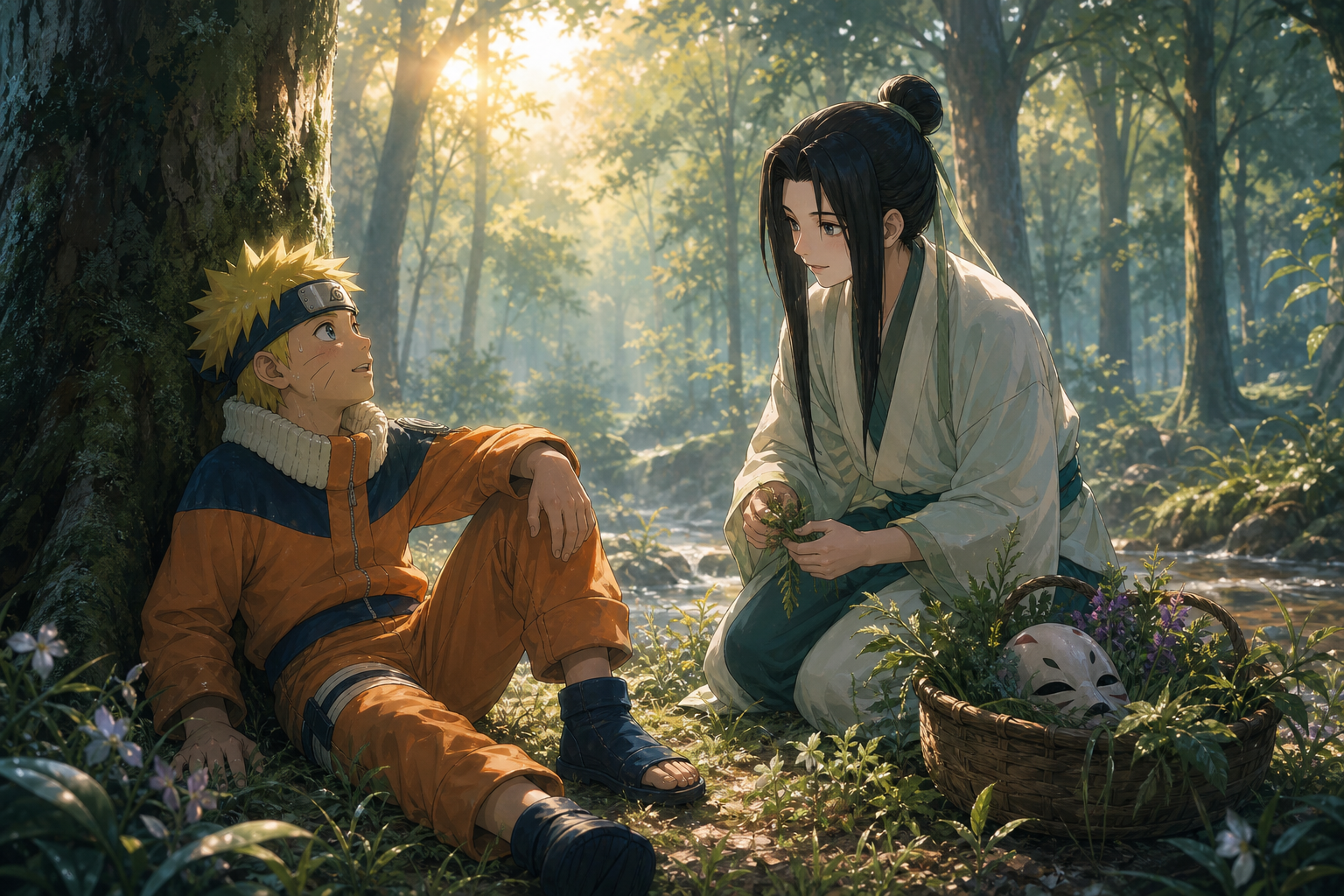
Naruto and Haku recognize the same truth in one another before masks, missions, and loyalty tell them that recognition cannot matter.
Two Boys Refuse to Leave the Forest
Naruto and Sasuke continue running up the trees after fatigue has stripped the exercise of novelty. Their progress marks climb higher. So do the costs recorded on their bodies.
The rivalry becomes almost wordless. Each boy hears the other strike bark, fall, breathe, and begin again. Neither wants to be the first to stop. Competition threatens injury, but it also creates companionship neither boy is willing to name.
They eventually reach the top. The achievement matters less as a victory over the tree than as evidence of learned control. Naruto has begun translating enormous reserves into precise contact. Sasuke has learned through a task where natural talent did not deliver immediate mastery.
At the canopy, difference remains. They arrived through separate struggles, yet the view can only be reached because both refused the old limit.
Exhaustion Makes Naruto Still
Naruto collapses in the forest after training. The boy usually defined by motion becomes quiet enough for another person to approach without first encountering a performance.
This stillness is narratively important. Haku meets Naruto when Naruto is not declaring his dream, attacking a rival, or demanding recognition. Haku meets the exhausted child underneath the strategy of loudness.
Vulnerability creates the conditions for honesty. Naruto has no energy left to control the impression he makes.
Haku Without the Mask
Haku gathers medicinal plants nearby. Long hair, gentle speech, and delicate features lead Naruto to assume Haku is a girl. Haku later corrects him, creating one of the series’ most remembered early jokes.
The humor works on the surface, but the deeper scene treats gender presentation as part of Naruto’s encounter with a person who escapes easy categories. Haku appears soft but possesses lethal skill. Haku is nurturing and an assassin. Haku speaks of love while serving a missing-nin.
Naruto’s world keeps refusing the boxes through which he initially reads it.
Most importantly, Haku is unmasked. The audience recognizes the hunter-nin whom Naruto does not. We watch intimacy occur across information asymmetry.
The Herb Basket and the Hidden Identity
Haku’s medicinal gathering reminds us that the same hands can heal and harm. Senbon created the appearance of Zabuza’s death. Herbs support his recovery. Knowledge of the body is not inherently violent or benevolent. Purpose directs it.
The hunter mask remains conceptually beside the conversation even when Naruto cannot see it. Haku has not become a different person by removing it. The gentle stranger and precise combatant coexist.
This dramatic irony makes every line ache. Naruto is not being tricked with false kindness. He is meeting a real kindness that does not cancel Haku’s allegiance.
“When a Person Has Something Precious to Protect”
Haku tells Naruto that people become truly strong when they have someone precious to protect. The idea enters Naruto with immediate force because his dream has often been described as private ambition: become Hokage, force the village to acknowledge him, prove everyone wrong.
Haku offers a relational source of strength. Power can grow not from the desire to elevate the self but from the refusal to let another person be lost.
Naruto already knows this without having named it. Iruka’s protection transformed his first use of the Multiple Shadow Clone Technique. Sasuke and Sakura feeding him turned three competitors into Team 7. Protecting Tazuna and freeing Kakashi have made his techniques more intelligent.
Haku gives language to a pattern Naruto has been living.
Who Is Precious to Naruto?
Haku asks whether Naruto has someone precious. The question touches an absence. Naruto’s earliest life was defined by not having an obvious answer.
Yet the answer is forming. Iruka is precious. Team 7 is becoming precious. The dream of Hokage is increasingly attached to protecting the village whose acknowledgment Naruto once sought only for himself.
Naruto’s emotional development can be measured through the expansion of this category. Strength begins as the tool by which he will force others to see him. Strength becomes the means by which he can keep seeing others.
Haku’s Precious Person
Haku does not name Zabuza in the forest conversation, but every word is organized around him. The herbs, the rescue, the secrecy, and the training serve the person who gave Haku a role after profound loss.
This devotion contains gratitude, love, dependence, and exploitation. Zabuza calls Haku a tool. Haku interprets usefulness as belonging.
The distinction will become the emotional center of the arc. Is being needed the same as being loved? Can a person freely choose service when abandonment has made usefulness feel like the only condition of survival?
Haku’s philosophy is beautiful because it is true and dangerous because Zabuza has become its object.
Recognition Before Opposition
Naruto and Haku experience immediate connection because each has built strength around loneliness. Both know what it means to search for a person who makes existence feel necessary.
They do not exchange biographies. Recognition does not always require complete information. Sometimes another person’s sentence reaches a structure already present inside the self.
The tragedy is that political and personal roles will soon demand opposition. Haku protects Zabuza. Naruto protects Tazuna and Team 7. The same ethic directs them toward conflict.
Shared values do not guarantee shared sides.
Naruto Returns With New Language
After Haku leaves, Naruto carries the idea of precious people back toward the household and mission. He still does not know who spoke to him, but the conversation has altered the meaning of training.
Tree climbing is no longer merely a contest with Sasuke or preparation to avoid humiliation. Control can serve protection.
This is how Naruto often changes: a stranger, enemy, teacher, or rival names a fragment of truth, and Naruto absorbs it into an expanding ethic. He is porous to other people’s meanings without becoming passive.
The Bridge Becomes a Battlefield
Team 7 accompanies Tazuna to the construction site and finds workers unconscious. Mist spreads across the unfinished structure. The bridge designed to restore public movement becomes a controlled zone of uncertainty.
Zabuza’s return confirms Kakashi’s reconstruction. The apparent corpse was a patient. The hunter-nin was an ally. The battle on the riverbank was interruption, not conclusion.
The unfinished bridge now holds multiple futures. If Tazuna completes it, the country can move beyond Gatō. If Zabuza kills him, the structure may remain a monument to defeated possibility.
Haku Replaces the Face With the Mask
The masked figure appears beside Zabuza. Naruto sees the hunter-nin who supposedly killed the assassin, not the gentle herb gatherer from the forest.
For the audience, the two images overlap. The person who spoke about precious people is now protecting one through combat. Nothing Haku said was false.
The mask changes social legibility. In the forest, Haku could be encountered as a person. On the bridge, Haku is a role, technique, and threat.
Naruto will have to decide whether recognition can survive the mask once he learns what lies beneath it.
Zabuza Returns With Knowledge
Zabuza has already fought Kakashi once. He knows the Sharingan’s psychological method and the genin’s capacity for interference. A rematch is not repetition because information has changed.
Kakashi also understands that Zabuza’s apparent death was staged. Both sides enter without the innocence of surprise.
The bridge battle therefore begins as a contest between revised models of the opponent. Growth is partly the willingness to let experience destroy the version of another person you preferred.
The Title’s Misdirection
“Battle on the Bridge” promises action, and Zabuza’s return delivers threat. Yet much of Episode 12 is quiet. Naruto talks with Haku beneath trees.
That structure is deliberate. The battle matters because the episode first humanizes one of its participants outside combat. Haku becomes more than the masked obstacle before techniques define the encounter.
Violence gains moral weight when the enemy has already been experienced as a person.
Strength for Someone Versus Strength Over Someone
Gato uses strength to place people beneath him. Zabuza sells strength to survive and pursue ambition. Kakashi uses strength to fulfill duty and protect students. Naruto and Haku understand strength through someone precious.
The same shinobi world contains all four orientations. Ability does not carry ethics automatically.
Episode 12’s philosophical center is therefore not “love makes you stronger” as a simple slogan. Love amplifies capacity, but the person protected and the structure of the relationship matter. Devotion can liberate, sustain, or trap.
Character Pulse Check
Naruto
He completes the tree exercise and discovers language for the way relationships have already improved his courage and creativity.
Haku
Gentleness, medicine, deception, and combat coexist. Protecting Zabuza gives Haku purpose while narrowing the conditions under which the self feels valuable.
Sasuke
He reaches the treetop through relentless practice and prepares to face an enemy with new control rather than a new dramatic technique.
Sakura
Her earlier mastery has become the standard the boys used to progress. On the bridge, she returns to the client-protection role.
Kakashi
His correct reading of the staged death prepares the team for a rematch, but Zabuza’s knowledge means the Sharingan cannot rely on the same surprise.
Zabuza
He returns because Haku’s devotion converted medical knowledge and institutional disguise into rescue.
Easter Eggs and Rewatch Echoes
Medicine and senbon share a body map
Haku’s herbs and needles come from the same intimate understanding of anatomy. Healing and incapacitation are adjacent applications of knowledge.
Naruto misreads Haku twice
He misreads gender presentation and allegiance. Both errors teach that visible categories offer incomplete access to a person.
The precious-person philosophy spreads
The concept becomes central to Naruto’s understanding of strength across mentors, rivals, families, teams, and villages.
The bridge connects enemies before land
Before completion links the country physically, the bridge brings Naruto and Haku’s parallel ethics into direct collision.
The Hidden Village and Masked Personhood
Shinobi roles require masks even when no literal mask is worn. Teacher, missing-nin, hunter, client, genin, and weapon organize how bodies may interact.
Haku demonstrates the cost most visibly. The unmasked person can speak gently about love. The masked professional must become legible as threat and instrument.
The roles are not wholly false. Haku truly is gentle and truly is dangerous. The problem begins when the system permits only the useful role to count.
Naruto’s larger project will be to insist that no role, seal, rank, or fear exhausts personhood.
Reaction: The Conversation That Makes the Fight Hurt
The forest meeting is one of the quiet scenes that defines Naruto more than many battles. Two children shaped by loneliness recognize each other without knowing enough to protect the recognition.
Haku does not offer a manipulative philosophy. The words are sincere. That sincerity makes the bridge painful. The person Naruto will oppose believes exactly what Naruto believes.
This is the arc’s emotional maturation. Enemies do not always hold alien values. Sometimes conflict is produced because the same value has attached itself to incompatible loyalties.
Naruto meets Haku as a person before meeting Haku as an enemy. The rest of the arc asks whether that order can change what violence is allowed to mean.
Episode Verdict
Emotional core: Naruto and Haku discover the same relational source of strength without recognizing their coming opposition.
Best character beat: Haku’s gentle statement about precious people carrying the full invisible weight of devotion to Zabuza.
Big idea: Shared values can intensify tragedy when loyalty directs them toward incompatible ends.
Rewatch value: Exceptional. The mask, herbs, gender misreading, and every line about protection acquire painful clarity.
CVM Sekai rating: 9.6/10. A luminous quiet episode whose conversation gives the bridge battle its soul.
Continue the Naruto Journey
Haku meets Naruto without the mask
The forest conversation is built on dramatic irony, but it never feels like a trick played only for suspense. Naruto meets the person who helped deceive Kakashi and carried Zabuza away, yet Haku approaches him with patience, gathers herbs, and speaks to him as another young person trying to become strong. The mask is absent, but the larger disguise remains. Naruto sees kindness and has no reason to call it false.
Haku’s question about having someone precious becomes the episode’s emotional key. Strength is not presented as hunger for rank or applause. It grows from devotion, which sounds beautiful until we remember that devotion can be recruited by somebody who treats a child as a tool. Haku’s belief is sincere. The arrangement surrounding it is still exploitation.
Naruto finally reaches the top because the lesson becomes personal
The tree-climbing exercise stops being a contest for a moment. Naruto carries Haku’s words back into training and connects effort to the people he wants to protect. He is still exhausted, reckless, and determined to beat Sasuke, but his motivation has widened. Control arrives when his attention does.
That does not mean love magically fixes technique. Naruto has repeated the exercise until his body understands what Kakashi explained. The emotional shift gives meaning to the repetition; it does not replace it. The episode respects practice enough to let the breakthrough feel earned.
Zabuza returns because the first victory was never closure
The fog settling over the bridge proves Kakashi’s suspicion correct. Haku’s hunter-nin performance did not conclude the threat. It bought recovery time. Team 7 now faces an enemy who knows Kakashi’s Sharingan, has watched Naruto and Sasuke improvise, and understands that Tazuna remains the mission’s immovable center.
There is no clean reset. Kakashi is recovering from overuse, the students have trained but remain children, and Sakura must guard the client while the others move toward combat. Progress matters, but it does not erase the imbalance between their official mission rank and the people trying to kill them.
The bridge makes every private choice public
Tazuna is not simply standing behind a ninja formation. His unfinished bridge represents whether the Land of Waves can break Gatō’s control of trade. Every attack on him is an attack on the possibility of collective independence. Every worker who stays home because fear makes sense leaves the project more vulnerable.
That political frame sharpens Haku’s tragedy. One exploited child is helping a missing-nin protect a businessman’s monopoly against a country with almost no power. Haku can genuinely love Zabuza while their labor still serves something cruel. Personal loyalty does not purify the purpose that loyalty advances.
Sakura’s assignment is defensive, not passive
Sakura stays with Tazuna because the mission fails if the client dies. The position gives her fewer spectacular movements, but it is tactically central. Naruto’s late arrival and Sasuke’s forward engagement draw the eye. Sakura has to measure every distraction against the person the enemy came to kill.
The recurring frustration is that the series rarely lets her strategic importance become an equally rich interior story. We know she has the best chakra control of the genin. We know she reads the field carefully. Episode 12 could make more of what it costs to hold position while teammates claim the visible danger.
Haku and Zabuza turn usefulness into family language
Zabuza describes people as tools because tools do not make moral claims on their owner. Haku embraces usefulness because being necessary feels safer than being disposable. Their bond lives inside that contradiction. Zabuza relies on Haku’s rare ability, precision, and absolute loyalty. Haku interprets the reliance as a place in the world.
The episode does not yet settle whether Zabuza feels more than he admits. It does show why Haku cannot simply walk away. A child who has lost home and family may experience conditional belonging as rescue. The condition can be violent and the belonging can still feel real.
Naruto’s entrance is a promise and a problem
Naruto arrives on the bridge with the timing and volume of somebody announcing a legend. Emotionally, it lands because he refused to remain behind while his team faced danger. Tactically, enthusiasm is not the same as awareness. The coming fight will punish him for entering a system he has not studied.
That gap is central to his growth. Naruto already possesses the instinct to stay beside people. He still needs the discipline to notice what those people need before he acts. Loyalty without attention can place another burden on the person he meant to help.
RaeRae’s final take
Episode 12 brings the Land of Waves arc back to the bridge with every relationship more complicated than it was during the first clash. Naruto has learned control but not restraint. Sasuke has learned to work beside him but will not name the bond. Sakura holds the mission’s center. Kakashi knows the victory was staged. Haku carries kindness into a fight serving Gatō’s violence.
The return is effective because nobody comes back unchanged, and none of those changes guarantee safety. The bridge is where private devotion, professional duty, childhood grief, and economic control collide. Zabuza’s fog only makes visible what the mission has been hiding from the start.
Official Viewing and Episode Guide
Streaming availability varies by region. Watch through an official licensed service carrying the original Naruto series, including Crunchyroll or Netflix where available. Episode continuity was checked against the official Naruto Episode 12 guide.
Editorial note: CVM Sekai’s Naruto coverage centers the original Japanese series and original Japanese performances. English dub casting is outside this project’s scope.