
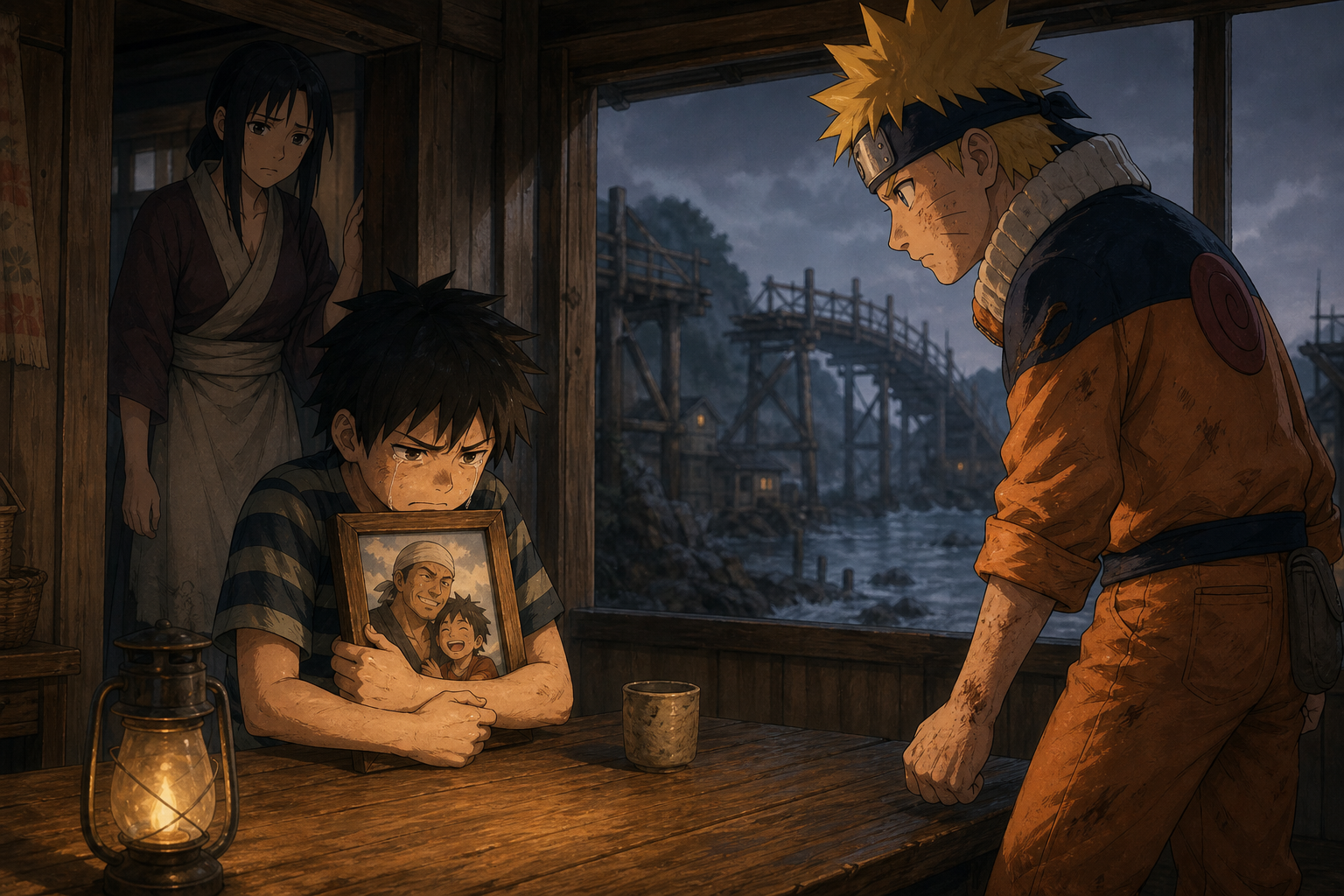
Inari does not lack courage because he never learned heroism. He rejects courage because he watched heroism punished in front of everyone.
Sakura Walks Into the Economy Behind the Assassins
Sakura travels with Tazuna through town and sees hardship that the mission briefing reduced to background. Shops are empty. Goods are scarce. People move beneath the resignation of a country whose access to imports has been captured by one company.
Gato’s violence does not require a blade in every frame. Monopoly operates through absence: food that does not arrive, work that disappears, prices people cannot meet, and routes they cannot use without permission.
The visit matters for Sakura because she has been guarding Tazuna as a client. Now she sees what the client represents. The bridge is not only the objective around which an escort mission has formed. The construction creates a material possibility for breaking dependence.
Sakura’s knowledge becomes embodied. Hearing that Gato controls shipping is information. Looking at empty shelves and tired faces is encounter.
The Bridge as Collective Agency
Tazuna explains that the bridge will connect the island country to the mainland and allow goods, labor, and movement to bypass Gato’s maritime control. Concrete, wood, rope, and human work become a political argument.
A bridge changes what people can do without requesting permission. That is why Gato treats construction as rebellion. Infrastructure redistributes agency.
The conflict clarifies the stakes of Tazuna’s deception. He did not lie merely to save himself. His survival is attached to a project that could reopen the country. Yet the communal purpose cannot erase the children exposed by the false mission rank.
Naruto repeatedly asks us to hold competing truths rather than purchase moral simplicity. Tazuna wronged Team 7. Tazuna’s work remains necessary.
Naruto and Sasuke Turn Rivalry Into Repetition
In the forest, Naruto and Sasuke continue climbing. They run, lose control, scar bark with their kunai, fall, and begin again.
The scene gives rivalry a productive shape. Each boy uses the other’s progress as evidence that the task is possible. The comparison still carries insecurity, but it prevents discouragement from becoming final.
Naruto’s body is bruised and depleted. Sasuke’s composure frays into visible effort. Tree climbing strips away the styles through which they protect pride. Both boys end up on the ground.
They return to Tazuna’s house so exhausted that competition has become almost communal. Each understands exactly what the other spent.
Sakura’s Success Changes the Team
Sakura has already mastered the exercise, so her role shifts from competitor to reference point. Naruto asks her for advice despite the embarrassment of needing help. Sasuke listens indirectly because asking would expose too much.
This is a small correction to the team’s emotional hierarchy. Sakura possesses knowledge the boys need, and her competence exists outside her affection for Sasuke.
The episode does not give her the same dramatic struggle because control came naturally. That ease can make achievement feel narratively smaller, but it should not. Mastery is still mastery even when the story does not require suffering to prove it.
Enter Inari’s Cold Stare
Inari watches the exhausted genin and dismisses them. They cannot defeat Gato. Trying will only make them die. His contempt sounds cruel because the audience has just watched Naruto and Sasuke pour themselves into improvement.
But Inari is not evaluating their work neutrally. He is defending a worldview built from bereavement. If effort can matter, then Kaiza’s effort becomes harder to explain. If courage can succeed, then the execution that shattered his family no longer provides a complete law of reality.
Hopelessness protects him from the vulnerability of believing again.
Naruto Recognizes the Shape of Isolation
Naruto reacts angrily to Inari’s defeatism. At first, he appears to treat grief as weakness. That interpretation would make him painfully insensitive.
What gives the confrontation depth is Naruto’s recognition. He knows the performance of pushing others away before they can decide to leave. He knows how anger can cover the fear that wanting connection gives the world another way to hurt you.
Naruto and Inari have different losses. Naruto never knew his parents and grew beneath unexplained rejection. Inari knew Kaiza’s love and watched it destroyed. Shared loneliness does not make their experiences identical. Their common ground gives Naruto a point from which to challenge the conclusion that pain has already authored the rest of Inari’s life.
Kaiza Enters the Family
Kaiza arrives in memory as a strong, warm fisherman whose courage first appears through rescue. Inari falls into the water, and Kaiza saves him. The physical act creates a relationship that deepens beyond gratitude.
Kaiza becomes Inari’s foster father and a source of emotional stability for Tsunami’s household. He does not enter as a legendary shinobi. He is an ordinary man whose reliability becomes heroic because it makes safety imaginable.
His strength is relational before it becomes political. He teaches Inari that protecting what matters requires action, and that courage can be practiced by people without titles.
A Hero the Country Could See
As Gato’s control tightens, Kaiza resists. His willingness to speak and act gives the Land of Waves a visible symbol. A frightened population can look at one person and imagine that submission is not the only available identity.
This is precisely why Gato must destroy him publicly. Kaiza’s threat is contagious courage.
Political domination depends not only on controlling resources but on controlling imagination. If people can picture resistance, coercion becomes more expensive. Kaiza gives the country an image Gato does not own.
Execution as Theater
Gato has Kaiza captured, mutilated, and publicly executed. The violence is designed for witnesses. Killing him privately would remove one opponent. Killing him before the community attempts to remove the category of opposition.
Inari sees the man who taught him courage rendered powerless. The lesson Gato wants is simple: heroes die, families suffer, and spectators should learn obedience.
The execution attacks language. After Kaiza, “hero” no longer means protector to Inari. The word means a person whose ideals invite catastrophe into the home.
Gato colonizes the child’s imagination through grief.
The Photograph and the Problem of Memory
Kaiza survives in photographs and stories, but memory is not automatically comforting. A photograph can prove love existed and prove it was taken away.
Inari clings to the loss because forgetting would feel like betrayal. At the same time, interpreting Kaiza’s death as proof that courage is useless allows Gato to define what the memory means.
Naruto’s challenge is not to make Inari stop grieving. Naruto must separate grief from Gato’s conclusion.
A dead hero can become evidence that resistance fails or evidence that someone believed the oppressed deserved another future. Memory remains contested territory.
Naruto’s Harsh Words
Naruto calls Inari a crybaby and refuses to accept his fatalism. The language is harsh, especially toward a child carrying trauma Naruto has only begun to understand.
The scene works because Naruto is not a therapist offering perfect care. He is another wounded child responding through the survival method he knows. Naruto survived isolation by declaring a future louder than the village’s contempt. He offers Inari defiance because defiance is the tool that kept him alive.
That tool is incomplete. Some pain needs gentleness Naruto has not yet learned. Yet his refusal provides something the household’s protective silence cannot: disagreement with despair.
Does Trauma Make Pessimism Rational?
Inari’s belief is not irrational. Gato has money, hired killers, political control, and a documented willingness to murder symbols. Kaiza resisted and died. Adults around Inari have adapted through fear.
The story does not need to prove that Inari’s assessment lacks evidence. The episode asks whether evidence of past defeat must become obedience to future defeat.
Existentially, trauma narrows possibility by making one outcome feel universal. Courage means loss. Attachment means vulnerability. Resistance means execution. These conclusions protect by eliminating surprise.
Naruto’s presence reopens contingency. The future may repeat, but repetition is not an obligation.
The Country Where a Hero Once Lived
The title’s past tense is devastating. Kaiza once lived here. Heroism once appeared possible. The country now behaves as if courage belongs to a completed era.
Tazuna’s bridge challenges that tense. Construction says the future is not closed. Naruto’s training says the self is not complete. Inari’s grief says the cost of reopening possibility is real.
A society under domination does not only lose material resources. Domination also destroys confidence in collective agency. The bridge must span water and learned helplessness.
Character Pulse Check
Naruto
He turns rivalry into disciplined repetition and recognizes despair beneath Inari’s contempt. His challenge is emotionally true even when his language lacks gentleness.
Sasuke
He trains until composure gives way to exhaustion. Competition with Naruto becomes a shared refusal to let the current limit remain final.
Sakura
She sees the economic suffering behind the mission and holds the knowledge Naruto and Sasuke need. Her perspective links chakra control to the country being defended.
Inari
He treats pessimism as protection because hope once delivered his family to public grief. His cruelty is trauma defending a closed future.
Kaiza
An ordinary fisherman becomes heroic through rescue, fatherhood, and resistance. Gato kills him publicly because his example made courage socially imaginable.
Gato
He controls imports and imagination. Kaiza’s execution demonstrates that economic power sustains itself through theatrical violence.
Easter Eggs and Rewatch Echoes
Kaiza and Naruto share symbolic labor
Both figures become capable of restoring belief in people who have learned hopelessness. Naruto’s later influence on the Land of Waves grows from the emotional role Kaiza once occupied.
The bridge is already resisting
Before completion, its existence forces Gato to spend money on assassins. Infrastructure can exercise political force while still unfinished because it reorganizes expectation.
Naruto asks Sakura for help
The request is easy to miss, but it marks movement away from performing self-sufficiency. He can accept instruction without treating dependence as annihilation.
Inari’s tears are not the opposite of courage
The arc will eventually distinguish crying from surrender. Emotion does not prevent action; sometimes it records exactly what action is for.
The Hidden Village and the Heroes Konoha Sells
Team 7 arrives because Tazuna purchased a mission below its actual risk. Kaiza acted without rank, payment, or institutional authority. The contrast asks who gets recognized as a protector.
Hidden villages professionalize protection, but courage exists outside them. Kaiza’s heroism emerges from citizenship and love. Gato’s power reveals that trained violence can just as easily serve domination when purchased privately.
Naruto’s dream of becoming Hokage seeks institutional recognition. The Land of Waves begins teaching him that title and heroism are not identical. A leader matters only if power remains connected to the people it claims to protect.
Reaction: Inari’s Cynicism Hurts Because His Logic Makes Sense
Inari can be frustrating on a first watch. Naruto and Sasuke are exhausted. We know they are trying. The child looks at them and says none of it matters.
Years later, his response feels less like bratty pessimism and more like a nervous system doing its job too well. He loved someone brave. Bravery did not save Kaiza. The same courage gave Gato a person to turn into an example.
Naruto does not win the argument in this episode. He refuses the premise. That refusal matters because everyone else has become careful around Inari’s wound. Care has protected him from pain and protected despair from challenge.
Naruto cannot promise that courage will prevent loss. He offers something smaller and more radical: loss does not get to decide that courage was meaningless.
Episode Verdict
Emotional core: Inari interprets Kaiza’s execution as proof that hope is a trap.
Best character beat: Sakura seeing the town and understanding that the bridge is economic liberation, not just a construction site.
Big idea: Domination becomes durable when violence teaches the oppressed to distrust their own capacity for courage.
Rewatch value: Extremely high. Kaiza’s memory, Inari’s defenses, and Naruto’s identification establish the emotional logic of the entire arc.
CVM Sekai rating: 9.4/10. A political and intimate episode that explains why defeating Gato requires restoring imagination as well as access.
Continue the Naruto Journey
Kaiza matters because the country chose him
Inari’s story could have made Kaiza important only as the man who joined his family. Instead, the episode shows how a community turns courage into shared language. Kaiza is not born to a famous clan, appointed by a hidden village, or protected by a title. He sees a child in danger, acts, and keeps acting until other people remember they can move too. The Land of Waves calls him a hero because his courage becomes useful to everyone around him.
That is precisely why Gatō must destroy him publicly. A tyrant does not only remove the person who resists. He attacks the meaning attached to resistance. Kaiza’s execution teaches the town that bravery will not merely fail; it will be displayed, humiliated, and made into a warning.
Inari did not lose faith in a single afternoon
The boy’s despair is often framed as something Naruto can correct with sufficient shouting. Episode 11 gives it a history that deserves more care. Inari trusted Kaiza because Kaiza showed up. He watched that reliable love become the exact vulnerability Gatō exploited. When Inari says heroes do not exist, he is trying to protect himself from loving another promise that power can break.
His anger is therefore not cowardice. It is grief performing certainty. If resistance is always pointless, then Kaiza did not die because the town failed to stand with him. If heroes are foolish, Inari does not have to ask why the adults survived and the bravest man did not. Cynicism offers him a story with fewer unbearable questions.
Naruto recognizes the wound and mishandles the patient
Naruto understands isolation intimately, but empathy does not automatically make him gentle. He hears Inari dismiss struggle and responds as if determination alone settles the argument. His conviction is sincere. It is also incomplete. Naruto survived loneliness by making acknowledgment his destination. Inari experienced love, found safety inside it, and then watched violence deliberately erase it. Those are related wounds, not identical ones.
The confrontation works because Naruto is both right and unfair. Inari cannot live forever inside the lesson Gatō forced on him. Naruto also has no right to demand that a child process terror on Naruto’s schedule. The scene lets two hurting boys collide before either knows how to listen.
Sasuke asks for help in the only way he can manage
Back in the forest, Sasuke’s sideways question about Sakura’s advice is quietly revealing. He wants information from Naruto and hates the vulnerability of needing it. Naruto enjoys having something Sasuke lacks, but he shares enough to keep the rivalry moving. They are building trust through bad manners.
Their tree-climbing progress becomes a measure of relationship as much as chakra control. Each boy uses the other as proof that one more attempt is possible. They will insist they are competing, and they are. They are also keeping each other from stopping.
Sakura remains the person who solved the assignment
Sakura’s mastery continues to expose the gap between what the story says she can do and how much narrative territory it gives her. She controls chakra better, understands the principle, and can explain it. Yet the emotional engine follows Naruto and Sasuke struggling toward her starting point. Her competence becomes support for their growth.
That imbalance deserves to be named without pretending she contributes nothing. Sakura helps guard Tazuna, watches the surrounding threat, and remains the clearest thinker in the exercise. The frustration comes from seeing how easily those strengths could support an arc with stakes of her own.
Gatō governs by making neighbors feel alone
The bridge is a collective project, so Gatō attacks collective belief. His control depends on every worker imagining that resistance would be solitary. Kaiza threatened that arrangement by making courage visible. Tazuna threatens it again by continuing construction. Inari’s grief is political because Gatō designed it to spread beyond one household.
This is why the Land of Waves story lasts beyond its early action scenes. The villain behind the villains does not need a supernatural bloodline. He understands fear, labor, and public punishment. Zabuza can kill a target. Gatō wants an entire country to police its own hope.
The title asks who gets to remain a hero
Kaiza once lived here, but his presence survives in the choices people make after his death. Tazuna builds. Tsunami keeps a family together. Inari remembers even while claiming memory proves hope is useless. A hero’s legacy is not a statue or a perfect victory. It is the argument left inside the people who witnessed the attempt.
Naruto cannot replace Kaiza, and the story is stronger when he does not try. What he can do is provide new evidence. He can show Inari that fear and action can occupy the same body, and that losing once does not grant oppression permanent ownership of the future.
RaeRae’s final take
Episode 11 turns a mission recap into a study of how authoritarian power colonizes memory. Gatō killed Kaiza to make courage look embarrassing. Inari repeats that lesson because believing it feels safer than risking another loss. Naruto challenges him with all the blunt force of a child who survived by refusing the verdict other people placed on his life.
The result is not tidy inspiration. It is two definitions of survival arguing across a dinner table while a bridge waits outside. That mess is exactly what gives the coming stand its emotional weight.
Official Viewing and Episode Guide
Streaming availability varies by region. Watch through an official licensed service carrying the original Naruto series, including Crunchyroll or Netflix where available. Episode continuity was checked against the official Naruto Episode 11 guide.
Editorial note: CVM Sekai’s Naruto coverage centers the original Japanese series and original Japanese performances. English dub casting is outside this project’s scope.