
Enter Naruto Uzumaki
The premiere starts with vandalism, a failed clone, and one terrible adult exploiting a lonely child, then ends with Iruka choosing Naruto in public, Naruto choosing himself, and Mizuki learning what happens when the class clown becomes an entire angry crowd.
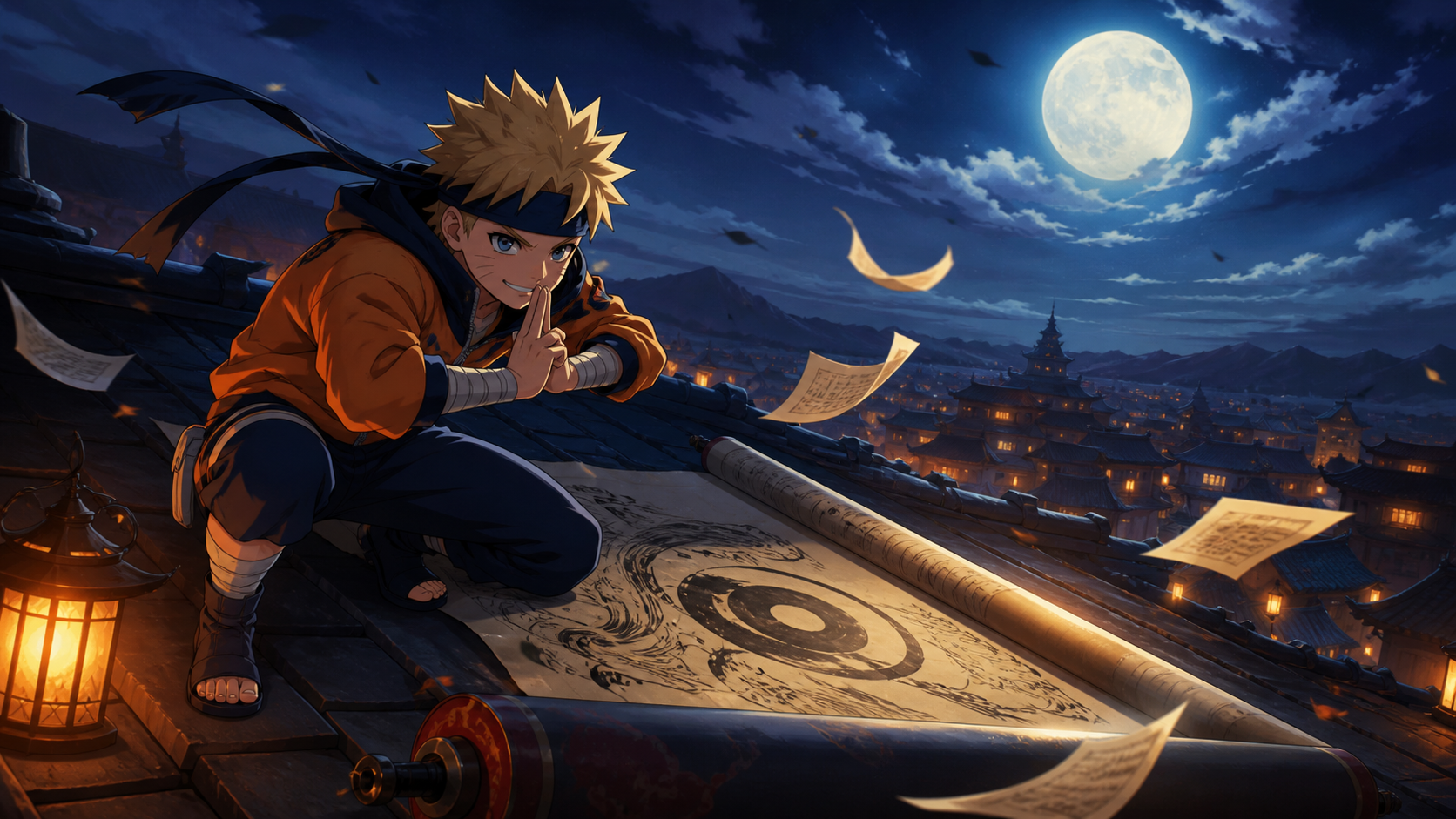
Mission file
Spoiler level: This recap discusses the entire episode and lightly identifies ideas that matter later in the original series. Major future events remain behind a clearly labeled section.
The episode before the legend
Naruto arrives in motion. He is not introduced through a solemn prophecy, a heroic rescue, or a polished combat demonstration. He is painting the Hokage Monument while half the village chases him. That choice tells us almost everything. Naruto wants the respect attached to those stone faces, but respect is not available to him, so he hijacks their visibility. If the village will not look at him with pride, it will at least have to look at his paint.
The prank is funny because Naruto commits to it with the confidence of a tiny criminal mastermind who has never planned the cleanup stage. The joke is also sad because he seems delighted that adults are finally shouting his name. Negative attention still contains attention. The premiere never pauses to announce this psychology, but it builds the behavior around it. Naruto is exhausting on purpose because being easy to ignore would feel worse.
Iruka catches him, makes him scrub the monument, and drags him back toward responsibility. Crucially, Iruka keeps returning. He is angry, but present. Naruto has learned that inconvenience can summon an adult, so he keeps making himself inconvenient. The pattern is not healthy, yet it makes perfect emotional sense.
Scene-by-scene recap and reaction
1. The Hokage Monument gets an unauthorized makeover
The village opens with the history of the Nine-Tailed Fox attack. A monstrous force once devastated the Hidden Leaf until the Fourth Hokage sacrificed himself to stop it. The story then cuts from catastrophe to Naruto’s graffiti spree, connecting a village-sized wound to one loud child before explaining why.
RaeRae reaction: the tonal whiplash is doing real work. We go from mythic destruction to a kid dangling from a rope with a paintbrush. Naruto looks like he belongs to a different genre than the village’s trauma, which is exactly how the villagers treat him. They think he is an interruption to their story. The series is about proving that he is at the center of it.
When Iruka orders him to clean the monument, Naruto complains that nobody at home will punish him. The line slips past quickly, but it changes the prank. He is not hurrying toward a worried parent or a warm dinner. Punishment from Iruka is one of the few reliable forms of care in his life.
2. Ramen is not a reward, it is a relationship
Iruka offers Naruto ramen if he finishes the cleanup, and Naruto lights up. The meal matters because Iruka is giving him something ordinary. They sit together like a teacher and student, not a village guard monitoring a dangerous container. Naruto talks about becoming Hokage and forcing everyone to acknowledge him. The dream sounds arrogant until we understand that acknowledgment is the thing he has never received for free.
Iruka asks why Naruto wears goggles when ninja normally wear forehead protectors. Naruto admits that he wants the real symbol after graduation. He is already dressing for the identity he hopes to earn. The goggles are homemade belonging, a substitute he can control until the institution lets him inside.
This little ramen scene is why the later conflict lands. Iruka is not suddenly kind when danger appears. He has been doing the less glamorous work of showing up, setting limits, feeding Naruto, and listening to the same impossible dream without laughing him out of the restaurant.
3. One failed clone empties the schoolyard
The graduation exam requires a basic Clone Jutsu. Naruto produces a pale, collapsed copy that looks like his self-esteem has left its body. The visual gag is excellent, but the aftermath hurts. Iruka fails him because Naruto has not met the requirement. Mizuki argues for leniency, presenting himself as the compassionate instructor while Iruka appears strict.
Then the families arrive. Students celebrate with parents, receive praise, and leave the Academy carrying proof that they belong. Naruto sits alone on a swing. The adults nearby speak about him with contempt they barely bother to hide. The framing isolates him even when the yard is crowded. This is the episode’s quietest cruelty because nobody needs to attack Naruto. The entire community simply demonstrates that every other child has somewhere to go.
Iruka’s decision is not wrong. A ninja instructor cannot certify a student who cannot perform the tested skill. The tragedy is that nobody has recognized why Naruto fails at a conventional clone while possessing the stamina for something far more difficult. The Academy measures one kind of competence and calls the result a complete judgment.
4. Mizuki finds the wound and calls it an opportunity
Mizuki approaches Naruto with a secret path to graduation. Steal the Scroll of Sealing, learn a technique from it, and prove that he deserves the forehead protector. The manipulation works because it mirrors Naruto’s deepest bargain with the village: if I become impressive enough, will you finally keep me?
Naruto does not steal the scroll because he wants forbidden power for its own sake. He believes an instructor has given him a makeup assignment. Once he escapes with it, he studies until exhaustion. That detail matters. Naruto is reckless, but not lazy. He is willing to work brutally hard when the goal feels connected to recognition.
Meanwhile, the theft alarms the Third Hokage and the village shinobi. A child who struggles with the Academy’s basic curriculum has somehow broken into a protected building and taken an object dangerous enough to mobilize trained ninja. The contradiction is the first big clue that Naruto’s problem has never been a simple lack of potential.
5. Iruka finds the student before the village finds the criminal
Iruka reaches Naruto in the forest and discovers him practicing the Shadow Clone Jutsu. Naruto proudly explains the secret test, expecting approval. Iruka immediately understands that Mizuki used him. Naruto’s face changes before the attack even begins because he realizes another adult offered kindness as bait.
Mizuki arrives and reveals the truth the village has hidden: the Nine-Tailed Fox is sealed inside Naruto. He tells Naruto that this is why the adults hate him and why the rule forbidding anyone from discussing the fox exists. Mizuki’s disclosure is an act of emotional violence before it becomes a physical one. Mizuki takes years of unexplained rejection and gives Naruto the most destructive possible interpretation.
The village’s policy deserves serious side-eye. Adults are forbidden to tell Naruto why he is ostracized, yet they are apparently free to glare, whisper, and teach their children to avoid him. That is not protection. The rule creates a system designed to preserve adult comfort while making the child carry consequences he cannot name.
6. Iruka takes the shuriken
Mizuki throws a massive shuriken at Naruto. Iruka covers him and takes the weapon in his back. The image is direct: the teacher places his own body between Naruto and the village’s hatred. The sacrifice marks the first time Naruto sees someone choose him when choosing him hurts.
Iruka understands more than Naruto knows. His own parents died during the Nine-Tails attack. He has every socially acceptable reason to keep the fox and the boy emotionally fused. Instead, he distinguishes Naruto’s pain from the creature sealed inside him. Iruka recognizes the pranks, loneliness, hunger, effort, and desperate need for praise as belonging to Naruto alone.
Naruto runs, and for a moment Iruka fears Mizuki’s words reached him first. Mizuki disguises himself as Iruka and pursues. The episode briefly invites the possibility that Naruto will believe the worst story about himself because it explains so much. Then Naruto hides and listens while the real Iruka defends him.
7. The sentence Naruto needed to overhear
Iruka tells Mizuki that Naruto is not the Nine-Tailed Fox. He is Naruto Uzumaki of the Hidden Leaf Village. He is a student, a hard worker, a troublemaker, and a person capable of pain. Iruka does not erase the damage caused by the fox. He refuses to transfer moral guilt from a creature to the child carrying it.
This defense matters because Naruto hears it when Iruka does not know he is listening. Praise offered directly can feel like pity or strategy to a child who has been manipulated. Iruka’s words are credible because they are spoken under threat, with nothing to gain and no audience to impress.
8. One clone becomes a thousand answers
Naruto steps out and uses the Multiple Shadow Clone Jutsu. He does not create one barely acceptable copy. He fills the forest with solid clones and gives Mizuki the group project beating he volunteered for. The payoff works as comedy, action, and character revelation at the same time.
A standard clone is an illusion. Naruto’s shadow clones are physical bodies that divide his chakra. The supposedly hopeless student has mastered a forbidden technique in a single night because his reserves and determination operate outside normal expectations. He has not become talented suddenly. The episode has finally placed him in a situation where his unusual strengths matter.
And yes, watching an army of Narutos descend on Mizuki is deeply satisfying. This man found the loneliest child in the village, pretended to offer him a chance, tried to turn him into a thief, exposed his most painful secret, and attempted murder. He receives exactly as much dignity as his choices deserve.
9. Iruka gives Naruto his forehead protector
After the fight, Iruka asks Naruto to close his eyes and gives him his own forehead protector. The gesture is personal rather than bureaucratic. Naruto is not merely passed by a system. He is welcomed by the person whose acknowledgment matters most.
The forehead protector covers the goggles Naruto used to imitate belonging. That visual transition is clean and emotional. Naruto no longer needs to invent a symbol for himself because Iruka has placed the village’s symbol in his hands. Iruka’s gift does not solve the village’s prejudice, and it does not heal years of isolation in one scene. The gesture gives Naruto a starting point that is real.
What Episode 1 is really about
The Hidden Village and the problem of assigned identity
The Hidden Leaf calls itself a village, a word that suggests home, memory, and mutual care. Yet Naruto experiences it first as a system of watching. His face is observed, his behavior is disciplined, and his body carries a secret everyone else is allowed to know. He lives inside the community while being denied the knowledge that explains his place within it. The village is hidden from outsiders, but its most damaging secrecy operates inward.
An existential reading asks whether Naruto is the identity handed to him or the identity he creates through choice. The villagers have already authored him as monster, nuisance, and container. Mizuki tries to make that story final. Naruto answers through action: he studies, protects himself, accepts Iruka’s recognition, and declares a future name, Hokage. He cannot choose the circumstances placed inside his body, but he can choose what those circumstances mean.
The stone Hokage faces sharpen that question. They represent identities made permanent by collective memory. Naruto paints them because he has no public story of his own. By the end, he receives a much smaller symbol, Iruka’s forehead protector, but it carries something the monument cannot give him: recognition from one human being who knows his pain. My reading is that the premiere values chosen relationship over official mythology. The village may decide who becomes a symbol, but personhood begins when someone refuses to let the symbol replace the person.
Belonging is the first power-up
The premiere links emotional recognition to action without claiming kindness magically produces skill. Naruto already has the chakra, stubbornness, and capacity to learn. What Iruka gives him is somewhere safe to stand. Once Naruto believes that one person sees him clearly, Mizuki’s definition loses control over him.
This becomes the series’ operating system. Techniques matter, but bonds determine why characters fight, which identities they accept, and whether inherited pain becomes destiny. Episode 1 establishes that argument before Team 7 even exists.
Iruka refuses the easiest version of grief
Iruka could reduce Naruto to the night his parents died, and the village would understand. Instead, he does the harder moral work of separating a child from the history adults project onto him. His heroism is not that he feels no anger. Iruka’s heroism lies in how he refuses to make Naruto pay for it.
That choice also explains his strictness at the exam. Iruka does not respect Naruto by pretending standards do not matter. He respects him enough to teach, discipline, and eventually advocate for the person underneath the disruption.
Mizuki understands Naruto, but only as a weapon
Mizuki reads Naruto’s loneliness accurately. That is what makes him dangerous. He knows which promise will bypass suspicion and which secret will cause maximum damage. Empathy without care becomes exploitation. Iruka sees the same wound and responds with responsibility. Mizuki sees it and asks how useful it can be.
Direction, performance, and adaptation notes
The premiere balances broad physical comedy with still, painful compositions. Naruto’s monument prank is full of movement and shouting. The swing scene removes that momentum and lets distance do the work. The forest confrontation then combines both modes, alternating between close emotional revelations and exaggerated action.
Junko Takeuchi’s Japanese performance gives Naruto a rasp that can sound boastful, childish, wounded, and ferocious without turning him into four different characters. The loudness feels defensive. When Naruto realizes Mizuki lied, the energy drains rather than simply becoming quieter. Maile Flanagan’s English performance leans into the bratty comic edge, which makes the emotional turn especially noticeable for dub viewers.
Toshihiko Seki gives Iruka enough irritation in the early scenes that his later protection does not feel sentimental or automatic. Iruka sounds like a tired teacher before he sounds like a surrogate family member. That order matters.
The anime expands the sense of village life around Naruto and lets the Academy isolation breathe visually. The central material comes from the manga’s opening chapter, but television pacing makes room for voices, pauses, movement through the village, and the musical shift from mischief to danger. The adaptation understands that the first episode must sell both a comic troublemaker and a child carrying communal trauma.
RaeRae take
What I love: Episode 1 never asks us to love Naruto because he is secretly important. The premiere asks us to recognize that he deserved care before anyone knew what he might become. Iruka’s defense is powerful because it is about personhood, not prophecy.
What makes me furious: The adults maintain a rule that prevents Naruto from understanding his own life while doing almost nothing to hide their disgust. Then everyone acts surprised that the child responds with vandalism. The village needs a therapist, a safeguarding policy, and several mandatory workshops.
What made me laugh: Naruto answering one failed clone with an entire forest of solid clones is the exact level of excessive retaliation I want from a premiere. He did not pass quietly. He turned remediation into a public demonstration.
What hits harder on rewatch: Iruka’s parents died because of the Nine-Tails. His compassion is not based on ignorance. His compassion is a conscious refusal to let grief choose the wrong target.
My verdict: This is a remarkably efficient pilot. Some exposition is blunt, and the village’s handling of Naruto is institutionally absurd, but the episode establishes the emotional engine, signature technique, central dream, first meaningful bond, and the series’ argument about inherited hatred without losing its comic energy.
Episode scorecard
Overall: 9.3/10. The animation belongs to its era and a few explanations arrive with a megaphone, but the emotional architecture is already sturdy enough to support hundreds of episodes.
Easter eggs, visual clues, and future threads
- Naruto paints the Hokage Monument before declaring that he will join those faces. The prank and the dream occupy the same physical symbol.
- Iruka’s forehead protector replaces Naruto’s goggles, turning self-invented belonging into recognition granted through relationship.
- The Shadow Clone Jutsu is introduced as forbidden before becoming inseparable from Naruto’s fighting style.
- Naruto’s difficulty with ordinary classroom techniques does not reflect the full shape of his ability.
- The village repeatedly struggles to separate people from the powers, clans, and histories attached to them.
- Iruka’s acknowledgment establishes the kind of bond Naruto will keep offering other isolated people.
The episode’s real cliffhanger is recognition
Naruto does not finish Episode 1 with the village repaired. Most adults still fear him, the law still hides the truth of his body, and one heroic night cannot replace years of care he never received. What changes is smaller and more important: Iruka sees the child underneath the behavior and acts on that recognition when it costs him something.
The forehead protector becomes proof of that choice. Naruto wanted a public symbol because he believed status would force people to acknowledge him. Iruka gives him the symbol only after offering the thing Naruto actually needed first: one adult willing to protect him as Naruto, not merely contain him as the Nine-Tails host. That is why the final smile lands harder than the forbidden scroll spectacle.
Watch and verify
Episode title, story placement, and core production credits were checked against the Naruto Official Site. Official viewing availability changes by region. Check the Crunchyroll Naruto page or VIZ Media’s licensed viewing options.