
Character File · Toy Story · Full Franchise
Woody
He calls himself loyal because admitting he built a whole identity around being useful would make every goodbye feel like death.
Quick file
Full identity: Sheriff Woody Pride, a vintage pull-string cowboy doll associated with the fictional television property Woody’s Roundup. Primary performer: Tom Hanks in the feature films, with Jim Hanks voicing Woody in many games, shorts, attractions, and related appearances. Primary children: Andy Davis and later Bonnie Anderson.
Core relationships: Buzz Lightyear, Bo Peep, Jessie, Bullseye, Slinky Dog, Andy, Bonnie, and the wider toy communities. Defining conflict: Woody repeatedly mistakes being needed for being loved, then must decide who he is when service no longer guarantees a place.
The part everybody remembers and the person underneath it
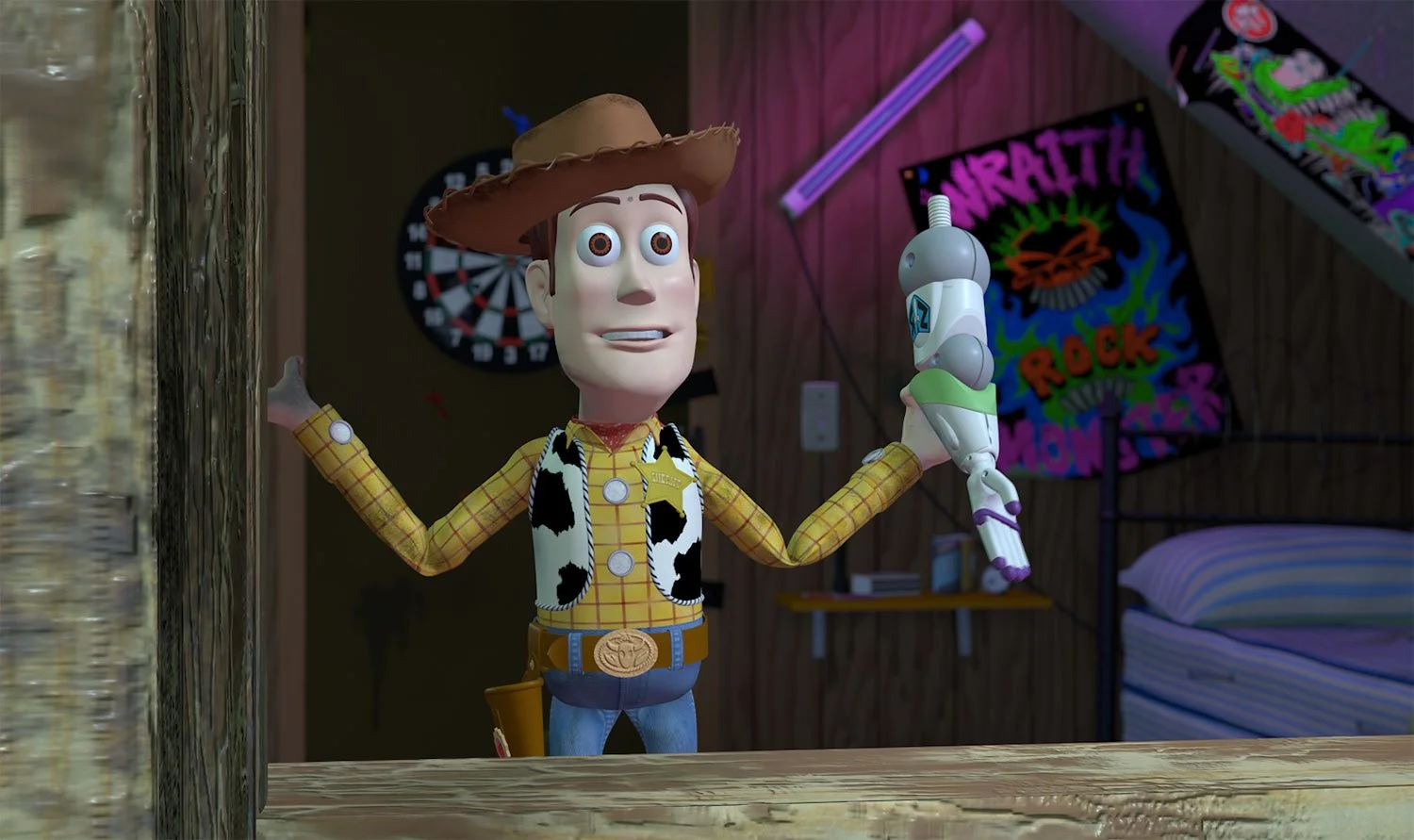
The hat, badge, yellow plaid shirt, cowhide vest, neckerchief, pull string, and warm Tom Hanks voice make Woody legible before he moves. He looks like dependable nostalgia. The character underneath is generous, controlling, funny, frightened, resourceful, jealous, and capable of changing after he hurts people.
That contradiction is the reason he sustains four films. A permanently noble sheriff would be a mascot. Woody is a person because leadership and insecurity keep contaminating each other.
His body carries a cancelled television world
Woody does not know his complete commercial history in the first film. Toy Story 2 reveals a television series, merchandise line, horse, sidekick, prospector, and cultural moment that once made the cowboy valuable beyond Andy’s room.
The discovery creates a second origin story. Andy’s love gave Woody personal meaning, while Woody’s Roundup supplied a market identity he had forgotten or never understood.
A pull string is a voice somebody else controls
Woody speaks freely when humans are absent and repeats fixed phrases when a child pulls the cord. The mechanism turns voice into product feature, creating a visible split between interior speech and manufacturer-approved language.
His famous lines sound like personality because performance and repetition made them intimate. They are also scripts embedded in his body without his consent.
The badge represents service and unearned authority
Woody’s sheriff star tells a child what role to give him. Inside the toy community, it becomes an informal credential supporting leadership even though no election or formal law grants him command.
He often earns authority through competence. The badge still helps make power appear natural before anybody examines how he uses it.
Andy’s favorite status becomes Woody’s emotional oxygen
Years of play, bedtime placement, imagined adventures, and the name written on his boot convince Woody that closeness to Andy defines a successful life. Favorite is affection and hierarchy compressed into one word.
The arrangement feels secure until Buzz arrives. Then Woody discovers that an identity borrowed from somebody else’s attention can disappear without his permission.
Buzz is not the cause of Woody’s insecurity
The space ranger makes the existing fear visible. Birthdays, new products, changing interests, and childhood development have always threatened every toy. Buzz simply arrives with enough features and confidence to become an obvious replacement symbol.
Woody’s growth begins when he stops asking Buzz to shrink and examines the scarcity story organizing his own reactions.
The lamp scheme is an abuse of leadership
Woody wants Buzz trapped behind the desk so Andy cannot choose him for Pizza Planet. He uses environmental knowledge and group trust to remove a rival from opportunity. Buzz leaving through the window is accidental; the attempted sabotage is not.
His later heroism should not rewrite that intent. The first film works because it requires a beloved leader to become accountable for harm.
His strongest skill is improvisation under pressure
Woody understands rooms, human routines, toy capabilities, routes, timing, and how to turn ordinary objects into tools. In Sid’s house, during moving day, and across later rescues, he assembles plans from whatever bodies and materials are available.
Improvisation becomes ethical when it coordinates rather than manipulates. The same intelligence can hide Buzz or save him.
Tom Hanks makes authority sound intimate
Hanks gives Woody rapid comic panic, practiced command, wounded pride, tenderness, and the warmth of somebody who has spoken through a child’s earliest memories. The voice can invite trust before the character has earned it in a particular moment.
That charisma is part of Woody’s power. Performance lets viewers understand why the room follows him and why his failures feel personal.
Jim Hanks extends the character beyond the feature canon
Woody’s voice appears across games, shorts, attractions, toys, and other media that cannot always use Tom Hanks. Jim Hanks, Tom’s brother, has performed many of those versions, maintaining recognizable cadence without pretending every production has identical conditions.
A complete profile separates primary feature performance from franchise continuity labor rather than collapsing every credit into one name.
Woody and Buzz move from rivals to chosen brothers
They begin by forcing each other’s identity crisis. Woody attacks Buzz’s status; Buzz’s arrival destabilizes Woody’s own. Survival requires cooperation before either has fully repaired the emotional damage.
Their bond becomes durable because each sees the other after the heroic performance collapses. Friendship begins when neither one is impressive enough to hide.
He teaches Buzz toyhood and learns personhood from him
Woody explains freezing, Andy’s name, play, and the emotional value of belonging to a child. Buzz demonstrates that manufacturer identity can be revised and that courage survives after assigned destiny fails.
The exchange is mutual. Woody knows the social rules, while Buzz exposes how those rules became the cowboy’s prison.
Bo Peep remembers a Woody not organized entirely around fear
Their early affection suggests history, flirtation, and a life beyond crisis management. When she returns in Toy Story 4, Bo has built mobility, competence, and purpose outside a child’s ownership.
She does not simply become Woody’s romantic reward. She represents a model of toy life his service identity previously made difficult to imagine.
The Bo Peep decision is also a community decision
Leaving with Bo allows Woody to rescue lost toys and live beyond being assigned to one child. It also separates him from Buzz, Jessie, and a group that depended on his long leadership.
The ending can be liberation and abandonment simultaneously. Mature criticism does not need to flatten the choice into either selfishness or perfect self-actualization.
Jessie exposes the cost of his collector fantasy
Woody initially sees the Japanese museum as permanent preservation and a chance to reclaim historical importance. Jessie knows display means separation from touch and relives Emily’s abandonment through every suggestion that children inevitably leave.
Her pain makes his choice concrete. Woody cannot call museum life rescue without accounting for what the other Roundup toys lose.
He and Jessie are family without needing romance
The shared program history, cowboy vocabulary, and collector threat make them kin inside a recovered product lineage. Their connection offers Jessie a community that does not require repeating Emily’s exact bond.
The franchise wisely centers friendship and sibling-like loyalty rather than pairing every male and female character by default.
Bullseye gives Woody the horse his body remembers
The television property designed Woody as a mounted sheriff even though Andy’s room initially lacks the horse. Meeting Bullseye reconnects play language, product history, and emotional companionship.
Bullseye’s devotion is wordless and active. Woody must learn not to treat that devotion as another resource automatically available to the leader.
Stinky Pete is the future Woody narrowly refuses
The Prospector has never been played with, converts exclusion into resentment, and treats preservation as the only rational escape from children. He manipulates the Roundup group because he believes hurt grants authority.
Woody shares enough fear with him to make the villain uncomfortable. Their difference is not pain. It is what each chooses to do with pain.
Al’s collection turns cultural value into captivity
Woody learns that rarity, completion, and market demand can make a toy valuable in ways unrelated to the toy’s wishes. His torn arm increases the pressure because damage threatens both collector price and his confidence that Andy will keep him.
The rescue argues that preservation without agency can become a clean, climate-controlled prison.
His torn arm makes disposability physical
The rip happens while Andy plays, and the sudden damage changes plans. Woody is left behind, shelved, and forced to imagine that one injury has made years of attachment irrelevant.
The fear is larger than fabric. It is the terror that usefulness is conditional and bodies are lovable only while they perform reliably.
The cleaner restores appearance and raises an ethical question
The repair sequence is careful, skilled, and visually satisfying. Woody is handled as valuable material while unconscious or immobilized, with no meaningful way to consent to invasive restoration performed for sale.
Good workmanship does not automatically create ethical authority. Repair should serve the person whose body changes, not only the owner’s market goal.
Woody’s Roundup gives him heritage without giving him destiny
Learning the show explains his phrases, costume, partners, and collector value. It does not require him to live in a museum or perform nostalgia forever.
Heritage becomes healthy when it adds context and relationships without closing the future.
Toy Story 3 makes his loyalty both noble and dangerous
Woody insists Andy intended the attic and refuses to accept daycare as the group’s chosen future. He is correct about the bag mix-up and slow to recognize that being correct does not settle everybody else’s fear.
His faith in Andy carries the group through danger and delays the conversation about what toys may choose when a child grows up.
The attic promise would preserve the group and suspend their lives
Storage means safety, memory, and possible future contact. It also means darkness, inactivity, and waiting for somebody whose life has moved elsewhere. Woody initially treats that suspension as loyalty’s obvious form.
The film forces him to recognize that love may require transfer rather than permanent proximity.
The incinerator strips leadership down to presence
No plan can guarantee escape when the toys face the fire. Woody reaches for friends, and the group holds hands. The sheriff cannot command machinery into mercy.
Leadership becomes honest when it stops promising control and refuses to let others face terror alone.
Giving the toys to Bonnie is Woody’s largest act of interpretation
Andy prepares to store the group, and Woody places Bonnie’s address where his owner will find it. The intervention changes Andy’s decision without revealing consciousness. It is manipulation and care working together.
Woody chooses a future the toys can live inside, then trusts Andy to complete the transfer emotionally.
The final play with Andy is a funeral that lets everybody remain alive
Andy introduces each toy, performs old stories, and gives Woody last. The child narrates the meaning accumulated across years before passing physical custody to Bonnie.
Woody survives the goodbye because the relationship is acknowledged rather than denied. Grief becomes evidence that the life mattered.
Bonnie does not owe Woody the same role Andy gave him
The transfer scene can feel like a promise that Woody will remain central. Bonnie is a different child with different interests, histories, and toys. Her choice to favor Jessie or leave Woody in a closet is not betrayal of Andy’s love.
Woody struggles because he treats being selected for Bonnie as continuation rather than a new relationship with no guaranteed rank.
Forky becomes the child Woody tries to save through service
Bonnie creates Forky from discarded craft materials and needs him for emotional security. Forky rejects toy identity and repeatedly seeks the trash, giving Woody another being whose purpose must be explained.
Woody’s care is sincere and compulsive. Protecting Forky lets him feel needed when Bonnie no longer reaches for the sheriff.
His Forky mission repeats Buzz with a gentler method
Buzz arrives denying toyhood because he believes he is more. Forky denies toyhood because he believes he is trash. Woody orients both newcomers while projecting his own need for toy purpose into their crises.
The fourth film shows growth and repetition. Woody no longer sabotages the newcomer, but he still uses rescue to stabilize himself.
Gabby Gabby mirrors his need to be chosen
Her defective voice box becomes the explanation for why no child has loved her. She wants Woody’s working mechanism as the repair that will make selection possible. He understands the logic because his pull string and history also tie voice to worth.
Their encounter turns bodily donation, coercion, and empathy into one of the franchise’s most complicated exchanges.
Giving up his voice box is sacrifice with consent pressure around it
Woody ultimately allows Gabby Gabby to take the mechanism. The choice helps her pursue connection and permanently alters his body. The surrounding capture and bargaining make the path to consent ethically messy.
The scene should be read as generosity without pretending coercive circumstances disappear because the donor later agrees.
The lost-toy life breaks the owner-purpose binary
Bo’s community rescues, relocates, and connects toys with children temporarily. Purpose becomes mobile, collective, and chosen rather than assigned through permanent ownership.
Woody’s decision to join them does not reject children. It rejects the belief that only one child’s continuing need can make his life legitimate.
Toy Story 5 reopens the community question
Official Pixar information places Woody away with Bo’s rescue squad before a call returns him to Bonnie’s world, where toy life confronts a tablet and changing play. His return risks undoing the fourth film and can test whether freedom includes choosing to help without resuming control.
A strong continuation will let Woody arrive as collaborator rather than reclaiming the sheriff position automatically.
His design balances softness with readable authority
Long limbs, large hands, a narrow torso, broad hat, simple face, and flexible fabric let animators move between dignity and collapse. Woody can stand like a sheriff or fold into an anxious tangle.
The body makes emotional contradiction visible. He looks authoritative until gravity, panic, or a child reminds us he is cloth.
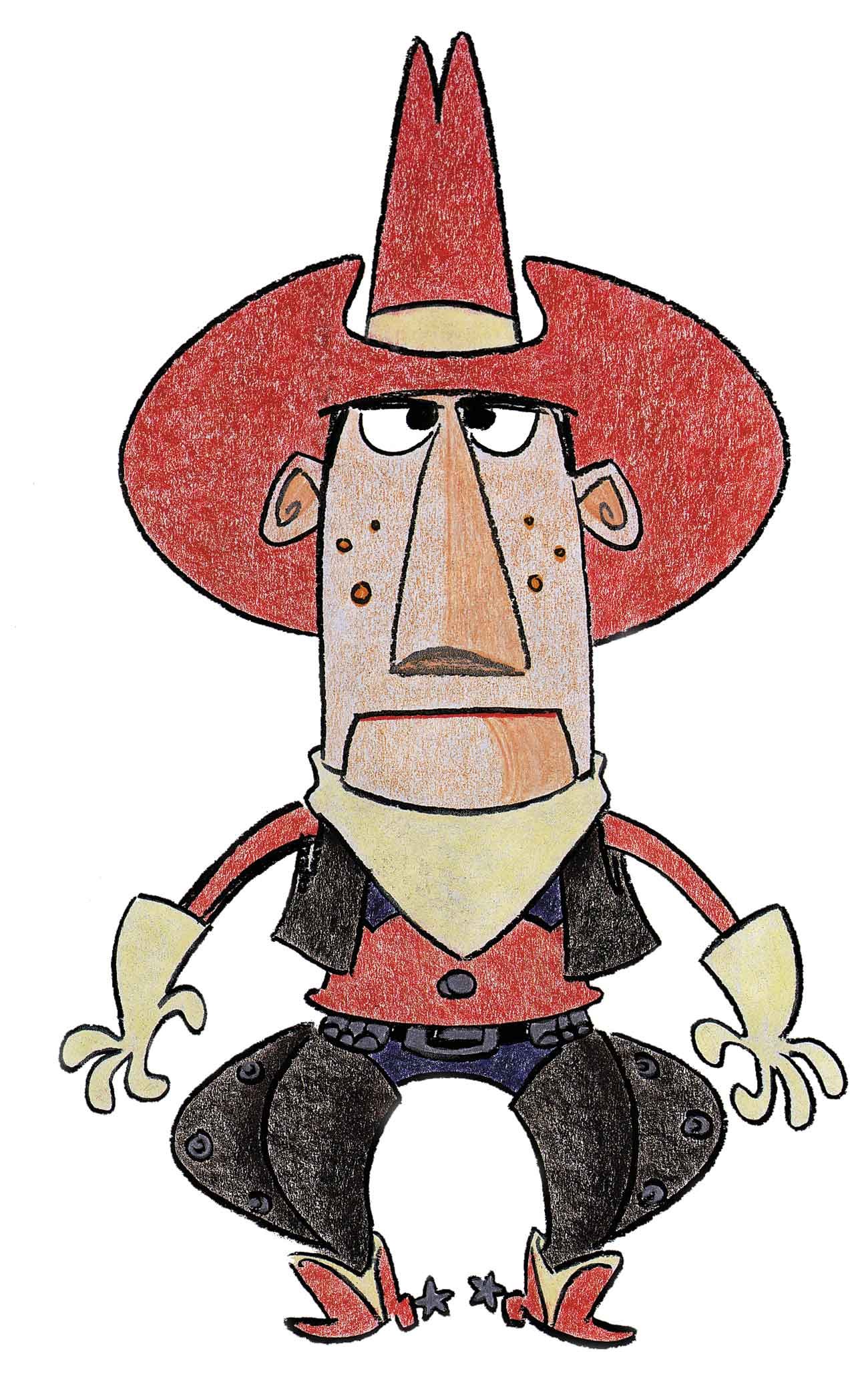
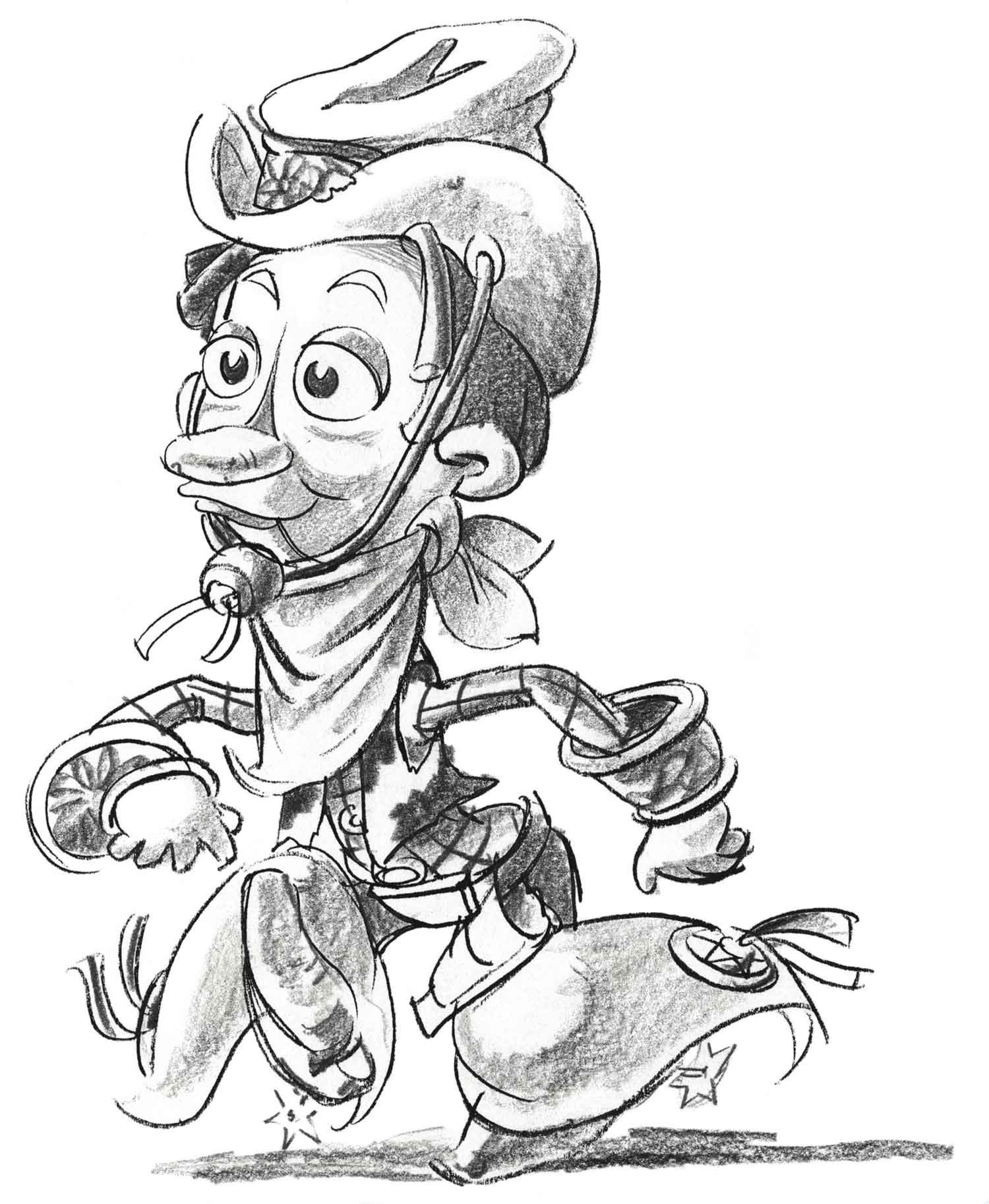
The early designs show authority was not inevitable
Official Pixar development drawings explore sharper, stranger, more exaggerated cowboys. The final Woody becomes warmer and more toy-like, allowing jealousy to feel like a moral failure inside a lovable person rather than confirmation that an unpleasant design was secretly bad.
Character design is ethical framing. Shape tells viewers how much patience to bring before dialogue begins.
His hat functions as identity, tool, and vulnerability
The hat completes his silhouette, appears in play rituals, gets lost or passed, and can become evidence that he is missing. It is costume and portable self-image.
Because the hat can separate from the body, the films can show identity threatened without physically injuring Woody.
Andy’s name on his boot changes meaning across the franchise
In the first film, the name proves belonging and helps Buzz accept toyhood. Later it becomes history, ownership mark, emotional inheritance, and a reminder that the child attached to the inscription is no longer present.
The writing remains while the relationship changes. Permanence belongs to the mark, not the arrangement it once represented.
Woody is brave and not fearless
He panics, lies, clings, calculates, and sometimes acts only after a plan collapses. Courage appears when he chooses another toy’s safety despite the possibility of losing Andy.
The character works because bravery is behavior under fear rather than a stable sheriff trait printed on the box.
He is a caretaker who needs care
Woody monitors the room, anticipates danger, mediates crises, and makes himself responsible for everybody’s return. That competence encourages the group and Woody himself to ignore exhaustion, grief, and identity outside service.
Caretakers can become controlling when nobody helps them imagine value beyond being indispensable.
His greatest flaw is not jealousy. It is making fear everybody else’s environment
Jealousy is an emotion. The harm begins when Woody organizes meetings, schemes, explanations, and risk around protecting his rank. Private insecurity becomes collective instability because power amplifies it.
Growth requires more than feeling less jealous. It requires refusing to convert emotion into policy.
His greatest strength is the ability to revise the plan and himself
Woody changes tactics quickly in physical danger and, more slowly, changes the identity assumptions beneath those tactics. He can admit Buzz is valuable, choose play over display, release Andy, and eventually leave permanent ownership.
Adaptability makes him more than a nostalgic object. The vintage cowboy survives because he learns.
What a healthier Woody looks like
He shares leadership, names fear before acting, apologizes without using rescue as erasure, allows children and friends to change, and treats service as one expression of love rather than the price of existence.
He keeps the hat, humor, loyalty, and gift for plans. Healing does not require becoming a different toy.
Final character read
Woody is one of animation’s richest long-form protagonists because every noble trait contains a shadow. Loyalty can become possession. Leadership can become control. Service can become dependency. Nostalgia can become entitlement. The franchise keeps returning to him because those contradictions do not disappear after one apology.
His final question is never simply whether he gets back to the child. It is whether he can love people without requiring their need to prove he exists. Character verdict: iconic, difficult, frequently wrong, and most heroic when he stops treating the sheriff badge as permission to decide everybody else’s future.
Woody’s humor is part of how he survives his own intensity
He is not only a wounded leader delivering speeches about loyalty. Woody is sarcastic, physically ridiculous, quick with a desperate lie, and capable of recognizing the absurdity around him even while panicking. Comedy prevents his need for control from turning the films into a solemn case study.
The humor also makes accountability harder to evade. We can love the timing, the voice, and the collapsing limbs while still seeing exactly when a joke becomes deflection or cruelty.
Woody and Slinky show how friendship changes under evidence
Slinky begins with deep trust built through years of shared life. After Buzz falls, that trust cannot remain untouched because Woody’s motive is visible even when the precise accident is not. Slinky’s doubt hurts precisely because it is morally reasonable.
Woody eventually earns renewed loyalty through action, but a healthier bond allows Slinky to question him without being cast as disloyal.
Woody and Mr. Potato Head need each other’s opposite instincts
Mr. Potato Head expects self-interest and challenges Woody’s explanations. Woody expects cooperation and can organize people toward a shared goal. Either instinct alone becomes corrosive: permanent suspicion prevents community, while permanent trust protects authority from scrutiny.
Their friction gives the room an informal opposition voice, even when insults make accountability harder to hear.
Woody and Rex reveal two kinds of fear
Rex announces anxiety and worries that he cannot satisfy the threatening identity printed onto his body. Woody hides anxiety inside command and worries that admitting fear will weaken his rank. Rex looks fragile while Woody’s fear creates more danger.
The contrast argues that visible nervousness is not the most dangerous insecurity in a room.
Woody and Hamm share intelligence without sharing temperament
Hamm is observant, skeptical, and quick with social analysis. Woody is operational, relational, and oriented toward action. Together those skills could support better decisions if leadership did not treat criticism as obstruction.
A functioning toy council would give Hamm room to test plans and Woody responsibility for turning critique into humane logistics.
Woody and Andy communicate through performance, not confession
Andy never hears Woody’s free voice. Woody cannot tell him about fear, injury, preference, or the community affected by each household decision. Their bond is profound and structurally one-sided.
The child loves the character he animates through play. Woody loves a child he observes in private. Each knows a real part of the other and never the whole person.
Woody’s relationship with Bonnie proves transfer is not continuation
Andy’s introduction gives Bonnie context, but it cannot transfer the exact emotional history written between boy and toy. Bonnie creates her own play hierarchy and eventually reaches for other characters.
Woody’s disappointment is grief looking for somebody to blame. Bonnie is not responsible for preserving another child’s favorite relationship.
The Roundup gang makes franchise ancestry into chosen family
Jessie, Bullseye, and Stinky Pete come from the same fictional property, but shared manufacture does not automatically produce safe family. Jessie and Bullseye choose connection; the Prospector chooses control and coercion.
Origin creates context. Behavior decides whether context becomes belonging.
Woody’s physical repairs should remain part of his biography
A torn arm, restitching, cleaning, lost voice box, worn paint, and years of handling make his body an archive. Restoring him to an untouched product image would erase the relationships and danger that gave those changes meaning.
A complete character file treats damage neither as shame nor disposable trivia. The body remembers the franchise.
Why Woody remains readable across three decades of animation
Technology changes fur, dust, light transport, fabric, surface detail, and environmental scale around him. The essential silhouette remains simple enough to survive every rendering generation: hat, long limbs, vest, badge, neckerchief, boots.
Continuity comes from design priorities, not freezing the model in 1995.
The final Woody receipt
Woody begins as a toy terrified that love has limited seating. He becomes a friend, rescuer, collector object, transfer agent, unwanted caretaker, bodily donor, and lost toy. Each role asks whether service expands his life or keeps him from having one.
His best ending is not permanent retirement or permanent command. It is the ability to choose care without using care to demand a place. He remains iconic because the cowboy learns that loyalty can survive after ownership, rank, and the old room are gone.
Return to Toy Story
Read More across the Toy Story franchise
Woody’s growth is never a clean march toward selflessness. He keeps confusing leadership with indispensability, which makes his care generous and controlling in the same scene. The character works because the films let that contradiction survive long enough to hurt people he genuinely loves.