
Memory, Sorrow, and Thorn · Canonical Character Profile
Tuillett
Tuillett is identified in the owned Book 1 character appendix as a young Hernystiri knight. The record gives him people, life stage, and martial rank—then stops. His canonical page keeps those facts alive without awarding him another knight’s horse, battle, romance, death, or coat of arms.
At a Glance
The young Hernystiri knight whose appendix line deserves accuracy instead of borrowed glory
- Name
- Tuillett
- People
- Hernystiri
- Role
- Knight
- Life-stage description
- Young
- Book
- The Dragonbone Chair
- Known actions and dialogue
- No independently searchable foreground passage recovered
- House and liege
- Unrecorded in the verified appendix receipt
- Status
- Unknown
What “Young Hernystiri Knight” Confirms
Three useful facts arrive together, and none of them includes a personal legend
The owned character appendix identifies Tuillett as Hernystiri, young, and a knight. Those descriptors establish cultural affiliation, relative life stage, and recognized martial or social status.
“Young” does not provide a number. Tuillett may be newly adult, early in a military career, young relative to veteran nobles, or described that way for another reason. The profile and future art should not silently declare a precise age.
“Knight” does not automatically supply land, wealth, nobility by birth, a named lord, a horse, armor style, weapon, heraldry, squire, oath text, or battlefield command. Osten Ard’s titles operate within specific political cultures; generic medieval assumptions are not substitutes for receipts.
“Hernystiri” cannot donate another character’s family, coloring, accent, costume, or politics. It places Tuillett within a people whose kingdom faces pressure from Elias, Skali, winter, disease, and war. It does not tell us which event he personally witnessed.
The three facts are enough for one canonical identity. They are not enough for fan fiction disguised as a biography.
Hernystir Context
Tuillett belongs to a kingdom squeezed between tribute demands, invasion, hunger, and grief
Book 1 presents Hernystir through Lluth’s court, Maegwin and Gwythinn, Eolair’s diplomacy, Skali’s pressure, and the wider unraveling of Elias’s rule. The land’s crisis is political, military, ecological, and personal at once.
A young knight exists inside that pressure whether or not the surviving receipt gives him a foreground scene. Martial service in this moment cannot be separated from failing harvests, livestock sickness, hostile demands, divided loyalties, and the fear that ordinary seasonal hardship has become something deliberate.
That context must not become a list of personal actions. We cannot say Tuillett fought Skali, guarded Lluth, rode with Gwythinn, escorted Eolair, defended Hernysadharc, or died in battle. Those deeds belong only to characters the text assigns them to.
What the context does explain is why a named young knight matters. Hernystir’s future is being spent in the present. Young retainers and fighters inherit wars shaped by kings, envoys, old grievances, and supernatural forces they did not choose.
Tuillett’s sparse record becomes a reminder that every army contains lives the narrative cannot follow equally.
Rank, Youth, and the War Machine
The romantic image of a young knight arrives with an invoice the appendix does not itemize
Fantasy often frames the young knight as pure possibility: bright armor, first command, brave eyes, a horse at sunrise, maybe a doomed love waiting near a tower. None of that belongs to Tuillett yet.
The verified description does create tension between youth and institutional violence. Knighthood can offer honor, identity, livelihood, advancement, obligation, and exposure to death. A young person carrying that rank stands at the point where cultural ideals meet practical danger.
We do not know whether Tuillett sought the role, inherited it, earned it, enjoyed it, feared it, or questioned the commands attached to it. We do not know whether he was experienced despite youth or ceremonial despite title.
Status remains unknown. The kingdom’s losses do not let us kill every named knight by association. Survival also cannot be assumed from silence. The profile must hold the unresolved state until a direct narrative or later appendix receipt changes it.
The Characters He Cannot Be Merged With
Hernystir has multiple young men around war, court, and succession; Tuillett remains Tuillett
Gwythinn is Lluth’s son and expected future king. Eolair is a count and diplomat. Craobhan, Fiathna, Penemhwy, Gwelan, and other Hernystiri names occupy their own records. Similar geography does not make them interchangeable.
Tuillett cannot inherit Gwythinn’s family, Maegwin relationship, torture, command, or fate. He cannot borrow Eolair’s diplomacy or romantic associations. He cannot receive another knight’s wounds simply because a scene needs a body.
This boundary matters most in generated art. A handsome young Hernystiri man may look plausible for several minor records. Reusing one face would collapse distinct canonical people into a casting error.
The registry assigns a stable post ID and slug so future evidence can attach to Tuillett without depending on title strings, visual resemblance, or memory.
Connections
The Hernystiri court and war context around Tuillett’s bounded identity
King Lluth
Hernystir’s ruler during Book 1; no direct liege relationship with Tuillett is confirmed by the recovered receipt.
Prince Gwythinn
The expected heir and young warrior whose documented actions and fate must not be borrowed for Tuillett.
Maegwin
Lluth’s daughter and witness to Hernystir’s crisis; no direct meeting with Tuillett is recorded.
Count Eolair
Hernystiri diplomat and political actor; no personal command relationship with Tuillett is verified.
Hernystir
Tuillett’s explicitly named people and the kingdom whose crisis frames his Book 1 inclusion.
Hernystiri knights and retainers
The military and social class his title places him near without specifying unit, house, or battlefield.
Character Image Continuity
Make the young knight hot; keep him historically grounded and completely his own
Visual state: approved editorial reconstruction. Tuillett now has one permanent living young-adult identity and the canonical profile is published.
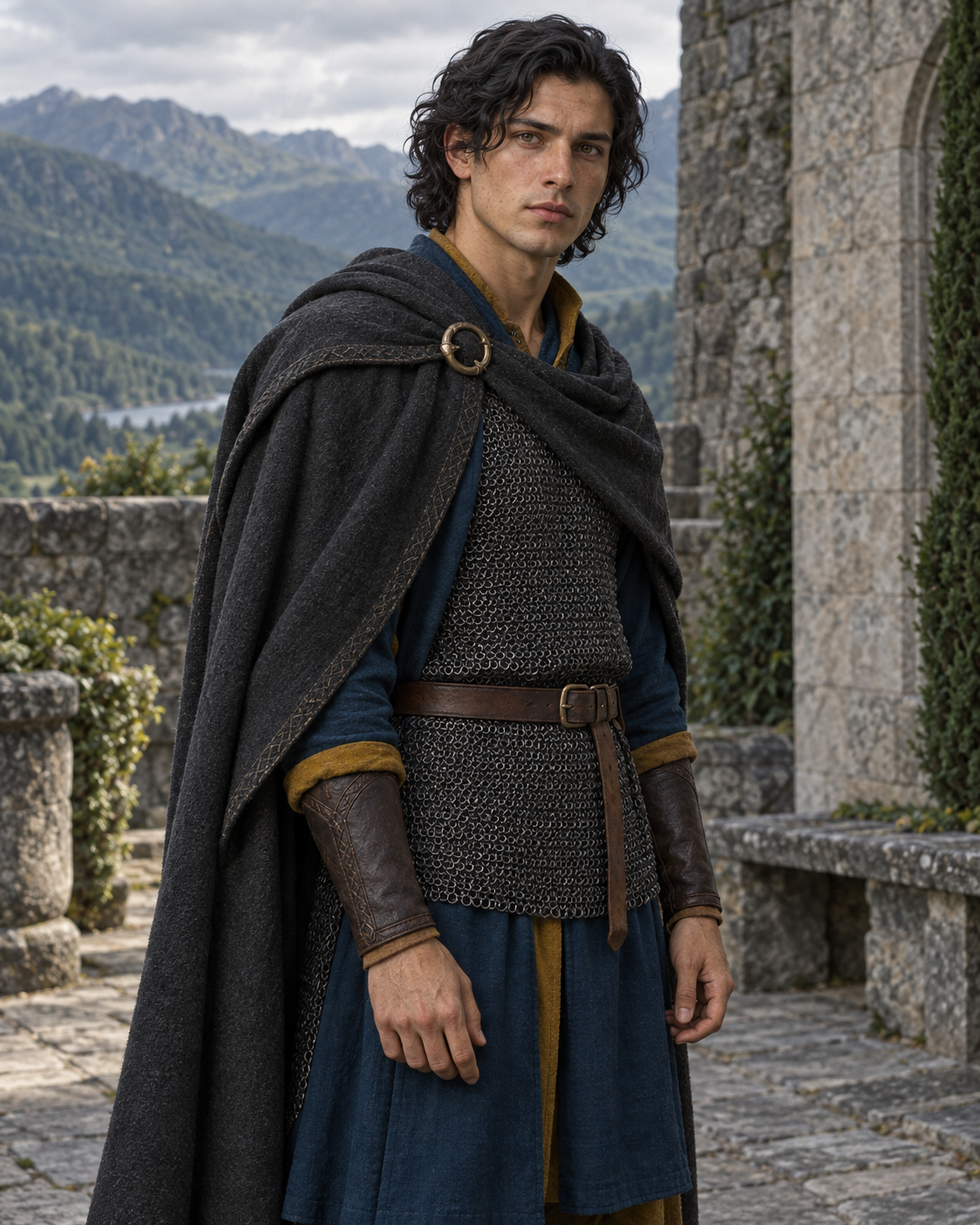
CVM depicts Tuillett as a breathtakingly handsome young adult Hernystiri knight around twenty-two: tall lean-athletic still-youthful build, amber-green eyes, warm olive-fair freckled skin, chin-length blue-black curls tucked behind one ear, clean-shaven, and seriously open in expression. He remains distinct from Gwythinn, Eolair, Simon, and every approved Hernystiri man.
Canon supplies no exact age, height, build, skin, hair, eyes, scars, armor, cloak, colors, heraldry, weapon, shield, horse, location, or weather. A practical sword and period armor may support the role, but captions must label those choices as interpretation.
The approved portrait shows Tuillett alive in deep peacock-blue, muted-saffron, restrained dark mail, charcoal wool, brown leather, and a plain bronze penannular clasp in a neutral mountain hill-fort. No wound, corpse, burning city, captivity, horse, weapon, or heroic last stand appears; youth reads through face and bearing without making him a child.
Attractive does not mean polished into a modern fashion model wearing costume-store plate. He should look capable of living and working inside the same physical world as the other Hernystiri cast.
Preserve this exact face, young-adult baseline, lean body, complexion, freckles, eyes, blue-black curl map, clean-shaven state, peacock/saffron/charcoal/mail/leather wardrobe, clasp, and poised capability across featured image, hero, directory card, social metadata, and every later scene. The same attachment powers all canonical placements; any later milestone must evolve from this locked identity.
Why Tuillett Matters
A full fandom ecosystem gives the young knight a page without pretending the appendix wrote him a saga
Tuillett tests the difference between comprehensive and inflated. Comprehensive coverage includes every named person, connects the record to the correct book and culture, preserves status, and makes future evidence easy to attach. Inflation fills silence with genre clichés.
His page adds scale to Hernystir. Royal decisions and famous defeats involve more people than the viewpoint can follow. The young knight’s name is one surviving point in that larger human field.
The profile also protects other characters. By recording exactly what belongs to Tuillett, the system prevents a later card writer or image generator from donating Gwythinn’s biography to the nearest minor knight.
If sequential rereading recovers the foreground passage, the profile can grow with chronology, relationships, and scene-specific detail. Until then, the appendix receipt remains strong enough to establish identity and narrow enough to demand restraint.
That is not a boring spreadsheet row. It is an editorial page about youth, rank, cultural pressure, visibility, and the limits of what war records preserve.
What Remains Unresolved
The open questions stay visible so future evidence has somewhere honest to land
We still need to know where Tuillett appears, who names him, what action or relationship prompted the appendix entry, and whether later volumes preserve his fate. We do not know whether his title is formal knighthood, translated social equivalence, or courtly shorthand.
We also do not know whether “young” comes from narration, another character’s perspective, or the appendix editor’s compression. That affects art direction and any future age claim.
These are research questions, not content holes to patch with invention. The canonical profile records them so a later pass can resolve the right identity rather than rediscovering the uncertainty from scratch.
On the Record
An owned-edition appendix identity with no borrowed battle attached
This is Tuillett’s one canonical, full-spoiler profile across Memory, Sorrow, and Thorn.
The owned Book 1 character appendix identifies Tuillett as a young Hernystiri knight. The reconciled manifest preserves him within the Hernystiri cast. A direct foreground passage was not independently recovered through the current searchable Kindle interface.
The record confirms Tuillett’s name, Hernystiri identity, relative youth, knightly role, and Book 1 membership.
The record does not confirm exact age, appearance, family, house, liege, unit, rank seniority, heraldry, armor, weapon, horse, actions, dialogue, personality, friendships, romance, battles, injuries, survival, death, burial, or later-volume presence.
Status: unknown.
Visual state: approved editorial reconstruction. The post now uses one distinct age-appropriate Hernystiri knight identity across featured image, hero, directory card, and social metadata, with every unsupported visual detail disclosed as CVM reconstruction.