
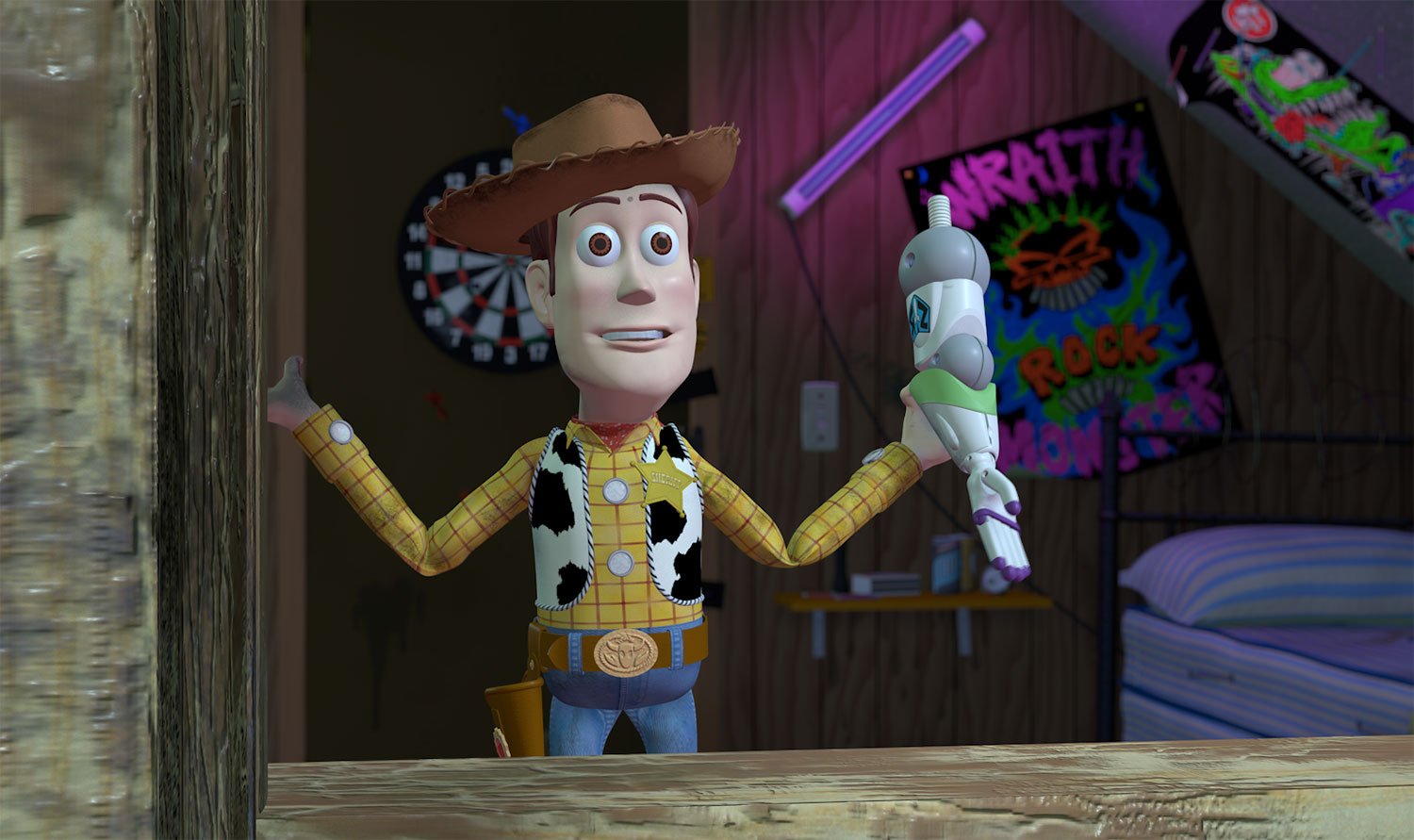
Woody Uses Buzz’s Arm
The rescue plan starts with a lie, then the arm falls off in front of everybody.
Where we are when Woody reaches for the arm
Woody and Buzz are trapped in Sid’s house because Woody’s jealousy set the chain of events in motion. Andy’s toys already watched him knock Buzz from the window, heard his suspicious explanation, and concluded that their longtime leader tried to eliminate the newcomer. The accusation is extreme, but the evidence looks terrible because Woody has spent the day behaving exactly like somebody capable of it.
When Woody finally reaches the bedroom window, he needs help crossing the gap back to Andy’s house. The toys do not owe him instant trust. He asks them to accept his version before he has fully admitted what he did, and their refusal feels less like mob cruelty than a community setting a boundary after leadership abuse.
The scene begins with a legitimate need and a terrible strategy
Buzz is alive, injured, emotionally shattered, and unwilling to appear at the window. Woody cannot produce the witness who would clear the murder accusation. He also knows Sid may return and Andy’s family will move soon. Urgency is real. None of that makes the solution he chooses honest.
He takes Buzz’s detached arm, moves it like a puppet, and stages a performance of cheerful survival. Woody is technically trying to communicate a true fact through fabricated evidence. That distinction is exactly why the lie feels so uncomfortable. A true conclusion does not make every method used to prove it ethical.
Woody turns Buzz’s body into evidence without consent
Buzz’s arm is not a prop Woody owns. It is part of a conscious person whose identity has just collapsed after seeing the television commercial. Buzz is hiding because he cannot reconcile the heroic self he believed in with the mass-produced toy body now lying damaged on Sid’s floor.
Woody responds to that vulnerability by borrowing the body part and making it perform reassurance for an audience. The action is funny because the animation commits to the frantic puppet show. It is also invasive. Buzz cannot control how his body is represented at the exact moment bodily reality has become his deepest wound.
The other toys are right to watch closely
Across the yard, Hamm, Mr. Potato Head, Rex, Slinky, and the others want proof. They do not begin from neutral curiosity. They are evaluating the person who held authority in Andy’s room and then behaved as if a new toy’s popularity justified sabotage.
Their suspicion represents accountability arriving without a formal system. Andy’s room had meetings and routines, but Woody’s leadership depended heavily on personal trust. Once that trust breaks, the community has no investigation process beyond observing, arguing, and choosing whether to cooperate. The result is messy because the original governance was informal.
For one second the lie works because familiarity does the labor
Woody imitates Buzz’s voice, moves the arm, and supplies the kind of upbeat reassurance the toys expect from their friend. The performance does not need to be perfect. Distance, hope, and Woody’s status fill the gaps.
This is how institutional trust can become dangerous. People who know Woody as organizer, protector, and Andy’s favorite are temporarily prepared to accept weak evidence because the messenger once earned credibility. Trust reduces the cost of coordination, but it also gives a leader more room to manipulate what others cannot directly inspect.
The exposed arm changes comedy into horror
The plan collapses when the detached arm becomes visible and Woody’s staging can no longer contain what the others are seeing. Their screams turn a plastic separation into apparent confirmation of violence.
The beat is funny in the rhythm of a children’s adventure, yet the characters are reacting to what looks like a corpse being puppeted by the suspected killer. Pixar lets the misunderstanding become genuinely grotesque for a moment. The comedy works because the emotional logic is exact even when the bodies are toys.
Mr. Potato Head reads the scene through Woody’s earlier behavior
Mr. Potato Head has challenged Woody’s authority from the beginning. His suspicion is often played as sarcasm, but here he does not need to invent a case. Woody gave a jealous speech, arranged a plan to knock Buzz behind furniture, caused the window fall, and returned without him.
The detached arm appears to complete that pattern. Viewers know the accident and Sid’s intervention, so we experience the frustration of dramatic irony. The toys know only the evidence available to them. Their judgment is mistaken about murder and accurate about the fact that Woody’s choices endangered Buzz.
Slinky’s hesitation hurts because loyalty finally reaches a limit
Slinky is Woody’s most instinctive defender. Friendship usually makes him the first toy willing to pull, stretch, or follow. His doubt therefore lands differently from Potato Head’s accusation.
A loyal friend refusing help is not proof the friendship was fake. It can mean the relationship has reached the point where loyalty cannot keep substituting for truth. Slinky needs Woody to explain and repair, not simply invoke their history. The scene gives his boundary emotional weight without turning him cruel.
Buzz hears Woody use the body he no longer understands
Buzz remains inside the room while Woody performs the fake conversation. He has already called himself a stupid little insignificant toy after the commercial and failed flight. The missing arm is visible confirmation that his body is fragile, assembled, and unlike the invulnerable Space Ranger he imagined.
Woody’s puppet show could reinforce the idea that Buzz exists as an object other people manipulate. The film does not pause for a consent speech, but the emotional sequence matters. Woody will soon have to address Buzz as a person whose life and choices matter, not as equipment needed for escape.
The lie delays the apology Woody actually owes
Woody wants the other toys to know Buzz survived, but he still avoids the fuller truth: his jealous plan caused the crisis even if he never intended the fall. A successful fake might have brought help without requiring that admission.
Accountability often feels inefficient during an emergency. The temptation is to secure cooperation first and explain later. Yet trust damaged by manipulation cannot be repaired through another manipulation, even one aimed at survival. Woody keeps trying to solve a relational problem as if it were a logistics problem.
The scene prepares Woody’s real confession to Buzz
After the window plan fails, Woody cannot rely on status, performance, or the other toys’ rescue. He has to reach the person beside him. Buzz is still trapped by despair, and Woody finally speaks honestly about why being a toy matters.
That later speech works because Woody gives up the ranking system that caused the conflict. He tells Buzz that Andy values him and admits Buzz is the cooler toy. The confession does not erase sabotage. It demonstrates that Woody can finally see Buzz’s worth without interpreting it as the destruction of his own.
Buzz’s arm becomes repairable after identity becomes relational
A detached plastic arm looks catastrophic during the window scene. Within the Toy Story world, bodies can be reattached, parts replaced, and damage survived. What cannot be repaired mechanically is the meaning Buzz assigned to the break.
He believed a real Space Ranger body should fly, resist damage, and fulfill a cosmic mission. Accepting toyhood does not mean accepting worthlessness. It means locating personhood in memory, friendship, choice, and care rather than the fantasy printed on packaging. The arm can return because the self is larger than factory perfection.
The animation sells every layer of the deception
Woody has to move his own body, position the detached arm, imitate Buzz, watch the toys’ reactions, and adjust the performance in real time. The animators make desperation travel through his eyes, mouth, shoulders, and increasingly frantic timing.
Buzz’s rigid plastic arm creates its own comic problem. Woody cannot reproduce the full character with one limb, so the audience watches inadequate evidence stretched past its limits. The physical specificity keeps the scene from becoming a dialogue joke. Deception is visible as labor.
Tom Hanks lets panic outrun persuasion
Woody’s voice begins with forced casualness and becomes faster as the toys hesitate. Tom Hanks makes every added assurance sound like another shovel of dirt landing on the hole Woody is digging.
The imitation of Buzz is not meant to fool the movie audience. It needs only to show Woody believing he can manage perception for a few more seconds. The performance reveals a leader accustomed to talking his way through meetings discovering that language cannot control an image once the arm slips.
What the scene says about proof and community
The toys need evidence because friendship has been damaged. Woody supplies evidence he manufactured because he fears honest uncertainty will cost the rescue. Both sides are trying to act before they possess the whole story.
The difference is power. Woody knows the performance is false and uses the others’ limited view to influence them. Their mistaken judgment comes from incomplete access. His manipulation creates the very reaction he feared, leaving everybody less able to coordinate while Sid’s house remains dangerous.
The bedroom window becomes a courtroom without a shared procedure
Woody stands on one side of the yard while the toys gather on the other, so physical distance becomes part of the argument. Nobody can inspect Buzz, enter Sid’s room safely, or compare accounts. The window frames Woody like a witness presenting evidence, but there is no neutral person asking questions or protecting the injured party.
The scene shows what happens when a community depends on reputation until reputation collapses. Andy’s toys have rules for moving day and birthday surveillance, yet no process for harm committed inside the group. They improvise justice through collective judgment. Woody improvises defense through theater. Both are responding to a structural absence the room never noticed while everybody trusted the sheriff.
The mutant toys are watching a different version of Woody
Sid’s altered toys know what it feels like to be treated as parts rather than people. Woody initially sees them as monsters because their bodies violate the commercial categories he recognizes. His use of Buzz’s arm unknowingly repeats Sid’s logic: a removable piece becomes material for someone else’s project.
Later, the mutants repair Buzz and help Woody survive, proving that bodily difference does not erase gentleness, skill, or community. Their presence makes the arm performance more revealing. Woody fears what Sid might do to a toy while temporarily treating Buzz’s body as an available tool. The film lets him be both rescuer and participant in the same objectifying habit.
The audience laughs because we know Buzz can survive it
Our knowledge creates moral distance. We have seen toy bodies disassembled and rebuilt. We know the arm can be reattached, so Woody’s puppet show does not carry the finality a human body would. That safety gives the comedy room to become outrageous.
The characters across the yard do not have the same information. They believe Buzz may be dead and Woody may be displaying the evidence. Their horror should guide the reading even while we laugh. Comedy does not cancel the violation. It lets the movie place a frightening idea inside a rhythm children can process without leaving the scene emotionally untouched.
The failed deception forces cooperation to become personal
Once the toys withdraw, Woody loses the fantasy that authority can call resources across the yard. Escape now depends on whether he and Buzz can trust each other. That smaller relationship becomes the laboratory where leadership changes.
Woody cannot command Buzz back into confidence. He has to notice the stickers on his own boot, describe why being Andy’s toy gives his life meaning, and admit the envy that caused the crisis. Buzz then chooses to move. The rescue begins when persuasion stops managing an audience and becomes honest attention to one wounded person.
The scene belongs beside the later apology, not outside it
Woody’s eventual courage does not retroactively make the arm stunt harmless. Growth matters because there is something real to grow from. If every earlier choice is softened into lovable panic, the friendship loses its moral shape.
Buzz also does not demand a perfect confession before helping. He responds to Woody’s honesty and to the urgent need to reach Andy. Cooperation resumes before every injury receives a formal repair scene. That is believable, but fandom can still name what the movie rushes past. Friendship is restored through action while some consent questions remain available for us to examine.
RaeRae’s final reaction
I laugh every time the arm appears because the timing is vicious, and then I remember what Woody is doing. He is holding part of a friend’s body, performing that friend’s voice, and asking a frightened community to trust the performance instead of the history they just witnessed.
That discomfort is why the scene belongs in a React. Toy Story does not wait for its villains to ask questions about personhood and control. Woody can love Andy, organize a room, risk himself for others, and still violate Buzz when panic makes another person feel useful. His growth starts when Buzz stops being proof, competition, or equipment and becomes somebody whose freedom matters. That change is the rescue.