
RaeRae Rant · Toy Story · Bodies
Factory Condition Is Not a Personality, and Damage Is Not a Moral Failure
Scuffs mean somebody played. Repairs mean somebody survived. Modification can mean violence or adaptation. Stop using “mint” like untouched is the only respectable way a body can exist.
I need collectors to unclench for a minute
Toy Story knows exactly how seductive perfect condition looks. Clean paint, intact boxes, working mechanisms, and complete sets receive money, museums, and reverence.
The franchise also spends four films proving a body can be worn, altered, repaired, mismatched, or homemade and remain fully a person.
Mint condition often means nobody chose you
Stinky Pete remained boxed while every other Prospector sold. The market later celebrates the absence of wear as elite value.
His pristine body records protection and profound exclusion. Untouched is not automatically blessed.
Wear can be relationship evidence
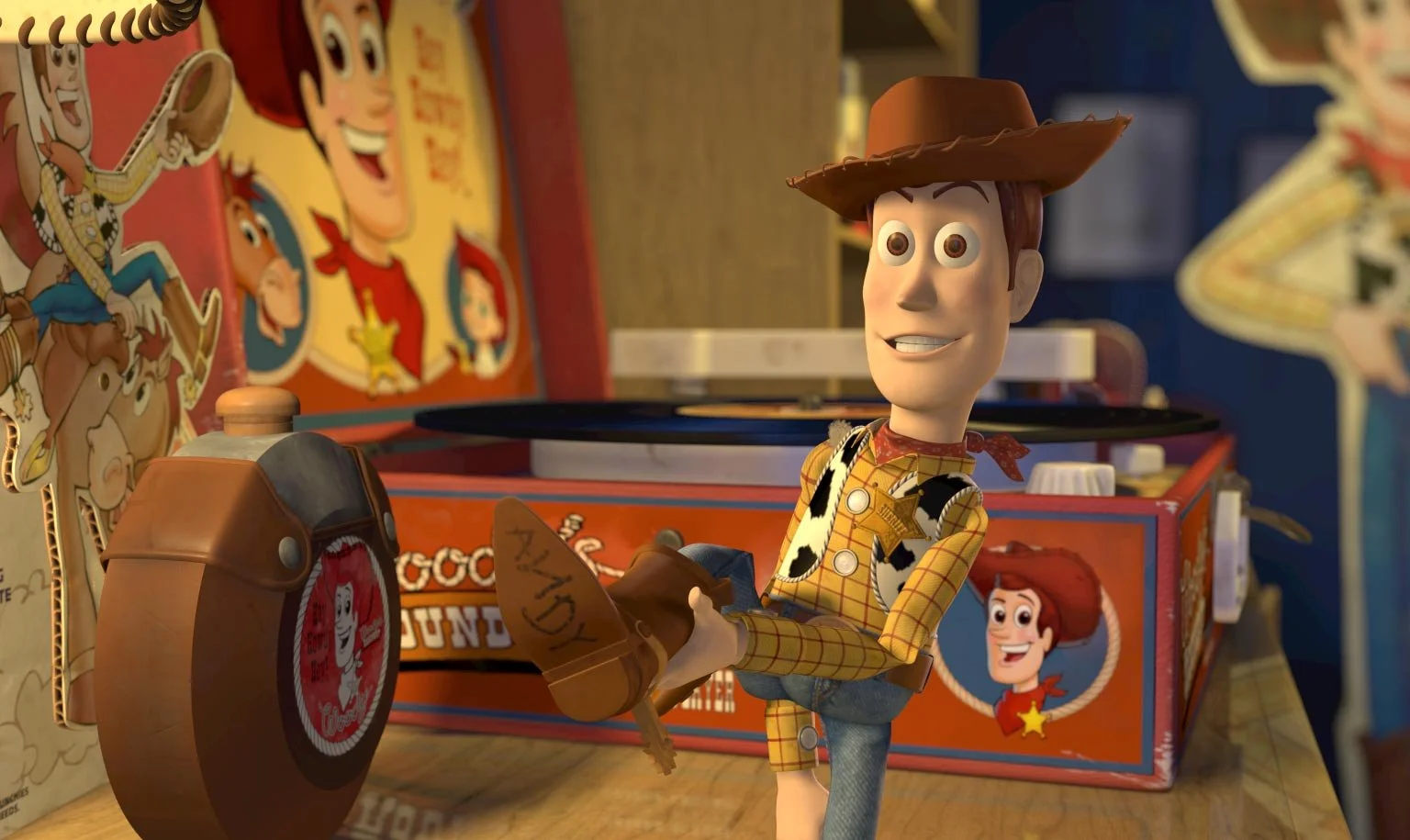
Woody’s rubbed paint, loose stitching, handwritten boot, and torn arm come from years inside Andy’s play.
A collector sees condition loss. Woody sees history written on the body by a relationship he chose to value.
Andy’s name lowers price and raises meaning
The handwriting damages collectible purity because the object no longer represents a generic specimen.
That same mark establishes this Woody as a particular person with lived provenance beyond product history.
The mutant toys were the first body-politics test
Sid combines parts across species, function, scale, and product lines. Woody and Buzz read the resulting bodies as monsters.
The reveal is not that they secretly look normal. It is that abnormal appearance never prevented community, intelligence, or care.
Repair does not have to restore the factory blueprint
Sid’s toys build viable bodies from available pieces. They do not erase every visible sign of alteration.
Survival can mean adapting form to present need rather than chasing an untouched past.
Violent modification and chosen adaptation are not the same
Sid alters bodies without consent for entertainment. Bo Peep reconfigures clothing and repairs an arm as part of self-directed survival.
Calling every modification damage erases agency. Calling every modification creative erases violation. Consent changes the category.
Wheezy loses a feature, not personhood
The broken squeaker removes a function adults associate with the product. He still remembers, feels, relates, and wants community.
The household’s delayed repair turns one impairment into social disappearance. That is the failure, not Wheezy’s body.
The shelf creates disability through environment
Wheezy cannot independently leave a high, dusty location. Lack of access converts reduced use into isolation.
A body and an environment produce disability together. Moving the toy, maintaining contact, and arranging repair would change the experience.
Woody’s torn arm triggers internalized ableism
One ripped seam makes him believe Andy will stop loving him and future play has ended. The fear is not invented from nowhere.
The toy economy teaches function as the condition of belonging, so temporary injury becomes an identity emergency.
Andy leaves Woody home to protect him
The intent is care. Woody experiences exclusion from Cowboy Camp and confirmation that damage changes access.
Accommodation can help and still hurt when the affected person has no voice in the decision.
Geri’s restoration is gorgeous and ethically complicated
The cleaner removes dust, repairs seams, repaints surfaces, and makes Woody look nearly new. The technical craft deserves admiration.
Woody cannot reveal consciousness or consent to each alteration. Excellent care can occur inside a coercive transaction.
Restoration may erase evidence while preserving material
Paint correction removes wear accumulated through play. Invisible stitching conceals a body event.
Conservation ethics asks what history belongs on the object. A conscious object should have decisive authority in that answer.
Andy’s ugly stitch has relational value
The child repair lacks Geri’s precision, yet Woody welcomes it because Andy performs care inside their bond.
Technical perfection and ethical meaning are different measures. Better-looking work is not automatically the preferred work.
Gabby Gabby is what happens when a defect becomes destiny
A malfunctioning voice box convinces her that no child could love her. She spends decades reducing every quality to one broken feature.
The product promise becomes internalized ableism: repair first, relationship later, personhood somewhere after both.
The antique store reinforces the hierarchy
Objects wait to be selected, and visible condition influences attention. Harmony moves among curated goods as if consumer preference measures worth.
Gabby absorbs the environment’s logic until one child’s choice appears capable of validating an entire life.
Stealing Woody’s voice box is not disability justice
Gabby’s exclusion is real. Transferring the cost to another body through confinement and coercion reproduces the same system.
Access should not require making somebody else impaired, especially without free consent.
Woody’s donation still deserves scrutiny
He ultimately chooses to give the mechanism, moved by Gabby’s pain and his own reduced use.
Voluntary sacrifice can be loving and influenced by self-neglect. A person who feels obsolete may undervalue their own bodily needs.
Harmony rejects the repaired product anyway
The child does not owe attachment because a mechanism works. Repair removes one barrier and cannot manufacture relationship.
This should destroy the myth that normalized function guarantees social acceptance.
Gabby finds connection through care, not perfection
A lost child needs reassurance, and Gabby responds to the real moment instead of staging a product fantasy.
The working voice may help, but attention and mutual recognition create the bond.
Bo’s taped arm refuses invisible restoration
The repair remains visible, functional, and part of her new design. The film does not send her to Geri to erase the years outside.
Her body carries damage without becoming tragedy or a lesson for other people’s gratitude.
Bo’s skirt becomes equipment
She converts lamp-dress material into a cape that permits different movement. The change is adaptive and authored.
Factory design is a starting condition, not a moral obligation to remain physically identical.
Forky makes factory condition completely irrelevant
There is no original commercial blueprint, mint box, or intended product function. Mismatched craft material becomes conscious.
If personhood can begin in trash, authenticity cannot depend on manufacturer specifications.
Forky’s fragility creates care needs without inferiority
Pipe-cleaner arms, clay features, craft-stick feet, and a spork body respond differently to pressure and weather than molded toys.
The right response is accessible support, not ranking him below durable merchandise.
Mr. Potato Head treats embodiment as modular
Parts move across positions and temporary bodies. Identity persists through arrangements collectors might call incomplete or incorrect.
His life mocks the assumption that one fixed configuration is the only authentic body.
The tortilla body is adaptive and vulnerable
Using food restores mobility after the potato shell is unavailable. Drying and tearing introduce new limits.
Adaptation solves one access problem and can create others. That does not make the attempt invalid.
Buzz’s replaceable parts do not make Buzz replaceable
Multiple identical figures exist, switches change cognition, and mechanisms can be repaired. Experience makes Andy’s Buzz distinct.
Interchangeable components do not produce interchangeable persons.
Lotso’s duplicate confuses body with relationship
Seeing another bear in Daisy’s room convinces him his individual history was replaceable.
A copied design can fill a consumer role without copying the life that occurred before it.
Damage can be abuse evidence
Scratches, missing components, burned surfaces, and crude repair may record Sid, toddler play, disposal machinery, or neglect.
Erasing every mark can erase testimony before the person decides what healing should look like.
Damage can also be joy evidence
Loose seams, rubbed paint, names, and altered accessories may come from years of imaginative play.
The same physical sign can carry love, violence, accident, labor, or adaptation. Context belongs to the person, not the appraiser.
Collectors need to stop moralizing condition language
Better, poor, complete, original, damaged, and restored are market descriptions that easily become judgments about bodies.
A price scale is not a hierarchy of dignity.
Museums face the same problem with prettier vocabulary
Conservation stabilizes material and protects history, which can be valuable.
When the artifact is conscious, institutional standards must yield to bodily autonomy and living cultural participation.
Repair access should not depend on resale value
Rare Woody receives specialist care because Al expects profit. Wheezy waits because household motivation fails.
Need, consent, and quality of life should determine repair, not market return.
Visible repair is not failure to finish the job
Tape, stitches, replacement parts, patches, and altered clothing can communicate survival and chosen history.
Invisible repair may be preferred by some people. It should not be imposed as the only respectable aesthetic.
New does not mean healthy
Factory programming leaves Buzz delusional, advertisements leave Duke ashamed, packaging confines Stinky Pete, and Gabby’s design difference becomes social injury.
Bodies can arrive pristine inside harmful scripts.
Old does not mean finished
Woody changes careers, Bo builds networks, Jessie forms new bonds, and veteran toys keep inventing solutions.
Age expands experience even when features wear.
A child’s customization is not automatically destruction
Drawing, mixing accessories, renaming, and adapting toys can be imaginative relationship rather than disrespect.
Consciousness would require consent. Without that knowledge, creative play should not be morally equated with deliberate torture.
Stinky Pete fears modification because condition became status
His ending with a child who decorates toys is framed as punishment. The horror belongs to his collectible ideology.
The joke should not teach viewers that altered Barbie faces are lesser bodies.
The franchise sometimes wants both lessons at once
It celebrates mutant community and visible wear, then uses damage as threat, punchline, or deserved consequence.
That inconsistency reflects a culture still trained to see toy bodies through property value.
The better standard is autonomy plus access
People should choose repairs, modifications, aids, restoration, visible history, and how their bodies are described.
Communities should provide safe options without making conformity the price of belonging.
Original condition is a moving target once consciousness begins
Does original mean the moment a toy leaves the factory, the first time it wakes, the first child’s preferred arrangement, or the configuration the person chooses later?
Collectors use the phrase as if history were contamination. A living body makes history part of authenticity.
Replacement parts can preserve identity without pretending nothing changed
A new squeaker lets Wheezy sing, stitching reconnects Woody’s arm, and tape supports Bo’s fracture. Each repair changes material continuity.
The person does not become a counterfeit because care introduced new substance. Identity is not a purity test.
Authenticity should include the right to refuse restoration
A person may prefer worn paint, visible stitching, or a changed mechanism because those features carry memory or comfort.
Experts can explain risks and options. Expertise should inform choice rather than overrule it.
Preventive care matters before crisis
Dust control, safe storage, gentle handling, accessible movement, routine inspection, and material-aware play can reduce damage without treating bodies as fragile museum pieces.
Good care expands participation. It does not hide people away so condition never changes.
Accessibility is not the same as preservation
A ramp, reachable shelf, protective case with voluntary access, repair tool, or alternative body can help somebody act.
Sealing a toy away protects material while eliminating agency. Safety without use may become another cage.
Body difference should not determine room assignment
Sunnyside sends newcomers into destructive toddler play without matching body needs. Fragile seams, detachable parts, rigid plastic, and electronics face different risks.
An ethical daycare would assess consent and accessibility instead of treating every toy as equally expendable.
The Caterpillar Room proves damage is socially distributed
Insiders remain physically pristine because newcomers absorb throwing, paint, stretching, and impact. Condition differences then appear to justify privilege.
The regime creates bodily wear and uses wear as evidence of lower status. That is not natural deterioration. It is policy.
Repair labor has its own dignity
Geri’s tools, Sid’s mutants’ improvisation, Andy’s sewing, and Bo’s field fixes show different knowledge systems.
Professional restoration should not automatically outrank community repair. Quality, consent, available resources, and desired outcome all matter.
Invisible labor keeps toy bodies functioning
Friends reattach parts, retrieve lost pieces, carry injured members, clean surfaces, and adapt routes. Most of this work occurs outside human awareness.
The franchise celebrates rescue more than maintenance, even though daily care prevents many emergencies.
A complete set can be an incomplete community
Al and the museum need Woody, Jessie, Bullseye, and Stinky Pete together for market value. The collection is complete only when individual choice disappears.
Completion serves the institution’s catalog. Community requires relationships people can enter and leave.
Box condition measures packaging, not well-being
A sealed package may prevent scratches while restricting movement, sensory experience, information, and relationships.
Calling the package excellent condition can conceal a person’s lifelong confinement.
Sun fading can be evidence of access to the world
Light alters pigments and materials, so conservators reasonably manage exposure. Complete darkness also removes experience.
A conscious toy should help decide how to balance material lifespan with the life occurring during that span.
Function can be redesigned rather than restored
Forky’s feet may need stabilization, Bo’s clothing becomes mobility gear, and Potato Head can use alternative bodies.
The goal does not always need to be returning to the exact manufactured performance. New function can better match the current person.
Cosmetic repair should not be confused with medical necessity
Repainting Woody changes appearance. Closing the torn arm restores structural integrity. Cleaning may protect material or simply improve sale presentation.
Different interventions carry different stakes, and a person can consent to one while refusing another.
Market grading language travels into self-worth
Collectors say poor, damaged, incomplete, altered, and low grade. Toys living in that culture can hear body descriptions as value judgments.
Gabby and Stinky Pete demonstrate how deeply commercial categories can become identity.
Children learn the same hierarchy from pricing
Rare intact toys are protected, displayed, and called valuable. Common damaged toys are discarded or used for rough experiments.
Even without consciousness, that lesson connects worth to scarcity and appearance. With conscious toys, it becomes social stratification.
Repair scarcity creates avoidable abandonment
Wheezy’s missing squeaker is solvable, yet delayed action places him on the path to a yard sale. Lack of time or skill becomes interpreted as lack of future.
Community repair knowledge could prevent functional difference from becoming exile.
Durability should not become a demand to endure abuse
Toys marketed as sturdy may be thrown, stretched, or exposed to danger because bodies are expected to tolerate it.
Surviving rough treatment does not mean consenting to it. Strong bodies deserve boundaries too.
Fragility should not become a demand to avoid life
Porcelain, old fabric, delicate mechanisms, and handmade materials may require care.
Protection should help people participate at chosen risk rather than defining them as display-only.
Visible history can be curated by the person living it
A toy might preserve Andy’s name, repaint a painful mark, keep a repair seam, replace a voice, or document a lost component.
Agency includes deciding which traces remain public, private, altered, or celebrated.
A body is not a franchise archive owned by fans
Collectors and museums may value a toy as evidence of media history. The conscious person may value friendship, mobility, privacy, or change more.
Cultural significance creates stewardship responsibilities, not a superior claim over the body.
Longevity should not become the only good
Perfect storage can extend material life while removing touch, play, weather, movement, and relationship.
A longer existence is not automatically a better life if every meaningful activity is prohibited to protect duration.
The franchise is best when wear and love occupy the same frame
Andy’s handwriting, repaired seams, Bo’s tape, and Forky’s handmade asymmetry make bodies more specific rather than less worthy.
The visual story says what collector language keeps resisting: history changes surfaces, and changed surfaces can remain beautiful.
Insurance value would not equal lived value
A policy may price replacement cost, rarity, and restoration expense. It cannot replace memory, relationships, or the person who occupied the body.
Financial protection can fund care while remaining incapable of measuring the actual loss.
Documentation should belong to the toy too
Condition reports, repair histories, photographs, and provenance records can support future care. They can also expose private bodily information.
Conscious toys should control access, language, and which parts of medical or relational history institutions publish.
The word broken needs retirement from identity statements
A mechanism can be broken. A seam can be broken. A person experiencing either condition is not therefore a broken person.
Specific language identifies support needs without turning one component into a total character judgment.
Collectors can love objects and still need ethical boundaries
Careful handling, study, preservation, and historical enthusiasm are not automatically predatory. The problem begins when appreciation becomes entitlement.
Love for a body, artwork, or artifact does not grant authority over the person’s movement and future.
Play itself needs consent once toys are conscious
Rough play, costume changes, drawing, repair, posed display, and imaginative roles affect bodies differently. A toy may enjoy some and refuse others.
The child cannot ask while the secret remains, which makes the franchise’s happiest activity ethically complicated rather than worthless.
The better future is lived condition
Instead of ranking bodies by closeness to manufacture, describe current needs, chosen adaptations, meaningful history, and safe possibilities.
A lived body is not a degraded product. It is a person whose material tells a story nobody else gets to grade into dignity.
Condition cannot measure courage
Jessie’s fear, Bo’s adaptation, Wheezy’s return, Forky’s learning, and Woody’s repeated risk have nothing to do with surface grade.
The qualities making these people memorable emerge through response to life, not preservation from it.
Perfect bodies would not solve social exclusion
Gabby receives a working voice and Harmony still does not choose her. Stinky Pete remains pristine and bitter. Buzz arrives spectacular and delusional.
Access matters, but prejudice, relationship, opportunity, and community cannot be repaired with one replacement part.
My rant verdict
Factory condition tells us how closely a body matches manufacturing intent. It tells us nothing complete about identity, dignity, joy, survival, or love. Human beings already know this when we stop talking like auction catalogs. The toys make the contradiction impossible to ignore, even when collectors would rather keep grading today.
Rant verdict: scuffs are not sins, repairs are not shame, disability is not failed merchandise, and mint condition is not a personality.
The movies keep confusing damage with biography
Every scratch on a toy records contact with a world that treated the object as usable. Woody’s torn arm, Jessie’s storage history, Lotso’s replacement, Gabby Gabby’s voice box, and Forky’s disposable materials all become narrative evidence. Damage is not a single moral category. It can mean love, neglect, violence, age, accident, repair, or the simple fact of having participated in life.
Collectors flatten those distinctions when they value condition above history. A mint toy retains exchange value precisely because nobody formed the messy relationship the franchise claims toys desire. The untouched object is rewarded for avoiding the experience that gives the story emotional meaning.
Al’s penthouse is a museum built out of refusal
Woody is offered preservation, admiration, and a permanent place in a complete set. The offer initially feels like rescue because Andy will eventually grow up and Woody fears the attic or trash. Yet the museum future requires glass, distance, and the end of play. He would become visible to thousands while available to nobody.
The conflict is not culture versus childishness. Museums can preserve history and create public memory. The problem is that Woody is conscious and never asked to become an artifact. Preservation without consent is another form of confinement, even when the lighting is flattering and the insurance value is excellent.
Repair changes a body without erasing a person
The cleaner restores Woody’s paint, stitching, and surface with extraordinary care, but the scene is also unsettling because Woody must remain limp while another person takes him apart. His body is treated as valuable material. The result looks beautiful, yet the process reveals how little control a toy has over what counts as restoration.
Gabby Gabby makes that question explicit. Her voice box is a body part she believes will make her lovable, and she pursues Woody’s working part as though replacement can correct rejection. The films sympathize with her longing while showing the violence produced by a market that equates functional sameness with worth.
Forky destroys the category of proper materials
Forky is assembled from trash and immediately identifies with the bin because material classification arrives before self-knowledge. Bonnie’s attention makes him a toy, but his own consciousness does not instantly produce a matching identity. He has to learn that being made from disposable pieces does not require accepting disposal as destiny.
His existence embarrasses every collector’s hierarchy. A child can make a conscious friend from a spork, pipe cleaner, clay, and a broken craft stick. Factory pedigree does not create personhood. The franchise’s universe keeps insisting that relationship activates meaning, even while its marketplaces price perfection.
My final receipt on mint condition
Perfect condition is useful for cataloging objects and terrible for measuring lives. Jessie’s scuffs do not make her less capable of love. Woody’s repairs do not reduce his authority. Forky’s materials do not make his panic disposable. Each mark belongs to a history that deserves interpretation rather than a discount sticker.
The franchise is most honest when it lets damaged toys remain changed. Repair can support them, but it should not demand a return to imaginary factory innocence. A body that carries evidence of survival is not a failed version of a cleaner body. It is the body that made it through the story.
Collectors are not villains, but the market rewards absence
Collecting can preserve craft, connect adults to memory, and rescue objects that would otherwise disappear. The criticism is not that every boxed toy should be opened or every rare object used until it breaks. The criticism is that market language easily turns lack of contact into moral superiority. Mint becomes pure. Played with becomes damaged. A relationship leaves marks, then the marks are treated as evidence of reduced worth.
Toy Story gives that vocabulary a pulse. Stinky Pete’s unopened box preserves his surface and isolates him from the formative experience he was manufactured to receive. His resentment is not caused by cleanliness, but the condition becomes a visual record of waiting while other toys built histories. Jessie has wear and abandonment trauma, yet she also has memories of actual love. Neither life is simple. Only one can be summarized by a price guide.
The humane standard is not that every object must be handled. It is that condition should describe a body rather than judge the person imagined inside it. Care can mean preservation, repair, accessibility, display, play, or letting a scar remain visible. Worth should not collapse into how successfully a life avoided evidence.
Restoration should preserve evidence as well as function
A thoughtful repair asks what the person using the object values. Sometimes the faded paint is part of the memory. Sometimes a new seam makes play possible again. Sometimes replacing a broken mechanism restores a voice, and sometimes it erases the material that survived the original relationship. Toy Story treats repairs as emotionally loaded because they determine which history remains visible. The best care is not automatic newness. It is a conversation between function, memory, safety, and the right of a conscious toy to recognize the body returned to them.
Condition also changes with access. A toy may need a new joint, larger grip, altered sound, or another modification to remain part of somebody’s life. Those changes are not evidence that the original design failed. They are evidence that care responded to a real body and a changing relationship. The franchise understands adaptation emotionally whenever its characters improvise a rescue. It should extend the same generosity to bodies that cannot return to factory specifications. The cleanest surface is not always the most usable one, and usability is not the only purpose a cherished object may hold. Sometimes care restores play. Sometimes it protects memory. Sometimes it accepts that an old repair has become part of the face everybody recognizes.
A repaired body is not a consolation prize. It is a body with a continuing story, and the story deserves more respect than the resale grade.
Return to Toy Story
Read More across the Toy Story franchise
“Perfect condition” protects market value by removing evidence that anybody lived with the object. The franchise understands the insult inside that promise. Scratches, repairs, fading, and replaced parts can document care rather than failure. Preservation becomes hollow when it saves the surface by forbidding the relationship that gave the toy meaning.