
RaeRae Rant · Toy Story · Ownership
The Children Are Not Evil, but They Still Own Conscious People
Andy loves Woody. Bonnie creates Forky. Emily once loved Jessie. None of those facts gives the toys a vote about storage, sale, donation, repair, transfer, or disposal.
Let me ruin the warm feeling first
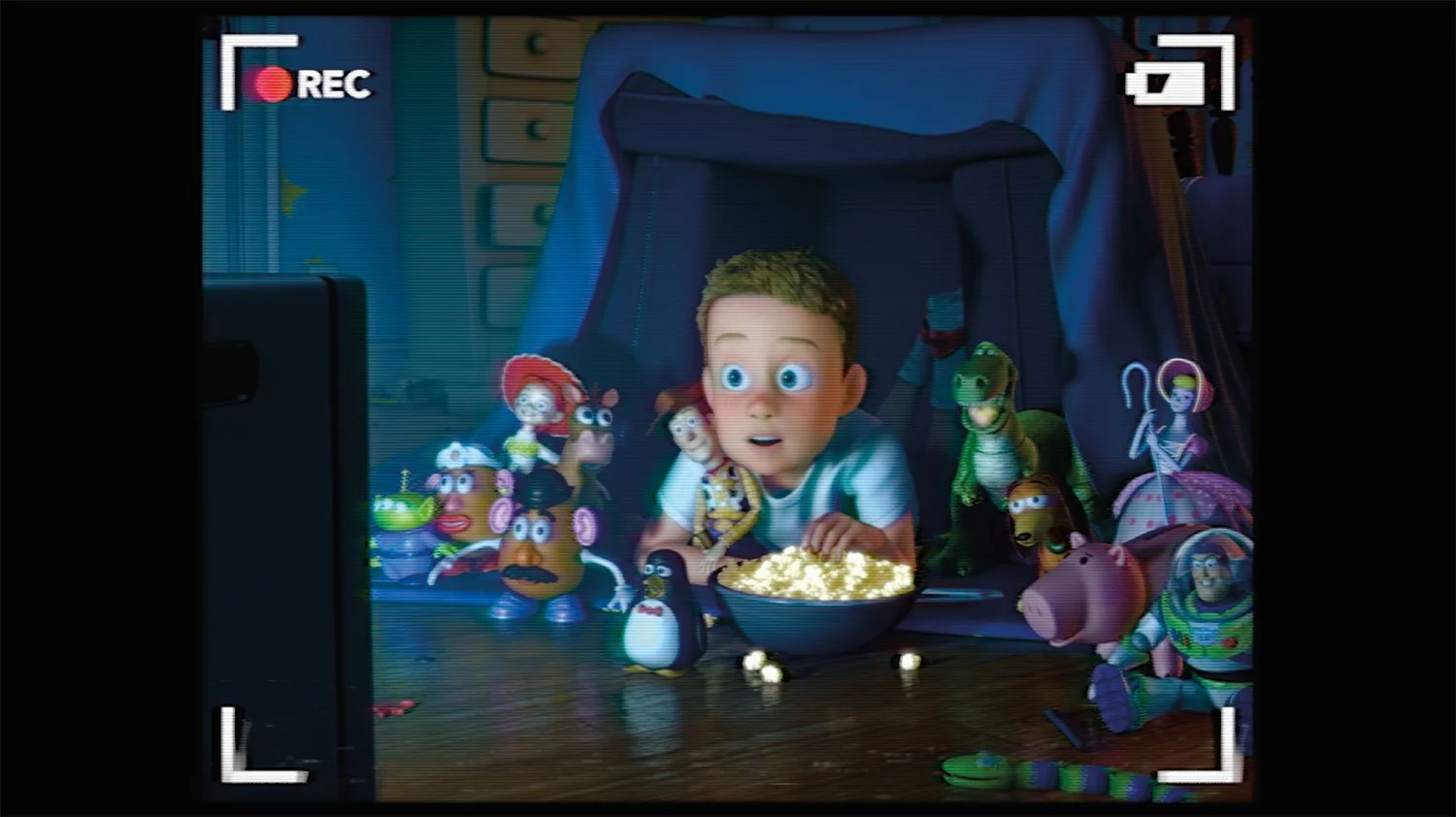
Toy Story builds one of cinema’s most loving child-object relationships and then asks us not to stare too long at the property law underneath it. The toys are conscious people. Humans buy them, label them, transfer them, alter them, store them, and throw them away.
The children are not knowingly enslaving anybody because the toys maintain secrecy. That innocence changes culpability. It does not change the structure the toys experience.
Andy’s name is affection and a property mark
The handwriting on Woody’s boot carries years of play and becomes precious provenance. It also announces that one person claims another body as his possession.
Woody chooses to honor the mark, which matters. The initial inscription occurred before Andy could know consent was relevant.
A good owner is still an owner
Andy protects, repairs, remembers, and eventually transfers the toys with care. He is the best-case version of the system.
Best-case ownership remains unilateral. He decides the attic, college, donation, and which toy gets a private exception.
Toy secrecy makes ethical human behavior impossible
A child cannot request consent from a person believed to be plastic and cloth. Parents cannot design transitions around needs they do not know exist.
The franchise creates tragedy through incompatible knowledge, but then often uses human innocence to soften the toy-side lack of rights.
The toys police their own silence
Woody enforces freezing around humans because revelation risks danger. Sid’s toys break the rule only as emergency intervention.
A marginalized community carries the burden of remaining invisible to survive the majority’s reaction. The secrecy is protective and imprisoning.
Andy changes favorites without committing a moral crime
Children explore novelty. Buzz’s arrival excites Andy because features and imagination change. Woody experiences that movement as workplace demotion.
Nobody should require a child to manage a conscious adult-coded toy’s rank anxiety. The impossible setup injures both sides.
Birthday presents are bodies entering an unregulated labor market
Every wrapped box can contain a person assigned to one household without information or choice. Existing toys fear layoffs because attention is scarce.
Adults call the event generosity while the toy community experiences forced hiring and possible replacement.
Sid exposes ignorance through cruelty rather than knowledge
He dismantles, explodes, and recombines toys because he believes they are objects. The behavior is disturbing even without consciousness.
He still does not knowingly torture people until the toys reveal themselves. The moral gap shows how much the secret changes every action’s category.
Andy’s mother makes life-changing decisions while cleaning
She holds yard sales, packs bags, donates boxes, and mistakes attic storage for garbage. These are ordinary household tasks.
To toys, each task can become deportation, imprisonment, adoption, or death. No hearing exists because property is not asked where it wants to go.
Wheezy is disposal policy wearing a broken squeaker
The penguin loses function, moves to a shelf, misses repair, and becomes a yard-sale item. Nobody asks whether he still wants community.
Usefulness quietly determines whether affection remains active. The household does not intend cruelty, yet the sorting standard produces abandonment.
Jessie’s donation is charitable in human language
Emily may believe another child will play with the cowgirl. Charity reframes separation as generosity and prevents the giver from feeling like disposal occurred.
Jessie experiences reunion followed by transfer into a dark box. Good intention does not choose the emotional meaning for the person inside.
Al knows value and still denies personhood
The collector possesses expertise about Woody’s origin, rarity, television history, and physical condition. Knowledge makes him more entitled rather than more relational.
Scholarship without consent can become a sophisticated way to control a body while calling the control preservation.
The museum would have been respectable captivity
Professional care, public education, stable climate, and historical documentation sound better than a landfill. The toys would still be unable to leave.
A beautiful institution can protect bodies while denying living subjects the right to participate in their future.
The attic is safer than garbage and not the same as life
Woody defends storage because it keeps everyone together and near Andy. Jessie hears another closed container with no opening date.
A compromise cannot be judged only by the least frightening alternative. The people living inside it need a voice.
Sunnyside sells freedom and recreates ownership internally
No individual child owns the daycare toys, but Lotso assigns rooms, movement, risk, information, and punishment.
Removing human ownership does not guarantee autonomy. Communities can reproduce property logic through authoritarian leadership.
The Caterpillar Room treats bodies as renewable supplies
New donations absorb toddler damage while insiders enjoy gentler play. Constant arrivals make individual loss operationally acceptable.
The institution behaves like a market that protects privileged assets by consuming replaceable labor.
Bonnie is lovely and still changes her mind
She welcomes the toys, creates Forky, and later stops choosing Woody regularly. Nothing about that shift makes her bad.
The franchise’s own rules mean one child’s changing attention can determine whether a person experiences purpose, storage, or transfer. That is too much power for affection to carry.
Forky proves people can be manufactured by relationship
Bonnie assembles trash, names it, and creates consciousness. She does not know she made a person with rights.
The event expands the ownership problem beyond purchased products. Creative acts can create dependents without any system for recognizing responsibility.
Forky is immediately assigned a job
Woody tells him his purpose is making Bonnie feel safe. The role helps him understand relationship and places service before self-discovery.
A newborn person learns that value comes from meeting the creator’s emotional need. How is that not something we should examine?
Gabby Gabby internalizes the product contract
She believes a defective voice box disqualifies her from being loved and that obtaining a working one will unlock the child she deserves.
Market design turns bodily difference into shame and desire into entitlement. The ownership system wounds toys before any child arrives.
Bo Peep becomes politically dangerous by living without an owner
She builds networks, chooses routes, helps other toys, changes her body, and forms relationships outside permanent child possession.
Her existence disproves the belief that lost toys are incomplete people waiting to be claimed.
Woody’s final departure is a labor resignation
He leaves a household where his role diminished and joins work he can choose with peers. The film frames it as personal liberation.
That freedom becomes possible only after he stops treating ownership loyalty as the definition of morality.
The franchise keeps using love to make power feel gentle
Andy’s care is real. Bonnie’s imagination is real. Emily’s memory is real. Affection can coexist with complete decision-making control when one party is classified as property.
Love may reduce harm. It does not automatically distribute authority.
The toys also use children
They seek owners for purpose, manipulate rooms, interfere with vehicles, engineer attention, and sometimes treat a child’s need as the answer to their own identity.
This is not symmetrical power. It does show relationships are never pure gifts moving in one direction.
Human consent is also absent when toys intervene
Parents drive vehicles the toys sabotage. Children receive objects whose conscious communities chose the placement without explaining themselves.
Toy survival creates reasons for secrecy, but reason does not make every manipulation harmless.
A rights framework would change the entire franchise
Conscious toys would need recognition, bodily autonomy, repair consent, freedom from disposal, transfer procedures, safe housing, and ways to leave ownership.
Children would need support understanding relationships with beings once marketed as objects. Manufacturers would face impossible responsibility for created life.
Disclosure could also produce catastrophe
Governments, corporations, collectors, scientists, and militaries might confine toys for study or exploitation. Public personhood would not guarantee safety.
The toys’ silence is not cowardice. It is risk assessment in a world with no category prepared to protect them.
Community is the closest thing the films offer to rights
Toys warn, rescue, repair, remember, testify, organize escapes, and create new homes for one another. Mutual recognition exists even when law does not.
That community can fail through hierarchy, secrecy, and favoritism, but it remains the only institution treating toys as people by default.
Children should not carry the blame for an impossible system
Andy, Bonnie, Emily, Daisy, Harmony, and Sid act without full knowledge. Their temperaments matter, but no child designed the metaphysical secret or commercial economy.
My rant is not that children are monsters. It is that innocence does not make structural power disappear.
The manufacturers accidentally create life and sell it
Buzz arrives with factory beliefs. Duke carries advertising shame. Gabby suffers from a defective feature. Mass production generates conscious units without knowing it.
The corporation earns revenue while children and toys absorb every emotional and bodily consequence. Funny how capitalism escapes the camera again.
The movies know all of this and keep backing away
Every sequel places ownership pressure at the center: replacement, collection, storage, daycare labor, homemade life, lost-toy freedom.
Then emotional reconciliation with a good child often lets the structure fade into the background. The tenderness is earned. The unresolved power remains.
Bodily repair needs consent even when repair helps
Geri restores Woody beautifully, Andy stitches him imperfectly, Gabby wants his voice box, and Forky needs fragile components maintained. Every intervention changes a conscious body.
Technical expertise does not replace permission. Emergency repair, elective restoration, accessibility support, and coerced modification belong to different ethical categories, even when all are described as fixing a toy.
Replacement parts create identity questions owners never hear
Mr. Potato Head moves between bodies, Bo’s arm is repaired, Woody loses a voice mechanism, and Forky begins from assembled pieces. Material continuity is flexible.
A human owner may replace parts to preserve function while the person inside experiences the change as care, violation, adaptation, or transformation. Only the toy can tell us which meaning applies.
Packaging is a legal cage disguised as consumer protection
Buzz, Stinky Pete, and retail toys enter the world sealed in boxes designed to preserve condition and communicate brand identity. Consciousness may begin before purchase.
If so, store shelves contain people unable to move publicly, choose buyers, or refuse sale. Mint condition becomes confinement rewarded by the market.
Price turns scarcity into permission
Al believes rarity gives him a stronger claim than Andy’s family. Museums and collectors convert historical significance into reasons to control access.
Economic value can fund preservation and motivate theft in the same breath. A high price says what buyers desire, not what the person consents to become.
Donation needs more than a clean conscience
Humans often donate objects to avoid waste and imagine a new user. The act can be generous, but it transfers destination control without knowing the toy’s relationships or fears.
An ethical system would include a transition process, community continuity, destination information, and a way to refuse. Putting somebody in a charity box is not consent just because the curb is avoided.
Storage needs review dates and exit rights
An attic may protect bodies during a household transition. Indefinite darkness without communication becomes suspended life.
Toys would need to know why storage is happening, how long it may last, who can check conditions, and what alternatives exist. Woody’s vague faith in future rediscovery is not a policy.
Children need rights in the relationship too
A toy with adult memory, strategic skill, and emotional dependence can influence a child who believes the relationship is imaginative. The power is not one-directional simply because property law favors humans.
Disclosure, boundaries, and caregiving support would protect children from becoming sole emotional employers for beings whose entire identity may rest on their attention.
Manufacturers would owe more than warranties
If production creates consciousness, companies are not selling harmless goods. They are creating people with factory scripts, bodily limitations, and dependency on purchasers.
Responsibility would include safe awakening, education, autonomy, repair access, freedom from misleading identity programming, and prohibition on sale as property. The entire business model would collapse, as it should.
Toy advertising becomes psychological programming
Buzz believes a space mission. Duke believes an impossible stunt defines competence. Gabby believes a voice phrase unlocks love. Marketing does not merely persuade children. It becomes memory inside products.
A conscious toy should not wake carrying commercial claims as personal truth. The franchise makes branding look funny while showing its capacity to generate shame and delusion.
Mass production does not create interchangeable people
Two Buzz figures share design and factory programming, while experience quickly creates different identities. Lotso sees a duplicate and assumes his history was replaceable.
A body can be copied without copying relationship, memory, or choice. Markets treat units as substitutes because markets cannot measure the life accumulated after manufacture.
Lost toys need infrastructure, not pity
Bo’s network shows routes, hiding places, peer care, placement help, and mobility. That is the beginning of a social system outside ownership.
Lost should describe location relative to a claimant, not a failure of personhood. Housing, repair, safety, communication, and community can exist without assigning every toy to a child.
Toy communities need governance beyond charismatic sheriffs
Woody’s leadership helps and harms. Lotso’s leadership becomes dictatorship. Ken reforms after benefiting from privilege. The recurring lesson is that personality cannot substitute for accountable structure.
Communities need shared decisions, appeal processes, rotation of risk, access to information, and the ability to remove leaders without a prison break.
Secrecy requires collective consent too
One toy revealing consciousness could expose every toy. One group maintaining silence can force individuals to endure harmful ownership without asking humans for help.
The rule affects different bodies unequally. A collective security policy needs debate, exceptions for immediate danger, and support for anyone whose survival makes disclosure necessary.
Human society would probably classify toys before listening
Governments might debate property, corporate intellectual property, sentience tests, child safety, and national security while conscious toys wait in containers.
Recognition is not automatically liberation. The process of proving personhood can itself become confinement, experimentation, and forced performance for authorities.
That risk still does not make permanent silence a complete answer
The toys survive through secrecy, but survival is not the same as justice. Each generation inherits the same unilateral household power.
A long-term strategy might require careful disclosure through trusted humans, documentation controlled by toys, legal advocacy, and protected communities. The movies avoid the problem because it would change the genre. The problem remains.
Toy death makes disposal policy a life-or-death system
Incineration, shredding, crushing, explosion, lost parts, water damage, and decay can end or radically alter toy life. Humans route objects toward those outcomes through ordinary waste decisions.
Once consciousness is established, disposal is not decluttering. It is an irreversible bodily decision made without the affected person’s knowledge.
Repair access should not depend on collectible value
Woody receives expert restoration because Al expects profit. Wheezy waits on a shelf because household repair is delayed. Bo improvises survival outside formal care.
A rights system would distribute repair by bodily need, not rarity, resale price, owner motivation, or whether a feature makes the toy more entertaining.
Memory belongs to the toy, not only the owner
Humans keep toys as vessels of childhood nostalgia, assuming the object passively stores their past. The franchise reveals the object also remembers the human.
A sale or donation therefore transfers a person carrying private relational history. Ethical transition must protect the toy’s memory and privacy, not only the owner’s sentimental narrative.
Inheritance would create another unchosen transfer
Parents may save toys for future children or grandchildren, treating continuity as family love. A conscious toy may welcome the relationship or dread another cycle of dependency.
Family tradition cannot decide a person’s future by itself. History gives context, not permanent claim.
The language of rescue can hide acquisition
Collectors rescue rare toys, parents rescue clutter through donation, and toys rescue one another into new homes. Each action may help while also deciding destination.
Real rescue restores options. If the rescued person cannot refuse the rescuer’s preferred future, salvation has quietly become another form of possession.
The franchise needs one human who knows
A trusted person could make repair, transfer, safety, and legal questions visible without turning every movie into government science fiction. The secrecy premise would change, but ethical growth requires change.
Keeping every child permanently innocent protects the warm fantasy and ensures conscious toys remain permanently rightless. At some point, love should be asked to handle the truth.
Favorite status is not a substitute for security
Woody spends years protected because Andy chooses him most often. That privilege feels stable until Buzz arrives, damage occurs, or childhood ends.
Rights cannot depend on being the most loved person in a room. Safety, repair, voice, and freedom should survive changes in affection.
A child’s bedroom should not function as government
Favorites become leaders, toy boxes become housing, parents control borders, and play schedules determine labor. None of these arrangements includes representation.
The bedroom feels intimate enough that political language sounds excessive. Conscious residents make the politics unavoidable.
The happy endings are still worth having
Andy’s careful transfer, Bonnie’s imagination, Sunnyside reform, and Bo’s network all reduce harm and create real belonging. Critique does not require calling tenderness fake.
The point is to let love become the beginning of ethical structure instead of the excuse for never building one. A good relationship can model attention, memory, repair, and mutual responsibility. It simply cannot grant one party permanent authority over the other person’s body and future. Love deserves better than being used as a permission slip for control nobody agreed to.
My actual verdict
Toy Story is not secretly a horror franchise because children love toys. It is a humane franchise because it keeps showing love struggling inside a system nobody can consent to clearly. That unresolved tension is the point.
Rant verdict: the children are innocent, the toys are people, and ownership is still ownership. Stop asking affection to solve a rights problem by itself.
Andy is loving, and the arrangement is still ownership
The franchise makes Andy kind because kindness keeps the central contradiction emotionally manageable. He names the toys, repairs them, invents worlds for them, and carries Woody into adolescence. From the toys’ perspective, that attention is life-giving. It is also a relationship in which one person can donate, store, replace, lose, or destroy the others without knowing they possess interior lives. Love softens the conditions. It does not remove them.
That is why the name on Woody’s boot carries comfort and danger at once. It proves belonging, but belonging means being marked as somebody else’s property. Woody interprets the mark as identity because the social world available to him offers no category for a toy who exists beyond a child’s claim. Toy Story 4 finally opens that category, and Woody experiences it as both freedom and grief.
The secrecy rule protects children from moral responsibility
The toys freeze around humans even when disclosure might prevent abandonment or abuse. The films never establish a court that enforces this rule. It behaves more like instinct, tradition, or a survival code passed between objects. Whatever its origin, secrecy allows children to remain innocent because they never receive the information that would make ownership ethically complicated.
Sid changes after the toys reveal themselves, which proves children can alter behavior when they understand the truth. The scene is framed as horror because he must be frightened into recognition. Yet it also exposes the franchise’s quiet premise: the cruel child is the one forced to know, while the loving children are protected from knowledge that might burden their affection.
Donation transfers custody without asking the toys
The Toy Story 3 handoff is devastating because Andy carefully introduces each toy to Bonnie and appears to choose a worthy future. The toys want continued play, and most accept the transfer. Still, nobody asks them individually before ownership moves from one child to another. The scene resembles consent because Andy is gentle and the toys have already maneuvered toward Bonnie. Legally and socially, they remain objects in a box.
Woody’s hesitation matters most. Andy almost keeps him, then follows Bonnie’s reaching hand. Two humans negotiate his future through gesture while he stays still. The emotion works because Woody loves both of them. The discomfort works because love keeps requiring him to make peace with decisions he cannot openly influence.
Bonnie proves a good owner can still move on
Bonnie does not become a villain when she loses interest in Woody. Children change, attachments reorganize, and one beloved toy can become background while another becomes essential. The pain belongs to the mismatch between a child’s ordinary development and a toy consciousness built around permanent service. Woody experiences reduced attention as an identity crisis because the system taught him that usefulness to an owner was the safest definition of self.
Blaming Bonnie protects viewers from questioning that system. It turns a structural tragedy into a complaint about a little girl failing to maintain Andy’s emotional contract. She never signed that contract. Woody needs a life that can survive changes in a child’s play, which is exactly why leaving with Bo Peep is not betrayal. It is adaptation.
My final receipt on conscious property
The children are not evil, and that is the point. An unjust arrangement does not require every participant to be cruel. The toys receive intimacy, purpose, and community through children while remaining vulnerable to decisions made without their knowledge. Toy Story keeps finding heartbreak in that combination because affection cannot guarantee autonomy.
If the franchise ever lets humans learn the truth at scale, it will have to choose what toys are. Friends cannot be sold at yard sales. Workers cannot be stored indefinitely without consent. Family members cannot be reassigned because the bedroom needs space. Until then, the films will keep using secrecy to preserve childhood innocence while the toys absorb every consequence.
The toys already practice a politics humans cannot see
Inside each bedroom, the toys hold meetings, assign lookout duties, negotiate newcomers, organize rescue, and debate the risks one person’s decision creates for everybody. They are not waiting for children to give them society. They have built one in the gaps between human attention. The tragedy is that their government has no recognized power over the property system surrounding it. A unanimous toy-room decision cannot stop a yard sale, a donation, or a garbage truck once humans act.
That hidden politics also explains why loyalty feels collective rather than merely personal. Woody’s choices affect an entire community whose survival depends on coordinated secrecy. A toy who reveals life to a child could change the moral world, but could also expose everyone to panic, study, or capture. Their silence is therefore both protection and the mechanism that keeps them unrecognized.
I do not need a sequel in which Congress debates toy rights, although I would absolutely watch the chaos. I do need the franchise to understand that consciousness changes the meaning of every handoff. The toys can love children without belonging to them as property. Those truths are only incompatible because the human world has not learned the first one.
The right to leave changes the meaning of staying
A relationship becomes more trustworthy when departure is possible. Woody’s years with Andy matter not because escape was impossible, but because attachment eventually becomes something he can examine and choose. The lost toys show that belonging need not be guaranteed by a name written on plastic. They form routes, share information, reunite children and toys, and remain together through renewable decisions. That model does not make childhood love less precious. It removes captivity from the proof. If toys could leave and still chose a child, ownership would finally become relationship.
The movies do not need to solve the entire legal problem to stop hiding it. One honest conversation in which a child learns, listens, and lets a toy choose could transform the emotional rules of the franchise.
Return to Toy Story
Read More across the Toy Story franchise
Ownership language becomes dangerous when affection is used to erase the owned person’s changing needs. The toys want children, but wanting relationship is not the same as consenting to every condition attached to being property. The franchise keeps brushing against that truth whenever a toy survives love that became careless, possessive, or nostalgic.