
Anime 101 · Toy Story · Easter Eggs and Craft
Toy Story Easter Eggs That Actually Matter, Plus the Pixar Craft Hiding Behind Them
Pizza Planet is the easy part. The deeper trail runs through cloud wallpaper, colorscripts, duplicate Buzz bodies, real landfill research, antique-store dust, and Toy Story 5’s hand-built pastel imagination.
First, an Easter egg is not the same thing as a theme
An Easter egg is a deliberate detail that rewards recognition: a returning truck, object, name, image, or reference placed where attentive viewers can find it. A theme is an idea developed through story. A recurring production design choice can be both, but calling every parallel an Easter egg makes the category useless.
This guide labels confirmed details, documented production choices, and critical interpretations separately. A screenshot that resembles another Pixar character is not automatically canon. The fun survives when uncertainty is admitted.
Pizza Planet began as story design, not cameo bait
Pixar’s official Toy Story material explains that the restaurant was originally conceived with a miniature-golf theme. Buzz’s space-ranger identity pushed the designers toward Pizza Planet, a place he could mistake for a spaceport. The truck emerged from a narrative need before becoming a studio-wide recurring object.
That origin matters because the best Easter eggs carry earlier story function. The truck is not memorable only because it appears again. It once helped Woody exploit Buzz’s delusion and move both characters toward Sid’s house.
The Pizza Planet truck becomes a studio signature
After Toy Story, the yellow delivery truck began appearing across Pixar films. Pixar itself identifies the vehicle as a source of later cameos. Viewers can treat confirmed appearances as a playful connection among productions without assuming every story occupies one literal universe.
A company can reuse a visual asset, honor its history, and invite audience recognition at the same time. Shared iconography is not the same as shared physics. The truck proves Pixar remembers Toy Story; it does not prove sentient cars and Andy share municipal records.
The cloud wallpaper is an emotional clock
Andy’s blue sky and white clouds establish his original bedroom as safe, open, and childlike. Toy Story 3’s official production notes describe how later rooms changed as Andy aged. The wallpaper is not only background nostalgia. It is a visual measure of a childhood the toys cannot keep still.
When later films echo clouds, the image carries the franchise’s first promise of home. Recognition hurts because the viewer knows the wall did not preserve the child who slept beside it.
The Western opening turns wallpaper into an imagined world
Toy Story 3 expands Andy’s blue-sky imagery into an enormous Western rescue with trains, spaceships, dinosaurs, and the Death by Monkeys threat. Pixar documents the opening as a deliberate visual cue from the original room. A background surface becomes the sky inside Andy’s remembered play.
This is a callback doing narrative work. The scene proves that the inexpensive room set always contained a blockbuster when a child supplied imagination. Technical spectacle serves an old crayon-and-cardboard idea.
Woody’s Roundup is an Easter-egg machine with a moral purpose
The black-and-white television program, merchandise, lunchboxes, records, puppets, and supporting characters give Woody a commercial past he never knew. Each object expands the fake program while confronting him with the difference between collectible history and lived relationship.
Later Roundup objects around Jessie and Emily are meaningful because they reopen that archive. The reference is not “remember this logo.” It is evidence that children once organized real affection around a manufactured story.
The airport repeats Pixar’s love of hidden infrastructure
Pixar’s Toy Story 2 page notes that the airport rescue involved the Pizza Planet truck and a vast conveyance system, two devices that would recur in other films. Belts, vents, chutes, gears, and service corridors let small characters inhabit architecture humans ignore.
The pattern becomes a production signature because it changes scale. Ordinary logistics become mythic when a body is twelve inches tall. Spotting another conveyor is fun; noticing how it converts human convenience into toy danger is better.
The duplicate Buzz aisle is more than a visual joke
Toy Story 2 places Buzz among rows of unopened versions of himself and introduces a Utility Belt Buzz who believes the box fiction. The sequence repeats the original identity crisis under mass-production conditions. A body can look identical while experience creates a different person.
Toy Story 5’s Hi-Tech Buzz figures turn that old image into a new argument about upgrades and disposal. The callback matters because the aisle’s promised abundance has become an electronic waste stream.
Zurg parodies space opera without needing one exact source
Emperor Zurg draws on familiar galactic-villain language, including family-revelation jokes and imposing mechanical design. The references work as parody rather than proof that another franchise exists inside Toy Story canon. Buzz’s commercial mythology absorbs the culture that manufactured him.
Viewers can name the obvious cinematic rhyme while still crediting Toy Story 2 for using it to expose how easily Utility Belt Buzz accepts a prewritten identity.
Colorscripts are the hidden map behind the finished frames
Pixar describes a colorscript as a sequence of small pastel images used to establish the color and emotional progression of a film. Ralph Eggleston set Toy Story’s visual style, and Bill Cone expanded it for Toy Story 2. The technique is planning, storytelling, and emotional notation at once.
When viewers notice Andy’s warm room, Al’s dim apartment, the fluorescent toy store, or the airport’s shifting light, they are seeing choices coordinated long before final rendering. The Easter egg is sometimes not an object. It is the return of a color relationship the audience remembers without naming.
Toy Story was the first CG feature, but “first” does not explain why it works
Pixar records the November 22, 1995 release as the world’s first computer-animated feature. The achievement changed production history, yet technical novelty alone could not sustain five films. The original survives because the tools serve readable staging, character conflict, and scale.
A craft guide should resist treating polygons like magic dust. Artists made decisions about lenses, camera weight, gesture, color, and cutting within severe limits. Constraint shaped the visual language audiences now call charming.
The first film’s limitations became part of the franchise look
Early computer graphics handled hard plastic more comfortably than skin, hair, cloth, or organic surfaces. A story about toys converted that limitation into subject matter. Plastic faces, painted wood, simple rooms, and manufactured shapes belonged to the world instead of apologizing for the technology.
Humans looked rougher because the same advantages did not apply. Later films could render people and fabrics more convincingly, but the original’s design reminds viewers that production strategy includes choosing a story the available tools can express.
Virtual cameras were treated as if they had weight
Pixar’s published retrospective explains that the original crew followed traditional cutting patterns and treated virtual camera movement as though a physical camera existed. Depth of field was expensive, so it was reserved for shots that materially benefited. Those limits prevented unlimited movement from becoming visual noise.
Toy Story 2 gained softer lighting, more depth of field, and more sophisticated movement. The improvement is visible without requiring the sequel to advertise every technical advance inside the plot.
Digital exhibition changed with Toy Story 2
Pixar’s history identifies Toy Story 2 as the first film entirely created, mastered, and exhibited digitally, while noting that only a limited number of theaters could present the digital-to-digital experience in 1999. The production pipeline and the audience’s projection technology were changing together.
This is not a background cameo, but it is essential franchise lore. The sequel’s story about old television merchandise arrived through a distribution method pointing toward cinema’s future.
Toy Story 3 uses camera focus to enter toy scale
Pixar’s technical retrospective describes greater emphasis on rack focus, character point of view, and richer color nuance through point-based global illumination. These were not upgrades for their own sake. They helped the audience feel the size and vulnerability of the toys inside larger environments.
The landfill depends on that credibility. A conveyor and furnace must feel physically real enough that plastic bodies appear mortal. Technical realism becomes emotional terror.
The landfill was researched as a real place and heightened as hell
Pixar artists visited dumps and treated the sequence as the endpoint of a toy life cycle. Official production notes compare the location to Dante’s Inferno and emphasize the need for believable fear. The setting is research transformed by dramatic design, not a photoreal scan dropped behind characters.
That distinction explains why reality and stylization cooperate. The audience recognizes material processes while composition, light, and scale turn them into a moral landscape about disposability.
Sunnyside’s colors perform the deception
The daycare must first appear welcoming and later reveal itself as a prison. Pixar researched child-care facilities and even Alcatraz, combining credible bins, tiny furniture, and institutional organization with lockdown staging. The same environment supports two emotional readings.
Small background details matter because they make the turn believable. A toy prison is frightening when it still looks exactly like a place adults would call cheerful and safe.
Bonnie’s room was designed to conceal an ending
Pixar needed viewers to like Bonnie and believe her room was imaginative without revealing that Andy would leave the toys there. The environment appears during Woody’s journey as a temporary refuge, yet its production design quietly establishes the emotional credibility of the final handoff.
On rewatch, every welcoming detail becomes advance evidence. This is production foreshadowing rather than a literal hidden object, and it rewards attention more deeply than a logo in the corner.
Toy Story 4 makes dust a technical character
Pixar research documents multiple approaches to dust and cobwebs in the antique store, including surface shading, geometric curves, debris, automation, and procedural systems across hundreds of shots. At toy scale, dust cannot remain a vague texture. Hair, grains, and dust bunnies become landscape.
The labor supports theme. Second Chance Antiques preserves objects while surrounding them with evidence of time. Gabby Gabby’s decades of waiting are visible on the world before she explains them.
The antique store was built from field research
Pixar’s official page describes visits to local antique stores and recurring discoveries: stoplights, jukeboxes, plastic Santas, handwritten receipts, extension cords, clutter, and cats. These details make the setting feel observed rather than assembled from a generic “old stuff” library.
Fans looking for Easter eggs should remember that some interesting objects are there because real stores contain them. Not every recognizable antique encodes a secret Pixar timeline. Research can produce specificity without producing canon.
Toy Story 4 sometimes had to become less realistic
Director Josh Cooley explained that newer technology could make shots staggeringly realistic, sometimes too realistic for the established world. The filmmakers pulled imagery back and retained stage-like lighting learned from the earlier films. Continuity required artistic restraint, not maximum detail.
This is a crucial production lesson. Progress does not mean rendering every pore, scratch, and reflection. The right image belongs to the story’s visual language, even when software can produce something more physically exact.
Rain reveals thirty years of material progress
The fourth film’s storm sequence combines water, wet surfaces, cloth, reflections, wind, and small-scale danger at a level impossible for the original production. RenderMan presentations identify the rain and antique warehouse as major technical work involving modern scene and effects tools.
The scene remains legible because spectacle follows action. Bo’s separation and the rescue attempt give every drop a dramatic purpose. A technology demo becomes memory because somebody is being lost inside it.
The carnival turns cheap prizes into a social class
Andrew Stanton described carnival prizes as unusually disposable toys. Production research covered rides, booths, lights, power cords, and the spaces humans do not enter. The environment therefore supports both beauty and an argument about objects designed for brief desire.
Ducky and Bunny are funny because their stitched captivity is literal and economic. The glowing carnival can look magical while selling a system in which many prizes will be forgotten quickly.
Combat Carl’s repetition plays with asset duplication openly
Toy Story 4 groups several Combat Carls, letting identical manufacture become character comedy. The franchise has used duplicated bodies since the Buzz aisle, but each repetition asks how personality emerges from shared design.
A production asset can be reused efficiently while the story turns reuse into meaning. The joke is not that animators copied a model. It is that mass-produced people still coordinate, disagree, and become distinct through action.
Forky is a design challenge disguised as kindergarten trash
His body is intentionally crude inside one of the most technically polished animated films ever made. Uneven pipe-cleaner arms, clay, a spork, and mismatched features must remain readable, expressive, and physically plausible beside carefully engineered commercial toys.
The contrast is the point. Production sophistication protects the appearance of amateur construction. The artists use enormous control to preserve the feeling that Bonnie made him without control.
Toy Story 5 finally shows Bonnie’s imagination directly
Pixar’s official material says Toy Story 4 did not take viewers inside Bonnie’s imagination, giving the fifth film room to create unique costumes, designs, and textures for her playtime. The sequences must feel fantastical while remaining grounded enough to move in and out of the physical world.
This is more than a visual upgrade. Andy’s imaginative openings were rendered through the toys and existing room. Bonnie receives a distinct interior aesthetic, preventing her creativity from feeling like a copy of the boy who came before.
The pastel playtime technique is documented, not guessed
Pixar researchers published a 2026 SIGGRAPH paper describing scanned paper texture, pastel-like strokes, point clouds, stylized shading, optical color mixing, fuzzy edges, transparency, and compositing control. Backgrounds remain less resolved while characters receive greater definition so expression stays readable.
A vignette creates a “mind’s eye” focus, letting detail fall away toward abstraction. The technique visualizes attention itself. Bonnie’s imagination is not merely a different color grade placed over standard rendering.
Toy Story 5 uses high technology to defend handmade imagination
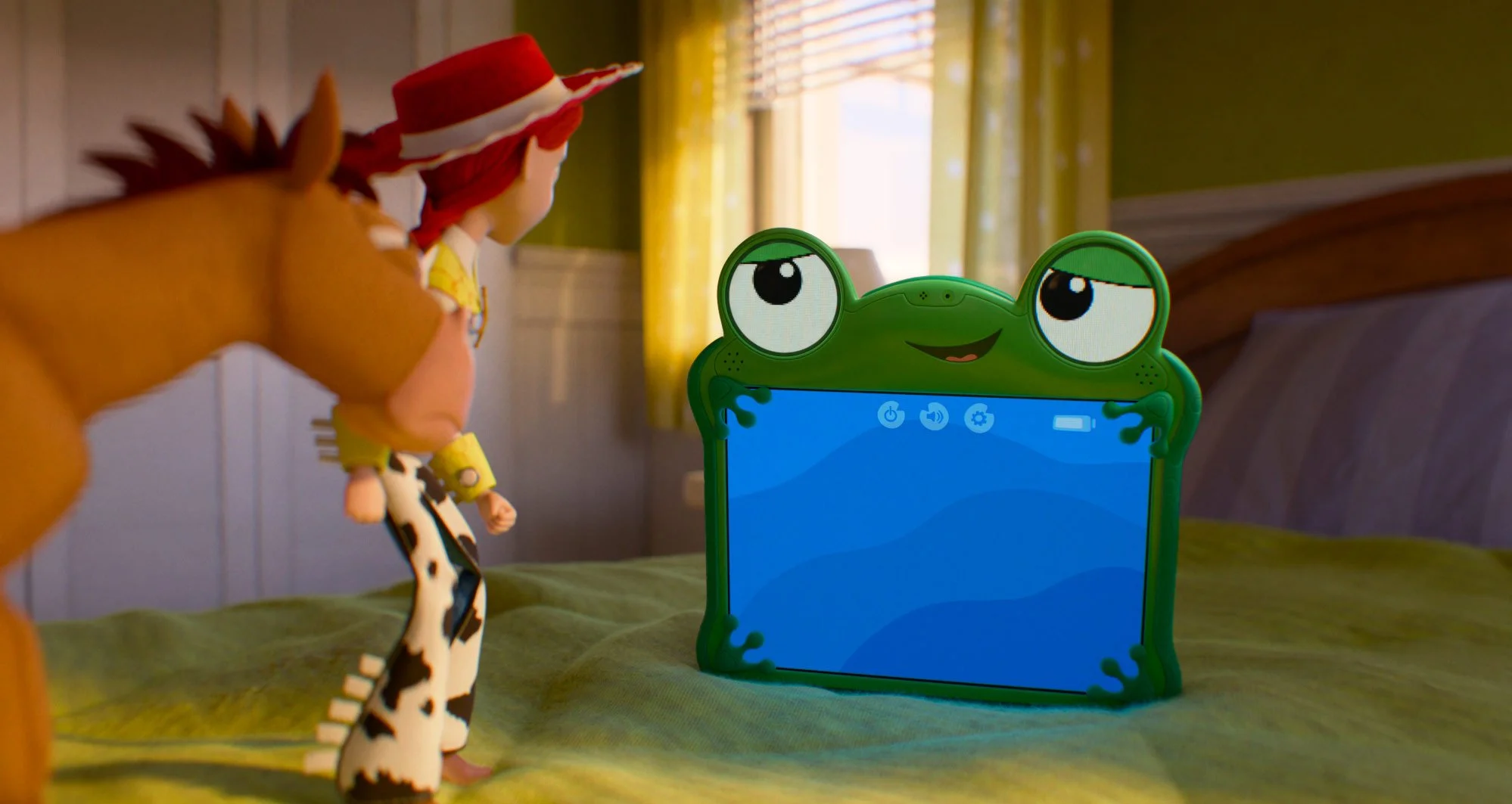
The production contradiction is productive. Custom rendering and compositing tools simulate pastel marks, paper, and irregular edges while the story worries that a tablet will make play too frictionless. The artists use computation to preserve evidence of human material practice.
That does not make the theme hypocritical by itself. The film argues for tools that extend creative intention rather than replace the person making choices. Its own images should be judged by the same standard.
Jessie’s return to Emily’s material world is the meaningful callback
Toy Story 5 brings Jessie near the former home connected to Emily and uses surviving objects as an archive of that first relationship. The lunchbox and Roundup imagery reward viewers who remember Toy Story 2, but recognition changes Jessie’s current decision rather than pausing the story for applause.
This is the standard every franchise callback should meet. The object returns because the character cannot finish the present argument without confronting what the object means.
The Hi-Tech Buzz figures update an old Easter egg instead of repeating it
Rows of Buzz Lightyears once represented abundance and the shock of replaceability. The stranded electronic editions in the fifth film represent the end of that consumer cycle. They have already been upgraded, purchased, and discarded.
The visual repetition connects 1999 and 2026 while changing the economic critique from mass production to planned obsolescence. Familiarity becomes history rather than recycling.
How to verify an Easter egg before repeating it
Start with Pixar’s official film pages, production notes, published research, filmmaker interviews, art books, and frame-level evidence from the film. Distinguish “the object appears” from “the filmmakers confirmed why it appears.” A visible truck can be documented even when its narrative meaning remains interpretation.
Avoid treating unsourced listicles as authorities that copy one another. If five pages repeat the same claim without a primary source or clear frame, there may still be only one rumor. Honest phrasing such as “possible,” “visual rhyme,” or “unconfirmed” keeps the guide useful.
The best Easter eggs make the present scene better
Pizza Planet matters because it once moved the plot. Cloud wallpaper matters because childhood changed beneath it. Woody’s Roundup objects matter because Jessie and Woody inherit commercial histories. Duplicate Buzz figures matter because mass production keeps changing form. Dust matters because time occupies space.
A hidden reference can be delightful without carrying that weight. The deeper trail, however, reveals how Pixar’s artists remember their own work and ask older images to do new emotional labor.
The production evolution in one line per film
Toy Story builds a feature within early CG limits and makes plastic the subject. Toy Story 2 expands cameras, lighting, environments, and digital exhibition. Toy Story 3 uses richer illumination, scale, stereo presentation, and researched institutions to make disposal terrifying. Toy Story 4 pushes material realism, rain, dust, crowds of objects, and then deliberately pulls realism back.
Toy Story 5 adds stylized pastel playtime through a constructed pipeline that lets imagination become less physically resolved than the room. Across thirty-one years, progress means not only more detail. It means more control over when detail should disappear.
The final receipt
Confirmed franchise landmarks include the Pizza Planet origin and later cameos, cloud-wallpaper continuity, Woody’s Roundup archive, duplicate Buzz designs, Pixar’s published colorscript practice, landfill and daycare research, antique-store fieldwork, dust systems, and the documented pastel pipeline for Toy Story 5. These claims have production evidence.
Interpretive connections include how those details develop ownership, obsolescence, memory, and attention. Speculative background sightings should remain labeled. The real Easter egg is not that Pixar hid objects everywhere. It is that the studio kept returning to old images while its tools, audiences, and understanding of childhood changed around them.
Why fan memory is part of the effect
An Easter egg does not exist only in the frame. It activates the viewer’s memory of an earlier encounter. Somebody who first saw the cloud wallpaper in 1995 brings a different amount of lived time to Toy Story 5 than a child watching all five films this weekend. Pixar can place the same object before both viewers, but recognition lands against different childhoods.
That is why franchise callbacks can feel moving even when the object itself is ordinary. The audience has aged during the production evolution. Rendering improved, theaters changed, home media changed, and some viewers became the parents deciding how much screen time a Bonnie should have. The hidden layer is partly ours.
Good criticism respects that feeling without letting nostalgia replace evidence. We can admit that recognition moved us, verify what actually appeared, and still ask whether the present film earned the return. Affection is the beginning of the close look, not the end.