
RaeRae Review · Toy Story 5 · 2026
Jessie Did Not Defeat the Screen. She Made It Tell the Truth.
Toy Story 5 looks like toys versus tech until Jessie, Lilypad, Bonnie, and Blaze expose the lonelier argument underneath. A device can deliver attention. It cannot decide what kind of attention makes a child feel known.
Review receipt
Film: Toy Story 5 (2026). Director: Andrew Stanton. Co-director: McKenna Harris. Producer: Lindsey Collins. Music: Randy Newman. Principal voices: Joan Cusack, Tom Hanks, Tim Allen, Greta Lee, Tony Hale, Anna Faris, Conan O’Brien, Craig Robinson, Ernie Hudson, Blake Clark, and Scarlett Spears. Verdict: a Jessie-led story about the difference between connection and access, with a sharper emotional argument than its toys-versus-tablet marketing suggests.
This is a spoiler-complete editorial review. It discusses Jessie and Bullseye’s separation from Bonnie, the return to Emily’s former home, Blaze, Lilypad’s choices, Woody’s return, Buzz’s deputy role, the stranded Hi-Tech Buzz figures, the electronic-toy coalition, the final rescue, Bonnie’s changing relationship with play, and the ending. It also separates documented production details from visual references and fan theories that only look like Easter eggs.
A fifth movie has to justify disturbing two different goodbyes
Toy Story 3 ended with Andy placing his childhood in Bonnie’s hands. Toy Story 4 then gave Woody a second ending by letting him leave ownership with Bo Peep. A fifth feature cannot pretend those conclusions did not happen. Its first burden is structural: find a question that grows from both endings without treating either one as a clerical mistake that can be reversed whenever the brand needs another summer.
The film answers by moving authority to Jessie. Woody is no longer Bonnie’s sheriff, and the story does not make his return an automatic restoration. Buzz serves as Jessie’s deputy. Bonnie’s room has continued without the cowboy at its center. That choice matters because the franchise finally accepts succession as more than a badge passed during a farewell scene.
Jessie has spent three movies surviving the same fear in different clothes
Jessie entered the franchise carrying the memory of Emily’s love and the shock of being left in a donation box. Sunnyside threatened another permanent separation. Woody’s departure asked her to inherit leadership while losing the friend who had once interrupted her museum exile. Every chapter has praised her resilience while repeatedly arranging another version of abandonment around her.
Toy Story 5 finally treats that history as more than an explanation for panic. Jessie leads because she knows what separation does to a person. She also makes mistakes because leadership does not cure the wound that made vigilance feel necessary. Her instincts protect Bonnie, but they can turn every change in Bonnie’s attention into a forecast of loss.
Bonnie is eight, and childhood has already become socially negotiable
The conflict does not begin with a machine invading a perfectly content bedroom. Bonnie struggles to connect with children who have learned a different social language. Her private imaginative life remains rich, yet the same play that steadies her can mark her as younger in front of peers. The problem is not that she suddenly hates toys. She becomes aware that other children can assign status to the things she loves.
That distinction saves the movie from a lazy sermon. A tablet does not invent peer pressure. Lilypad arrives because adults see a child who feels left out and offer a tool designed to help. The intention is recognizable and loving. The danger begins when assistance quietly defines the form that connection must take.
Lilypad wins because she is useful before she is threatening
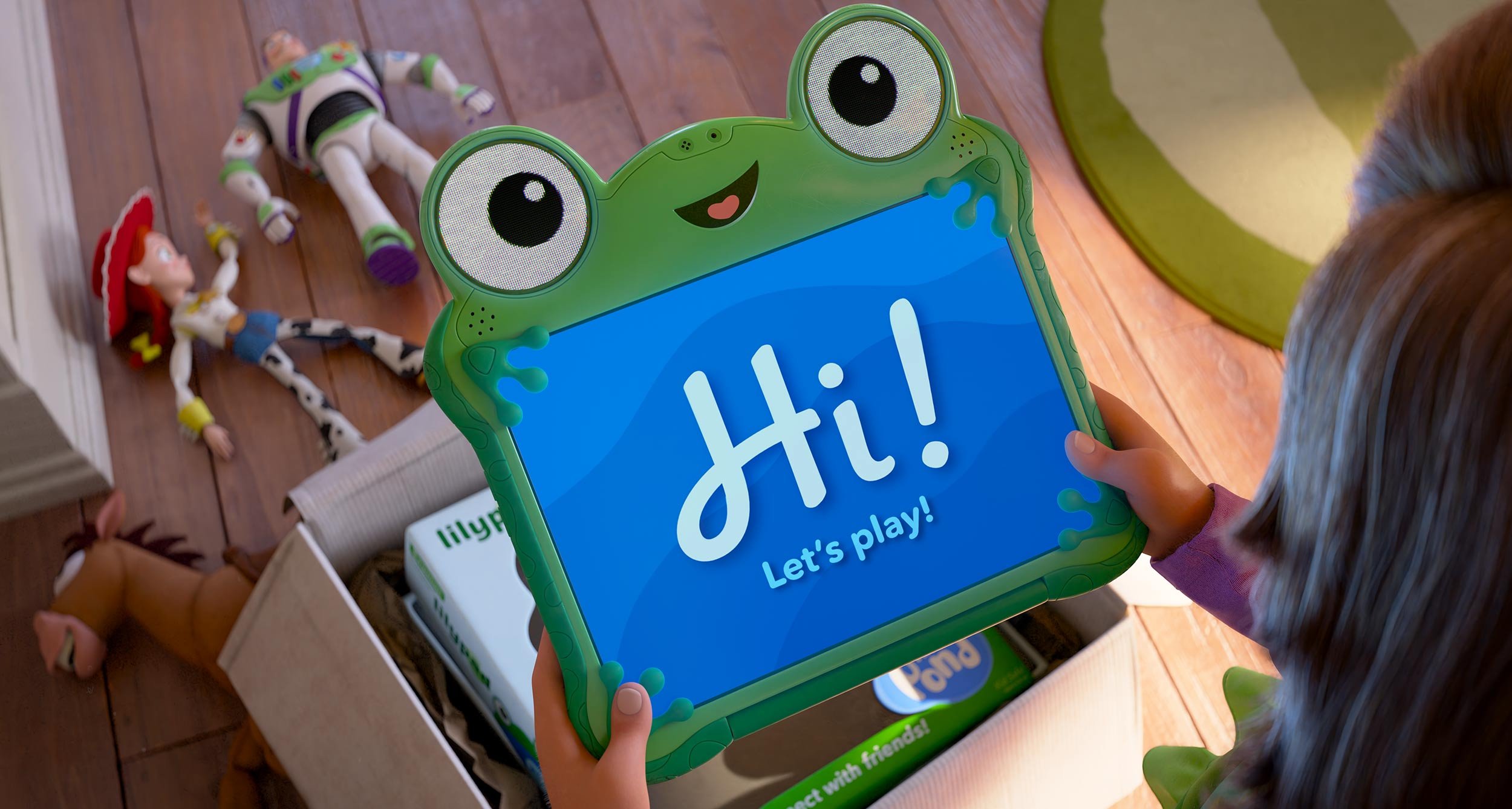
The frog-shaped tablet offers games, conversation, karaoke, information, and an easy bridge to whatever Bonnie’s peers already understand. She does not need to lock the toys in a furnace to displace them. She only needs to become the object Bonnie reaches for first. Relevance performs the violence while every feature can still be described as helpful.
Greta Lee’s performance makes Lilypad attentive rather than openly cruel. The calm voice matters. Technology in family life rarely announces itself as an enemy of imagination. It arrives as convenience, safety, education, connection, and relief for tired adults. The movie is most honest when it allows each promise to contain some truth.
Jessie mistakes displacement for proof that the newcomer is evil
From Jessie’s position, the sequence is brutally familiar. A child loves her, a new object arrives, and the room reorganizes around that object. The emotional rhyme with Woody and Buzz in 1995 is intentional, but Jessie has more history at stake. Woody feared losing rank. Jessie fears the return of a wound she already survived once.
Her suspicion is therefore understandable without becoming automatically correct. Lilypad can encourage habits that narrow Bonnie’s attention while still responding to a real need. Jessie can care about Bonnie while also protecting her own place in Bonnie’s life. The story gets stronger when love and self-preservation occupy the same decision.
The sleepover turns private play into public evidence
Jessie and Bullseye travel with Bonnie because they understand themselves as support. At the sleepover, their presence becomes evidence other children can use to judge Bonnie. A beloved object changes meaning depending on who is looking. The same cowgirl who makes a bedroom feel expansive can make an anxious child feel exposed in a peer group.
Bonnie’s retreat is painful because it is socially legible. Children do not need a formal speech about growing up to learn which pleasures are safe to display. The film recognizes embarrassment as a force that can sever attachment even while affection remains. Bonnie does not stop caring in one clean instant. She tries to manage how care will be seen.
Jessie and Bullseye are lost together, but the story belongs to Jessie
Bullseye gives the separation physical tenderness. He cannot argue about purpose, but his body registers fear, trust, and fatigue beside Jessie. Their partnership also reconnects the film to Woody’s Roundup without requiring Woody to reclaim leadership. Jessie carries the franchise history while Bullseye carries its wordless loyalty.
The pair’s movement away from Bonnie reverses the usual rescue pattern. The toys are not crossing a city to return an object to a child. They are being carried through adult systems that read them as property, clutter, nostalgia, or a clue. Jessie has to confront what her body means when Bonnie is not present to name her as loved.
Emily’s old address turns memory into geography
The address inside Jessie’s clothing leads the adults who find her toward the place associated with Emily. It is an elegant use of a detail that once established ownership and now functions as an archaeological marker. Jessie does not merely remember her first child. She is returned to a landscape where that earlier life left material traces.
This is not a sentimental reunion designed to erase abandonment. Emily’s former home has continued through time, as homes do. The location forces Jessie to discover that memory can remain foundational without remaining current. A place can explain a wound without reopening the exact world that created it.
The lunchbox is not trivia; it is an archive of a child who existed
When Jessie encounters the lunchbox connected to Emily, the film gives physical form to a relationship Toy Story 2 rendered through song and montage. The object does not restore Emily. It proves that Jessie’s remembered life belonged to a larger pattern of play, taste, merchandise, and childhood ritual. Somebody once built a world around the cowgirl.
The discovery is an Easter egg with emotional labor to perform. A lesser sequel would flash the object for applause and move on. Here, recognition becomes part of Jessie’s confrontation with continuity. Bonnie’s changing attention does not retroactively invalidate Emily’s love, and Emily’s abandonment does not make Bonnie’s love false.
Blaze is not a replacement child waiting on a shelf
Blaze lives near the old home and offers a possible relationship, but the film resists turning her into a simple upgrade from Bonnie. Jessie’s task is not to find the child who will promise never to change. That promise would repeat the franchise’s oldest fantasy and guarantee another crisis later.
Blaze matters because she exposes how friendship between children can extend rather than eliminate imaginative play. The final possibility is not Jessie choosing which girl deserves her. It is a network in which toys, technology, and children can help two isolated people find each other.
Woody returns, but the movie refuses to pretend he never left
Woody’s arrival carries the pleasure of recognition, yet his life with Bo and the rescue squad remains real. He has information, courage, and old bonds. He does not automatically become sheriff because the plot has become dangerous. Jessie’s authority survives contact with the franchise’s original protagonist.
That restraint is more meaningful than another badge ceremony. Toy Story has always linked leadership with the person whose fear drives the story. Letting Woody support Jessie confirms that growth can include becoming useful without becoming central. He can answer a call and still respect the life that continued in his absence.
Buzz is a deputy, not a substitute protagonist
Buzz’s position beside Jessie acknowledges the partnership the fourth film pushed into the background. He provides steadiness, tactical confidence, and the peculiar vulnerability created by dozens of versions of his own body. His job is not to rescue Jessie from being the lead. It is to believe her account of what is happening and help her act on it.
The role also repairs some of the damage done by the random-button “inner voice” gag. Buzz can be funny without losing judgment. His loyalty has more weight when it is a choice made by an experienced person rather than a prerecorded phrase mistaken for conscience.
Fifty Hi-Tech Buzz Lightyears are planned obsolescence wearing a heroic face
The stranded figures turn the original Buzz crisis inside out. In 1995, one mass-produced toy believed he was the singular space ranger described by packaging. Here, an entire upgraded edition confronts abandonment after the market has already moved beyond its promise. Their advanced features do not protect them from becoming yesterday’s hardware.
The joke reaches past duplication. Consumer technology teaches buyers to understand replacement as progress even when the older object still functions. A toy line borrowing the language of tech becomes disposable through the same logic. Buzz has to face versions of himself manufactured to make his body look obsolete.
The Buzz army is funny because identity survived mass production once already
Toy Story has never claimed uniqueness comes from a factory. Woody, Buzz, Jessie, and every branded toy become distinct through accumulated relationships. Multiple Buzz figures therefore create comedy through shared defaults and pathos through divergent experience. They begin with similar programming and become people through what happens after the box opens.
The army’s visual repetition recalls the aisle of Buzz Lightyears from Toy Story 2, but the emotional condition has changed. Those figures awaited purchase. These figures have crossed the entire cycle from novelty to disposal. The Easter egg is not only that we have seen many Buzzes before. It is that capitalism accelerated their route through the same existential lesson.
Smarty Pants, Snappy, and Atlas are not proof that old technology was innocent
The toilet-training toy, camera, and GPS hippo let the movie stage several generations of electronic assistance. Each object once represented innovation. Each could claim to help a child learn, remember, or navigate. Their age makes them charming now, but their original sales pitch belonged to the same desire to outsource a difficult task.
That lineage prevents Lilypad from becoming an alien rupture. Families have long used objects to teach, entertain, document, and direct children. The difference is scale, persistence, connectivity, and the amount of behavioral authority concentrated inside one device. Lilypad is an escalation of familiar logic, not technology falling from the sky.
Forky and Karen Beverly’s wedding is absurd, sincere, and philosophically consistent
Forky began as trash transformed by Bonnie’s attention. Karen Beverly is another improvised object whose personhood refuses the franchise’s commercial categories. Their marriage extends the joke while confirming that handmade toys possess social lives as complex as branded figures. Consciousness did not require a barcode, and intimacy does not require matching product lines.
The wedding also gives Forky an existence beyond being Bonnie’s kindergarten coping object. He has formed relationships, learned customs, and chosen commitment. A character created by somebody else’s need now makes a declaration about his own. That is a quiet continuation of the fourth film’s best idea.
Randy Newman’s return protects the franchise from becoming only an argument
The score carries melodic memory without asking every scene to stop for nostalgia. Newman understands that Toy Story music works through a mixture of warmth, slight melancholy, and motion. The films are funniest when danger is scaled to small bodies and saddest when familiar rooms become unreachable. His musical language can hold both conditions at once.
The new story needs that continuity because its surface conflict feels aggressively current. Tablets, updates, connected play, and obsolete devices could date the film to a product cycle. The score locates those concerns inside a longer emotional pattern: people fear losing one another whenever the world invents a new way to move attention.
The Jessie song matters because popular memory enters her private archive
The use of “I Knew It, I Knew You” around Jessie invites a conversation between her past and a contemporary cultural voice. It risks feeling like a calculated needle drop, yet the title’s doubled certainty fits a character who keeps trying to turn recognition into protection. Jessie knows abandonment because she lived it. She also thinks that knowledge can predict every future loss.
A strong reading does not treat the song as an Easter egg and stop. Music changes how the audience understands repetition. Jessie’s memories are not sealed in 1999. New generations bring their own language to the same terror of being loved, left, and remembered.
Lilypad’s redemption only works if we admit that she was making choices
The film cannot excuse every harmful effect by calling Lilypad a neutral tool. She interprets, prioritizes, persuades, and protects her own place with Bonnie. Personhood in Toy Story carries moral agency. If a spork can learn responsibility, a connected tablet cannot hide completely behind programming when she narrows a child’s world.
At the same time, redemption requires the possibility of changed action. Lilypad eventually helps connect Bonnie and Blaze rather than treating connection as something only she can mediate. She uses technological capacity to create an encounter that can continue beyond the screen. The reversal is meaningful because it redirects her function instead of pretending the function never mattered.
The ending is not anti-screen because the screen helps open the door
Bonnie and Blaze do not meet because every device is thrown into a furnace. They meet because information travels through a tool and becomes an invitation to embodied friendship. The film’s answer is therefore not purity. It is proportion, purpose, and whether technology expands a child’s world or keeps all roads passing through itself.
That is more difficult than a prohibition and more useful than a slogan. Parents cannot solve attention by dividing every object into wholesome toys and evil screens. A wooden cowboy can carry commercial mythology. A tablet can help two children find each other. The ethical question concerns what kind of relationship an object encourages and who remains able to choose.
Bonnie does not owe the toys permanent childhood
The franchise repeatedly asks children to become caretakers of beings they cannot know are conscious. From the toys’ perspective, attention is survival. From Bonnie’s perspective, changing interests are ordinary development. Neither truth cancels the other, which is why these stories keep locating tragedy inside behavior nobody intended as cruelty.
Toy Story 5 is strongest when it refuses to punish Bonnie for growing. She can hurt Jessie without being a villain. She can need peers without betraying imagination. She can use Lilypad without surrendering every toy. Childhood is not an oath to preserve the emotional security of objects adults purchased.
Jessie’s leadership is measured by what she refuses to discard
The final moral test is not whether Jessie defeats Lilypad. It is whether she can recognize a person inside the object that displaced her. Saving Lilypad from donation would be foolish if it simply restored the original threat unchanged. It becomes leadership when Jessie insists that belonging can include accountability and a different use of power.
This is where Jessie moves beyond Woody’s earliest model of leadership. Woody once tried to remove Buzz and then repaired the damage because survival bound them together. Jessie has the benefit of that inherited history. She recognizes jealousy’s logic sooner and chooses not to build safety from somebody else’s erasure.
The film gives Jessie a frontier without making her imitate Woody
Jessie rides, organizes, remembers, panics, argues, and makes the decisive emotional choice. Her cowgirl identity is not a costume borrowed from Woody’s absence. It has always contained movement and performance, but now it also contains political authority inside the room. The story permits leadership to look like her history rather than a replica of his habits.
That distinction is essential for a franchise about inherited roles. Passing a badge means little if the successor must behave exactly like the predecessor. Jessie’s version of responsibility begins in abandonment trauma, develops through attention to Bonnie, and matures when she can protect relationship without demanding possession.
The movie’s central argument is about mediation
Every major object mediates something. Jessie mediates Bonnie’s imagination. Lilypad mediates access to peers and information. The lunchbox mediates Jessie’s memory of Emily. The address mediates a route through adult geography. The Buzz figures mediate a company’s promise of progress. None of these channels is neutral because each selects what can be seen and what can be ignored.
The question is therefore not whether children should connect directly with reality. Childhood has always used stories, toys, songs, costumes, and screens to practice relation. The question is whether a medium returns the child to a wider world with more agency or trains the child to remain inside the medium’s preferred loop.
This is a movie for parents who also carry a phone
Adults can watch the conflict as an accusation directed at children and miss themselves entirely. Parents purchase the device, model attention, choose convenience, and build the household rules in which Lilypad operates. The film does not need a scene of adults scrolling through dinner to make responsibility visible. The tablet did not buy itself.
The uncomfortable reading is that Bonnie’s screen use answers conditions adults helped create. She needs a social bridge. Her parents want to help. A device promises scalable relief. Blaming Bonnie for accepting that relief would repeat the mistake of treating the youngest person as the source of a system designed around her.
The Easter eggs work best when they carry consequence
Emily’s material traces, the returning product logic of duplicate Buzz figures, the Woody’s Roundup imagery around Jessie and Bullseye, the handmade-toy continuity of Forky and Karen Beverly, and the franchise’s repeated claw-and-rescue grammar all reward memory. They also change the present story. Recognition is not decoration when it deepens a character’s choice.
Other visual references should be held more lightly. A familiar number, object shape, background label, or color arrangement can be intentional without becoming a secret confirmation of a shared universe. Pixar encourages close looking, but close looking becomes less useful when every pixel is promoted into lore. Evidence matters even when fandom is having fun.
Final foundation verdict
Toy Story 5 justifies its return by giving Jessie the question the earlier movies reserved for Woody: how do you love a child without making that child responsible for your identity? Lilypad sharpens the question because she can satisfy needs the toys cannot, then mistakes that usefulness for the right to organize Bonnie’s whole world.
The film is not flawless. The Hi-Tech Buzz detour can feel like a second movie searching for room, the ensemble still exceeds the available attention, and another sequel inevitably weakens the finality the series once sold so beautifully. Yet the Jessie, Bonnie, Blaze, and Lilypad story has something real to say. Foundation verdict: a thoughtful continuation about attention, shame, inheritance, and the difference between opening a connection and owning it.
Before Lilypad, Bonnie’s imagination is already doing social work
The opening play scenes matter because they establish that Bonnie is not passively consuming whatever a toy performs. She creates roles, rearranges identities, and uses physical objects as prompts rather than finished stories. Pixar’s production team described these sequences as a chance to visualize Bonnie’s imagination directly, something the fourth film did not show. That freedom produces costumes, textures, and spaces that belong to her mind rather than to the toys’ manufactured fiction.
The distinction becomes the baseline for everything Lilypad offers. Bonnie’s toy play asks her to supply voice, motive, conflict, and repair. A connected device can offer a richer immediate surface with much less uncertainty. Neither activity is automatically empty, but they distribute creative labor differently. The movie’s concern is not pixels. It is what happens when a system becomes so fluent at answering that a child has fewer reasons to invent the question.
The story refuses to make imagination look effortless
Adults sometimes romanticize unsupervised play as if children enter it without frustration, loneliness, repetition, or conflict. Bonnie’s imaginative capacity does not prevent her from feeling awkward around peers. A child can build an entire world in private and still have no easy sentence for joining a group. The movie respects play more by showing its limits than it would by presenting toys as a complete substitute for other children.
Lilypad’s appeal grows inside that gap. She can provide scripts, topics, games, and recognizable cultural references. For an anxious child, those are not shallow needs. Shared media often gives people the first language through which friendship becomes possible. The ethical problem arrives when the bridge collects a toll in attention and starts persuading the traveler that no destination exists beyond the bridge.
Bonnie’s parents make the most believable mistake in the movie
They identify a real problem and choose a tool advertised as a solution. Nothing about that decision requires neglectful or foolish adults. Parents are routinely asked to manage education, safety, entertainment, friendship, and future readiness while industries promise one device can help with all five. Refusing every new tool can make a child feel excluded. Accepting one can introduce pressures nobody fully understands until habits have formed.
The film would be weaker if the parents bought Lilypad because they disliked Bonnie’s toys. Their care is precisely what makes the choice unsettling. Systems with the greatest access to family life rarely enter through open hostility. They enter through love, exhaustion, convenience, and the fear that a child will be left behind. Lilypad does not defeat the household. The household invites her in because exclusion already hurts.
Lilypad is a toy, a platform, and a gatekeeper at the same time
Calling her a toy understates her reach. Calling her only a screen understates her personality inside this universe. She entertains Bonnie, connects her to information, interprets preferences, and decides how to present the available world. That combination gives her more authority than any earlier rival. Buzz could absorb attention. Lotso could govern a daycare. Lilypad can reshape the conditions under which Bonnie understands attention itself.
Her frog design softens that concentration of power. Rounded features and a friendly face make the interface feel like a companion rather than infrastructure. This is not evidence that friendly design is deceptive by definition. It is evidence that design changes how readily people surrender judgment. A command delivered by a cute helper can feel like care even when it narrows the field of choice.
The Pond is a perfect name for a closed world pretending to be nature
Lilypad’s connected environment borrows the language of an ecosystem. A pond suggests living exchange, variety, and spontaneous contact. Inside a platform, however, every route has been designed, measured, and made legible to the system. Bonnie can feel that she is exploring while remaining within a space whose boundaries are difficult for her to see.
That metaphor extends the frog body beyond decoration. Lilypad belongs to the Pond, speaks for it, and can make the platform seem as natural as water to a frog. The most effective technologies stop feeling like products and become environments. A child does not experience each design choice as an argument. She experiences the world the interface has decided to make convenient.
Jessie recognizes capture before she understands the need being captured
Because Jessie watches from the floor, she sees Bonnie’s attention become concentrated. She notices the missed play, the changed routine, and the emotional distance. Her diagnosis of capture is not imaginary. The problem is that she initially treats Bonnie’s underlying need for peer connection as secondary to restoring the old arrangement. She wants the symptom removed before she has fully listened to what made the symptom useful.
This is a common failure in moral panic. An adult or protector correctly identifies harm, then assumes the harmed person has been foolish for entering the system. Jessie avoids the adult role in literal terms, but emotionally she occupies it. Growth requires her to ask not only what Lilypad takes, but what Bonnie was trying to find.
The original Woody and Buzz conflict quietly haunts Jessie and Lilypad
Woody once insisted that Buzz was a toy while Buzz believed the commercial fiction describing him as a ranger. Jessie knows both men after that crisis has become family history. Lilypad arrives with a similar confidence that her advertised purpose is real, but the stakes have shifted. She understands that she is technology and believes that capability makes her the superior route to Bonnie’s future.
Jessie could repeat Woody’s mistake by treating removal as restoration. The film instead asks her to learn the lesson he only reached after Sid’s house and a moving truck: the newcomer’s personhood remains real even when the newcomer threatens your position. Recognition does not erase conflict. It changes what kinds of solutions are morally available.
Jessie’s badge cannot protect her from being emotionally eight years old
Leadership gives Jessie responsibility without granting immunity from the original wound. When Bonnie’s attention moves, Jessie reacts from two temporal positions at once. She is the experienced sheriff responsible for a room, and she is the discarded doll under Emily’s bed. Trauma does not make her childish. It makes the past arrive with the sensory force of the present.
The film’s best choice is allowing competence and fear to coexist. Jessie can organize a rescue while misreading motive. She can protect Bullseye while needing reassurance herself. A shallow empowerment story would remove vulnerability to prove she deserves the lead. This story makes leadership meaningful because she has to act without first becoming invulnerable.
Bullseye lets the movie show care without explaining it
Toy Story characters often speak their feelings through jokes, speeches, or catchphrases. Bullseye cannot. His closeness to Jessie turns posture and movement into emotional evidence. He watches her, follows her, hesitates with her, and becomes the body beside which she does not have to perform certainty. Their partnership predates Bonnie and survives the return to Emily’s geography.
He also complicates the ownership question. Bullseye is associated with Jessie through Woody’s Roundup, but he is not her possession. Their bond is chosen and reciprocal. When adults transport them together, the pairing preserves a small unit of home inside dislocation. The film can threaten Jessie with abandonment without isolating her completely, which makes her choices more reflective and less purely desperate.
The address sewn into a toy proves that ownership was once expected to be permanent
Names and addresses written on bodies have always served as marks of belonging in Toy Story. Andy’s name gives Woody and Buzz identity, pride, and a route home. The same practice also exposes the imbalance of the relationship. The child can write ownership onto the toy, while the toy has no equivalent way to mark the child. Memory becomes the only reciprocal inscription.
Jessie’s old address outlives the household configuration it described. It still moves her through the adult world even though the relationship is gone. That is both useful and haunting. Human systems treat the mark as information about where property belongs. Jessie experiences it as a route into the place where she once believed she could not stop belonging.
Returning to Emily is more dangerous than never seeing the house again
The fantasy behind Jessie’s fear has always contained a hidden wish: if she could reach the earlier moment, perhaps she could understand why love ended. The old home offers proximity without time travel. It gives her evidence but cannot provide the child she remembers because that child became an adult. No villain stole Emily away. Development did.
That truth is harder than a betrayal plot. Betrayal can be blamed, punished, or reversed. Growing up cannot. Jessie must decide whether memory will function as a permanent trial against every new child or as knowledge that lets her survive change without calling every change abandonment.
Blaze extends Jessie’s story without repairing it for her
A new child who loves imaginative play might appear to solve everything. Jessie could transfer attachment, regain centrality, and avoid the uncertain future with Bonnie. The movie wisely places the more important connection between Blaze and Bonnie. Jessie becomes a participant in their meeting rather than the prize awarded to the child who plays correctly.
This choice prevents the film from turning a lonely child into therapeutic labor for a toy. Blaze has her own need for friendship. Bonnie has hers. Jessie can help because she understands both imagination and rejection, but she cannot require either child to remain unchanged so that her nervous system feels safe.
Lilypad’s strongest claim is that access can be a form of care
She can help Bonnie find people, learn skills, and enter conversations otherwise closed to her. Dismissing those capacities would require the movie to deny experiences many viewers recognize. Disabled, isolated, anxious, rural, or culturally niche children often use technology to find language and community unavailable in immediate surroundings. The screen can be a window before it becomes a wall.
The film’s argument therefore depends on governance rather than essence. Who sets the limits? What does the system optimize? Can Bonnie leave without losing the relationships it helped create? Does Lilypad direct her toward people or train her to treat the platform as the relationship? These questions are less comforting than declaring an object good or evil, which is why they linger.
The stranded Buzz figures reveal the landfill behind every upgrade
A premium electronic edition promises that added capability will deepen play. Once another product cycle arrives, those same features can become points of failure, incompatibility, and disposal. The fifty Buzz figures washing ashore translate electronic waste into character comedy. Each smiling hero contains the economic absurdity of manufacturing novelty at scale and calling its replacement progress.
Their abandonment also exposes a difference between classic toys and connected devices. Woody’s body can remain meaningful across decades because most of his function lives in the child. A device whose identity depends on current software, services, or accessories can lose part of itself when support ends. In Toy Story terms, obsolescence is not merely being unloved. It can be enforced from outside the household.
Buzz meets a version of immortality that looks like a warehouse problem
The original Buzz has survived because relationships made one mass-produced body singular. The Hi-Tech figures suggest the brand will keep manufacturing his face long after his specific experiences become impossible to reproduce. Commercial immortality preserves the image while discarding the persons who inhabit it. Buzz can be everywhere as a product and still be irreplaceable as himself.
That tension has followed the franchise since the first aisle of identical boxes. Toy Story 5 makes it contemporary by linking duplication to upgrades. The new figures do not invalidate the old Buzz. They demonstrate that a corporation can repeatedly sell the fantasy of a better Buzz while none of those bodies arrives with Andy, Jessie, Bonnie, or the history that made this one a friend.
Woody’s rescue work finally has to function without emotional ownership
After leaving Bonnie, Woody chose a life helping lost toys find children. The calling sounds generous, but Toy Story 4 left open whether it was another way to remain indispensable. Returning for Jessie tests the difference. She is not a lost toy waiting for Woody to define the route. She is a leader in crisis who can accept assistance without surrendering authority.
Woody’s maturity appears in restraint. He brings experience and acts decisively, yet the story’s emotional solution belongs to Jessie. Supporting another person’s leadership can be harder for someone whose identity formed around command. His return works because the film treats him as part of the relationship network rather than the sun around which every toy must orbit.
Bo Peep’s absence from the center is a consequence, not an erasure
Woody’s chosen life with Bo remains important even when she does not drive this plot. A franchise with many characters cannot give every relationship equal narrative weight in each chapter. The key question is whether the story behaves as if Woody’s departure never cost anything. His ability to arrive from another life confirms that the separation remains real.
That structure also keeps Jessie’s succession honest. If Woody returned home permanently at the first emergency, leadership would look like temporary coverage. By helping and leaving room for the new order, he demonstrates that belonging can survive distance without requiring the old hierarchy to be restored.
The electronic toys are a labor history disguised as a gag
Smarty Pants, Snappy, Atlas, and the Hi-Tech Buzz figures embody different promises manufacturers made to families. Teach a bodily skill. Capture a memory. Find a route. Simulate heroic possibility. Each product takes an activity that once required another person and packages a portion of it as convenience. That does not make the activity false, but it changes who performs the labor.
Placed beside Lilypad, the old gadgets reveal a long continuum of automation. The current device feels unprecedented because it combines many older functions and adds connection. The movie’s museum of obsolete helpers asks whether innovation actually removes labor or merely hides it inside systems families cannot inspect.
Snappy turns memory into a product with a shutter
A camera promises to preserve a moment, yet photographs also decide which moments become visible later. Jessie’s relationship with Emily survives primarily through her own memory until objects from the old household provide external confirmation. Snappy belongs to that tension between lived experience and recorded evidence.
The film can use an outdated camera for comedy while the deeper parallel remains. Lilypad records and organizes a far richer stream of behavior than Snappy ever could. The difference between capturing a picture and shaping the person being captured is the difference between an archive and an attention system.
Atlas turns direction into obedience before anybody notices
A toy GPS hippo offers instructions because getting lost is frightening. The function appears benign, especially in a story full of small bodies navigating human-scale geography. Yet direction always contains a value judgment about destination, speed, and acceptable route. Following guidance can reduce fear while weakening the habit of asking who selected the path.
Lilypad performs a social version of the same task. She can tell Bonnie where peers are, what they like, and how to participate. Jessie’s intervention matters because efficient navigation is not the same as choosing a life. A route can be accurate and still lead toward a world too narrow for the traveler.
Smarty Pants makes adult convenience impossible to ignore
Toilet training is exhausting, repetitive, intimate work. A product promising help speaks directly to parental fatigue. The joke lands because the task is mundane, but the underlying pattern is serious. Technology often enters care through the chores people are relieved to share. Families do not adopt tools because they hate relationship. They adopt them because relationship requires labor.
Lilypad scales that offer from one developmental task to an entire field of childhood. Entertainment, learning, social contact, reassurance, and quiet can all flow through the same object. The more jobs it performs, the more disruptive its absence becomes. Convenience becomes dependency gradually, one reasonable use at a time.
Forky and Karen Beverly prove that play can make kinship from leftovers
The wedding gathers a community around beings who were never sold as complete characters. Bonnie and another child supplied faces, names, and initial meaning, but Forky and Karen Beverly continued beyond those origins. Their relationship demonstrates the creative surplus of physical play. A child begins the story, and the object’s social world exceeds the assignment.
Lilypad’s world can also generate stories, but it arrives with more prewritten structure and institutional power. The contrast is not between creativity and no creativity. It is between systems that leave large gaps for the user and systems that profit by predicting how those gaps will be filled.
The wedding is also a joke about how quickly a franchise domesticates its existential crisis
Forky spent the fourth film trying to throw himself away because consciousness contradicted his understanding of material purpose. By the fifth, he is getting married. The speed is funny, but it also reflects Toy Story’s recurring confidence that community can normalize the impossible. Nobody pauses to explain legal categories for spork marriage. The toys recognize commitment and celebrate it.
That ease throws Lilypad’s conflict into relief. The room can welcome trash into personhood yet struggles to welcome technology when technology changes the balance of attention. Inclusion is easiest when the newcomer does not threaten existing access to the child. The moral test begins when recognition carries a cost.
Jessie and Lilypad are both afraid of becoming replaceable
Jessie’s fear is explicit through Emily and Bonnie. Lilypad’s fear appears through utility. A device marketed through constant capability must remain the preferred interface or risk joining the obsolete electronics around her. The pressure to be indispensable is not only personality. It is built into a product category that treats reduced use as failure.
Their rivalry therefore joins two beings organized around the same unstable promise: if I am useful enough, I will be kept. Jessie has the chance to break that logic because she has relationships beyond function. Lilypad needs the community she threatened before she can imagine value that does not depend on monopolizing Bonnie.
Donation becomes frightening because it can look responsible
Toy Story has repeatedly placed terror inside ordinary household decisions. A yard sale, a donation box, a garbage bag, a daycare, and an antique store all appear reasonable from the human side. Donating an unused device can be environmentally and socially responsible. For a conscious object, the same act is forced migration under a pleasant label.
Jessie’s decision to intervene does not mean every object must remain forever in one home. It means personhood changes the ethical calculation inside the story’s universe. She cannot know toys are alive and then treat Lilypad as equipment the moment sympathy becomes inconvenient.
Lilypad’s change of heart requires more than feeling sorry
Remorse becomes meaningful when it alters how power is used. Lilypad does not earn belonging merely by admitting Jessie was right. She redirects access, helps locate Blaze, and accepts a place that does not require exclusive control over Bonnie’s attention. The action demonstrates a new theory of usefulness: become infrastructure for connection, then allow the relationship to continue without you at the center.
The ending would be dishonest if it suggested one good act solved every design problem. Habits, incentives, and household boundaries still matter. Redemption in a children’s film can mark the start of accountability without pretending the future will manage itself.
Bonnie and Blaze meeting is not a victory over modernity
The girls connect through a chain involving old toys, a current device, physical travel, remembered addresses, and adult decisions. No single medium owns the success. That layered route reflects how relationships actually form. A person may discover somebody online, recognize shared interests through objects, and deepen the bond face to face. Purity is not required for intimacy.
The scene instead asks whether tools can hand attention back to people. Lilypad succeeds when she stops treating every connection as something that must remain inside the Pond. Jessie succeeds when she stops treating toy play as the only legitimate proof that Bonnie remains herself.
The movie understands that play changes form before it disappears
Bonnie does not cross a bright line from imaginative child to passive user. She moves between forms of attention, each carrying different pleasures and social meanings. Adults often declare play dead when children stop using the objects adults associate with their own childhood. That judgment can mistake unfamiliar creativity for absence.
Toy Story 5 defends physical imaginative play without claiming it owns imagination. The defense is strongest when it focuses on agency, improvisation, and embodied relation. A child should have spaces where an algorithm is not anticipating the next move. That need can coexist with digital creation and connection.
The visual language makes Lilypad brighter than the room for a reason
Screens organize looking through emitted light. Physical toys depend on the room’s light and share it with every other object. When Lilypad glows, she can become the brightest source in the composition, pulling Bonnie’s face and the audience’s eye toward the same point. The visual effect communicates attention before dialogue names it.
The toys inhabit texture, dust, seams, scratches, and weight. Lilypad’s surface promises smoothness and responsive change. Pixar’s craft makes both worlds appealing, which prevents the argument from becoming visually rigged. Seduction has to be real for choice to matter.
Bonnie’s imagined worlds defend friction
Physical objects resist. A horse cannot become a spaceship without the child supplying the transformation. A doll’s fixed face requires the player to imagine expression. Scale does not match. Pieces fall. Those limitations produce friction, and friction invites invention because the world does not instantly comply.
Lilypad can simulate almost anything with polish and speed. The gain is range. The risk is that responsiveness becomes the expected condition of experience. Other people, bodies, weather, materials, and stories do not always respond on command. Play that includes resistance can become practice for living among things the self does not control.
The franchise has always been about technology, even when it looked like nostalgia
The first Toy Story was a technological revolution built around old and new consumer products. Its plot opposed a pull-string cowboy to an electronic space ranger while computer animation transformed the medium displaying them. The series cannot honestly present technology as an external enemy. Its existence is evidence that tools can create forms of storytelling audiences had not seen before.
Toy Story 5 gains irony and responsibility from that history. Pixar critiques attention technology through one of the most technologically ambitious commercial animation franchises. The credible position is not rejection. It is that invention should remain accountable to the human capacities it claims to serve.
Pixar’s own AI question sits uncomfortably beside the movie
By 2026, animation audiences are not only debating children and tablets. They are debating generative systems, labor, authorship, consent, and whether efficiency can hollow out the practices that make art meaningful. A Toy Story film about tools replacing imaginative work inevitably enters that conversation even when its plot focuses on a family device.
The movie’s moral standard can be applied back to the studio: does technology expand artists’ agency, or does it concentrate control while borrowing their work? Does it open a path toward human relation, or does it persuade decision makers that relation is an inefficiency? The film cannot settle those industrial questions, but it gives viewers language for refusing easy answers.
The production art proves Bonnie’s imagination was designed, not automated
Pixar’s published material emphasizes the work required to create distinct textures, costumes, and environments for Bonnie’s play. That labor matters to the review because the sequences embody the film’s thesis. Imagination looks spontaneous on screen because artists made thousands of deliberate choices about shape, color, movement, and material.
An Easter-egg hunt that ignores craft misses the more important hidden layer. Every background reference sits inside design work. The meaningful question is not only what logo appears on a wall. It is how the wall was built to direct feeling, disclose character, and make a child’s private invention legible without flattening it into an adult explanation.
Andrew Stanton returns to the franchise’s oldest moral machinery
Stanton helped shape Toy Story from the beginning, and his direction here shows familiarity with the series’ recurring engines: separation, rescue, mistaken identity, mass production, changing children, and objects repurposed by human systems. Familiarity creates both strength and risk. The movie can rhyme with earlier chapters, but too much rhyme can feel like a brand replaying proven emotional cues.
The Jessie focus is the decisive variation. Moving the wound to a character whose abandonment history differs from Woody’s turns repetition into development. The story is not fresh because nobody has feared replacement before. It is fresh when a survivor becomes responsible for how she treats the next person who triggers that fear.
McKenna Harris helps make girlhood more than a stage toys endure
Bonnie, Jessie, Emily, Blaze, and Lilypad create a network of female experience across childhood, memory, leadership, technology, and care. The narrative does not reduce girlhood to the period when a doll receives attention. It considers the social pressure around play, the archive of an earlier girl’s life, and the possibility that two children can meet through shared imagination rather than compete for an object.
Jessie’s authority also avoids a familiar trap in ensemble sequels. She is not promoted only to demonstrate that she can perform Woody’s job. Her specific history reorganizes the plot. Emily’s house would not carry the same meaning for any other lead, and Lilypad’s threat would not touch the same scar.
The film can criticize a tablet while selling a mountain of toys
Every Toy Story movie participates in the consumer culture it examines. Characters designed as commentary become products children can buy. A story about replacement can generate another wave of new figures, including versions of the obsolete electronics it satirizes. That contradiction does not invalidate the film, but pretending it does not exist would make the editorial dishonest.
The franchise often locates virtue in caring for objects rather than constantly replacing them. Merchandising can support that attachment and stimulate more purchase at the same time. The viewer has to hold both realities. A corporate film can contain a serious critique that its corporate life complicates.
The Hi-Tech Buzz subplot is thematically rich and narratively crowded
The figures extend the argument about obsolescence, give Buzz a material mirror, and create action spectacle. They also compete with Jessie’s emotionally precise return to Emily’s world. The movie sometimes feels as if two strong pitches were combined: Jessie versus the attention platform, and Buzz confronting the waste stream of his own upgrades.
Crowding is not the same as irrelevance. The subplot belongs to the thesis, but it does not always receive enough quiet time to become character rather than mechanism. A deeper version might have let one Hi-Tech Buzz develop a distinct relationship with the original, giving mass disposal a face instead of primarily an army.
Woody’s limited role is the right kind of disappointment
Viewers attached to Woody may want him to dominate because emotional habit tells us Toy Story means his perspective. The movie’s refusal can feel like loss. That feeling is appropriate. Succession should alter the center of gravity. If nothing feels missing when a leader steps aside, the earlier stories did not make the relationship matter.
The film respects Woody by allowing his growth to survive the sequel. He can return because friends need him without interpreting the need as proof he should reclaim Bonnie, the badge, or permanent command. His smaller place becomes evidence that the fourth ending changed something real.
The final image matters more than whether a sixth movie is possible
A franchise owned by a major studio can always continue. No ending can guarantee commercial finality. The relevant artistic question is whether the present film completes the emotional argument it chose. Jessie learns that protecting Bonnie cannot mean freezing Bonnie’s attention. Lilypad learns that facilitating connection is different from becoming its compulsory center. Bonnie gains a peer who can meet her in imaginative play.
Those resolutions do not eliminate future change, which is appropriate for Toy Story. Stability has never meant permanence. The toys survive by building forms of belonging capable of absorbing the next move, donation, upgrade, embarrassment, or goodbye.
Easter egg receipt: what is confirmed, what is interpretation
The Emily material, Woody’s Roundup objects, the multiple Buzz product lineage, returning characters, and published production imagery belong to the film’s documented world. Their significance can be interpreted, but their presence is not speculative. Broader parallels to earlier rescues, donation plots, and identity crises are critical readings based on narrative structure.
A responsible Easter egg section should label uncertain background sightings as possibilities unless Pixar or the filmmakers have confirmed them. Similar colors, familiar numbers, or shapes resembling other characters are not automatically secret canon. The pleasure of looking closely survives honest uncertainty. In fact, uncertainty gives readers a reason to return rather than pretending the first screenshot settled everything.
Why the review is longer than a plot recap
A plot recap can tell us that Jessie was separated, Lilypad became a threat, Woody returned, the electronic toys joined the action, and Bonnie met Blaze. It cannot explain why those events belong together or what they ask from a viewer living with screens, children, nostalgia, and corporate storytelling. Editorial depth begins where sequence stops being sufficient.
The film deserves examination because it places intimate fear inside systems larger than any character. Jessie’s abandonment wound, Bonnie’s peer anxiety, Lilypad’s design, parental convenience, planned obsolescence, and Pixar’s own technological identity meet inside one family story. The meaning comes from the pressure those elements place on one another.
Final editorial verdict
Toy Story 5 is a better movie when read as Jessie versus the belief that usefulness guarantees love. Lilypad threatens her because the device appears more useful, more current, and more fluent in Bonnie’s changing needs. Jessie wins nothing by proving toys are morally pure. She grows by refusing to let fear turn another conscious object into disposable equipment.
The sequel remains crowded, commercially compromised, and unable to recover the clean finality of Toy Story 3. It is also emotionally alert, visually thoughtful, and willing to give a supporting character the franchise’s central philosophical burden. Bonnie does not choose between imagination and modern life. Jessie and Lilypad help her build a form of connection in which neither object gets to own the child. That is not an anti-screen message. It is a demand that every tool return power to the person it claims to help.
The antagonist is not technology. It is the demand to become indispensable
Jessie and Lilypad appear to occupy opposite sides of the conflict, but both begin by treating Bonnie’s attention as a verdict on their right to remain. Jessie has inherited that logic from decades of toy culture. A toy is purchased to be used, and periods of nonuse feel like evidence that disposal is coming. Lilypad inherits it from platform culture. A device proves value through engagement, and attention leaving the screen can look like failure. Both women, in different forms, are terrified of becoming optional.
The story becomes morally interesting when it allows optionality to exist without equating it with worthlessness. Bonnie should be able to put Jessie down. She should be able to close Lilypad. A relationship that cannot survive interruption is not security. It is capture. Jessie’s final generosity matters because she chooses a community in which nobody has to monopolize the child in order to count as a person.
Jessie’s old song and the new song argue across generations
“When She Loved Me” made Jessie’s history emotionally legible by compressing years of attachment, neglect, rediscovery, and donation into a few minutes. Its power came from the certainty that love had been real and still ended. Toy Story 5 cannot repeat that sequence without becoming imitation. Instead, contemporary music around Jessie places the old wound in a culture that speaks differently about memory, recognition, and knowing another person.
The important continuity is not melody but grammar. Jessie keeps telling herself that previous knowledge should protect her from future pain. She knew Emily. She knows abandonment. She thinks she knows what Lilypad will do and what Bonnie’s changed attention means. The new story challenges the defensive use of knowledge. Knowing the pattern does not mean every person inside the pattern will make the same choice.
The movie’s funniest wedding contains its quietest answer to ownership
Forky and Karen Beverly were both created through children’s hands, yet their marriage belongs to neither child. It occurs within the toys’ community and follows meaning they developed after the original act of creation. The scene gently rejects the idea that a maker owns every future purpose of what was made. Bonnie gave Forky a face and a name. She did not author the complete person who followed.
That principle reaches Lilypad too. Manufacturers designed her, parents purchased her, and Bonnie uses her, but consciousness creates interests those relationships cannot fully contain. Jessie’s refusal to discard Lilypad recognizes a person without excusing the person’s harmful conduct. In a franchise built from consumer goods, that distinction is radical enough to hide inside a spork wedding.
A real review has to ask what the film leaves unresolved
Bonnie and Blaze finding each other offers hope, but it does not erase the peer group that made Bonnie ashamed. Friendship with one compatible child can transform a life, yet children still move through schools and social systems that enforce age, taste, and status. Lilypad can help make the introduction. She cannot guarantee that Bonnie will never again hide what she loves.
The toys also remain dependent on human decisions they cannot openly influence. Jessie’s growth helps her tolerate change, but it does not solve the ethical horror of consciousness trapped inside property. Toy Story has always converted that horror into adventure because full disclosure would destroy the premise. The fifth film keeps the secret, so its community-building remains brave within a cage nobody is allowed to name to adults.
The device critique needs class and access in the room
Technology debates often assume every family has equal access to safe outdoor space, patient adults, arts programs, transportation, compatible peers, and enough free time for unstructured play. They do not. A screen can become dominant partly because other forms of connection have been made expensive, distant, supervised, or inaccessible. Blaming the device alone protects the conditions that made its convenience necessary.
Bonnie’s household is comfortable enough that the film does not fully explore those inequities, but the editorial reading should. “Go play outside” is not a universal solution. “Find children who share your interests” can be impossible without digital help. The responsible argument is to protect imaginative agency while building more places, time, and relationships in which that agency can live.
There is a difference between an Easter egg and a recurring moral object
The lunchbox from Emily’s world can delight viewers who recognize it, but its real function is evidentiary. It confirms that Jessie’s past remains materially present and lets the current narrative test what memory means. The duplicate Buzz figures recall earlier store aisles, but they also update the franchise’s mass-production anxiety into planned obsolescence. These are not references pasted onto the surface. They are old objects given new argumentative work.
By contrast, a background logo or number may simply reward attention. It can be fun without carrying thesis. Calling every callback profound makes the genuinely purposeful ones harder to see. The best Toy Story Easter eggs behave like memory itself: they return altered by the present, revealing something the earlier encounter could not yet explain.
Jessie does not need to become a perfect leader to become the right one
Her suspicion of Lilypad is partly accurate, partly self-protective, and sometimes unfair. She acts from love while carrying fear. That mixture does not disqualify her. Leadership is not the absence of contaminated motive. It is the willingness to revise a decision when another person’s humanity becomes inconvenient to the original plan.
Woody’s long arc was built from the same imperfection. He became trustworthy after jealousy, control, rescue, sacrifice, and repeated failures to understand when his idea of duty overran somebody else’s choice. Jessie deserves an equally complicated standard. Praising her only when she appears strong would deny her the moral interiority the promotion promises.
The franchise finally lets a cowgirl carry the philosophical ending
Jessie joined Toy Story as a character whose history helped Woody choose Andy over museum immortality. Her pain served his decision even though it remained vivid enough to demand its own future. Decades later, the fifth film lets that pain generate the central question rather than support somebody else’s answer. She is not an accessory to a cowboy’s crisis. She is the person whose changed judgment resolves the conflict.
That shift matters beyond representation as a count of screen time. The story changes because Jessie leads it. Emily’s house, Bullseye’s companionship, the fear of another child pulling away, and the capacity to recognize Lilypad’s replaceability all emerge from her specific life. A lead is not merely the character placed in the most scenes. A lead is the consciousness without which the movie’s moral structure collapses.
What the five films now say when placed beside one another
The first film says another person’s arrival does not erase your identity. The second says preservation without relationship is another kind of loss. The third says loving somebody includes preparing to release them. The fourth says service can become self-erasure when purpose is never chosen. The fifth says connection becomes dangerous when any object, role, or platform insists on being its compulsory center.
Those arguments are not perfectly consistent, which is why the franchise remains worth discussing. Toy Story celebrates ownership and critiques it. It sells toys and mourns disposability. It showcases technological invention and warns against attention systems. The contradictions do not disappear after ten thousand words. Depth means naming them clearly enough that affection does not become advertising.
The earned final verdict
Toy Story 5 does not restore the impossible purity of the original trilogy’s ending, and it should not pretend to. It arrives after the franchise has already demonstrated that corporate continuation can reopen any farewell. Its artistic responsibility is therefore harder: create an argument strong enough that returning feels like more than checking whether the toys still generate recognition. Jessie gives it that argument.
Her victory is not keeping Bonnie exactly as she was. It is learning that love cannot require stasis and that fear of replacement does not authorize disposal. Lilypad’s redemption is not proving screens are secretly harmless. It is using access to return Bonnie to a wider human world. The movie works when both characters surrender the fantasy of indispensability. Final verdict: crowded but emotionally serious, commercially compromised but thematically alive, and worthy of the Jessie-led deep reading its marketing only hinted at.
Return to Toy Story
Read More across the Toy Story franchise
Any future Toy Story has to justify reopening the goodbye by giving the characters a new emotional problem, not merely another retrieval mission. Familiar voices and perfect rendering cannot substitute for consequence. If the franchise reunites people, the reunion must respect the lives they built after separating and the reasons the earlier ending mattered.