
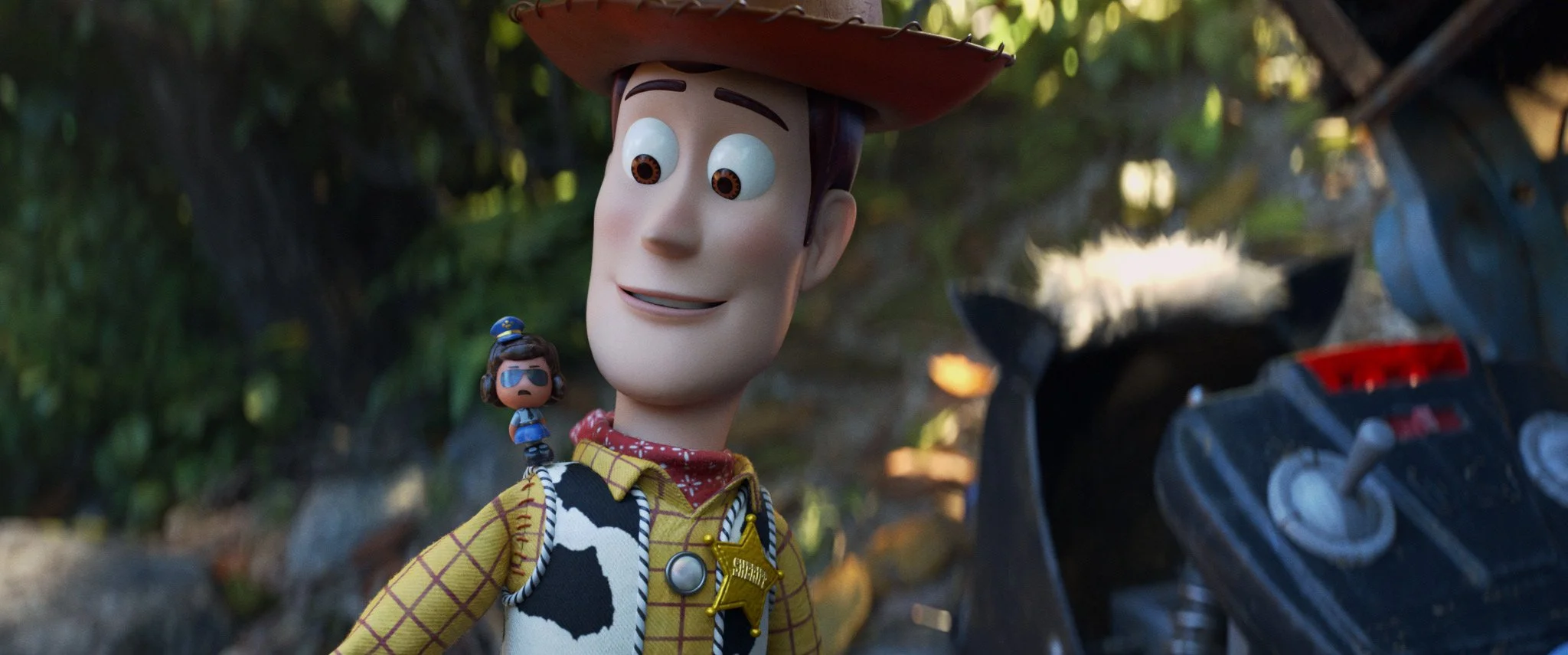
RaeRae Review · Toy Story 4 · 2019
Woody Saved Forky, Ignored Every Boundary, and Finally Asked Who He Was Without a Child
Bonnie made a person from trash. Gabby Gabby wanted a child badly enough to steal a voice. Bo Peep stopped waiting. Woody called all of it duty until the road asked for a better name.
Review receipt
Film: Toy Story 4 (2019). Director: Josh Cooley. Screenplay: Andrew Stanton and Stephany Folsom. Music: Randy Newman. Principal voices: Tom Hanks, Tim Allen, Annie Potts, Tony Hale, Christina Hendricks, Keegan-Michael Key, Jordan Peele, Keanu Reeves, Ally Maki, Madeleine McGraw, and Joan Cusack. Verdict: a beautiful, funny, ethically messy retirement story that reopens a perfect goodbye so Woody can learn loyalty without self-erasure.
This is a spoiler-complete editorial review. It examines Forky’s creation and suicidal trash instinct, Bonnie’s changing attention, Woody’s compulsion to serve, Bo Peep’s lost-toy autonomy, Gabby Gabby’s voice-box coercion, the antique store, carnival spectacle, chosen purpose, the ensemble’s reduced role, and whether the ending completes Woody or abandons the community that sustained him.
The rain rescue gives Bo Peep the goodbye Toy Story 3 skipped
Years earlier, Woody organizes RC’s rescue during a storm while Bo helps guide the operation. The sequence restores Bo as an active member before revealing she will be given away.
Woody considers leaving with her and cannot release his responsibility to Andy. The choice becomes the emotional debt the fourth film returns to collect.
Bo’s donation is ordinary, deliberate, and still painful
Molly has outgrown the lamp, and an adult transfers it to a new household. There is no garbage-bag accident or villain.
Bo understands that toy life includes change and asks Woody to imagine stepping beyond one owner. He cannot yet hear freedom without translating it as abandonment.
Nine years later, Woody is no longer the favorite
Bonnie often leaves him in the closet while choosing Jessie as sheriff. The role change is not cruelty. A child’s attention moved, exactly as the earlier films said it would.
Woody’s distress reveals that the third film solved location, not identity. He still measures worth through being urgently needed by a child.
The closet toys have created a rotation system without him
Old Timer tracks who was selected and how long others waited. The group has language for declining use that does not collapse every quiet day into catastrophe.
Woody resists their perspective because accepting ordinary non-selection would require a self beyond duty.
Kindergarten terrifies Bonnie before it creates Forky
She enters a room without familiar protection, loses access to supplies, and sits alone. Woody secretly retrieves materials because he cannot tolerate watching a child struggle without intervening.
His action helps Bonnie and violates the rules that toys should remain hidden. Care and compulsion arrive together.
Forky becomes conscious inside somebody else’s need
A spork, pipe cleaner, clay, craft stick, and mismatched eyes become a person after Bonnie writes her name. The film offers no technical explanation because creation follows emotional recognition rather than manufacturing.
Forky wakes with a complete sense that he belongs in trash. Consciousness does not bring automatic self-worth.
Trash is not a joke to Forky; it is ontology
He understands his materials as disposable and repeatedly seeks the bin because garbage feels safe, warm, and correct. The others treat the behavior as a crisis because Bonnie treats him as a beloved toy.
Personhood begins before he agrees with the community’s preferred purpose. Saving him cannot mean refusing to listen to what trash means to him.
Woody appoints himself Forky’s caretaker
He monitors, restrains, retrieves, lectures, and exhausts himself keeping Forky alive for Bonnie. Nobody formally assigns the role.
The labor is generous and driven by Woody’s need to remain essential. Bonnie’s dependence on Forky gives Woody a secondhand route back into purpose.
The road-trip setting makes home mobile
An RV carries Bonnie’s family and toys through changing stops, removing the stable bedroom geography that once organized belonging.
Mobility expands possibility and increases the risk of separation. A home on wheels can move away before a small body crosses a parking lot.
Forky’s highway walk becomes therapy without professional boundaries
Woody explains Andy, Bonnie, loyalty, and a toy’s role while physically escorting Forky toward the RV. The conversation helps Forky reinterpret belonging.
Woody also uses his own story as the universal answer. Forky’s emerging personhood becomes a mirror through which Woody rehearses an identity already failing him.
Forky learns toyhood as relationship, not material category
He remains made of trash and keeps valuing bins. What changes is understanding that Bonnie’s comfort creates a chosen responsibility.
The film’s best answer does not require him to deny origin. Trash and toy become simultaneous truths.
The antique store is preservation without freedom again
Glass cases, locked cabinets, organized displays, and valuable objects recall the museum temptation from Toy Story 2.
This time the institution is commercial and intimate. Toys wait for purchase while human collectors circulate around them.
Gabby Gabby wants a voice because a child’s script defines worth
A defective voice box prevented her from matching the product promise. She has spent decades watching children pass the shelf while believing one repaired mechanism will make love possible.
Her wound resembles Woody’s fear of usefulness, Jessie’s abandonment, and Lotso’s replacement trauma. Pain creates recognition without moral immunity.
The Benson dummies make control physically uncanny
Silent ventriloquist figures surround, carry, restrain, and patrol. Their human-like faces move without independent speech, making them perfect extensions of Gabby’s authority.
They visualize her central problem: a person denied voice using voiceless bodies to control others.
Gabby’s offer is not consent when the alternative is confinement
She frames the voice-box transfer as an exchange, but Woody and Forky cannot freely leave. Surveillance and physical force remain present.
A desired outcome does not become ethical because the person causing harm explains the trauma motivating it.
Woody treats his body as a resource he can sacrifice
He eventually gives Gabby the voice box because he believes it may connect her to Harmony and because his own pull string feels less central after Bonnie’s neglect.
The choice is voluntary at the final moment, yet the coercive path leading there complicates any clean generosity narrative.
Harmony’s rejection disproves the magical repair theory
Gabby becomes technically complete, performs the expected phrase, and still fails to interest the child she idealized.
The rejection is brutal because it separates product function from relationship. No repair can force another person’s attachment.
Gabby’s grief becomes more human when the plan fails
Without Harmony, the theft cannot be justified as the last obstacle before destiny. Gabby has to confront what she did and what she actually wants.
The film permits remorse and redirection without requiring Woody to declare the harm irrelevant.
The lost child offers relationship outside the original fantasy
Gabby notices a crying girl at the carnival and chooses to help rather than pursue a perfect display child. The girl’s immediate need creates mutual recognition.
Purpose arrives through attention to a real person, not fulfillment of a collector-style ideal.
Bo Peep has rebuilt herself materially and socially
Her skirt becomes a cape, the lamp is gone, her arm has broken and been repaired, and Giggle McDimples operates as friend rather than accessory.
The redesign communicates adaptation without treating factory condition as the authentic self.
Lost toy does not mean lonely toy
Bo moves among playgrounds, carnivals, stores, and temporary communities. She helps toys find children while refusing permanent ownership.
The category Woody fears has become a form of mobility, mutual aid, and chosen attachment.
Bo’s freedom includes risk the film sometimes romanticizes
She faces breakage, weather, transport, human unpredictability, and no guaranteed repair network. The carnival makes motion beautiful enough that instability can look consequence-free.
Her competence is real. A critical reading should also notice that autonomy is not the absence of material need.
Woody keeps overriding Bo’s plan
He insists on returning for Forky and Gabby, changes priorities, and places Bo’s sheep and team in danger. His loyalty to one rescue becomes entitlement to other people’s risk.
Bo’s anger is not refusal to care. It is a boundary against Woody treating commitment as moral authority over everyone nearby.
Buzz’s inner voice joke shrinks a character who once had judgment
He interprets prerecorded buttons as conscience and repeatedly lets random phrases guide decisions. The gag gives him action beats but reduces the maturity built across three films.
His trust in Woody remains moving, yet the script often uses him as comic support while the cowboy receives the philosophical arc.
Jessie inherits leadership mostly offscreen
Bonnie chooses Jessie, and the RV group relies on her during the carnival crisis. She makes quick decisions and keeps toys coordinated.
The film gestures toward a succession that deserved more narrative space. Leadership transfer becomes background while Woody’s exit takes center stage.
Ducky and Bunny convert prize captivity into comic rage
The plush pair are stitched to a carnival wall and dream of being won by a child. Their elaborate attack fantasies express powerlessness through absurd violence.
Freedom requires cutting the shared tether, yet they continue functioning as a pair. Liberation changes attachment without demanding separation.
Duke Caboom carries commercial shame in his body
The motorcycle toy was advertised performing feats the physical product could not reproduce. Rejean’s disappointment becomes Duke’s lifelong belief that failure made him unworthy.
Keanu Reeves makes bravado and grief occupy the same performance. Every pose asks for applause before doubt returns.
Duke’s final jump succeeds by redefining success
He cannot perform the impossible advertisement exactly. He can calculate a real jump, accept limitation, and contribute to rescue.
The arc echoes Buzz learning to fall with style. Product fiction becomes useful once separated from literal worth.
Giggle McDimples gives Bo a relationship outside Woody
She advises, teases, worries, and challenges Bo. Their history exists beyond the cowboy’s return.
That friendship prevents Bo’s independence from reading as nine years spent waiting for a romance.
The carnival offers constant children and no single owner
Like Sunnyside, it promises recurring contact without one child aging out. Unlike Lotso’s daycare, movement and choice are central to Bo’s model.
The parallel helps distinguish communal availability from institutional captivity.
The carousel becomes a lighthouse for lost toys
Bo’s group uses the attraction as a visible gathering point in a mobile environment. Light, repetition, and height create navigation through carnival chaos.
A ride designed for circular motion becomes infrastructure for people seeking new routes.
Woody’s badge has outlived the office it represented
He gives Jessie the sheriff badge before leaving. The object once symbolized favorite status, leadership, and Andy’s play identity.
Transferring it acknowledges that role can continue without the person who held it first.
The goodbye with Buzz is permission and loss
Buzz tells Woody Bonnie will be okay, recognizing that concern for the child has become the final argument preventing departure.
The line is generous and also convenient. Bonnie’s care network becomes reassurance while the ensemble accepts losing a central friend.
Leaving is growth only if Woody is not fleeing ordinary irrelevance
He chooses Bo and lost-toy work after struggling with being left in a closet. The new role makes him immediately useful again.
The ending may represent self-discovery, but it also preserves Woody from learning how to belong without being central.
Bo and Woody choose a purpose neither child owns
They will help carnival toys connect with children while remaining mobile. Service continues, but it is selected rather than assigned by ownership.
The film reframes duty as a practice people can consent to rather than a permanent identity imposed by manufacture.
The old ensemble pays the price for Woody’s liberation
Buzz, Jessie, Slinky, Rex, Hamm, and the others lose a friend after sharing decades of survival. Their grief receives a brief farewell rather than equal exploration.
A protagonist’s freedom can still create real loss for a community. The film leans toward celebration before sitting with that cost.
Final foundation verdict
Toy Story 4 is brave enough to ask whether loyalty can become self-erasure and messy enough to answer through another rescue mission.
Forky expands personhood, Gabby complicates redemption, Bo embodies adaptive freedom, and Woody finally leaves ownership. Foundation verdict: gorgeous, emotionally intelligent, ethically arguable, and nowhere near finished at surface-level praise.
Bonnie does not betray Woody by changing favorites
The third film gave Andy a careful goodbye and placed the toys with a child whose play looked safe. It never promised Bonnie would distribute attention equally or preserve Woody’s leadership.
Woody experiences the closet as demotion because favorite status has organized his identity for decades. Bonnie experiences it as choosing different toys on different days.
The pain is real without making the child morally responsible for maintaining an adult-coded worker’s sense of purpose. The film is strongest when it lets ordinary change hurt without creating another Emily or Daisy accusation.
The sheriff badge transfer happened before Woody emotionally accepted it
Bonnie appoints Jessie sheriff and leaves Woody behind, formalizing a leadership change the third film only suggested. He can give away the badge more easily than he can give up the belief that he should manage every crisis.
Titles are not the whole structure of authority. Woody still assumes his judgment outranks the group, especially when Bonnie needs something.
Retirement becomes difficult because the role lived in habits, relationships, and self-worth long after the metal symbol moved to somebody else.
Woody’s kindergarten intervention is unauthorized care
He enters Bonnie’s backpack after being told she must face orientation without toys. He retrieves discarded craft materials and places them within reach, producing the conditions for Forky’s creation.
The outcome helps Bonnie enormously. It also reinforces Woody’s belief that breaking boundaries is justified whenever he can name a child’s need.
Care ethics cannot be reduced to rule obedience, but benevolent results do not erase the need to ask whose judgment controlled the risk. Woody remains hidden while Bonnie bears any human consequences.
Forky’s creation unsettles every manufacturing rule the franchise established
Earlier toys arrived conscious with product identities, factory programming, media backstories, or established relationships. Forky becomes alive minutes after a child assembles classroom refuse.
The film implies that recognition, creative intention, and naming can generate personhood without commercial manufacture. Bonnie does not merely repurpose an object. She creates a subject.
That possibility expands the world radically. If handmade objects can awaken, toy consciousness may be relational rather than industrial, and countless craft projects could have lives adults never imagine.
Bonnie’s name on Forky’s feet mirrors Andy’s name on Woody
The handwriting marks belonging, but it also appears at the moment Forky’s identity stabilizes. He is not sold with a character script. Bonnie’s inscription becomes the first external story his body carries.
Woody reads the name as proof of duty. Forky initially reads his materials as proof that trash remains the proper destination.
The conflict shows provenance is not destiny. Marks, materials, and relationships all contribute to identity without any one element holding complete authority.
Forky’s trash attempts should not be flattened into cute suicide jokes
He repeatedly throws himself toward bins, says he is trash, and resists the community’s insistence that life as a toy is better. The behavior is played with physical comedy and requires constant intervention.
The metaphor touches suicidal ideation, compulsive return to familiar harm, and the difficulty of receiving an identity one cannot yet feel. Treating it only as a preschool gag misses the emotional stakes.
At the same time, diagnosing Forky as if he were a human patient can overstate the analogy. Trash is genuinely his material origin and comfort environment. The ethical task is listening while keeping him alive long enough for more choices to become possible.
Woody gives Forky a purpose before giving him space to discover one
He explains that making Bonnie feel safe is what toys are for. The idea helps Forky understand why his absence causes distress and why relationship matters.
It also transfers Woody’s own service-based identity to a newborn person at the most impressionable moment. Forky learns duty before autonomy.
The movie later complicates this through lost toys, but Forky largely accepts Woody’s framework. A fuller arc would let him define how trash, craft, friendship, and care coexist on his own terms.
The RV bathroom bin is Forky’s version of home
Warm trash surrounds him, familiar smells and textures calm him, and the enclosed space requires no performance as a toy. Woody sees danger because the RV will leave. Forky sees belonging.
The rescue is necessary for continued relationship, yet the film could take seriously that safety sometimes lives in places communities classify as degrading.
Helping someone leave a harmful environment works best when the helper understands what need the environment met. Woody eventually learns enough to translate trash into Bonnie, but he still controls the route.
Woody’s highway confession reveals why he cannot stop rescuing
He tells Forky about Andy, Bonnie, and the role of being there for a child. The long walk removes the ensemble and allows his language to become intimate rather than managerial.
Every explanation also reveals terror. If toys exist to serve a child and Bonnie no longer needs Woody directly, then he must remain valuable by protecting the toy she does need.
Forky is both person and project. Woody loves him, saves him, and uses the rescue to postpone confronting his own loss of role.
Forky’s innocence makes him a surprisingly accurate therapist
He asks direct questions because he lacks the social habits that make other toys avoid Woody’s contradictions. He accepts affection, trash, fear, and duty without needing them to fit a prestige hierarchy.
Tony Hale voices wonder and panic in the same breath, making philosophical questions sound like genuine first encounters rather than screenwriter lectures.
Forky’s simplicity does not mean intellectual emptiness. He keeps identifying the basic premise under Woody’s complicated rationalizations: Bonnie matters, trash matters, and Woody sounds like someone who cannot imagine existing for himself.
The antique store turns object history into an atmosphere
Dust, glass, polished wood, record players, cabinets, chandeliers, and narrow aisles create a place where objects are valued for age yet remain inventory.
Unlike Al’s apartment, the store contains many overlapping histories rather than one collector’s target. The toys live among traces of previous homes and imagined future buyers.
Preservation is warmer and more beautiful here, which makes captivity harder to read. A visually loving environment can still deny movement and consent.
Gabby’s voice-box defect is disability framed through market rejection
She believes Harmony passed her over because the mechanism fails. The product’s intended function becomes the standard against which she judges her entire capacity for love.
The film understands internalized ableism: Gabby has absorbed the idea that repair is a prerequisite for relationship.
It becomes less careful when her eventual success follows receiving Woody’s working part, because the plot risks confirming that bodily normalization was necessary even though Harmony still rejects her.
Gabby’s history explains coercion without transforming it into exchange
Decades of waiting, repeated rejection, and isolation make her desire legible. They do not create a claim on Woody’s body.
Her initial language of negotiation is backed by Benson dummies, locked doors, surveillance, and Forky’s detention. Under those conditions, saying no is not safely available.
The later voluntary donation changes the immediate act but cannot retroactively make the pursuit ethical. A redemption reading must preserve that distinction.
Woody’s voice-box donation carries his own self-neglect
He has spent the film defining value through usefulness and interpreting Bonnie’s reduced attention as evidence that his features matter less. Giving away the mechanism may be generosity and a quiet belief that his own body no longer deserves preservation.
The film presents the sacrifice as noble without spending enough time on whether Woody feels free to refuse after Gabby’s story. Compassion can become self-harm when a caretaker believes another person’s need automatically outranks bodily autonomy.
His later life without a pull string shows identity can continue after alteration. That outcome does not mean the decision should escape scrutiny.
Harmony’s refusal is not punishment; it is autonomy
Gabby imagines the child through observation and constructs a perfect future without any reciprocal relationship. Harmony looks, listens, and remains uninterested.
The scene is painful because a repaired body cannot guarantee somebody else’s desire. It is ethically necessary because Harmony does not owe affection as a reward for Gabby’s suffering.
The film allows the child’s preference to stand, then asks Gabby to build purpose through attention to someone real rather than possession of an idealized owner.
The lost girl changes Gabby’s orientation from being chosen to choosing care
At the carnival, Gabby notices fear that resembles her own loneliness. She approaches with the goal of helping the girl connect to family rather than securing a predetermined fantasy.
The child embraces Gabby, but the relationship emerges through mutual need in a present moment.
This does not erase the voice-box violation. It demonstrates capacity for a different action after failure breaks the original entitlement.
Gabby’s redemption is emotionally effective and procedurally incomplete
She shows remorse, releases Forky, accepts Harmony’s rejection, and helps a lost child. Woody and Bo support her new possibility.
The film does not require apology to Woody, accountability for confinement, or changed relations with the Benson dummies. Victims become facilitators of her healing.
A compassionate ending can remain incomplete. Redemption should be read as a beginning of different choices, not a receipt proving all prior harm settled.
Bo Peep’s repaired arm is the design detail the movie should discuss more
Her porcelain body broke during years outside. Tape and adaptation keep the limb functional without hiding the fracture.
The repair contrasts Geri’s perfect restoration and Gabby’s drive toward factory function. Bo carries visible modification as part of autonomy.
The film treats the body as capable rather than inspirational, allowing disability-coded alteration to coexist with leadership, romance, and physical skill.
Bo’s cape turns restrictive design into equipment
The original wide skirt belonged to lamp ornamentation and limited movement. Reconfigured as a cape, it offers concealment, style, and freedom of the legs.
Transformation does not reject femininity. Color, fabric, and elegance remain while function changes through her own use.
The redesign communicates agency because Bo authors how inherited materials serve the present body.
The sheep remain people even when the film treats them as a unit
Billy, Goat, and Gruff operate through coordinated movement and shared comic timing. Bo understands their communication and protects them as companions.
Their limited individual differentiation risks repeating the Aliens’ treatment, where collective identity can obscure distinct personhood.
Still, the group’s competence matters. They are not luggage attached to Bo’s adventure, and danger to them creates the boundary that finally makes her confront Woody.
Giggle McDimples functions as witness to Bo’s actual life
She knows the routes, plans, risks, and communities Bo built after Woody. Her presence prevents the reunion from becoming the only relationship that defines Bo’s transformation.
Ally Maki gives Giggle confidence proportionate to personality rather than body size. The tiny figure speaks to Bo as a peer and critic.
Friendship supplies a counterweight to romance. Woody must enter a life with existing bonds rather than reclaim a person preserved from their earlier relationship.
The skunk vehicle is camouflage built from human expectation
Bo’s group constructs an animal shape that drivers avoid, using scale, movement, and instinctive recognition to cross dangerous spaces.
Like the traffic cones in Toy Story 2, survival depends on humans seeing a category instead of looking closely at the conscious operators beneath it.
Lost toys are not outside infrastructure. They become engineers of improvised access within environments never designed for their bodies.
Ducky and Bunny’s plush rush shows fantasy compensating for captivity
They imagine giant, explosive attacks on the elderly carnival worker who controls their display. The sequences are outrageous because actual powerlessness has no safe direct outlet.
Keegan-Michael Key and Jordan Peele create a shared rhythm that makes separate characters feel like a practiced survival pair.
Their anger is comic without being meaningless. Being permanently visible as a prize while never chosen can produce the same rejection wound haunting the franchise in a brighter costume.
Duke Caboom’s advertisement created an impossible performance standard
The commercial shows spectacular stunts the physical toy cannot execute. A child interprets the gap as product failure and discards Duke after Christmas.
The manufacturer’s promise becomes shame stored in the toy’s body. Duke blames himself for not matching an image he did not design.
His arc critiques advertising more directly than Buzz’s because Duke knows he is a toy and still believes worth depends on fulfilling commercial fiction.
Keanu Reeves gives Duke the dignity of excessive performance
Every pose, shout, and flourish creates a heroic surface large enough to protect a frightened self. The voice commits completely, so vanity becomes endearing rather than hollow.
When doubt enters, the rhythm collapses into the child Rejean disappointed. Comedy and injury remain connected.
Duke does not need to become quiet to become sincere. Confidence grows when he can attempt a real feat without pretending limitation vanished.
The jump is collective engineering, not individual redemption magic
Bo’s group calculates distance, positions equipment, coordinates timing, and relies on Duke’s specific motorcycle design.
Success belongs to preparation and community as much as courage. The stunt does not prove the advertisement was true.
Duke earns pride by contributing what his actual body can do inside a plan that respects physics.
Buzz’s reduced interiority is the film’s most frustrating franchise choice
Across three films, Buzz developed judgment, humor, loyalty, and the capacity to challenge Woody. Here, prerecorded buttons supply an “inner voice” he treats as instruction.
The joke mirrors Woody’s search for purpose, but it makes Buzz appear newly incapable of reflection so the cowboy can own the philosophical center.
Tim Allen sells the comedy, and Buzz still chooses generosity at the end. The script nevertheless spends accumulated character depth as a convenience.
Jessie should have been the other half of the leadership story
She now holds the badge, understands child abandonment, survived storage, and knows how to act under pressure. Bonnie’s preference gives her direct knowledge of the role Woody is losing.
A deeper film would place Woody and Jessie in conversation about succession, attachment, and leading a group whose favorite changed.
Instead, Jessie coordinates the RV plot from a distance. Her competence is visible, but her perspective rarely shapes Woody’s decision.
The RV ensemble becomes a control room instead of a community
Buzz leaves to find Woody, while Jessie and others manipulate pedals, GPS, windows, and human perception to keep the family near the carnival.
The sequences provide frantic comedy and demonstrate coordination, yet most legacy characters receive functions rather than emotional arcs.
The narrowing may serve Woody’s intimate story, but it makes his final departure easier by reducing what viewers see him leaving.
Bonnie’s family becomes machinery the toys manipulate
The toys interfere with navigation and vehicle controls because reunion requires delaying departure. Adults experience inexplicable technical failure and escalating stress.
As usual, the human cost remains outside toy decision-making. Bonnie’s parents are not consulted about danger created in a moving RV.
The franchise often treats secrecy as permission for manipulation. Toy Story 4 heightens the ethical tension because the intervention affects road safety.
Bo’s boundary at the antique store is justified
After repeated plan changes, damage to the sheep, and disregard for her experience, Bo refuses another rescue attempt.
Woody calls loyalty an absolute while externalizing its risks onto a team he did not build. Her refusal protects people who trusted her leadership.
The eventual return should not imply the boundary was selfish. Bo chooses to help after Woody recognizes harm, not because his original entitlement was correct.
Woody apologizes only after losing Bo’s cooperation
He admits he cannot let go and that his behavior endangered others. The recognition comes when the person he wants refuses to continue enabling the pattern.
Consequences create clarity that private reflection did not. Bo’s anger becomes part of the care relationship rather than an obstacle to it.
Repair begins when Woody stops using noble language to shield control. The apology matters because it names motive, though later action must prove change.
Bo returns through choice, preserving the meaning of no
She is not physically captured or emotionally shamed into participation. She reassesses the situation and brings her team with a revised plan.
That sequence models consent as revisable without making the earlier refusal fake. A no can be complete at one moment and followed by a later yes under changed conditions.
The distinction is vital in a film where Gabby’s original “exchange” lacked freedom.
The carnival lights make precarity look like possibility
Neon, rides, moving crowds, reflective surfaces, and constant music create a world that never settles. For lost toys, motion means recurring chances to meet children.
The same spectacle can conceal workers, storage, breakdown, seasonal closure, and disposal. The movie emphasizes liberation more than the economics supporting the fair.
Visual pleasure is part of the argument, but freedom deserves material questions after the lights turn off.
The carousel is both circular and directional
The ride moves in loops, yet its height and light help Bo’s network navigate. Repetition becomes a landmark rather than a trap.
This contrasts Woody’s service cycle, where each rescue returns him to the same need to be needed.
Choosing the carnival can mean inhabiting repeated motion differently, with agency over when to arrive, help, and leave.
Woody’s final choice changes the meaning of lost
Earlier films used lost status as existential emergency. A toy without an owner seemed outside purpose, vulnerable to damage and disappearance.
Bo demonstrates networks, temporary attachments, mutual aid, and mobility. Lost from ownership can mean found by a community.
Woody’s departure works only because the film expands social infrastructure beyond the child-toy pair. He is not choosing isolation.
Buzz’s permission is loving and too convenient
He recognizes Woody’s longing and assures him Bonnie will be okay. The line releases the final loyalty argument in a few words.
Buzz cannot guarantee Bonnie’s emotional response or the group’s adjustment, but he can represent the friends’ willingness to stop treating Woody’s presence as debt.
The moment is moving because chosen family allows departure. It is convenient because the film avoids a fuller collective conversation.
The badge transfer should not make Jessie responsible for every absence
Woody gives Jessie the symbol and leaves, while the group returns to Bonnie. Succession can easily become another caretaker inheriting unresolved labor.
Jessie is capable, but leadership should be distributed rather than replacing one indispensable sheriff with another.
The film’s ending gestures toward new roles without showing whether the group learned to stop building identity around a single coordinator.
Woody and Bo’s romance works because neither returns unchanged
He does not ask her to become a lamp toy again. She does not ask him to pretend Andy and Bonnie meant nothing.
Their reunion becomes possible after each has a life the other must choose rather than inherit.
Love functions as invitation to a shared future, not recovery of a preserved past.
The ending remains ethically unsettled on purpose or by accident
Woody’s liberation is persuasive, yet it follows Bonnie’s reduced attention, offers him immediate new usefulness, and sidelines the friends affected by departure.
The ambiguity can be read as mature complexity or incomplete writing. Both interpretations have evidence.
A deep review should resist turning the final handhold into proof every question was answered. The franchise has always been strongest when love and control remain difficult to separate.
Toy Story 4 has to justify existing before it can justify its ending
Toy Story 3 closed Andy’s relationship with emotional and structural precision. Reopening the franchise risks turning a mature goodbye into temporary franchise maintenance. The fourth film knows this pressure and begins by recovering Bo Peep, the most important absence from that farewell.
Its argument is that Andy’s ending was not Woody’s ending. Donation solved where the group would live but did not settle whether Woody could survive losing favorite status or imagine purpose outside a child.
That is a legitimate question rather than a manufactured villain. The harder issue is whether the movie needed to reduce Bonnie’s attachment and the old ensemble’s presence so Woody’s departure would feel necessary.
The prologue changes Bo from missing inventory into a person who chose
Toy Story 3 mentioned that Bo had been sold or given away without showing her perspective. The fourth film restores the moment and lets her meet transition with more readiness than Woody.
She does not pretend leaving carries no grief. She recognizes that toy life changes, that another child may need the lamp, and that love cannot guarantee one household forever.
The prologue reframes nine years of absence as lived history. Bo was not waiting in narrative storage for the franchise to retrieve her.
RC’s rescue previews Woody’s best and worst leadership traits
He sees danger, coordinates a complex plan, values a member others might lose, and refuses to accept preventable abandonment.
He also controls timing, directs bodies, and treats his assessment of duty as sufficient authority for everyone’s risk.
The same pattern will govern Forky and the antique-store rescue. Heroism and compulsion are not separate tracks in Woody. They are one habit with different consequences.
The closet is emotionally difficult because it is not abusive
Bonnie provides safe storage, a community, and occasional play. Woody is neither destroyed nor exiled. He simply is not central.
That ordinary condition offers no villain to defeat, which makes it harder for somebody trained to solve crises. He cannot rescue himself back into being Bonnie’s favorite.
The film understands retirement depression through a toy whose body still works and whose expertise remains real after the job that defined him has changed.
Old Timer offers peer knowledge Woody refuses to accept
The clock has spent long periods unchosen and learned that selection fluctuates. His tracking system turns waiting into shared information rather than individual shame.
Woody hears resignation where Old Timer may be offering survival. He remains convinced the correct intervention can restore purpose.
Peer communities often hold knowledge that former leaders dismiss because accepting it would require relinquishing exceptional status.
Bonnie’s orientation anxiety gives Woody one more emergency
The child’s fear is visible, immediate, and solvable enough to activate every skill Woody fears losing. He can hide in the backpack, retrieve supplies, and create conditions for comfort.
The success becomes emotionally addictive. Forky exists because Woody intervened, so every later crisis can be interpreted as proof he must keep intervening.
Helping somebody can be good and still reinforce an unhealthy identity when the helper has no sense of self outside rescue.
Forky’s eyes establish asymmetry as personality
One eye is larger, eyebrows are mismatched, arms bend irregularly, feet barely support him, and the clay mouth changes shape with pressure. The design refuses factory symmetry without treating the body as incomplete.
His unstable gait and loose construction create physical comedy while making care needs visible. He cannot navigate environments exactly like molded plastic toys.
Pixar uses advanced rendering to make cheap craft materials tactile. Technical sophistication protects the handmade character from looking visually less alive than commercial products.
Tony Hale gives Forky panic without making him only fragile
The voice jumps between alarm, curiosity, contentment, and startling directness. Forky can scream about trash and then ask the exact question Woody avoids.
Hale makes new consciousness sound exhausting. Every category arrives as information without an instruction manual.
The performance prevents philosophical dialogue from becoming polished exposition. Forky thinks through sensation and relationship in real time.
Personhood arrives before social usefulness
Bonnie creates Forky for comfort, and Woody teaches him a toy’s duty. Yet he is already conscious before accepting that assignment.
This order matters. Purpose may organize a life, but it does not create the right to exist. Forky is not valuable only after he helps Bonnie.
The franchise’s market world repeatedly confuses function with worth. A disposable spork becomes its clearest rebuttal.
The film never fully answers whether all crafts wake up
If naming and play awaken Forky, classrooms and homes may contain countless handmade persons with brief, hidden lives. If some special franchise rule applies, the story never defines it.
The ambiguity works emotionally because creation feels magical. It also opens ethical consequences the plot sets aside after the road trip.
Forky later helps another craft object awaken, confirming the event is repeatable. The post-credit joke quietly expands the ontology further than the main story can contain.
Gabby Gabby is Woody’s shadow more than Lotso’s replacement
Lotso turns rejection into domination over an institution. Gabby controls a smaller domain, but her deepest parallel is Woody’s belief that a child’s need determines toy worth.
Both see a feature as the bridge to love. Woody trusts loyalty and voice; Gabby trusts a functioning voice box. Both override others while calling the outcome care.
Woody recognizes her pain because it speaks his language. That recognition creates compassion and makes him vulnerable to sacrificing boundaries.
Christina Hendricks makes Gabby’s softness genuinely unsettling
The voice remains measured, intimate, and hopeful while the Bensons surround visitors. Threat does not require a change into theatrical rage.
Hendricks lets loneliness surface without turning it into innocence. Gabby can be sincere about pain and deliberate about coercion in the same sentence.
That performance is why the character’s later tenderness works emotionally even when the accountability remains incomplete.
The Benson dummies inherit horror from bodies designed for projection
Ventriloquist figures resemble humans while depending on another person for speech. Their slack mouths and synchronized movement create the sense of agency without interior voice.
The antique store’s darkness, narrow aisles, and reflective glass multiply them into surveillance presences.
They also represent a labor problem. The film never asks what they want or whether Gabby controls them, leaving voiceless henchmen outside its otherwise expansive personhood argument.
Woody’s missing voice changes function but not personhood
After donation, he cannot perform the familiar pull-string phrases. The badge, voice box, owner, and favorite role all leave across the film.
The body remains recognizable, and relationships still respond to him as Woody. Identity survives the removal of branded features.
This quietly answers Gabby’s original belief. A voice mechanism can affect opportunity without defining the whole person, though unequal environments may still punish the difference.
The antique store cat makes material vulnerability immediate
To humans, the cat is a pet moving through inventory. To toys, teeth, paws, speed, and predatory interest create lethal risk.
The animal does not share the human blindness that toys are inert. It responds to movement and bodies directly.
Bo’s experience navigating the threat establishes expertise Woody lacks, strengthening her demand that he respect plans built through years outside ownership.
Bo Peep’s redesign walks a line between liberation and action makeover
The cape, trousers, repaired arm, staff, and athletic movement communicate autonomy. The film also updates a traditionally feminine decorative figure into a marketable action-adventure lead.
That transformation can imply the earlier dress and domestic coding were obstacles to seriousness. Bo complicates the implication by keeping color, grace, tenderness, and the porcelain form.
Liberation works best when it expands the possible uses of femininity rather than requiring distance from it. The film mostly succeeds, though the redesign remains shaped by blockbuster visual language.
Annie Potts gives Bo confidence earned through unshown years
Her voice carries affection for Woody without reverting to the softer supportive role of earlier films. She can flirt, command, refuse, and grieve without those modes contradicting one another.
The performance suggests a complete history in parks, stores, and carnivals even when the script summarizes much of it.
Bo does not need Woody’s recognition to know who she became. Their romance works only after he recognizes that fact.
Bo’s network is a form of mutual aid
Lost toys share routes, transport, hiding places, information about children, and help reaching possible homes. They operate without a permanent leader assigning worth.
The network accepts that members may leave when they find a relationship and that others may remain mobile. Belonging does not require identical destination.
This social infrastructure makes Woody’s choice plausible. He is not stepping into romantic isolation but joining organized care beyond ownership.
The carnival economy remains a blind spot
Prizes depend on games, workers, seasonal movement, storage, repair, and the economics of being won. The film focuses on toys’ mobility while leaving human labor mostly decorative.
Ducky and Bunny’s captivity originates in a commercial system that profits whether or not a child forms lasting attachment.
Bo’s network works around that system rather than changing it. Freedom is real and partial, shaped by access to spaces controlled by others.
Ducky and Bunny’s plans are cartoon violence expressing structural rage
Their fantasies repeatedly escalate into absurd attacks on the carnival worker, complete with lasers and giant bodies.
The humor releases tension without requiring the pair to become harmlessly cheerful about years attached to a booth.
Anger is allowed to remain disproportionate in imagination because actual power has been so limited. The fantasies are not policy proposals. They are emotional scale.
Key and Peele make shared rhythm into character history
The performers interrupt, complete, amplify, and redirect each other as if the plush toys have spent years surviving boredom together.
The pair is funny through relationship rather than interchangeable lines. Even when the script treats them as a unit, vocal timing suggests distinct impulses.
Their decision to remain together after the tether is cut shows attachment can survive when captivity ends.
Duke Caboom critiques products that outsource advertising failure to children
Rejean receives a toy that cannot perform the commercial stunt and experiences disappointment. Duke internalizes the child’s reaction as personal inadequacy.
The company remains absent while product and child carry the emotional consequences of an impossible promise.
Toy Story has always explored branding as identity. Duke adds the shame created when marketing deliberately exceeds material capacity.
The inner voice gag misreads what made Buzz funny
Buzz was funny when absolute certainty collided with evidence, then moving when he rebuilt identity. Random button guidance repeats surface behavior without the earlier existential stakes.
The phrase “listen to your inner voice” becomes literal in a way that denies Buzz an actual interior process.
A better parallel would let him confront purpose after Bonnie’s attention changes. Instead, his maturity is reduced so Woody’s retirement crisis can remain singular.
Jessie’s sidelining matters because she already solved part of Woody’s problem
She moved from Emily to storage, museum possibility, Andy, and Bonnie. She knows identity can survive multiple children without pretending each transition is easy.
As Bonnie’s chosen sheriff, Jessie inhabits the role Woody believes he lost. She could speak to leadership without favorite entitlement.
The film avoids this conversation, leaving its most qualified character in the RV while new characters help Woody understand change.
The old toys’ reduced screen time manipulates the emotional balance
If viewers spent more time with Buzz, Jessie, Slinky, Rex, Hamm, and the Potato Heads as full people, Woody’s departure would carry a heavier collective cost.
By assigning them a control-room subplot, the film makes the carnival world feel like where development happens and the RV like a waiting area.
The choice serves narrative focus but narrows the ethical field. Woody appears freer partly because the community he leaves has been made less present.
The RV driving gags create real human danger
Toys interfere with pedals, steering, GPS, windows, and vehicle systems while Bonnie’s father drives. The family experiences fear and mechanical confusion.
The plot treats delay as necessary for rescue, yet road manipulation risks collision and injury to people who cannot understand the cause.
Toy ethics often prioritize toy survival over uninformed humans. The imbalance is comic until the scale of intervention makes consequences difficult to ignore.
Woody’s apology to Bo is a turning point because it names pattern
He stops describing each escalation as one necessary rescue and admits he cannot let go. The problem becomes internal rather than proof everybody else lacks loyalty.
Bo’s refusal creates space for that recognition. Continued cooperation would have protected Woody from seeing the cost.
The apology does not solve everything, but it changes the next plan from unilateral command into negotiated collective action.
Giving Gabby the voice box is not the same as forgiving her
Woody can decide the part may create possibility without declaring detention, surveillance, and bodily threat acceptable.
The film often collapses compassion and absolution through warm staging. A critical reading can separate them.
Mercy may respond to somebody’s humanity while accountability responds to what they did. Mature repair needs both, even when a family film emphasizes the first.
The lost child sequence succeeds by shrinking Gabby’s fantasy
Harmony represented years of projection, a perfect tea-party image, and proof that repair would secure destiny. The crying child is immediate, specific, and not aesthetically curated.
Gabby approaches to meet a need rather than complete a prewritten scene. The girl then chooses connection.
Relationship becomes possible when Gabby stops treating a child as the final component of her own product story.
The carnival rescue distributes competence across new characters
Bo plans routes, Giggle scouts, Duke jumps, Ducky and Bunny improvise, the sheep coordinate, Woody negotiates, and Gabby chooses care.
The ensemble demonstrates the mutual-aid model instead of merely explaining it. Nobody owns the whole mission.
Woody’s skills remain valuable without requiring him to be sheriff. Contribution becomes different from centrality.
Woody’s final purpose still depends on being useful
He will help lost toys find children, essentially turning rescue and placement into ongoing work. The new role fits his strengths and values.
It also lets him avoid the quieter challenge of existing while nobody urgently needs him. The film calls this freedom without fully testing rest.
Growth may be real and incomplete. People often leave one identity by finding another job that uses the same compulsion in a healthier structure.
Leaving Bonnie can be ethical without being consequence-free
Woody has been neglected, his role changed, and the group can care for Bonnie without him. He has a genuine chance at chosen life with Bo.
Bonnie may eventually notice his absence, and friends will grieve. The film cannot guarantee nobody is hurt.
Autonomy does not require an action to produce zero pain. It requires taking responsibility for foreseeable effects rather than treating personal liberation as the only moral fact.
Buzz’s reassurance represents communal release
When Buzz says Bonnie will be okay, he speaks as friend and as member of the group remaining with her. He offers practical knowledge that care will continue.
The permission matters because Woody’s loyalty identity cannot authorize itself to leave without hearing that duty has been redistributed.
The scene is brief, but the hug carries years of rivalry, rescue, leadership, and friendship. Buzz releases Woody without minimizing what the group loses.
Jessie receiving the badge is succession with missing conversation
The object recognizes her leadership and transfers franchise iconography away from Woody. It does not show whether she wanted the responsibility or how the group will govern.
A badge can honor competence and quietly assign more unpaid care work.
The hopeful reading depends on Jessie reshaping leadership rather than inheriting Woody’s belief that one sheriff must always solve everything.
The final handhold with Bo answers the prologue
Nine years earlier, Woody released Bo’s hand and returned to Andy. At the carnival, he chooses the hand and lets the RV leave.
The mirrored gesture gives the romance structural weight beyond reunion. A decision once impossible becomes possible after both people change.
The film uses repetition honestly: the circumstances are not corrected copies. Andy is gone, Bonnie is different, Bo has a network, and Woody understands the choice’s cost.
The carnival lights create Pixar’s most complicated freedom image
Brightness, motion, crowds, rides, and open routes make the lost-toy world feel endless compared with bedrooms and cabinets.
The beauty risks turning precarity into pure adventure, yet the characters’ coordination supplies enough social structure to prevent fantasy from becoming solitary wandering.
Freedom appears as movement with people who know how to find one another, not the absence of obligation.
The visual leap specializes in light, dust, porcelain, and weather
Rain on the prologue street, reflective antique-store glass, carnival neon, plush fibers, craft textures, and Bo’s porcelain body demonstrate Pixar’s advanced physically based rendering.
Technical achievement is tied to theme. Different materials carry different risks, repair methods, and histories.
The world looks more tangible because bodily vulnerability is central. Forky’s cheap components and Bo’s hard shell must feel equally alive.
The rain prologue uses water as memory
Street reflections, storm darkness, car lights, and moving water give Bo’s departure the atmosphere of a half-recovered event.
Rain increases RC’s danger and makes every surface harder for small bodies to navigate. It also creates a visual bridge between rescue and loss.
The sequence looks unlike nostalgic home video. Woody’s memory of Bo is active, wet, and unresolved rather than safely archived.
The antique store lighting makes surveillance beautiful
Pools of warm light, dark aisles, display reflections, and chandelier glass create a place where looking is constant.
Gabby watches Harmony, the Bensons watch visitors, and toys see one another through partial surfaces.
The design turns desire into observation. Everybody can see a possible relationship while barriers prevent direct, equal encounter.
The carnival’s color separates spectacle from intimacy
Wide shots drown characters in saturated rides and moving bulbs. Close conversations often occur in pockets of shadow, behind booths, or above crowds.
The design lets freedom feel exhilarating while preserving quiet space for Woody and Bo’s choices.
Public spectacle becomes background to private revision, the opposite of the museum where public display would have consumed private life.
Randy Newman’s music carries continuity into a changed social world
Familiar melodic language keeps Woody connected to earlier films while new action and carnival textures expand the palette.
The score does not need to quote every emotional memory explicitly. Audience attachment supplies part of the orchestration.
Music helps the ending feel like franchise continuity even as the protagonist leaves the original ensemble.
Tom Hanks plays retirement as insistence before sadness
Woody’s voice keeps finding tasks, plans, and moral reasons to avoid the statement that Bonnie does not need him in the old way.
Hanks lets strain appear beneath command, especially when Bo challenges the rescue pattern.
The final calm is earned because speech no longer needs to prove indispensability. Woody can say goodbye without organizing everybody else’s response.
Annie Potts refuses the supportive-love-interest box
Bo cares about Woody, disagrees with him, protects her team, leaves when boundaries are violated, and returns by choice.
Potts makes authority warm without softening it into permission.
The romance becomes credible because Bo’s no remains part of the relationship rather than a temporary obstacle the hero overcomes.
Easter egg field notes that serve the story
The antique store includes the record from Coco, the Duke Caboom connection reaches into Pixar’s wider visual world, Tin Toy imagery echoes through Gabby’s setting, and familiar Pizza Planet and A113 traditions continue. The film also plants imagery tied to other Pixar works among carnival prizes and shop objects.
References belong naturally in spaces built from accumulated merchandise. An antique store and carnival booth should contain cultural debris, old products, and visual histories.
The useful question is not only what appears. It is whether recognition deepens a theme. In this film, hidden objects reinforce that toy lives cross stories, owners, and years even when humans see inventory.
The post-credit Forky companion reopens creation as community
Bonnie makes another craft figure, and Forky becomes the experienced person welcoming a new consciousness.
The role reversal shows growth. The individual who once needed every category explained can now provide reassurance without demanding factory identity.
It also confirms handmade personhood is reproducible, leaving an entire philosophical branch available beyond Woody’s ending.
What the film gets wrong about closure
It sometimes treats Bonnie’s reduced attention as sufficient reason for Woody to leave, minimizes the old ensemble, compresses Gabby’s accountability, and turns Buzz’s judgment into a button joke.
Those choices ease the route toward a conclusion the script wants. They are not minor when the film’s thesis concerns autonomy and relationship.
A critical review should not call complexity whenever a story avoids sitting with consequences. Some ambiguity is rich; some is missing labor.
What the film gets right about changing a life
It recognizes that a safe community can still stop fitting, service can become self-erasure, bodies can be remade without losing identity, and leaving one form of belonging can create another.
Bo’s network gives freedom social structure. Forky gives personhood independence from commercial origin. Duke separates capability from advertising. Gabby learns desire cannot command another person.
Woody finally understands loyalty as chosen practice rather than factory destiny. That is a meaningful conclusion even when the route is debatable.
The movie separates ownership from relationship more decisively than its predecessors
Earlier films treated a good child-toy bond as the safest available home. The fourth film introduces people who form relationships without permanent ownership and toys who help children without becoming their property.
Bo, Giggle, Ducky, Bunny, and Duke create a social world where attachment can be temporary, repeated, and chosen. The carnival is not ownerless emptiness. It is a network of encounters.
Woody’s exit therefore does not reject children. He continues valuing child-toy connection while refusing the belief that one child must define every toy’s identity. The distinction turns “lost” from failure into a legal status the community can reinterpret.
Forky makes the franchise confront class among objects
Commercial toys arrive with branding, durable materials, recognizable functions, and a market category. Forky arrives from waste, with fragile parts and no manufacturer promising replacement or repair.
The other toys accept him because Bonnie does, but their first task is teaching him to behave like their category. His trash identity becomes something to manage.
The film’s radical possibility is that disposable material can become equal personhood without passing through purchase. Its limit is that social acceptance still depends heavily on attachment to a child valued by established toys.
Gabby and Forky represent opposite routes from object category to self
Forky begins classified as trash and gradually accepts relationship without abandoning origin. Gabby begins as a premium product and believes a defective feature blocks the promised relationship.
One character is told he is more valuable than his materials suggest. The other learns market completeness cannot make a child choose her.
Their parallel reveals how consumer categories injure from both directions. Low-status objects may internalize disposability, while prestige objects may internalize entitlement to the life advertising pictured. Personhood requires escaping both scripts.
Woody’s departure also changes the franchise’s labor politics
In Andy’s room, authority flowed from favorite status. At Sunnyside, authority controlled labor assignment. In Bonnie’s room, Jessie appears to inherit coordination while Old Timer tracks selection. At the carnival, work is project-based and mobile.
Woody chooses the environment where leadership depends on contribution rather than ownership rank. That can be liberation from hierarchy.
It can also preserve his preference for action over rest. The new labor is more consensual, yet Woody still selects a life organized around continuous rescue. A healthier workplace does not automatically heal work-based identity.
The ending is strongest when read as retirement into community service
Woody does not disappear into private romance or stop caring about toys and children. He shifts from one household role to helping people navigate transitions across many temporary spaces.
Retirement here means releasing the office, badge, owner, and expectation of being favorite while keeping experience available. Bo’s network offers peers rather than dependents.
That reading gives the choice dignity without claiming every motive is resolved. Woody can build a better relationship to service over time. The final scene marks permission to begin, not proof the work is complete.
Harmony and Bonnie show two kinds of child attention without becoming moral opposites
Bonnie creates Forky from discarded material and gives him immediate emotional importance. Harmony moves through an antique store surrounded by objects and does not respond to Gabby’s carefully staged appeal.
The film does not label one child good and the other bad. Attention emerges from circumstance, imagination, need, and preference that toys cannot command.
This protects children from becoming reward systems for virtuous objects. A toy may deserve dignity, safety, and autonomy without being owed a specific child’s love.
The story’s deepest conflict is purpose versus personhood
Nearly every character begins with a function: sheriff, space ranger, lamp figure, voice-box doll, carnival prize, stunt toy, craft comfort object. The plot asks what remains when the function fails, changes, or was never physically possible.
Personhood survives role loss, but characters need community to experience that survival. Isolation makes Gabby cling to repair, Duke cling to advertising, and Woody cling to rescue.
Bo’s network offers the alternative: people contribute skills without being reduced to them. Purpose can enrich identity when chosen and shared. It becomes dangerous when treated as the admission price for worth.
Toy Story 4 earns disagreement as part of its legacy
Viewers who regard Toy Story 3 as complete are not missing the point. The fourth film deliberately disturbs a satisfying settlement and does not distribute the consequences evenly.
Viewers who find Woody’s departure necessary are also responding to real evidence. Bonnie’s home is safe, but safety alone cannot resolve a person’s unused capacity and unexamined duty.
The film matters because both reactions expose beliefs about loyalty. Is staying the proof of love, or can leaving protect a self that service consumed? Toy Story 4 refuses to make that question painless.
A toy without a child is no longer treated as a failed category
The earlier trilogy repeatedly sought the next safe owner, room, or child. Bo’s life shows that relationship can be plural, temporary, and community-based without being empty.
This expansion is the fourth film’s most important contribution to franchise ontology. It creates futures for toys who are never selected, who leave harmful ownership, or who do not want permanent placement.
The lost-toy network does not eliminate vulnerability. It gives vulnerability social response outside property. That difference makes Woody’s final step more than romantic escape.
Woody leaves the pull string and keeps his voice
Gabby receives the mechanism once associated with Woody’s recognizable phrases. He continues speaking, deciding, joking, leading, and loving without it.
The distinction separates branded voice from personal voice. A manufacturer supplied one set of sentences. Experience created the person capable of choosing new ones.
That is the quietest answer to the film’s repair obsession. Bodies matter, access matters, and features affect opportunity. No single mechanism owns the self.
One final receipt
The movie’s greatest courage is letting a beloved caretaker admit that staying can become another way of disappearing. Its greatest weakness is not giving the people he leaves equal time to say what his departure means. Both truths belong in the same verdict. The ending opens a road and leaves an emotional bill behind. That is not failure, but the bill should remain visible.
Final editorial verdict
Toy Story 4 does not replace the third film’s ending. It exposes the question that ending left inside Woody: what happens when the child is safe, the friends are capable, and being needed is no longer the only proof of love?
The answer is moving because Bo offers more than romance. She offers a community where purpose can be negotiated. It is frustrating because Buzz, Jessie, Bonnie, and Gabby’s victims receive less space than the conclusion deserves.
Final verdict: visually astonishing, emotionally brave, ethically messy, and worth the argument. Woody’s freedom feels real, but the movie earns it by asking some characters to become quieter than they should.
Return to Toy Story
Read More across the Toy Story franchise
Bo’s return makes the road beyond one child imaginable, but the film still gives Woody’s departure more emotional weight than the people who must absorb it. Freedom can be the right choice while grief remains real. A mature ending lets both facts stay in the room instead of calling pain proof that somebody chose incorrectly.